


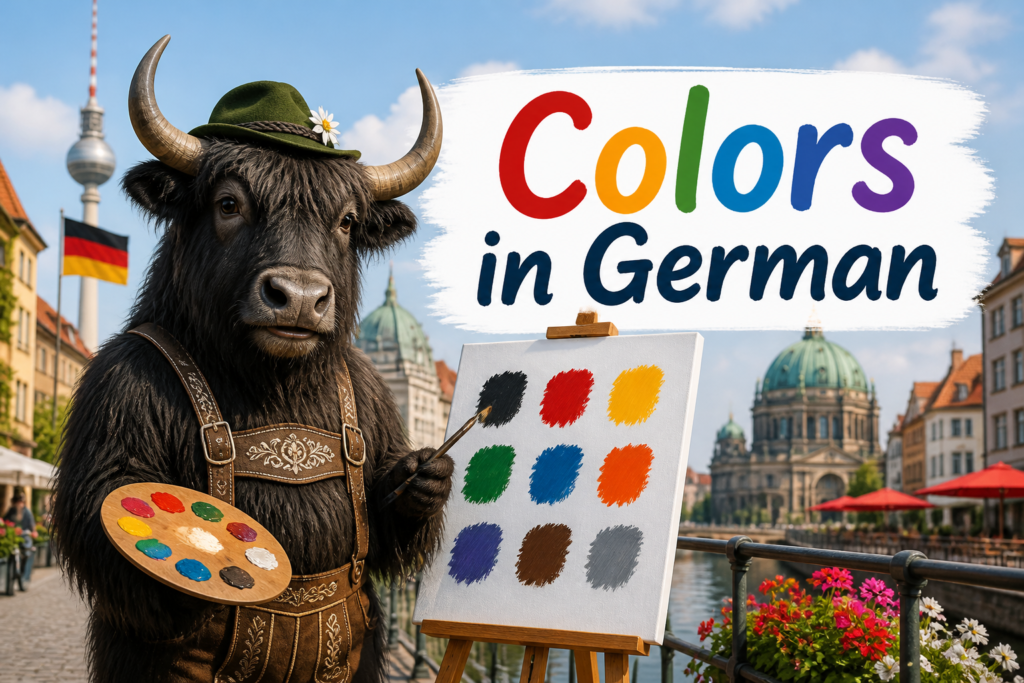
Colors in German are one of those topics that look easy at first and then quietly start messing with your adjective endings. Charming. Still, once you learn the main color words, you can describe clothes, food, cars, rooms, emotions, and just about anything else without sounding like a lost tourist at a paint shop.
For the broader learning path, visit our parent guide.
This guide keeps things practical: you’ll learn the most useful German color words, how to pronounce them, how to use them in real sentences, and how colors change when they sit before a noun. By the end, you should be able to say things like “I want the blue one,” “That shirt is too red,” and “I like green better than yellow” without second-guessing every adjective ending like it’s a life decision.
One tiny cultural note: Germans do use colors in everyday speech a lot, but not always in the same way English does. Sometimes a color is just a color. Sometimes it becomes part of an expression. Language likes to keep you busy.
Quick Starter: The Most Common Colors
Here are the basic color words you’ll meet everywhere in German. When a color comes before a noun, it usually works like an adjective and may change its ending. More on that in a minute, because German would never allow simple joy for too long.
| German | Pronunciation | Meaning | Example Sentence | Translation | Learner Note |
|---|---|---|---|---|---|
| rot | roht | red | Das Auto ist rot. | The car is red. | Very common; final t is pronounced clearly. |
| blau | blow | blue | Ich mag das blaue Hemd. | I like the blue shirt. | Before Hemd, it becomes blaue. |
| grün | groon | green | Die Wand ist grün. | The wall is green. | ü is a rounded “ee” sound. |
| gelb | gelp | yellow | Der gelbe Pullover ist teuer. | The yellow sweater is expensive. | Final b sounds like p at the end of a word. |
| schwarz | shvarts | black | Ich habe schwarze Schuhe. | I have black shoes. | sch sounds like “sh”. |
| weiß | vites | white | Das ist ein weißes T-Shirt. | That is a white T-shirt. | ß is usually a long vowel + sharp s sound. |
| braun | brown | brown | Der Tisch ist braun. | The table is brown. | Easy one. German gives you a free pass sometimes. |
| grau | grow | gray / grey | Der Himmel ist grau. | The sky is gray. | Common in weather and describing things that feel a bit dull. |
| orange | o-RAHN-sheh | orange | Sie trägt einen orangefarbenen Schal. | She is wearing an orange scarf. | Orange can be used, but orangefarben is also common. |
| rosa | ROH-zah | pink | Das Kinderzimmer ist rosa. | The children’s room is pink. | Very common and natural, especially for things and rooms. |
| lila | LEE-lah | purple / lilac | Ich habe eine lila Jacke. | I have a purple jacket. | Useful and very common in everyday speech. |
| beige | bayzh | beige | Die Tasche ist beige. | The bag is beige. | Borrowed word; pronunciation is close to French-influenced “beizh.” |
For a basic pronunciation check on color words and adjective forms, a boring-but-useful source like Duden is always handy.
More Useful Color Words
Once you know the basics, these extra colors help a lot in real conversations. People use them for clothes, design, hair, food, flowers, cars, and random opinions about home decor.
| German | Pronunciation | Meaning | Example Sentence | Translation | Learner Note |
|---|---|---|---|---|---|
| türkis | tewr-KEES | turquoise | Die Flasche ist türkis. | The bottle is turquoise. | Common for objects and design. |
| gold | golt | gold | Sie trägt goldene Ohrringe. | She is wearing gold earrings. | golden often appears as goldene before a noun. |
| silber | SIL-ber | silver | Der Ring ist silber. | The ring is silver. | Useful for jewelry, metal, style, and color descriptions. |
| violett | vee-oh-LET | violet / purple | Die Blume ist violett. | The flower is violet. | More formal than lila in many everyday contexts. |
| hell | hel | light / bright | Das Zimmer ist hell. | The room is bright. | Also used in combinations like hellblau. |
| dunkel | DOON-kel | dark | Ich habe einen dunkelblauen Mantel. | I have a dark blue coat. | Very common in compound color words. |
| hellblau | hel-blow | light blue | Das Hemd ist hellblau. | The shirt is light blue. | Compound colors are extremely common in German. |
| dunkelgrün | DOON-kel-groon | dark green | Die Jacke ist dunkelgrün. | The jacket is dark green. | Easy pattern: hell- or dunkel- + color. |
| beerenfarben | BEH-ren-far-ben | berry-colored | Das Kleid ist beerenfarben. | The dress is berry-colored. | Nice descriptive word for richer tones. |
| pastellfarben | pas-TELL-far-ben | pastel-colored | Ich mag pastellfarbene Wände. | I like pastel-colored walls. | Common in home decor and fashion. |
How Colors Work Before Nouns
This is the part that usually makes beginners sigh into their coffee. In German, a color word often behaves like an adjective when it comes before a noun.
Rule: Color + noun = color may need an ending.
| Pattern | Meaning | German Example | English Translation | Learner Note |
|---|---|---|---|---|
| das rote Auto | the red car | Ich sehe das rote Auto. | I see the red car. | rot becomes rote before Auto. |
| ein rotes Auto | a red car | Ich kaufe ein rotes Auto. | I am buying a red car. | After ein, the ending changes again. |
| der blaue Himmel | the blue sky | Der blaue Himmel ist schön. | The blue sky is beautiful. | Notice blau becomes blaue. |
| die grüne Tasche | the green bag | Ich nehme die grüne Tasche. | I’ll take the green bag. | The adjective ending depends on the article and case. |
| keine schwarzen Schuhe | no black shoes | Ich habe keine schwarzen Schuhe. | I have no black shoes. | kein works like an article and affects the ending too. |
If you want the deeper adjective-ending rabbit hole, the guide on common German adjectives helps a lot, because colors follow the same basic pattern.
Simple takeaway: when a color stands alone after sein, bleiben, or werden, it usually stays in its basic form.
| Pattern | Example | Meaning |
|---|---|---|
| Das Auto ist rot. | ist rot | The car is red. |
| Der Himmel bleibt blau. | bleibt blau | The sky stays blue. |
| Die Wand wird gelb. | wird gelb | The wall becomes yellow. |
Yak wisdom: If the color is just sitting there after sein or werden, it’s usually relaxed. Put it before a noun, and suddenly German remembers it has rules.
Color Phrases You’ll Actually Use
These phrases come up in daily life: shopping, describing clothes, talking about rooms, and pretending you know exactly what kind of blue someone means.
| German | Pronunciation | Meaning | Example Sentence | Translation | Learner Note |
|---|---|---|---|---|---|
| Welche Farbe? | VEL-kheh FAR-beh | Which color? | Welche Farbe hat das Kleid? | What color is the dress? | Great for shopping and asking about objects. |
| Die Farbe von … | DEE FAR-beh fon | The color of … | Die Farbe von dem Auto gefällt mir. | I like the color of the car. | More natural in speech than awkward literal English structure. |
| hellblau | hel-blow | light blue | Ich suche ein hellblaues Hemd. | I’m looking for a light blue shirt. | Useful with clothes and design. |
| dunkelrot | DOON-kel-roht | dark red | Sie hat dunkelrote Haare. | She has dark red hair. | Often used for hair, lipstick, wine, flowers, and decor. |
| knallrot | knal-roht | bright red / vivid red | Das Kleid ist knallrot. | The dress is bright red. | knall- adds strong, intense color. |
| schneeweiß | shnay-vites | snow-white | Der Tisch ist schneeweiß. | The table is snow-white. | Common descriptive compound. |
| pechschwarz | pekh-shvarts | jet black | Ihr Haar ist pechschwarz. | Her hair is jet black. | Very vivid, very common in descriptions. |
| farblos | FARP-los | colorless / pale | Das Getränk ist farblos. | The drink is colorless. | Can also mean dull or lifeless depending on context. |
| bunt | boont | colorful | Die Kinder malen ein buntes Bild. | The children are painting a colorful picture. | Very useful everyday word. |
| farbig | FAR-bikh | colored | Ich brauche farbige Stifte. | I need colored pens. | Often used in product descriptions. |
There’s also a handy little difference between bunt and farbig. Bunt usually means lively, colorful, mixed, or multi-colored. Farbig is more neutral and often shows up in product descriptions or technical language.
Useful Color Combinations
German makes a lot of color combinations by attaching descriptive pieces together. This is not a bug. It’s the system.
| German | Pronunciation | Meaning | Example Sentence | Translation | Learner Note |
|---|---|---|---|---|---|
| hellgrün | hel-groon | light green | Die Küche ist hellgrün. | The kitchen is light green. | Super common pattern. |
| dunkelblau | DOON-kel-blow | dark blue | Er trägt einen dunkelblauen Anzug. | He is wearing a dark blue suit. | Watch the ending: dunkelblauen. |
| rotbraun | roht-brown | reddish brown | Der Hund ist rotbraun. | The dog is reddish brown. | Very natural in descriptions of hair, fur, wood, and leather. |
| gelblich | GELB-likh | yellowish | Die Sauce ist gelblich. | The sauce is yellowish. | The suffix -lich means “-ish” often. |
| gräulich | GROI-likh | grayish | Der Himmel wirkt gräulich. | The sky looks grayish. | Notice the umlaut in ä. |
| rötlich | RERT-likh | reddish | Die Wände sind rötlich. | The walls are reddish. | Useful for natural descriptions. |
German Color Word Tips That Save Embarrassment
There are a few little traps here. Nothing dramatic, just the kind of details that trip people up when they’re trying to sound normal.
- Colors are usually not capitalized unless they start a sentence or are part of a noun.
- Rot means “red,” but das Rot can mean “the red color” as a noun.
- Schwarz often gets used in compounds and expressions, not just for objects.
- Orange can be a noun and a color word. German likes that kind of multitasking.
- Beige, rosa, lila, and some borrowed color words often behave a bit more simply than classic adjective colors.
- Final devoicing matters: gelb sounds more like “gelp,” and grün keeps its rounded vowel sound.
For a slightly more formal look at color terms and spelling, Wikipedia’s German page on Farbe is a decent background source, and the DW Learn German materials are reliably practical if you want more study time without the drama.
Colors in Real-Life Sentences
Here are natural sentences you can steal for daily use. Steal in a respectful, language-learning way, obviously.
| German | Pronunciation | Meaning | Example Sentence | Translation | Learner Note |
|---|---|---|---|---|---|
| Das ist mein Lieblingsblau. | das ist mine LEE-blings-blow | That is my favorite shade of blue. | Das ist mein Lieblingsblau. | That is my favorite shade of blue. | Lieblings- means “favorite.” |
| Ich suche etwas in Grün. | ikh ZOO-kheh et-vahs in groon | I’m looking for something in green. | Ich suche etwas in Grün. | I’m looking for something in green. | Using a color as a noun after in is common. |
| Die Küche ist in warmen Farben gehalten. | dee KUE-kheh ist in VAR-men FAR-ben geh-HAHL-ten | The kitchen is kept in warm colors. | Die Küche ist in warmen Farben gehalten. | The kitchen is kept in warm colors. | Very natural for decor, design, and interiors. |
| Ich mag helle Farben. | ikh mahk HEL-leh FAR-ben | I like light colors. | Ich mag helle Farben. | I like light colors. | hell becomes helle before Farben. |
| Das ist zu grell. | das ist tsoo grell | That is too bright / too garish. | Das ist zu grell. | That is too bright / too garish. | Useful when a color is too intense. |
| Welche Farbe haben deine Schuhe? | VEL-kheh FAR-beh HAH-ben DYE-neh SHOO-uh | What color are your shoes? | Welche Farbe haben deine Schuhe? | What color are your shoes? | Great everyday question. |
| Ich finde das Rot schön. | ikh FIN-deh das roht shern | I think the red is nice. | Ich finde das Rot schön. | I think the red is nice. | Here Rot is used as a noun. |
| Die Katze ist schwarz-weiß. | dee KAT-tseh ist shvarts-vites | The cat is black and white. | Die Katze ist schwarz-weiß. | The cat is black and white. | Hyphenated color pairs are very common. |
| Ich hätte es lieber in Blau. | ikh HET-teh es LEE-ber in blow | I would prefer it in blue. | Ich hätte es lieber in Blau. | I would prefer it in blue. | Polite, useful, and very shopping-friendly. |
| Die neuen Vorhänge sind beige. | dee NOY-en FOR-hen-geh zint bayzh | The new curtains are beige. | Die neuen Vorhänge sind beige. | The new curtains are beige. | beige often stays unchanged. |
If you want to keep building everyday descriptive vocabulary, the related guide on compliments in German pairs nicely with color words, especially for talking about clothes, appearance, and style without sounding like a random paint catalog.
Mini Grammar Note: Noun Colors vs Adjective Colors
German can use some colors as nouns. That means the color word becomes “the red,” “the blue,” or “the green” in English terms. This is useful when you talk about a shade, a color choice, or a design preference.
| Pattern | Meaning | German Example | English Translation | Learner Note |
|---|---|---|---|---|
| das Rot | the red color | Das Rot gefällt mir. | I like the red. | Capitalized because it acts like a noun. |
| das Blau | the blue color | Das Blau ist zu dunkel. | The blue is too dark. | Common in design and art contexts. |
| das Grün | the green color | Das Grün erinnert mich an den Wald. | The green reminds me of the forest. | Useful for describing shades and moods. |
Rule of thumb: if the color is a noun, it is capitalized. If it describes a noun, it usually is not.
Practice: Swap The Color
Try replacing the color in each sentence. This is a simple way to make the pattern stick without staring at grammar charts until your soul leaves your body.
- Das Auto ist rot. → change to blau, grün, or schwarz.
- Ich habe ein gelbes T-Shirt. → change to weiß, grau, or lila.
- Sie trägt eine schwarze Jacke. → change to braune, blaue, or rote.
- Der Himmel ist grau. → change to blau, weiß, or dunkel.
- Ich mag helle Farben. → change to dunkle Farben or bunte Farben.
Now make your own sentence with each of these: rot, blau, grün, schwarz, and weiß. If you can say them aloud, even better. Your mouth learns faster than your notes do.
Common Mistakes And Easy Fixes
| Mistake | Correct Form | Why It Matters |
|---|---|---|
| Das Auto ist rote. | Das Auto ist rot. | After sein, the color usually stays in basic form. |
| Ich habe ein rot Auto. | Ich habe ein rotes Auto. | Before a noun, the color needs the right ending. |
| Der Himmel ist blaues. | Der Himmel ist blau. | Adjectives after sein do not take the same ending as before nouns. |
| Ich mag das grau. | Ich mag das Grau. | As a noun, the color must be capitalized. |
| Weis ist schön. | Weiß ist schön. | ß matters; spelling changes meaning and correctness. |
| Das ist gelbe Auto. | Das ist ein gelbes Auto. | Adjective endings depend on the article and noun gender. |
One more thing: if a color word has a compound or descriptive form, don’t panic. Hellblau, dunkelgrün, and schwarz-weiß are normal and common. German likes to weld words together and move on with its day.
Quick Reference Summary
- Basic colors: rot, blau, grün, gelb, schwarz, weiß, braun, grau.
- Common extras: rosa, lila, orange, beige, türkis, violett.
- Light/dark: hell- = light, dunkel- = dark.
- Before nouns: color words often act like adjectives and change ending.
- After sein/werden/bleiben: color words often stay in their basic form.
- Capitalization: color words become capitalized when they are used as nouns.
- Useful question: Welche Farbe hat …? = What color is …?
- Very practical phrase: Ich hätte es lieber in … = I’d prefer it in …
German color words are one of the easiest ways to make your speech feel more natural fast. Learn the basics, notice the endings, and keep using colors in real sentences. That way, you’re not just naming shades—you’re actually saying things people say.
Yak takeaway: learn the core colors, use them with real objects, and remember that German is happiest when it turns a simple color into a grammar exercise with excellent posture.