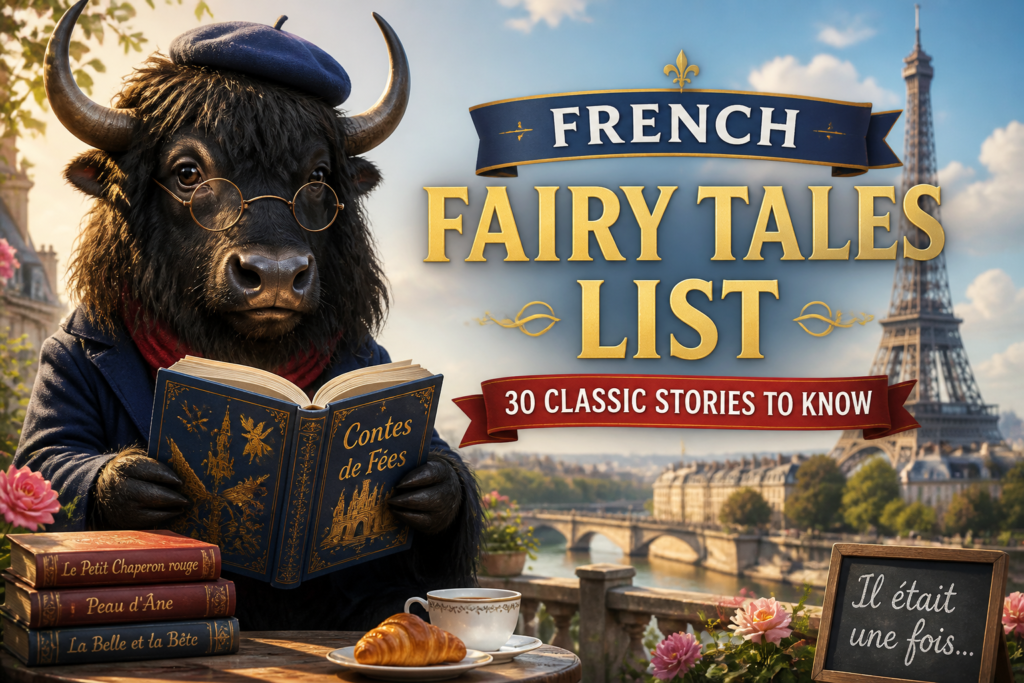
French fairy tales are full of castles, wolves, fairies, impossible promises, suspicious stepmothers, and the kind of life advice that sounds charming until you realize half the characters get eaten, cursed, or married off by page three. In other words: excellent material for learning French.
This reference guide gives you 30 classic French fairy tales and story titles you should know, plus the key French vocabulary behind them. You will learn how to recognize famous titles, understand useful story words, and talk about these tales in simple French without sounding like a confused pumpkin.
If you want more everyday language before diving into enchanted forests, start with popular French phrases. If you want to check your current level, try the French placement test or the French vocabulary test.
Why Fairy Tales Are Useful For French Learners
Fairy tales are great for learners because the language is often repetitive and full of common high-frequency words: roi (king), reine (queen), forêt (forest), fille (girl), prince (prince), maison (house), and il était une fois (once upon a time).
You also get useful grammar patterns again and again, especially the simple past in written French, descriptive adjectives, and basic storytelling phrases like un jour (one day), alors (then), and à la fin (in the end).
Yak Wisdom: If you can follow a fairy tale, you can survive a lot of beginner reading in French. Maybe not the wolf, but the French, yes.
30 Classic French Fairy Tales And Related Story Titles
Some of these are originally French literary fairy tales, especially from Charles Perrault. Others are famous tale titles commonly known in French. For learners, what matters most is recognizing the French name and understanding the key vocabulary inside it.
| French Title | Pronunciation | Meaning | Example Sentence | Translation | Learner Note |
|---|---|---|---|---|---|
| Le Petit Chaperon rouge | luh puh-tee sha-puh-ron roozh | Little Red Riding Hood | Le Petit Chaperon rouge traverse la forêt pour voir sa grand-mère. | Little Red Riding Hood crosses the forest to see her grandmother. | Rouge means red. Petit changes to petite with a feminine noun, but the title keeps the set form. |
| Cendrillon | sahn-dree-yon | Cinderella | Cendrillon perd sa chaussure au bal. | Cinderella loses her shoe at the ball. | A classic Perrault title. Very common in French culture. |
| La Belle au bois dormant | lah bell oh bwah dor-mahn | Sleeping Beauty | La Belle au bois dormant s’endort pendant cent ans. | Sleeping Beauty falls asleep for one hundred years. | Literally “the beauty in the sleeping wood.” Bois sounds like “bwah.” |
| Le Chat botté | luh shah bo-tay | Puss in Boots | Le Chat botté aide son maître avec ruse. | Puss in Boots helps his master with cunning. | Botté means wearing boots. |
| Peau d’Âne | po dahn | Donkeyskin | Dans Peau d’Âne, la princesse se cache sous une peau d’âne. | In Donkeyskin, the princess hides under a donkey skin. | The apostrophe in d’Âne shows elision: de + âne. |
| Les Fées | lay fay | The Fairies | Dans Les Fées, une sœur est récompensée pour sa gentillesse. | In The Fairies, one sister is rewarded for her kindness. | Les is plural “the.” |
| Barbe bleue | barb bluh | Bluebeard | Barbe bleue interdit à sa femme d’ouvrir une porte. | Bluebeard forbids his wife to open a door. | Bleue is the feminine form of bleu. |
| Les Souhaits ridicules | lay soo-eh ree-dee-kool | The Ridiculous Wishes | Dans Les Souhaits ridicules, le couple gaspille ses vœux. | In The Ridiculous Wishes, the couple wastes their wishes. | Souhait means wish. Written stories may use vœu too. |
| Riquet à la houppe | ree-kay ah lah hoop | Riquet with the Tuft | Riquet à la houppe parle d’amour et d’apparence. | Riquet with the Tuft talks about love and appearance. | Less known in English, but important in French fairy-tale tradition. |
| Griselidis | gree-zay-lees | Griselidis | Griselidis est célèbre pour sa patience. | Griselidis is famous for her patience. | Another literary fairy-tale title from Perrault. |
| French Title | Pronunciation | Meaning | Example Sentence | Translation | Learner Note |
|---|---|---|---|---|---|
| La Belle et la Bête | lah bell ay lah bet | Beauty and the Beast | La Belle et la Bête montre que l’amour change tout. | Beauty and the Beast shows that love changes everything. | Et means “and.” |
| Le Petit Poucet | luh puh-tee poo-say | Tom Thumb | Le Petit Poucet laisse des cailloux derrière lui. | Tom Thumb leaves pebbles behind him. | Poucet relates to a thumb-sized child. |
| Blanche-Neige | blahnsh nezh | Snow White | Blanche-Neige parle avec les sept nains. | Snow White talks with the seven dwarfs. | Blanche means white in feminine form. |
| Les Sept Nains | lay set nahn | The Seven Dwarfs | Dans l’histoire, les sept nains protègent Blanche-Neige. | In the story, the seven dwarfs protect Snow White. | The final s in sept is usually not pronounced here. |
| Hansel et Gretel | ahn-sel ay greh-tel | Hansel and Gretel | Hansel et Gretel trouvent une maison en pain d’épices. | Hansel and Gretel find a gingerbread house. | Not originally French, but often read in French translation. |
| Raiponce | ray-ponss | Rapunzel | Raiponce a des cheveux très longs. | Rapunzel has very long hair. | The final e is silent. |
| Le Vilain Petit Canard | luh vee-lan puh-tee ka-nar | The Ugly Duckling | Le Vilain Petit Canard devient un cygne magnifique. | The Ugly Duckling becomes a magnificent swan. | Vilain can mean ugly, nasty, or unpleasant depending on context. |
| La Petite Sirène | lah puh-teet see-ren | The Little Mermaid | La Petite Sirène rêve de vivre sur terre. | The Little Mermaid dreams of living on land. | Petite agrees with feminine sirène. |
| Les Trois Petits Cochons | lay trwah puh-tee ko-shon | The Three Little Pigs | Les Trois Petits Cochons construisent trois maisons. | The Three Little Pigs build three houses. | Trois sounds like “trwah.” |
| Le Loup et les Sept Chevreaux | luh loo ay lay set shuh-vro | The Wolf and the Seven Young Goats | Dans Le Loup et les Sept Chevreaux, la mère sauve ses petits. | In The Wolf and the Seven Young Goats, the mother saves her little ones. | Loup is wolf. The final p is silent. |
| French Title | Pronunciation | Meaning | Example Sentence | Translation | Learner Note |
|---|---|---|---|---|---|
| Le Joueur de flûte de Hamelin | luh zhoo-yer duh floot duh am-lan | The Pied Piper of Hamelin | Le Joueur de flûte de Hamelin attire les rats avec sa musique. | The Pied Piper of Hamelin attracts the rats with his music. | Flûte means flute. The accent helps show the vowel sound. |
| Le Prince Grenouille | luh prans gruh-noo-yuh | The Frog Prince | Dans Le Prince Grenouille, un baiser change le destin. | In The Frog Prince, a kiss changes destiny. | Grenouille means frog. |
| Les Musiciens de Brême | lay mu-zee-syan duh brem | The Bremen Town Musicians | Les Musiciens de Brême quittent leur maison pour une vie meilleure. | The Bremen Town Musicians leave their home for a better life. | Musiciens is a useful everyday word too. |
| La Princesse au petit pois | lah prahn-sess oh puh-tee pwah | The Princess and the Pea | La Princesse au petit pois ne peut pas dormir. | The Princess and the Pea cannot sleep. | Au = à + le. A very common French contraction. |
| Le Vaillant Petit Tailleur | luh vah-yan puh-tee tah-yuhr | The Brave Little Tailor | Le Vaillant Petit Tailleur trompe des géants. | The Brave Little Tailor tricks giants. | Vaillant means brave or valiant. |
| Les Habits neufs de l’empereur | lay ah-bee nuhf duh lahn-puh-ruhr | The Emperor’s New Clothes | Dans Les Habits neufs de l’empereur, tout le monde ment. | In The Emperor’s New Clothes, everyone lies. | Notice elision in l’empereur. |
| La Petite Fille aux allumettes | lah puh-teet fee oh zah-loo-met | The Little Match Girl | La Petite Fille aux allumettes est une histoire très triste. | The Little Match Girl is a very sad story. | Aux = à + les. |
| Jack et le Haricot magique | jack ay luh a-ree-ko ma-zheek | Jack and the Beanstalk | Jack et le Haricot magique monte dans le ciel. | Jack and the Beanstalk goes up into the sky. | Haricot means bean. The h is silent here. |
| La Reine des neiges | lah ren day nezh | The Snow Queen | La Reine des neiges contrôle le froid. | The Snow Queen controls the cold. | Des here means “of the,” not just plural “some.” |
| Le Rossignol | luh ro-see-nyol | The Nightingale | Le Rossignol chante pour l’empereur. | The Nightingale sings for the emperor. | gn sounds like the “ny” in “canyon.” |
| French Title | Pronunciation | Meaning | Example Sentence | Translation | Learner Note |
|---|---|---|---|---|---|
| Poucette | poo-set | Thumbelina | Poucette voyage à travers le monde. | Thumbelina travels through the world. | The ending -ette can sound small or feminine. |
| La Bergère et le Ramoneur | lah ber-zhehr ay luh ra-mo-nuhr | The Shepherdess and the Chimney Sweep | La Bergère et le Ramoneur veulent être libres. | The Shepherdess and the Chimney Sweep want to be free. | Vouloir in the plural: ils veulent. |
| L’Oiseau bleu | loh-zoh bluh | The Blue Bird | L’Oiseau bleu apparaît dans plusieurs contes. | The Blue Bird appears in several tales. | Liaison-like flow: l’oiseau connects smoothly. |
| Le Roi Grenouille | luh rwah gruh-noo-yuh | The Frog King | Le Roi Grenouille est une autre version du même conte. | The Frog King is another version of the same tale. | Roi sounds like “rwah.” |
| La Belle aux cheveux d’or | lah bell oh shuh-vuh dor | The Beauty with Golden Hair | La Belle aux cheveux d’or est un conte traditionnel connu. | The Beauty with Golden Hair is a well-known traditional tale. | Cheveux means hair, plural in French. |
| Le Petit Noël | luh puh-tee no-el | Little Christmas / Little Noël | Le Petit Noël apparaît dans certaines collections de contes. | Little Noël appears in some tale collections. | Less universal, but useful as a title pattern with petit. |
| Le Nain jaune | luh nan zhohn | The Yellow Dwarf | Le Nain jaune est un conte merveilleux célèbre. | The Yellow Dwarf is a famous fairy tale. | Nain means dwarf. |
| L’Oiseau de vérité | loh-zoh duh vay-ree-tay | The Bird of Truth | L’Oiseau de vérité révèle la vérité cachée. | The Bird of Truth reveals the hidden truth. | Vérité means truth. |
| La Chatte blanche | lah shat blahnsh | The White Cat | La Chatte blanche n’est pas une chatte ordinaire. | The White Cat is not an ordinary cat. | Chatte is feminine cat. Be careful with pronunciation and context. |
| Finette Cendron | fee-net sahn-dron | Finette Cendron | Finette Cendron est une héroïne rusée des contes français. | Finette Cendron is a clever heroine of French fairy tales. | A classic literary tale title worth recognizing. |
Useful Fairy Tale Vocabulary In French
Knowing the titles is nice. Knowing the building blocks inside them is much better. These words show up constantly in French stories and in everyday reading too.
| French | Pronunciation | Meaning | Example Sentence | Translation | Learner Note |
|---|---|---|---|---|---|
| un conte de fées | uhn kont duh fay | a fairy tale | J’aime lire un conte de fées avant de dormir. | I like to read a fairy tale before sleeping. | Very common phrase. Singular: un conte, plural: des contes. |
| il était une fois | eel ay-tay oon fwah | once upon a time | Il était une fois une princesse qui vivait dans une tour. | Once upon a time, there was a princess who lived in a tower. | This is the classic fairy-tale opening. |
| un prince | uhn pranss | a prince | Le prince arrive trop tard. | The prince arrives too late. | Watch the nasal sound in prince. |
| une princesse | oon prahn-sess | a princess | La princesse attend dans le château. | The princess waits in the castle. | Feminine noun: une. |
| une fée | oon fay | a fairy | Une fée offre un cadeau magique. | A fairy offers a magical gift. | The accent helps mark the sound: fée. |
| un château | uhn sha-toh | a castle | Le roi habite dans un château. | The king lives in a castle. | Very common in French culture and travel too. |
| une sorcière | oon sor-syehr | a witch | La sorcière prépare une potion. | The witch prepares a potion. | Another must-know story word. |
| un loup | uhn loo | a wolf | Le loup cache ses intentions. | The wolf hides his intentions. | Final p is silent. |
| une forêt | oon fo-ray | a forest | Les enfants entrent dans la forêt. | The children go into the forest. | Very common setting word. |
| un sort | uhn sor | a spell | La fée lance un sort sur le château. | The fairy casts a spell on the castle. | Lancer un sort = to cast a spell. |
Useful Phrases For Talking About Fairy Tales
These are practical sentence patterns you can actually use in class, conversation, or reading notes.
| French Phrase | Pronunciation | Meaning | Example Sentence | Translation | Learner Note |
|---|---|---|---|---|---|
| C’est un conte classique. | say tuhn kont klas-seek | It’s a classic tale. | C’est un conte classique de la littérature française. | It’s a classic tale of French literature. | Useful for giving a simple opinion. |
| L’histoire parle de… | lees-twar parl duh | The story is about… | L’histoire parle de deux enfants perdus dans la forêt. | The story is about two children lost in the forest. | Easy sentence starter for summaries. |
| Le personnage principal est… | luh pair-so-nazh pran-see-pal ay | The main character is… | Le personnage principal est une jeune fille courageuse. | The main character is a brave young girl. | Personnage means character. |
| À la fin… | ah lah fan | At the end… | À la fin, le prince comprend la vérité. | At the end, the prince understands the truth. | Great for retelling stories. |
| Il y a une morale. | eel yah oon mo-ral | There is a moral. | Dans ce conte, il y a une morale sur l’honnêteté. | In this tale, there is a moral about honesty. | Very useful for literature discussion. |
| Ce conte me fait peur. | suh kont muh fay puhr | This tale scares me. | Ce conte me fait peur depuis mon enfance. | This tale has scared me since childhood. | Faire peur = to scare. |
| Je préfère cette version. | zhuh pray-fehr set vair-syon | I prefer this version. | Je préfère cette version parce qu’elle est plus courte. | I prefer this version because it is shorter. | Good for comparing adaptations. |
| Le style est simple. | luh steel ay sanpl | The style is simple. | Le style est simple, donc c’est facile à lire. | The style is simple, so it’s easy to read. | Handy for learner reviews. |
| Je connais ce conte. | zhuh ko-nay suh kont | I know this tale. | Je connais ce conte en anglais et en français. | I know this tale in English and in French. | Connaître = to know, be familiar with. |
| Je ne connais pas ce titre. | zhuh nuh ko-nay pah suh teetr | I don’t know this title. | Je ne connais pas ce titre, mais l’histoire a l’air intéressante. | I don’t know this title, but the story looks interesting. | Notice the basic negation: ne…pas. |
Common Patterns You Will Notice In French Titles
Fairy tale titles are sneaky little grammar lessons.
- Le / La / Les / L’: These are definite articles, meaning “the.” Example: Le Chat botté, La Belle, Les Fées, L’Oiseau bleu.
- Petit / Petite: Adjectives change for gender. Le Petit Poucet but La Petite Sirène.
- Au / Aux: These are contractions. Au = à + le. Aux = à + les. Example: La Princesse au petit pois, La Petite Fille aux allumettes.
- De / Des / D’: These often show possession or relation. Example: La Reine des neiges = the queen of the snows.
- Et: Means “and.” Example: La Belle et la Bête.
Also notice elision, where French drops a vowel and adds an apostrophe: l’oiseau, l’empereur, d’Âne. This happens because French likes flow and hates vowel traffic jams.
Common Mistakes English Speakers Make
- Saying every final consonant. In words like loup, pois, and bois, the final letter is often silent.
- Ignoring gender. Petit becomes petite with feminine nouns: la petite fille, not la petit fille.
- Translating titles too literally. La Belle au bois dormant is not usually translated word-for-word in normal English use.
- Forgetting contractions. French uses au and aux, not à le or à les in these cases.
- Mixing up conte and compte. Un conte is a tale. Un compte is an account. One gives you magic. The other gives you passwords.
Quick Reference Summary
- Conte de fées = fairy tale
- Il était une fois = once upon a time
- Le Petit Chaperon rouge, Cendrillon, Le Chat botté, and La Belle au bois dormant are core French fairy-tale titles
- Watch gender forms like petit / petite
- Watch contractions like au and aux
- Watch silent final letters in many story words
- Use simple summary phrases like L’histoire parle de… and À la fin…
If you want to keep exploring, you can revisit this French fairy tales reference, browse more lessons on Learn French, or build your foundation with popular French phrases.
Yak Takeaway: fairy tales may be full of magic beans, cursed castles, and emotionally unstable royalty, but the French inside them is wonderfully learnable. Start with the titles, steal the key vocabulary, and suddenly il était une fois stops looking mysterious and starts feeling useful.