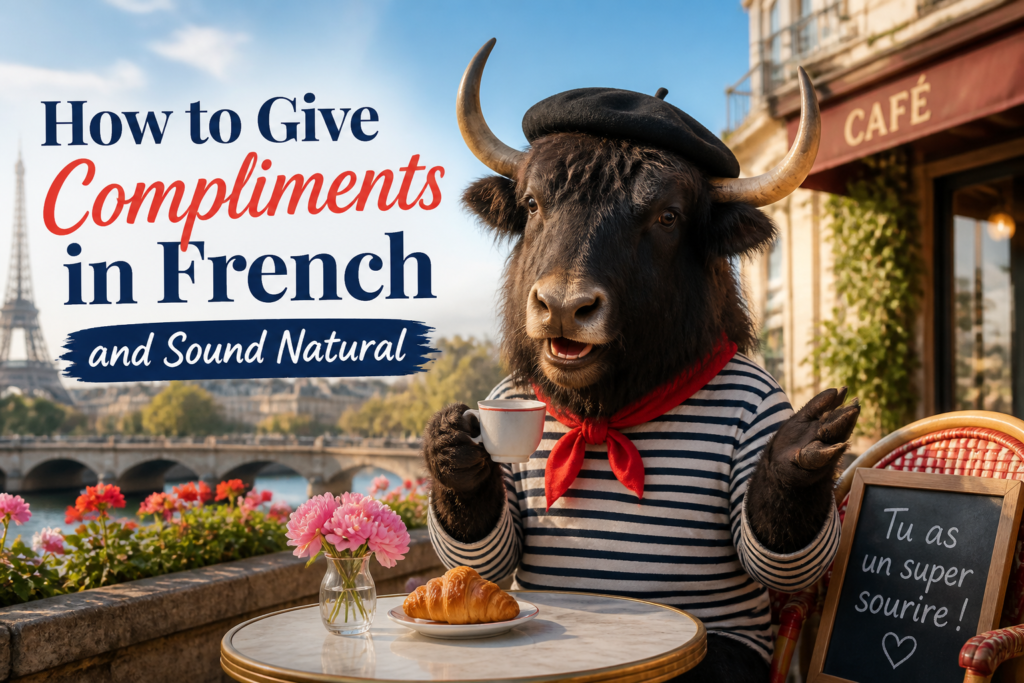
French compliments can be charming, warm, and elegant. They can also go spectacularly wrong if they sound too intense, too formal, or like you learned them from a suspiciously dramatic movie.
The good news: real French compliments are often simple. You do not need poetry, a violin soundtrack, or a speech about someone’s eyes looking like moonlit lakes. In fact, “That’s really nice” will get you surprisingly far.
By the end of this guide, you’ll know how to compliment someone’s appearance, clothes, work, personality, and achievements in natural modern French without sounding stiff, creepy, or like a malfunctioning phrasebook.
If you want to build your overall level too, you can start with the main Learn French hub or check your level with this French placement test.
The Golden Rule: Keep It Light And Specific
In English, people often say “You look amazing” or “I love your outfit” very casually. In French, compliments are common too, but the safest natural style is usually:
- short
- specific
- friendly
- not too intense at the start
So instead of going full Shakespeare, French speakers often say things like:
- C’est joli. — That’s pretty.
- J’aime bien ton pull. — I really like your sweater.
- Tu as bien travaillé. — You did a good job.
- Ça te va bien. — That suits you.
The most natural compliment in French is often the one that sounds almost a little understated. Yes, French can be romantic. It can also be gloriously low-key.
Useful Compliment Phrases You Can Actually Use
Here are the core compliments worth learning first. These are the kinds of things you can use with friends, classmates, coworkers, dates, hosts, and the nice person at the bakery who somehow always looks more put together than the rest of humanity.
| French | Pronunciation | Meaning | Example Sentence | Translation | Learner Note |
|---|---|---|---|---|---|
| C’est joli. | say zho-lee | It’s pretty. | Cette robe, c’est joli. | That dress is pretty. | Simple and safe for objects, clothes, décor, design. |
| C’est beau. | say boh | It’s beautiful. | Ton dessin, c’est beau. | Your drawing is beautiful. | Use beau for masculine things, but in this structure c’est beau works very naturally. |
| J’aime bien… | zhem byan | I really like… | J’aime bien ton style. | I really like your style. | J’aime bien sounds softer and more natural than a huge dramatic j’adore in many situations. |
| J’adore… | zha-dor | I love… | J’adore tes boucles d’oreilles. | I love your earrings. | Stronger than j’aime bien. Great when you mean it, just do not use it every six seconds. |
| Ça te va bien. | sah tuh vah byan | That suits you. | Le bleu, ça te va bien. | Blue suits you. | Very common for clothes, colors, haircuts, glasses. |
| Tu es élégant / élégante. | tu eh zay-lay-gahn / zay-lay-gahnt | You’re elegant. | Tu es très élégante ce soir. | You’re very elegant tonight. | Adjust adjective for gender. Nice for a dressed-up situation. |
| Tu es magnifique. | tu eh ma-nye-feek | You look amazing / You’re gorgeous. | Tu es magnifique dans cette tenue. | You look amazing in that outfit. | Strong compliment. Best when the context supports it. |
| Tu as bonne mine. | tu ah bun meen | You look well. | Tu as bonne mine aujourd’hui. | You look well today. | Very French. Means healthy, fresh, rested-looking. |
| Tu as l’air en forme. | tu ah lair ahn form | You look in good shape. | Tu as l’air en forme en ce moment. | You look in good shape lately. | Good for energy and wellness, not just appearance. |
| Tu travailles bien. | tu tra-vai byan | You work well. | Franchement, tu travailles bien. | Honestly, you work well. | Useful for school or work, but can sound slightly general. |
| Tu as fait du bon travail. | tu ah fay du bon tra-vai | You did good work. | Tu as fait du bon travail sur ce projet. | You did good work on this project. | Natural in professional or academic contexts. |
| C’est une excellente idée. | say tun ek-say-lahnt ee-day | That’s an excellent idea. | Franchement, c’est une excellente idée. | Honestly, that’s an excellent idea. | Great for complimenting thinking, not looks. |
Complimenting Someone’s Appearance Without Sounding Weird
This is where tone matters a lot. French does use appearance compliments, but you usually want to choose something that fits your relationship with the person.
For example, Tu es magnifique is lovely, but it is more intense than Tu es très bien aujourd’hui or Ça te va bien. If you are talking to a colleague or someone you do not know well, compliments about clothes, style, or haircut often feel safer than comments about their body.
| French | Pronunciation | Meaning | Example Sentence | Translation | Learner Note |
|---|---|---|---|---|---|
| Tu es très beau / belle. | tu eh tray boh / bel | You’re very handsome / beautiful. | Tu es très belle aujourd’hui. | You’re very beautiful today. | Warm and direct. Better with someone you know fairly well. |
| Tu es canon. | tu eh ka-non | You look amazing / hot. | Wow, tu es canon ce soir. | Wow, you look amazing tonight. | Casual and stronger. Not for formal contexts. |
| Tu es ravissant / ravissante. | tu eh ra-vee-sahn / ra-vee-sahnt | You look lovely. | Tu es ravissante dans cette robe. | You look lovely in that dress. | A bit more elegant and slightly dressy. |
| Tu es bien coiffé(e). | tu eh byan kwa-fay | Your hair looks nice. | Tu es bien coiffée aujourd’hui. | Your hair looks nice today. | Useful, but less common than simply praising the haircut directly. |
| J’aime beaucoup ta coupe de cheveux. | zhem boo-koo ta koop duh shuh-vuh | I really like your haircut. | J’aime beaucoup ta nouvelle coupe de cheveux. | I really like your new haircut. | Very natural and friendly. |
| Tu portes bien ce style. | tu port byan suh steel | You wear that style well. | Tu portes bien ce style minimaliste. | You wear that minimalist style well. | Good for fashion, less personal than body compliments. |
A handy trick: if you are unsure, compliment the choice, not the body.
- J’aime bien ta veste. — I like your jacket.
- Cette couleur te va bien. — That color suits you.
- Ta coiffure est super. — Your hairstyle is great.
That usually sounds nicer, safer, and more natural.
Complimenting Clothes, Style, And Taste
This is one of the easiest compliment categories in French because it works in lots of situations and rarely feels too personal.
| French | Pronunciation | Meaning | Example Sentence | Translation | Learner Note |
|---|---|---|---|---|---|
| J’aime bien ton pull. | zhem byan ton pull | I like your sweater. | J’aime bien ton pull, il est sympa. | I like your sweater, it’s nice. | Classic, natural, easy. |
| Ta robe est magnifique. | ta rob eh ma-nye-feek | Your dress is gorgeous. | Ta robe est magnifique, elle te va très bien. | Your dress is gorgeous, it suits you very well. | Warm and specific. |
| J’adore tes chaussures. | zha-dor tay sho-syr | I love your shoes. | J’adore tes chaussures, elles sont super originales. | I love your shoes, they’re really original. | Original in French usually means creative or unusual in a good way. |
| Tu as bon goût. | tu ah bon goo | You have good taste. | Franchement, tu as bon goût en déco. | Honestly, you have good taste in décor. | Excellent for style, design, fashion, music, food choices. |
| C’est super élégant. | say su-pair ay-lay-gahn | That’s super elegant. | Cette tenue, c’est super élégant. | That outfit is super elegant. | Good for praising the outfit itself. |
| Tu es toujours bien habillé(e). | tu eh too-zhoor byan a-bee-yay | You’re always well dressed. | Tu es toujours bien habillé pour le travail. | You’re always well dressed for work. | Nice compliment, but a little broader and more personal. |
Complimenting Personality And Character
These compliments often feel more meaningful than appearance compliments, and they are useful in friendships, dating, work, and daily life. Also, nobody ever gets tired of hearing they are kind, funny, or thoughtful. Well, almost nobody.
| French | Pronunciation | Meaning | Example Sentence | Translation | Learner Note |
|---|---|---|---|---|---|
| Tu es gentil / gentille. | tu eh zhan-tee / zhan-tee-yuh | You’re kind. | Merci, tu es vraiment gentille. | Thanks, you’re really kind. | Very common and warm. |
| Tu es drôle. | tu eh drol | You’re funny. | Tu es drôle, tu me fais toujours rire. | You’re funny, you always make me laugh. | Great casual compliment. |
| Tu es sympa. | tu eh sam-pa | You’re nice. | Tu es sympa de m’aider. | It’s nice of you to help me. | Very common. Easy and friendly. |
| Tu es intelligent / intelligente. | tu eh ahn-tel-ee-zhahn / zhahnt | You’re smart. | Tu es très intelligente, ton analyse est claire. | You’re very smart, your analysis is clear. | Better when connected to something specific. |
| Tu es patient / patiente. | tu eh pa-syahn / syahnt | You’re patient. | Tu es très patient avec les débutants. | You’re very patient with beginners. | Useful and thoughtful. |
| Tu es attentionné(e). | tu eh a-tahn-syo-nay | You’re thoughtful. | Tu es très attentionné, ça me touche. | You’re very thoughtful, that means a lot to me. | A lovely compliment for someone considerate. |
Complimenting Work, Skills, And Achievements
These are some of the most useful compliments in French because they work in school, professional life, hobbies, and everyday conversations. They also sound mature and natural.
| French | Pronunciation | Meaning | Example Sentence | Translation | Learner Note |
|---|---|---|---|---|---|
| Bravo ! | bra-voh | Well done! | Bravo, tu t’es bien débrouillé. | Well done, you handled it well. | Short, common, useful everywhere. |
| Bien joué. | byan zhoo-ay | Nicely done. | Bien joué, ta présentation était claire. | Nicely done, your presentation was clear. | Casual and natural. |
| Tu t’es bien débrouillé(e). | tu tay byan day-broo-yay | You did well / handled it well. | Pour un premier essai, tu t’es bien débrouillé. | For a first try, you did well. | Very natural for performance or effort. |
| Tu as assuré. | tu ah a-syur-ay | You nailed it. | Franchement, tu as assuré pendant l’entretien. | Honestly, you nailed the interview. | Casual spoken French. Great phrase. |
| Ton travail est excellent. | ton tra-vai eh ek-say-lahn | Your work is excellent. | Ton travail est excellent, surtout l’introduction. | Your work is excellent, especially the introduction. | Works well in school and work settings. |
| Tu as beaucoup de talent. | tu ah boo-koo duh ta-lahn | You have a lot of talent. | Tu as beaucoup de talent pour la photo. | You have a lot of talent for photography. | Good for art, music, design, sport, writing. |
Polite Vs Casual: Tu Or Vous?
Just like in many other French situations, compliments change depending on whether you use tu or vous.
Use tu with friends, family, many classmates, children, and people you know well. Use vous in formal situations, with strangers, older people in some contexts, clients, bosses in more traditional workplaces, or when you want to be polite and a little more distant.
| Tu Version | Vous Version | Meaning | Note |
|---|---|---|---|
| Tu es élégant. | Vous êtes élégant. | You look elegant. | Same idea, different level of formality. |
| J’aime bien ton idée. | J’aime bien votre idée. | I like your idea. | Votre means your in formal/plural contexts. |
| Ça te va bien. | Ça vous va bien. | That suits you. | Very useful in shops or polite conversation. |
| Tu as fait du bon travail. | Vous avez fait du bon travail. | You did good work. | Handy for workplace French. |
If you are unsure, polite French is usually safer. Then, if the relationship becomes more relaxed, the switch to tu often happens naturally.
Common Patterns That Make Compliments Sound More Natural
Instead of memorizing one hundred separate compliments, learn a few reusable patterns.
Pattern 1: J’aime Bien + Noun
J’aime bien ton sac. — I like your bag.
J’aime bien votre présentation. — I like your presentation.
This is soft, friendly, and easy to use. Very natural French.
Pattern 2: Ça Te / Vous Va Bien
Cette couleur te va bien. — That color suits you.
Ce style vous va très bien. — That style suits you very well.
Perfect for clothes, accessories, colors, makeup, glasses, and haircuts.
Pattern 3: C’est + Adjective
C’est beau. — It’s beautiful.
C’est super élégant. — It’s super elegant.
C’est une excellente idée. — That’s an excellent idea.
This works beautifully for objects, choices, work, ideas, and creative output.
Pattern 4: Tu Es / Vous Êtes + Adjective
Tu es drôle. — You’re funny.
Vous êtes très aimable. — You’re very kind.
This is direct, so choose the adjective carefully based on the relationship.
Common Mistakes English Speakers Make
- Using compliments that are too intense too early.
Saying Tu es parfaite to someone you barely know can feel a bit much. Try J’aime bien ton style or Tu es très sympa instead. - Translating English word for word.
“You look cute” does not always map neatly onto one everyday French phrase. Often Tu es mignon / mignonne works, but context matters, and it can sound flirtier or more personal. - Forgetting agreement.
Tu es gentil for a man, Tu es gentille for a woman. Same idea with élégant / élégante, ravissant / ravissante, and many others. - Overusing magnifique.
Yes, it is a real French word. No, it should not replace every other adjective in your vocabulary. - Complimenting the body when the situation calls for the outfit.
In many everyday contexts, Cette chemise te va bien sounds better than a more personal comment.
Mini Practice: Which Compliment Fits Best?
Try these quick situations.
- Your friend got a new haircut.
J’aime beaucoup ta nouvelle coupe de cheveux. - A coworker gave a strong presentation.
Vous avez fait du bon travail. or Votre présentation était très claire. - Your sister chose a great outfit.
Cette tenue te va super bien. - Someone had a clever idea in class.
C’est une excellente idée. - Your friend is always kind and supportive.
Tu es vraiment attentionnée. or Tu es vraiment gentil.
Notice how many natural compliments are about a choice, action, or quality, not just raw appearance.
A Few Natural Compliment Combos
If you want to sound smoother, combine two short ideas instead of one giant compliment.
- J’aime bien ta veste, elle te va bien.
I like your jacket, it suits you. - Tu as bien travaillé, ton texte est clair et précis.
You worked well, your text is clear and precise. - Tu es très élégante ce soir, cette couleur te va bien.
You’re very elegant tonight, that color suits you. - Bravo, tu t’es bien débrouillé.
Well done, you handled it well.
That sounds much more natural than stacking three giant adjectives like you are reviewing a luxury candle.
Quick Reference Summary
- Use short, specific compliments first.
- J’aime bien… is one of your best friends.
- Ça te va bien is perfect for clothes and style.
- For work and achievements, use Bravo, Bien joué, and Tu as fait du bon travail.
- Use tu or vous based on the relationship.
- Complimenting choices often feels safer than complimenting bodies.
- Do not overdo dramatic compliments unless the moment clearly calls for it.
Keep Practicing
If you want more useful everyday French, you can also read different ways to say “how are you” in French. It pairs nicely with compliments, since most actual conversations begin before the compliment arrives.
You can also test how much vocabulary you already know with this French vocabulary test, or revisit this guide anytime at How to Give Compliments in French.
Yak Takeaway: in French, the best compliment is usually not the biggest one. Keep it simple, keep it sincere, and keep at least one dramatic masterpiece in reserve for emergencies.