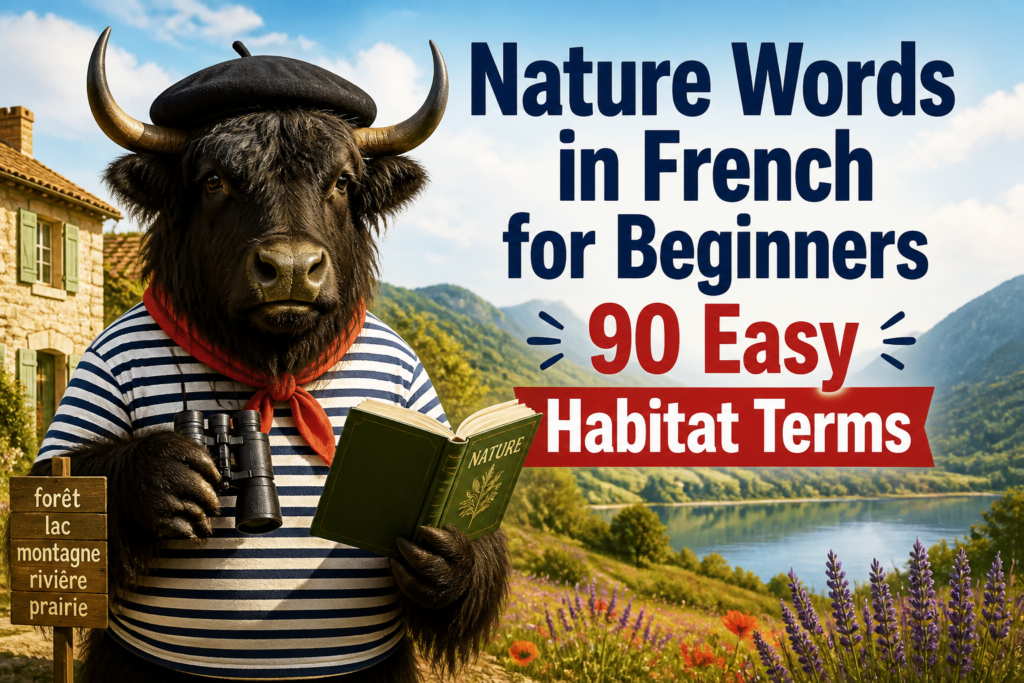
If you learn French with only café, croissant, and bonjour, you can absolutely survive a weekend in Paris. But the second someone says a bird lives in a forest, a fish lives in a river, or your hike passes through a valley, things get a bit more leafy.
This guide teaches practical French habitat vocabulary for beginners: places in nature, landforms, water words, weather-related environment words, and the useful phrases people actually say when talking about where animals and plants live.
In other words: less textbook fog, more real-world mud.
You’ll get 90 easy habitat terms, 14 useful phrases, simple pronunciation help, example sentences, and quick learner notes. If you want a broader French learning path after this, you can also explore more French lessons.
How To Read The Pronunciation
The pronunciation help here is kept simple and English-friendly. It is not fancy phonetics class territory. A few quick tips:
- r in French is usually softer and further back in the throat than in English.
- Final consonants are often silent: forêt, champ, étang.
- Words like l’eau and l’île use elision: le/la becomes l’ before a vowel sound.
- French articles matter, so try to learn words with le, la, or l’ when possible.
Useful Habitat Phrases In French
Before the big vocabulary tables, here are 14 high-frequency phrases you can actually use to describe where animals, plants, and people are in nature.
| French | Pronunciation | Meaning | Example Sentence | Translation | Learner Note |
|---|---|---|---|---|---|
| dans la forêt | dahn lah fo-ray | in the forest | Le cerf vit dans la forêt. | The deer lives in the forest. | Forêt is feminine: la forêt. |
| au bord de la rivière | oh bor duh lah ree-vyehr | on the riverbank / by the river | Nous marchons au bord de la rivière. | We are walking by the river. | Au bord de is very useful for edges and banks. |
| près du lac | preh dew lak | near the lake | Il y a un village près du lac. | There is a village near the lake. | Près de + le = près du. |
| loin de la ville | lwahn duh lah veel | far from the city | Cette réserve est loin de la ville. | This reserve is far from the city. | Good contrast with près de. |
| dans les montagnes | dahn lay mon-tahn-yuh | in the mountains | Ils habitent dans les montagnes. | They live in the mountains. | Plural: les montagnes. |
| sous l’eau | soo loh | underwater / under the water | Ce poisson vit sous l’eau. | This fish lives underwater. | Elision: l’eau, not la eau. |
| sur la plage | sur lah plahzh | on the beach | Les enfants jouent sur la plage. | The children are playing on the beach. | Sur = on. |
| dans le désert | dahn luh day-zehr | in the desert | Le chameau vit dans le désert. | The camel lives in the desert. | Désert is masculine: le désert. |
| au milieu de | oh mee-lyuh duh | in the middle of | Il y a un arbre au milieu du champ. | There is a tree in the middle of the field. | Common structure for location descriptions. |
| à côté de | ah koh-tay duh | next to / beside | Le sentier passe à côté de la rivière. | The path goes beside the river. | Works for places, objects, people. |
| vivre dans | veevr dahn | to live in | Les loups peuvent vivre dans les montagnes. | Wolves can live in the mountains. | Very common with animal habitats. |
| pousser dans | poo-say dahn | to grow in | Ces fleurs poussent dans les prés. | These flowers grow in meadows. | Use for plants and crops. |
| on trouve | on troov | you find / one finds / there are | On trouve des grenouilles dans cet étang. | You find frogs in this pond. | Very natural French for “there are” in descriptions. |
| il y a | eel ee ah | there is / there are | Il y a beaucoup d’arbres ici. | There are many trees here. | One of the most important French phrases, full stop. |
Land And Natural Place Words
Let’s start with the biggest, most useful habitat words: the places animals, people, and plants exist in. These are the words you’ll use all the time in beginner French.
| French | Pronunciation | Meaning | Example Sentence | Translation | Learner Note |
|---|---|---|---|---|---|
| la nature | lah nah-tur | nature | J’aime marcher dans la nature. | I like walking in nature. | Very common general word. |
| l’habitat | ah-bee-tah | habitat | La forêt est l’habitat de nombreux animaux. | The forest is the habitat of many animals. | Masculine: un habitat. |
| la forêt | lah fo-ray | forest | La chouette vit dans la forêt. | The owl lives in the forest. | Final t is silent. |
| le bois | luh bwah | woods | Nous nous promenons dans le bois. | We are walking in the woods. | Often smaller than forêt. |
| la jungle | lah zhoongl | jungle | Beaucoup d’animaux vivent dans la jungle. | Many animals live in the jungle. | Sounds close to English. |
| la savane | lah sah-vahn | savanna | Le lion vit dans la savane. | The lion lives in the savanna. | Feminine noun. |
| le désert | luh day-zehr | desert | Le désert est très sec. | The desert is very dry. | Do not confuse with English “dessert.” Cruel language prank. |
| la plaine | lah plen | plain | Les chevaux courent dans la plaine. | The horses run in the plain. | Open flat land. |
| la prairie | lah pray-ree | prairie / grassland | Les vaches mangent dans la prairie. | The cows eat in the prairie. | Very useful rural word. |
| le pré | luh pray | meadow | Les fleurs poussent dans le pré. | Flowers grow in the meadow. | Short and common. |
| le champ | luh shah | field | Le tracteur est dans le champ. | The tractor is in the field. | Final p is silent. |
| la campagne | lah kom-pahn-yuh | countryside | Mes grands-parents habitent à la campagne. | My grandparents live in the countryside. | Very common in everyday French. |
| la colline | lah koh-leen | hill | La maison est sur la colline. | The house is on the hill. | Useful with sur. |
| la montagne | lah მონ-tahn-yuh | mountain | Il neige sur la montagne. | It is snowing on the mountain. | Plural often used: les montagnes. |
| la vallée | lah vah-lay | valley | Le village se trouve dans la vallée. | The village is in the valley. | Se trouver = to be located. |
| la grotte | lah grot | cave | Les chauves-souris vivent dans la grotte. | Bats live in the cave. | Final e is silent. |
| la falaise | lah fah-lez | cliff | Les oiseaux nichent sur la falaise. | Birds nest on the cliff. | Good coastal nature word. |
| l’île | leel | island | Ils vivent sur l’île. | They live on the island. | Feminine, but article becomes l’. |
| la côte | lah kot | coast | Nous visitons la côte en été. | We visit the coast in summer. | Useful for geography and travel. |
| la région | lah ray-zhee-on | region | Cette région est très verte. | This region is very green. | Broad area word. |
Water Habitat Words
French loves precise little location words, and water habitats show that nicely. Learn these and suddenly fish, ducks, beaches, and rainy weather all become much easier to talk about.
| French | Pronunciation | Meaning | Example Sentence | Translation | Learner Note |
|---|---|---|---|---|---|
| l’eau | loh | water | L’oiseau boit de l’eau. | The bird drinks water. | Elision: de l’eau. |
| la mer | lah mehr | sea | Nous regardons la mer. | We are looking at the sea. | Very common word. |
| l’océan | loh-say-ahn | ocean | L’océan est immense. | The ocean is huge. | Masculine: un océan. |
| la rivière | lah ree-vyehr | river | Le castor vit près de la rivière. | The beaver lives near the river. | French distinguishes rivière and fleuve. |
| le fleuve | luh fluv | major river flowing to the sea | La Loire est un fleuve. | The Loire is a river that flows to the sea. | More specific than English “river.” |
| le lac | luh lak | lake | Le lac est calme ce matin. | The lake is calm this morning. | Masculine. |
| l’étang | lay-tahn | pond | Il y a des grenouilles dans l’étang. | There are frogs in the pond. | Final g is silent. |
| le marais | luh mah-ray | marsh | Le héron vit dans le marais. | The heron lives in the marsh. | Can also mean swampy wetland. |
| la cascade | lah kas-kahd | waterfall | La cascade est magnifique. | The waterfall is magnificent. | Good nature-trip word. |
| la source | lah soors | spring / source | Cette rivière commence à la source. | This river starts at the spring. | Useful in geography. |
| le ruisseau | luh rwee-soh | stream | Un petit pont passe au-dessus du ruisseau. | A small bridge crosses over the stream. | Small flowing water. |
| la plage | lah plahzh | beach | Les enfants jouent sur la plage. | The children play on the beach. | Common holiday word too. |
| le sable | luh sabl | sand | Le sable est chaud. | The sand is warm. | Useful with beach and desert talk. |
| la rive | lah reev | bank / shore | Nous attendons sur la rive. | We are waiting on the bank. | Often with rivers and lakes. |
| le bord | luh bor | edge / side / bank | Ils mangent au bord du lac. | They are eating by the lake. | Often in the phrase au bord de. |
Ground, Plant, And Surface Words
These words help you describe what covers a habitat: earth, grass, trees, rocks, and all the stuff your shoes regret stepping on.
| French | Pronunciation | Meaning | Example Sentence | Translation | Learner Note |
|---|---|---|---|---|---|
| le sol | luh sol | ground / soil surface | Le sol est humide après la pluie. | The ground is damp after the rain. | General ground word. |
| la terre | lah tehr | earth / soil / land | Les carottes poussent dans la terre. | Carrots grow in the soil. | Also means Earth, the planet, in some contexts. |
| la boue | lah boo | mud | Mes chaussures sont pleines de boue. | My shoes are full of mud. | Annoyingly useful. |
| le rocher | luh roh-shay | rock | Le lézard est sur le rocher. | The lizard is on the rock. | Larger rock or boulder feel. |
| la pierre | lah pyehr | stone | Il ramasse une pierre. | He picks up a stone. | Smaller than rocher usually. |
| l’herbe | lerb | grass | Le lapin mange de l’herbe. | The rabbit eats grass. | Silent h, so you get elision. |
| la mousse | lah moos | moss | La mousse couvre le rocher. | Moss covers the rock. | Also means foam in other contexts. |
| l’arbre | larbr | tree | L’arbre est très haut. | The tree is very tall. | Masculine despite l’. |
| la branche | lah brahnsh | branch | L’oiseau est sur la branche. | The bird is on the branch. | Feminine noun. |
| la feuille | lah fuh-yuh | leaf | La feuille tombe en automne. | The leaf falls in autumn. | Plural: les feuilles. |
| la fleur | lah flur | flower | Cette fleur pousse au soleil. | This flower grows in the sun. | Easy everyday word. |
| la racine | lah rah-seen | root | La racine est sous la terre. | The root is under the ground. | Great for plant descriptions. |
| la graine | lah gren | seed | La graine devient une plante. | The seed becomes a plant. | Useful beginner science word. |
| la plante | lah plahnt | plant | Cette plante aime l’humidité. | This plant likes humidity. | Very common. |
| le tronc | luh trohn | tree trunk | L’écureuil monte sur le tronc. | The squirrel climbs on the trunk. | Final c is silent. |
Climate And Environment Words
Habitats are not just places. They also include conditions: heat, cold, moisture, shade, and light. These words make your French descriptions sound much more natural.
| French | Pronunciation | Meaning | Example Sentence | Translation | Learner Note |
|---|---|---|---|---|---|
| le climat | luh klee-mah | climate | Le climat ici est sec. | The climate here is dry. | Similar to English. |
| le temps | luh tahn | weather | Le temps change vite en montagne. | The weather changes quickly in the mountains. | Also means time. Because French enjoys multitasking. |
| la pluie | lah plwee | rain | Après la pluie, la forêt sent bon. | After the rain, the forest smells nice. | Useful in many contexts. |
| la neige | lah nezh | snow | La neige couvre la montagne. | Snow covers the mountain. | Also in weather reports. |
| le vent | luh vahn | wind | Le vent souffle fort sur la côte. | The wind blows strongly on the coast. | Common with souffler. |
| le soleil | luh soh-lay | sun | Les lézards aiment le soleil. | Lizards like the sun. | Masculine noun. |
| l’ombre | lombr | shade / shadow | Nous cherchons l’ombre sous les arbres. | We are looking for shade under the trees. | Useful in summer and habitat descriptions. |
| la lumière | lah loo-myair | light | Cette plante a besoin de lumière. | This plant needs light. | Often used with avoir besoin de. |
| la chaleur | lah shah-lur | heat | La chaleur du désert est extrême. | The desert heat is extreme. | Feminine noun. |
| le froid | luh frwah | cold | Le froid est intense en hiver. | The cold is intense in winter. | Can be noun or adjective in other structures. |
| l’humidité | loo-mee-dee-tay | humidity / moisture | La jungle a beaucoup d’humidité. | The jungle has a lot of humidity. | Silent h, so elision again. |
| la sécheresse | lah say-sheh-res | drought / dryness | La sécheresse menace la région. | Drought threatens the region. | More advanced but useful. |
| sec / sèche | sek / sesh | dry | Le sol est sec. | The ground is dry. | Adjective changes for gender. |
| humide | u-meed | humid / damp | Le marais est très humide. | The marsh is very damp. | Same form for masculine and feminine in many uses. |
| sauvage | soh-vahzh | wild | C’est une région sauvage. | It is a wild region. | Great descriptive adjective. |
Animal Shelter And Living Place Words
These are smaller habitat words: nests, dens, burrows, and other places living things stay. Very handy if you also study animal vocabulary.
If you want more bug-related French after this, have a look at French insect vocabulary.
| French | Pronunciation | Meaning | Example Sentence | Translation | Learner Note |
|---|---|---|---|---|---|
| le nid | luh nee | nest | L’oiseau construit un nid. | The bird builds a nest. | Final d is silent. |
| la tanière | lah tahn-yehr | den | Le renard dort dans sa tanière. | The fox sleeps in its den. | Common with wild mammals. |
| le terrier | luh teh-ree-ay | burrow | Le lapin entre dans son terrier. | The rabbit goes into its burrow. | Good animal habitat word. |
| la ruche | lah rush | beehive | Les abeilles vivent dans la ruche. | Bees live in the hive. | Useful with insect topics. |
| la fourmilière | lah foor-mee-lyair | anthill | Les fourmis sortent de la fourmilière. | The ants come out of the anthill. | Long word, but logical. |
| le trou | luh troo | hole | La souris se cache dans un trou. | The mouse hides in a hole. | Very common everyday word too. |
| l’abri | lah-bree | shelter | Les animaux cherchent un abri pendant l’orage. | Animals look for shelter during the storm. | Masculine noun. |
| la réserve naturelle | lah ray-zerv nah-tu-rel | nature reserve | Cette espèce vit dans une réserve naturelle. | This species lives in a nature reserve. | Excellent useful phrase. |
| le parc naturel | luh park nah-tu-rel | nature park | Nous visitons un parc naturel ce week-end. | We are visiting a nature park this weekend. | Good travel + nature combo. |
| la zone humide | lah zohn u-meed | wetland | Les oiseaux migrateurs utilisent la zone humide. | Migratory birds use the wetland. | Common environmental term. |
Extra Everyday Nature Words To Reach 90
Here’s a final batch of useful habitat-adjacent words that show up all the time in simple French descriptions.
| French | Pronunciation | Meaning | Example Sentence | Translation | Learner Note |
|---|---|---|---|---|---|
| le chemin | luh shuh-mahn | path / track | Le chemin traverse la forêt. | The path crosses the forest. | Very useful outdoors word. |
| le sentier | luh sahn-tee-ay | trail | Le sentier monte vers la colline. | The trail goes up toward the hill. | More like hiking trail. |
| le paysage | luh pay-ee-zahzh | landscape | Le paysage est magnifique ici. | The landscape is magnificent here. | Great descriptive noun. |
| l’environnement | lahn-vee-rohn-mahn | environment | Nous devons protéger l’environnement. | We must protect the environment. | Very common in news and school French. |
| l’espèce | les-pes | species | Cette espèce vit en montagne. | This species lives in the mountains. | Feminine noun. |
| la faune | lah fohn | wildlife / fauna | La faune locale est riche. | The local wildlife is rich. | Often paired with la flore. |
| la flore | lah flor | plant life / flora | La flore de cette île est unique. | The flora of this island is unique. | Common in nature texts. |
| la mousse de mer | lah moos duh mehr | sea foam | La mousse de mer couvre les rochers. | Sea foam covers the rocks. | Useful descriptive phrase. |
| la dune | lah dewn | dune | Le vent déplace la dune. | The wind moves the dune. | Useful with beaches and deserts. |
| le rivage | luh ree-vahzh | shore | Ils marchent le long du rivage. | They walk along the shore. | More literary than bord, but still useful. |
| le sommet | luh soh-may | summit / peak | Le sommet de la montagne est enneigé. | The mountain peak is snowy. | Common mountain word. |
| la pente | lah pahnt | slope | La pente est très raide. | The slope is very steep. | Useful in hiking and geography. |
| le volcan | luh vol-kahn | volcano | Le volcan domine l’île. | The volcano dominates the island. | Masculine noun. |
| la lave | lah lahv | lava | La lave est très chaude. | Lava is very hot. | Easy cognate. |
| le glacier | luh glah-see-ay | glacier | Le glacier fond lentement. | The glacier is melting slowly. | Useful climate word. |
Quick Notes On French Usage
A few small things make habitat French much easier:
- Use articles: say la forêt, le désert, l’eau, not just the bare noun.
- Use prepositions carefully: dans for “in,” sur for “on,” sous for “under,” près de for “near.”
- Watch contractions: près du lac = près de + le. Also au bord du lac = à le becomes au, and de les becomes des.
- Notice elision: l’île, l’eau, l’ombre, l’arbre.
- Adjectives may change: sec becomes sèche with a feminine noun.
If you can say where something is, what the place is like, and what lives there, you’re already doing real French—not just collecting random nouns like a nervous dictionary squirrel.
Common Beginner Mistakes
| Mistake | Better French | Why |
|---|---|---|
| dans forêt | dans la forêt | French usually needs the article. |
| à côté le lac | à côté du lac | de + le = du. |
| la eau | l’eau | Use elision before vowel sound. |
| le montagne | la montagne | Montagne is feminine. |
| sur le forêt | dans la forêt | Usually you are in a forest, not on it. |
| les animal vivent | les animaux vivent | Plural of animal is irregular: animaux. |
Mini Practice
Try translating these into French:
- The fish lives in the lake.
- There are many trees in the forest.
- The rabbit hides under the ground in a burrow.
- We are walking by the river.
- This plant grows in wet ground.
Possible answers:
- Le poisson vit dans le lac.
- Il y a beaucoup d’arbres dans la forêt.
- Le lapin se cache sous la terre dans un terrier.
- Nous marchons au bord de la rivière.
- Cette plante pousse dans un sol humide.
Quick Reference Summary
- Forest: la forêt
- River: la rivière
- Lake: le lac
- Mountain: la montagne
- Field: le champ
- Beach: la plage
- Desert: le désert
- Tree: l’arbre
- Grass: l’herbe
- To live in: vivre dans
- To grow in: pousser dans
- There is / there are: il y a
- Near: près de
- By the edge of: au bord de
Keep Building Your French Vocabulary
Want to keep going? You can check your level with the French placement test, measure your word power with the French vocabulary test, or branch out into related topics like house vocabulary in French and French transportation vocabulary.
Yak Takeaway: learn habitat words with their articles, pair them with simple location phrases like dans, sur, and près de, and suddenly your French gets much more alive. Literally. The trees, birds, rivers, and muddy shoes all agree.