French Future And Conditional Tenses
Learn when to say I will do it, I would do it, and I would like without your brain filing for resignation.
The French future and conditional tenses are close cousins. That is good news, because once you learn one pattern, the other one stops looking mysterious and starts looking slightly dramatic.
This guide gives you the simple future, the present conditional, the most useful irregular stems, real-life examples, and the classic traps that catch beginners every single time.
Yak Box: The One Big Idea
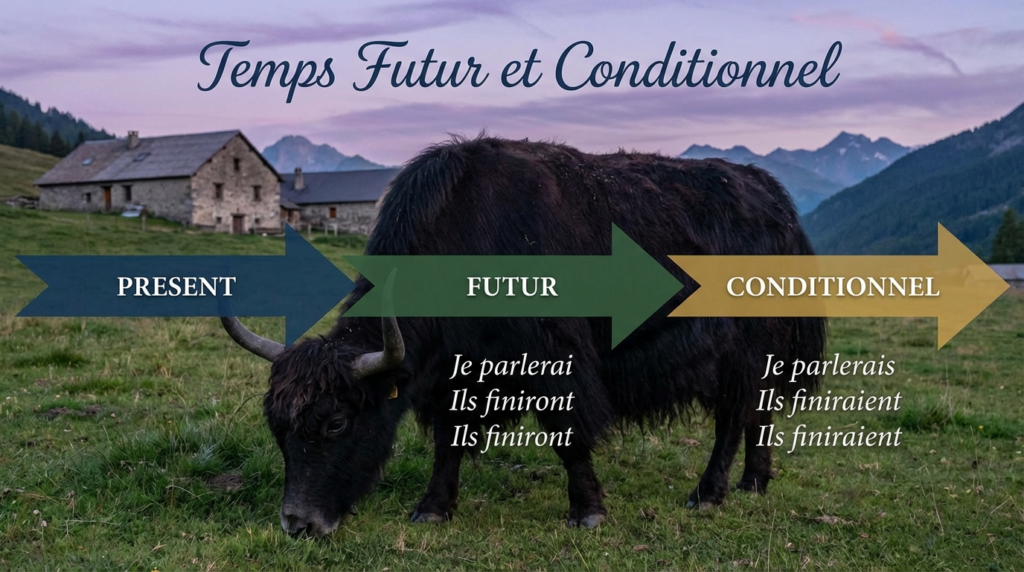
In French, the future usually means will. The conditional usually means would, and it is also used for polite requests like I would like.
- Future: Je parlerai = I will speak.
- Conditional: Je parlerais = I would speak.
The fun part: both tenses often use the same stem. French really did one helpful thing here.
What Each Tense Actually Does
Future Tense
Use it for actions that will happen later.
- Demain = tomorrow. Demain, je travaillerai. = Tomorrow, I will work.
- Plus tard = later. On parlera plus tard. = We will talk later.
- Un jour = one day. Un jour, j’habiterai à Paris. = One day, I will live in Paris.
Conditional Tense
Use it for things that would happen, for polite requests, and for actions depending on a condition.
- Je voudrais = I would like. Je voudrais un café. = I would like a coffee.
- Si = if. Si j’avais le temps, je voyagerais. = If I had time, I would travel.
- À ta place = in your place. À ta place, j’attendrais. = In your place, I would wait.
How To Build The Future Tense
For many verbs, you take the infinitive and add the future endings. For -re verbs, drop the final e first.
| Subject | Ending | Pattern | Example |
|---|---|---|---|
| je | -ai | parler + ai | Je parlerai. = I will speak. |
| tu | -as | parler + as | Tu parleras. = You will speak. |
| il / elle / on | -a | parler + a | Elle parlera. = She will speak. |
| nous | -ons | parler + ons | Nous parlerons. = We will speak. |
| vous | -ez | parler + ez | Vous parlerez. = You will speak. |
| ils / elles | -ont | parler + ont | Ils parleront. = They will speak. |
Regular examples:
- Parler = to speak. Je parlerai français demain. = I will speak French tomorrow.
- Finir = to finish. Nous finirons à midi. = We will finish at noon.
- Vendre = to sell. Il vendra sa voiture. = He will sell his car.
How To Build The Conditional Tense
The present conditional uses the same stem as the future, but with imperfect endings. That sounds scarier than it is.
| Subject | Ending | Pattern | Example |
|---|---|---|---|
| je | -ais | parler + ais | Je parlerais. = I would speak. |
| tu | -ais | parler + ais | Tu parlerais. = You would speak. |
| il / elle / on | -ait | parler + ait | On parlerait. = One / we would speak. |
| nous | -ions | parler + ions | Nous parlerions. = We would speak. |
| vous | -iez | parler + iez | Vous parleriez. = You would speak. |
| ils / elles | -aient | parler + aient | Elles parleraient. = They would speak. |
Regular examples:
- Je finirais = I would finish. Je finirais ce travail ce soir, mais je suis fatigué. = I would finish this work tonight, but I am tired.
- Nous vendrions = we would sell. Nous vendrions la maison pour le bon prix. = We would sell the house for the right price.
- Vous parleriez = you would speak. Vous parleriez plus lentement, s’il vous plaît ? = Would you speak more slowly, please?
The Shared Stem Trick
This is the shortcut worth remembering:
- Future = stem + future endings
- Conditional = same stem + imperfect endings
Look at the pair:
- Je pourrai = I will be able to.
- Je pourrais = I would be able to.
Only the ending changes. Tiny spelling change, big meaning change. Classic French drama.
Most Useful Irregular Verbs
These verbs are everywhere, so learn them early and your life gets easier fast.
| Verb | English Meaning | Future | Conditional | Example |
|---|---|---|---|---|
| être → ser- | to be | je serai | je serais | Je serai prêt à huit heures. = I will be ready at eight o’clock. |
| avoir → aur- | to have | tu auras | tu aurais | Tu auras une réponse demain. = You will have an answer tomorrow. |
| aller → ir- | to go | nous irons | nous irions | Nous irons au marché samedi. = We will go to the market on Saturday. |
| faire → fer- | to do / to make | il fera | il ferait | Il fera un gâteau. = He will make a cake. |
| venir → viendr- | to come | elle viendra | elle viendrait | Elle viendra plus tard. = She will come later. |
| vouloir → voudr- | to want | je voudrai | je voudrais | Je voudrais de l’eau. = I would like some water. |
| pouvoir → pourr- | to be able to | vous pourrez | vous pourriez | Vous pourrez entrer à dix heures. = You will be able to come in at ten o’clock. |
| devoir → devr- | to have to / must | ils devront | ils devraient | Ils devraient partir tôt. = They should leave early. |
| voir → verr- | to see | on verra | on verrait | On verra demain. = We’ll see tomorrow. |
| envoyer → enverr- | to send | j’enverrai | j’enverrais | J’enverrai le message ce soir. = I will send the message tonight. |
Rule To Example Patterns
| Rule | Meaning | Example 1 | Example 2 |
|---|---|---|---|
| Future for later actions | will | Je téléphonerai ce soir. = I will call tonight. | Ils arriveront demain. = They will arrive tomorrow. |
| Conditional for polite requests | would | Je voudrais réserver une table. = I would like to book a table. | Pourriez-vous répéter ? = Could you repeat? |
| Conditional after an unreal condition | would if | Si j’avais de l’argent, j’achèterais cette veste. = If I had money, I would buy that jacket. | Si nous étions en vacances, nous dormirions plus. = If we were on holiday, we would sleep more. |
| Future in the result clause of a real condition | will if | Si tu viens, je serai content. = If you come, I will be happy. | Si vous étudiez, vous réussirez. = If you study, you will succeed. |
Useful Phrases And Real-Life Sentences
- Je reviendrai. = I will come back. Je reviendrai dans cinq minutes. = I will come back in five minutes.
- Tu comprendras plus tard. = You will understand later. Tu comprendras plus tard pourquoi c’est important. = You will understand later why it is important.
- On se verra demain. = We will see each other tomorrow. On se verra demain au bureau. = We will see each other tomorrow at the office.
- Nous ferons attention. = We will be careful. Nous ferons attention à la route. = We will be careful on the road.
- Ils auront besoin d’aide. = They will need help. Ils auront besoin d’aide pour déménager. = They will need help to move house.
- Je voudrais parler au responsable. = I would like to speak to the manager. Je voudrais parler au responsable, s’il vous plaît. = I would like to speak to the manager, please.
- Tu pourrais m’aider ? = Could you help me? Tu pourrais m’aider avec ce sac ? = Could you help me with this bag?
- Nous aimerions partir tôt. = We would like to leave early. Nous aimerions partir tôt demain matin. = We would like to leave early tomorrow morning.
- Vous devriez essayer. = You should try. Vous devriez essayer ce restaurant. = You should try this restaurant.
- Elles seraient ravies. = They would be delighted. Elles seraient ravies de vous voir. = They would be delighted to see you.
- À ta place, je prendrais le train. = In your place, I would take the train. À ta place, je prendrais le train, pas la voiture. = In your place, I would take the train, not the car.
- Si j’étais toi, j’attendrais. = If I were you, I would wait. Si j’étais toi, j’attendrais un peu. = If I were you, I would wait a little.
Mini Table Of Time And Condition Words
| French | English Meaning | Example 1 | Example 2 | Example 3 |
|---|---|---|---|---|
| demain | tomorrow | Je partirai demain. = I will leave tomorrow. | On parlera demain. = We will talk tomorrow. | Elle reviendra demain soir. = She will come back tomorrow evening. |
| bientôt | soon | Il arrivera bientôt. = He will arrive soon. | Tu comprendras bientôt. = You will understand soon. | Nous déciderons bientôt. = We will decide soon. |
| plus tard | later | Je le ferai plus tard. = I will do it later. | On verra ça plus tard. = We will see about that later. | Ils répondront plus tard. = They will answer later. |
| si | if | Si tu viens, je cuisinerai. = If you come, I will cook. | Si j’avais le choix, je resterais. = If I had the choice, I would stay. | Si elle appelait, je serais surpris. = If she called, I would be surprised. |
| à ta place | in your place | À ta place, je refuserais. = In your place, I would refuse. | À ta place, j’irais à pied. = In your place, I would go on foot. | À ta place, je demanderais. = In your place, I would ask. |
Practice Section
Try these before peeking at the answers. Mild suffering helps memory. Just a bit.
Choose Future Or Conditional
- Demain, nous __________ (aller) au cinéma.
- Je __________ (vouloir) un thé, s’il vous plaît.
- Si tu étudiais davantage, tu __________ (réussir).
- Ils __________ (être) prêts dans une heure.
- À votre place, je __________ (dire) la vérité.
Answers
- irons — Demain, nous irons au cinéma. = Tomorrow, we will go to the cinema.
- voudrais — Je voudrais un thé, s’il vous plaît. = I would like a tea, please.
- réussirais — Si tu étudiais davantage, tu réussirais. = If you studied more, you would succeed.
- seront — Ils seront prêts dans une heure. = They will be ready in an hour.
- dirais — À votre place, je dirais la vérité. = In your place, I would tell the truth.
Swap The Meaning
Change the future sentence into a conditional one.
- Je pourrai venir. = I will be able to come. → Je pourrais venir. = I would be able to come.
- Nous ferons cela. = We will do that. → Nous ferions cela. = We would do that.
- Elle aura le temps. = She will have time. → Elle aurait le temps. = She would have time.
Common Mistakes And Fast Fixes
- Mixing up the endings: -ai, -as, -a, -ons, -ez, -ont are future endings. -ais, -ais, -ait, -ions, -iez, -aient are conditional endings.
- Using the wrong stem: être becomes ser-, not êtrer-. avoir becomes aur-, not avoir-.
- Using future after unreal si: say Si j’avais le temps, je voyagerais, not Si j’aurais le temps. French is very picky here.
- Forgetting the silent difference in speech: je parlerai and je parlerais can sound close depending on speed and accent, so context matters.
- Using present instead of conditional for politeness: Je veux un café = I want a coffee. Correct, but blunt. Je voudrais un café = I would like a coffee. Much nicer.
Quick Reference Summary
- Future = what will happen later.
- Conditional = what would happen, polite requests, advice, or unreal situations.
- Future endings = -ai, -as, -a, -ons, -ez, -ont.
- Conditional endings = -ais, -ais, -ait, -ions, -iez, -aient.
- Same stem, different endings for both tenses in many verbs.
- Polite superstars: je voudrais = I would like, pourriez-vous… ? = could you… ?
- After unreal si: imperfect + conditional. Si j’avais le temps, je lirais. = If I had time, I would read.
Final Yak
Memorise this shortcut: future = will, conditional = would, and both usually share the same stem. Once that clicks, French future and conditional tenses stop being two giant topics and start being one family with different outfits.
Learn the irregular stems for être, avoir, aller, faire, vouloir, and pouvoir first. Those six do a ridiculous amount of work in real French.