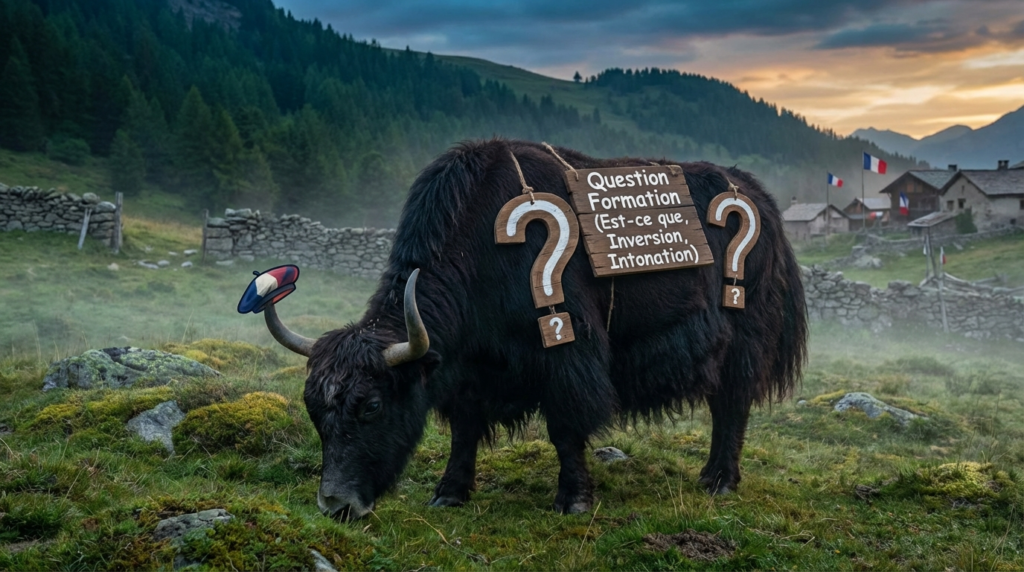
French question formation is not one giant grammar monster hiding under a beret. You can ask questions in French with a few clear patterns: rising intonation, est-ce que, inversion, and question words like où, quand, and pourquoi.
By the end, you will know how to ask yes/no questions, open questions, polite questions, casual questions, and the everyday phrases French speakers actually use. Tiny grammar win. Huge conversation upgrade.
There are three main ways to form a question in French:
- Intonation: say a normal sentence with your voice rising at the end. Tu viens ? = Are you coming?
- Est-ce que: put est-ce que before a statement. Est-ce que tu viens ? = Are you coming?
- Inversion: swap the verb and subject pronoun. Viens-tu ? = Are you coming?
For beginners, est-ce que is your safest all-purpose tool. It is clear, common, and much less dramatic than wrestling with inversion before breakfast.
How French Questions Work
In English, we often use helper words like do, does, and did: Do you like coffee? French does not use a direct equivalent of “do” for questions. Instead, French changes the tone, adds est-ce que, or changes the word order.
Start with a simple statement:
Tu parles français. = You speak French.
Now turn it into a question:
- Tu parles français ? = Do you speak French?
- Est-ce que tu parles français ? = Do you speak French?
- Parles-tu français ? = Do you speak French?
The Three Main Ways To Ask Yes/No Questions
Yes/no questions are questions you can answer with oui or non. French gives you three main styles, from casual to formal.
| Method | Best For | Pattern | Example |
|---|---|---|---|
| Intonation | Casual speech | Statement + rising voice | Tu viens ? = Are you coming? |
| Est-ce que | Neutral, clear French | Est-ce que + statement | Est-ce que tu viens ? = Are you coming? |
| Inversion | Formal speech, writing | Verb + hyphen + subject pronoun | Viens-tu ? = Are you coming? |
Intonation Questions
Intonation is the easiest question form. You keep the sentence order the same and raise your voice at the end. In writing, the question mark does the job.
Tu viens ?
Meaning: Are you coming?
Example: Tu viens au café avec nous ? = Are you coming to the café with us?
Vous avez faim ?
Meaning: Are you hungry?
Example: Vous avez faim maintenant ? = Are you hungry now?
Il est prêt ?
Meaning: Is he ready? / Is it ready?
Example: Le dîner est prêt ? = Is dinner ready?
Use intonation with friends, family, classmates, shopkeepers after a friendly exchange, and anyone who seems unlikely to judge your punctuation aura.
Est-Ce Que Questions
Est-ce que turns a statement into a question. It does not translate neatly word-for-word, but it works like a question marker. Put it at the beginning, then keep normal sentence order.
Pattern: Est-ce que + subject + verb + rest of sentence ?
Est-ce que tu aimes le café ? = Do you like coffee?
Est-ce que vous travaillez ici ? = Do you work here?
Est-ce qu’elle vient ce soir ? = Is she coming tonight?
Use est-ce qu’ before a vowel sound: est-ce qu’il, est-ce qu’elle, est-ce qu’on. French loves contractions. It heard there might be extra syllables and immediately called security.
Inversion Questions
Inversion means you reverse the verb and subject pronoun, then connect them with a hyphen. It often sounds more formal, polished, or written.
| Statement | Inversion Question | English Meaning |
|---|---|---|
| Tu parles français. | Parles-tu français ? | Do you speak French? |
| Vous aimez Paris. | Aimez-vous Paris ? | Do you like Paris? |
| Elle arrive bientôt. | Arrive-t-elle bientôt ? | Is she arriving soon? |
| Ils comprennent. | Comprennent-ils ? | Do they understand? |
When a verb ends in a vowel and the subject pronoun begins with a vowel, add -t- to make pronunciation smoother.
- Aime-t-il le thé ? = Does he like tea?
- Parle-t-elle anglais ? = Does she speak English?
- Va-t-on au restaurant ? = Are we going to the restaurant?
Which Question Form Should Beginners Use?
Use est-ce que when you want to be clear and safe. Use intonation when speaking casually. Recognize inversion, but do not panic if you do not use it perfectly right away.
| Situation | Best Choice | Example |
|---|---|---|
| Talking with a friend | Intonation | Tu viens ? = Are you coming? |
| Speaking clearly as a beginner | Est-ce que | Est-ce que tu viens ? = Are you coming? |
| Writing an email or formal note | Inversion | Venez-vous demain ? = Are you coming tomorrow? |
| Asking a stranger politely | Est-ce que or inversion | Est-ce que vous pouvez m’aider ? = Can you help me? |
French Question Words You Need First
Question words let you ask for information, not just yes or no. Learn these early. They carry a lot of conversational power for such tiny little words.
Qui
Meaning: Who / whom
Example: Qui vient ce soir ? = Who is coming tonight?
Que / Quoi
Meaning: What
Example: Qu’est-ce que tu veux ? = What do you want?
Où
Meaning: Where
Example: Où est la gare ? = Where is the train station?
Quand
Meaning: When
Example: Quand est-ce que tu pars ? = When are you leaving?
Pourquoi
Meaning: Why
Example: Pourquoi tu ris ? = Why are you laughing?
Comment
Meaning: How
Example: Comment ça va ? = How are you?
Combien
Meaning: How much / how many
Example: Combien ça coûte ? = How much does it cost?
Quel
Meaning: Which / what
Example: Quel jour sommes-nous ? = What day is it?
Question Word Table With Real Examples
| French | English Meaning | Example 1 | Example 2 | Example 3 |
|---|---|---|---|---|
| Qui | Who / whom | Qui est là ? = Who is there? | Qui as-tu vu ? = Whom did you see? | Tu connais qui ? = Who do you know? |
| Que | What | Que fais-tu ? = What are you doing? | Que veux-tu ? = What do you want? | Qu’a-t-il dit ? = What did he say? |
| Quoi | What | Tu fais quoi ? = What are you doing? | Tu veux quoi ? = What do you want? | C’est quoi ? = What is it? |
| Où | Where | Où vas-tu ? = Where are you going? | Tu habites où ? = Where do you live? | Où est la sortie ? = Where is the exit? |
| Quand | When | Quand pars-tu ? = When are you leaving? | Tu arrives quand ? = When do you arrive? | Quand est-ce que ça commence ? = When does it start? |
| Pourquoi | Why | Pourquoi tu dis ça ? = Why are you saying that? | Pourquoi est-ce fermé ? = Why is it closed? | Pourquoi viens-tu ? = Why are you coming? |
| Comment | How | Comment ça marche ? = How does it work? | Comment allez-vous ? = How are you? | Comment tu t’appelles ? = What is your name? |
| Combien | How much / how many | Combien ça coûte ? = How much does it cost? | Combien de personnes viennent ? = How many people are coming? | Tu en veux combien ? = How many do you want? |
| Quel / quelle | Which / what | Quel est ton nom ? = What is your name? | Quelle heure est-il ? = What time is it? | Quel train prends-tu ? = Which train are you taking? |
| Lequel / laquelle | Which one | Lequel préfères-tu ? = Which one do you prefer? | Laquelle est à toi ? = Which one is yours? | Lesquels sont gratuits ? = Which ones are free? |
How To Ask Open Questions In French
Open questions ask for information. The answer is not just oui or non. You can make open questions in casual, neutral, or formal French.
| Style | Pattern | Example | English Meaning |
|---|---|---|---|
| Casual | Statement + question word | Tu vas où ? | Where are you going? |
| Neutral | Question word + est-ce que + statement | Où est-ce que tu vas ? | Where are you going? |
| Formal | Question word + inversion | Où vas-tu ? | Where are you going? |
Casual French often puts the question word at the end: Tu vas où ? Neutral French often uses est-ce que: Où est-ce que tu vas ? Formal French often uses inversion: Où vas-tu ?
Est-Ce Que Vs Qu’Est-Ce Que
Est-ce que introduces a yes/no question. Qu’est-ce que asks “what” when “what” is the object of the sentence. Similar outfit, different job. Classic grammar disguise.
| French Phrase | English Meaning | Example |
|---|---|---|
| Est-ce que | Question marker for yes/no questions | Est-ce que tu viens ? = Are you coming? |
| Qu’est-ce que | What, when asking about an object | Qu’est-ce que tu veux ? = What do you want? |
| Qu’est-ce qui | What, when asking about a subject | Qu’est-ce qui se passe ? = What is happening? |
| Qui est-ce que | Whom / who, when asking about a person as object | Qui est-ce que tu invites ? = Whom are you inviting? |
| Qui est-ce qui | Who, when asking about a person as subject | Qui est-ce qui vient ? = Who is coming? |
The Quick Difference Between Que And Qui
Use qu’est-ce que when the answer is the object receiving the action. Use qu’est-ce qui when the answer is the subject doing the action.
- Qu’est-ce que tu manges ? = What are you eating? The answer is the thing being eaten.
- Qu’est-ce qui fait ce bruit ? = What is making that noise? The answer is the thing making the noise.
- Qui est-ce que tu appelles ? = Who are you calling? The answer is the person being called.
- Qui est-ce qui appelle ? = Who is calling? The answer is the person doing the calling.
70 Important French Question Phrases
Here are useful French question phrases for real life. Each one includes the English meaning and a sentence you can actually say without sounding like you swallowed a grammar workbook.
Everyday French Questions
| French | English Meaning | Example Sentence |
|---|---|---|
| Ça va ? | How are you? / Is it going okay? | Salut, ça va ? = Hi, how are you? |
| Comment ça va ? | How are things? | Comment ça va aujourd’hui ? = How are things today? |
| Tu vas bien ? | Are you doing well? | Tu vas bien ce matin ? = Are you doing well this morning? |
| Comment tu t’appelles ? | What is your name? | Bonjour, comment tu t’appelles ? = Hello, what is your name? |
| Vous vous appelez comment ? | What is your name? formal | Excusez-moi, vous vous appelez comment ? = Excuse me, what is your name? |
| Tu viens d’où ? | Where are you from? | Tu viens d’où exactement ? = Where exactly are you from? |
| Vous êtes d’où ? | Where are you from? formal | Vous êtes d’où en France ? = Where are you from in France? |
| Tu habites où ? | Where do you live? | Tu habites où maintenant ? = Where do you live now? |
| Quel âge as-tu ? | How old are you? | Quel âge as-tu cette année ? = How old are you this year? |
| Qu’est-ce que tu fais ? | What are you doing? / What do you do? | Qu’est-ce que tu fais dans la vie ? = What do you do for a living? |
Travel And Direction Questions
| French | English Meaning | Example Sentence |
|---|---|---|
| Où est la gare ? | Where is the train station? | Excusez-moi, où est la gare ? = Excuse me, where is the train station? |
| Où sont les toilettes ? | Where are the toilets? | Pardon, où sont les toilettes ? = Sorry, where are the toilets? |
| C’est loin ? | Is it far? | Le musée, c’est loin ? = Is the museum far? |
| C’est près d’ici ? | Is it near here? | La pharmacie, c’est près d’ici ? = Is the pharmacy near here? |
| Comment on va au centre-ville ? | How do we get to the city center? | Comment on va au centre-ville en métro ? = How do we get to the city center by metro? |
| Quel train va à Lyon ? | Which train goes to Lyon? | Quel train va à Lyon ce matin ? = Which train goes to Lyon this morning? |
| À quelle heure part le train ? | What time does the train leave? | À quelle heure part le train pour Nice ? = What time does the train to Nice leave? |
| Où puis-je acheter un billet ? | Where can I buy a ticket? | Où puis-je acheter un billet de bus ? = Where can I buy a bus ticket? |
| Est-ce que ce siège est libre ? | Is this seat free? | Bonjour, est-ce que ce siège est libre ? = Hello, is this seat free? |
| Vous descendez ici ? | Are you getting off here? | Excusez-moi, vous descendez ici ? = Excuse me, are you getting off here? |
Restaurant And Café Questions
| French | English Meaning | Example Sentence |
|---|---|---|
| Vous avez une table ? | Do you have a table? | Bonsoir, vous avez une table pour deux ? = Good evening, do you have a table for two? |
| Est-ce que je peux voir le menu ? | Can I see the menu? | Est-ce que je peux voir le menu, s’il vous plaît ? = Can I see the menu, please? |
| Qu’est-ce que vous recommandez ? | What do you recommend? | Qu’est-ce que vous recommandez comme dessert ? = What do you recommend for dessert? |
| C’est quoi, ce plat ? | What is this dish? | Excusez-moi, c’est quoi, ce plat ? = Excuse me, what is this dish? |
| Il y a du fromage dedans ? | Is there cheese in it? | Il y a du fromage dedans ou pas ? = Is there cheese in it or not? |
| Est-ce que c’est végétarien ? | Is it vegetarian? | Est-ce que c’est végétarien, cette soupe ? = Is this soup vegetarian? |
| On peut avoir de l’eau ? | Can we have water? | On peut avoir de l’eau, s’il vous plaît ? = Can we have water, please? |
| Je peux payer par carte ? | Can I pay by card? | Je peux payer par carte ici ? = Can I pay by card here? |
| L’addition, s’il vous plaît ? | The bill, please? | On peut avoir l’addition, s’il vous plaît ? = Can we have the bill, please? |
| Le service est compris ? | Is service included? | Le service est compris dans le prix ? = Is service included in the price? |
Shopping Questions
| French | English Meaning | Example Sentence |
|---|---|---|
| Combien ça coûte ? | How much does it cost? | Excusez-moi, combien ça coûte ? = Excuse me, how much does it cost? |
| C’est combien ? | How much is it? | Cette écharpe, c’est combien ? = How much is this scarf? |
| Vous avez une autre taille ? | Do you have another size? | Vous avez une autre taille en bleu ? = Do you have another size in blue? |
| Vous avez ça en noir ? | Do you have this in black? | Vous avez ça en noir ou en gris ? = Do you have this in black or gray? |
| Je peux essayer ? | Can I try it on? | Je peux essayer cette veste ? = Can I try on this jacket? |
| Où sont les cabines d’essayage ? | Where are the fitting rooms? | Où sont les cabines d’essayage, s’il vous plaît ? = Where are the fitting rooms, please? |
| Est-ce que c’est en solde ? | Is it on sale? | Est-ce que cette chemise est en solde ? = Is this shirt on sale? |
| Vous acceptez les cartes ? | Do you accept cards? | Vous acceptez les cartes bancaires ? = Do you accept bank cards? |
| Je peux avoir un sac ? | Can I have a bag? | Je peux avoir un sac, s’il vous plaît ? = Can I have a bag, please? |
| Je peux le retourner ? | Can I return it? | Je peux le retourner si ça ne va pas ? = Can I return it if it does not fit? |
Polite Help Questions
| French | English Meaning | Example Sentence |
|---|---|---|
| Est-ce que vous pouvez m’aider ? | Can you help me? | Excusez-moi, est-ce que vous pouvez m’aider ? = Excuse me, can you help me? |
| Vous pouvez répéter ? | Can you repeat? | Vous pouvez répéter plus lentement ? = Can you repeat more slowly? |
| Vous pouvez parler plus lentement ? | Can you speak more slowly? | Vous pouvez parler plus lentement, s’il vous plaît ? = Can you speak more slowly, please? |
| Qu’est-ce que ça veut dire ? | What does that mean? | Qu’est-ce que ça veut dire en anglais ? = What does that mean in English? |
| Comment dit-on ça en français ? | How do you say that in French? | Comment dit-on “receipt” en français ? = How do you say “receipt” in French? |
| Je peux poser une question ? | Can I ask a question? | Excusez-moi, je peux poser une question ? = Excuse me, can I ask a question? |
| Vous comprenez ? | Do you understand? | Vous comprenez ce que je veux dire ? = Do you understand what I mean? |
| Est-ce que c’est correct ? | Is it correct? | Est-ce que cette phrase est correcte ? = Is this sentence correct? |
| Où dois-je aller ? | Where should I go? | Où dois-je aller pour le rendez-vous ? = Where should I go for the appointment? |
| À qui dois-je parler ? | Whom should I speak to? | À qui dois-je parler pour changer mon billet ? = Whom should I speak to in order to change my ticket? |
Time And Planning Questions
| French | English Meaning | Example Sentence |
|---|---|---|
| Quelle heure est-il ? | What time is it? | Excusez-moi, quelle heure est-il ? = Excuse me, what time is it? |
| À quelle heure ça commence ? | What time does it start? | À quelle heure ça commence ce soir ? = What time does it start tonight? |
| À quelle heure ça finit ? | What time does it end? | À quelle heure le film finit ? = What time does the movie end? |
| Quand est-ce que tu arrives ? | When are you arriving? | Quand est-ce que tu arrives à Paris ? = When are you arriving in Paris? |
| Quand est-ce que vous partez ? | When are you leaving? | Quand est-ce que vous partez en vacances ? = When are you leaving for vacation? |
| On se voit quand ? | When shall we see each other? | On se voit quand cette semaine ? = When shall we see each other this week? |
| Tu es libre quand ? | When are you free? | Tu es libre quand demain ? = When are you free tomorrow? |
| Est-ce que lundi te va ? | Does Monday work for you? | Est-ce que lundi matin te va ? = Does Monday morning work for you? |
| On peut déplacer le rendez-vous ? | Can we move the appointment? | On peut déplacer le rendez-vous à mardi ? = Can we move the appointment to Tuesday? |
| Ça dure combien de temps ? | How long does it last? | La visite dure combien de temps ? = How long does the tour last? |
Clarifying Questions
| French | English Meaning | Example Sentence |
|---|---|---|
| C’est quoi ? | What is it? | C’est quoi, ce mot ? = What is this word? |
| Ça veut dire quoi ? | What does that mean? | Ça veut dire quoi exactement ? = What does that mean exactly? |
| Pourquoi pas ? | Why not? | Pourquoi pas demain ? = Why not tomorrow? |
| Depuis quand ? | Since when? | Tu habites ici depuis quand ? = Since when have you lived here? |
| Jusqu’à quand ? | Until when? | Tu restes jusqu’à quand ? = Until when are you staying? |
| Avec qui ? | With whom? | Tu vas au cinéma avec qui ? = Who are you going to the movies with? |
| Pour qui ? | For whom? | Ce cadeau est pour qui ? = Who is this gift for? |
| De quoi tu parles ? | What are you talking about? | De quoi tu parles maintenant ? = What are you talking about now? |
| Tu veux dire quoi ? | What do you mean? | Tu veux dire quoi par “bizarre” ? = What do you mean by “strange”? |
| Comment ça ? | What do you mean? / How so? | Comment ça, tu ne viens pas ? = What do you mean, you are not coming? |
Casual, Neutral, And Formal Versions Of The Same Question
French often gives you several ways to ask the same thing. The meaning stays similar, but the tone changes.
| English | Casual French | Neutral French | Formal French |
|---|---|---|---|
| Are you coming? | Tu viens ? | Est-ce que tu viens ? | Viens-tu ? |
| Where are you going? | Tu vas où ? | Où est-ce que tu vas ? | Où vas-tu ? |
| What do you want? | Tu veux quoi ? | Qu’est-ce que tu veux ? | Que veux-tu ? |
| When are you leaving? | Tu pars quand ? | Quand est-ce que tu pars ? | Quand pars-tu ? |
| Why are you doing that? | Pourquoi tu fais ça ? | Pourquoi est-ce que tu fais ça ? | Pourquoi fais-tu cela ? |
| How do you know? | Tu sais comment ? | Comment est-ce que tu sais ? | Comment le sais-tu ? |
| Who did you see? | Tu as vu qui ? | Qui est-ce que tu as vu ? | Qui as-tu vu ? |
| How much does it cost? | Ça coûte combien ? | Combien est-ce que ça coûte ? | Combien cela coûte-t-il ? |
How To Ask Negative Questions In French
To make a French question negative, place ne before the verb and pas after it. In everyday spoken French, people often drop ne, but beginners should learn the full version first.
| French | English Meaning | Example Sentence |
|---|---|---|
| Tu ne viens pas ? | Aren’t you coming? | Tu ne viens pas ce soir ? = Aren’t you coming tonight? |
| Est-ce que tu ne viens pas ? | Aren’t you coming? | Est-ce que tu ne viens pas avec nous ? = Aren’t you coming with us? |
| Ne viens-tu pas ? | Aren’t you coming? formal | Ne viens-tu pas demain ? = Aren’t you coming tomorrow? |
| Vous n’avez pas faim ? | Aren’t you hungry? | Vous n’avez pas faim après le voyage ? = Aren’t you hungry after the trip? |
| Pourquoi tu ne réponds pas ? | Why aren’t you answering? | Pourquoi tu ne réponds pas à mon message ? = Why aren’t you answering my message? |
How To Answer French Questions
Once someone asks you a question, you need a few answer tools. Yes, no, maybe, and “I have no idea” are conversation survival gear.
| French | English Meaning | Example Sentence |
|---|---|---|
| Oui | Yes | Oui, je viens. = Yes, I’m coming. |
| Non | No | Non, je ne peux pas. = No, I can’t. |
| Si | Yes, in response to a negative question | Tu ne viens pas ? Si, je viens. = Aren’t you coming? Yes, I am. |
| Peut-être | Maybe | Peut-être, je dois vérifier. = Maybe, I need to check. |
| Je ne sais pas | I don’t know | Je ne sais pas encore. = I don’t know yet. |
| Bien sûr | Of course | Bien sûr, je peux vous aider. = Of course, I can help you. |
| Pas encore | Not yet | Pas encore, mais bientôt. = Not yet, but soon. |
| Pas du tout | Not at all | Non, pas du tout. = No, not at all. |
Common Mistakes With French Question Formation
Mistake: Translating “Do” Directly
English says Do you speak French? French does not say “do you” this way.
Wrong idea: Do tu parles français ?
Better: Tu parles français ? = Do you speak French?
Better: Est-ce que tu parles français ? = Do you speak French?
Mistake: Using Que When You Need Quoi
Que often appears at the beginning of a formal question. Quoi often appears after a verb or preposition in casual questions.
Formal: Que veux-tu ? = What do you want?
Neutral: Qu’est-ce que tu veux ? = What do you want?
Casual: Tu veux quoi ? = What do you want?
Mistake: Forgetting The Hyphen In Inversion
In written French, inversion uses a hyphen between the verb and subject pronoun.
Incorrect: Parles tu français ?
Correct: Parles-tu français ? = Do you speak French?
Mistake: Overusing Inversion In Casual Speech
Où vas-tu ? is correct, but in everyday conversation, Tu vas où ? and Où est-ce que tu vas ? are often more natural for beginners.
Useful casual example: Tu vas où après le cours ? = Where are you going after class?
Practice: Turn Statements Into Questions
Use the three question forms: intonation, est-ce que, and inversion.
Practice 1: Tu aimes le chocolat.
Intonation: Tu aimes le chocolat ? = Do you like chocolate?
Est-ce que: Est-ce que tu aimes le chocolat ? = Do you like chocolate?
Inversion: Aimes-tu le chocolat ? = Do you like chocolate?
Practice 2: Vous parlez anglais.
Intonation: Vous parlez anglais ? = Do you speak English?
Est-ce que: Est-ce que vous parlez anglais ? = Do you speak English?
Inversion: Parlez-vous anglais ? = Do you speak English?
Practice 3: Elle travaille ici.
Intonation: Elle travaille ici ? = Does she work here?
Est-ce que: Est-ce qu’elle travaille ici ? = Does she work here?
Inversion: Travaille-t-elle ici ? = Does she work here?
Practice 4: Ils arrivent demain.
Intonation: Ils arrivent demain ? = Are they arriving tomorrow?
Est-ce que: Est-ce qu’ils arrivent demain ? = Are they arriving tomorrow?
Inversion: Arrivent-ils demain ? = Are they arriving tomorrow?
Quick Reference: French Question Formation
| Goal | French Pattern | Example |
|---|---|---|
| Ask a casual yes/no question | Statement + rising tone | Tu viens ? = Are you coming? |
| Ask a clear yes/no question | Est-ce que + statement | Est-ce que tu viens ? = Are you coming? |
| Ask a formal yes/no question | Verb-subject inversion | Viens-tu ? = Are you coming? |
| Ask “where” casually | Statement + où | Tu vas où ? = Where are you going? |
| Ask “where” neutrally | Où est-ce que + statement | Où est-ce que tu vas ? = Where are you going? |
| Ask “where” formally | Où + inversion | Où vas-tu ? = Where are you going? |
| Ask “what” as object | Qu’est-ce que + subject + verb | Qu’est-ce que tu veux ? = What do you want? |
| Ask “what” as subject | Qu’est-ce qui + verb | Qu’est-ce qui se passe ? = What is happening? |
Frequently Asked Questions About French Questions
What Is The Easiest Way To Form Questions In French?
The easiest way is intonation: keep normal word order and raise your voice at the end. Tu viens ? = Are you coming? For clear beginner French, est-ce que is also excellent: Est-ce que tu viens ? = Are you coming?
Is Est-Ce Que Formal Or Informal?
Est-ce que is neutral. It is not too casual and not too formal. Est-ce que vous avez une table ? = Do you have a table? This is polite and clear in many everyday situations.
Do French Speakers Use Inversion A Lot?
French speakers use inversion more in formal speech, writing, interviews, announcements, and polished questions. In everyday conversation, intonation and est-ce que are very common. Parlez-vous français ? = Do you speak French? is correct, but Vous parlez français ? is very normal in speech.
What Is The Difference Between Que And Quoi?
Both can mean “what.” Que appears at the beginning of more formal questions: Que veux-tu ? = What do you want? Quoi often appears at the end of casual questions or after prepositions: Tu veux quoi ? = What do you want?
What Does Qu’Est-Ce Que Mean?
Qu’est-ce que means “what” when asking about the object of a sentence. Qu’est-ce que tu fais ? = What are you doing? It is a very useful beginner structure.
Final Yak
French question formation becomes much easier when you stop treating every question like a tiny legal contract. Start with intonation for casual speech, use est-ce que for clear beginner-friendly questions, and recognize inversion when French gets dressed up.
Your best starter formula is simple: question word + est-ce que + normal sentence. With that, you can ask Où est-ce que tu vas ?, Quand est-ce que ça commence ?, Pourquoi est-ce que c’est fermé ?, and many more useful questions without grammar gymnastics. The yak approves, and the yak has standards.