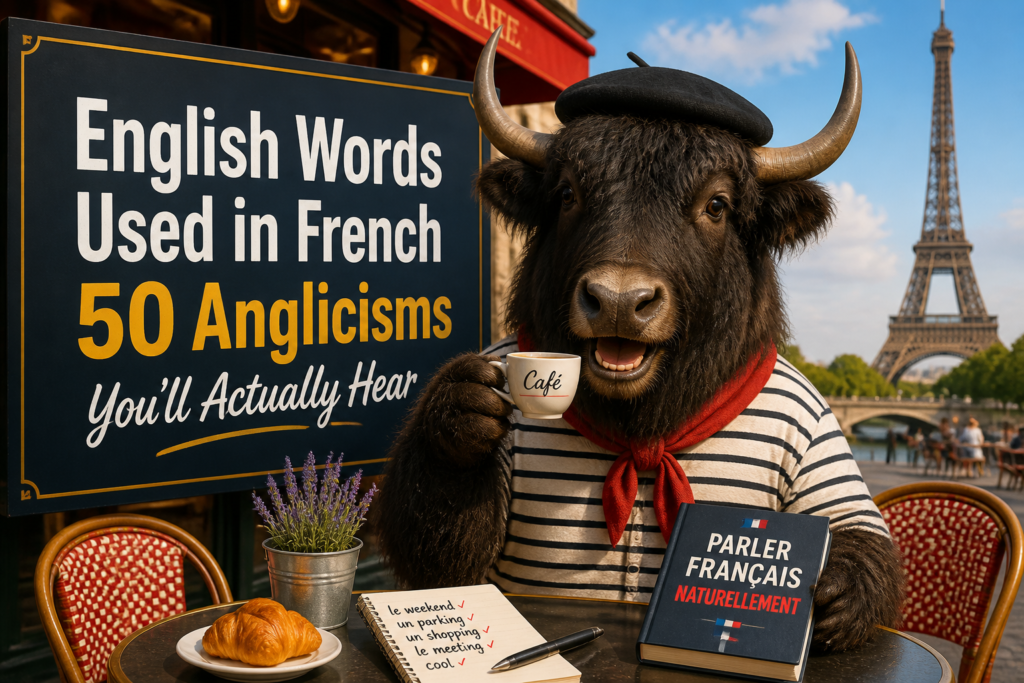
French famously loves protecting French. French also very famously uses a mountain of English words anyway. Language is messy like that.
These borrowed English words are called anglicismes in French. Some sound almost the same as in English, some have shifted meaning, and some are so common in everyday France French that you will hear them at work, in cafés, online, in fashion, in tech, and in conversations that are trying just a little too hard to sound modern.
In this guide, you’ll learn 50 English words used in French that people actually say, how to pronounce them in a French-friendly way, what they mean, and how to use them naturally. You’ll also see where French usage does not match English usage, because borrowed words love causing trouble.
If you want a broader path through French, you can also explore the main Learn French hub.
What Is An Anglicisme?
An anglicisme is a word or expression borrowed from English and used in French. Sometimes the meaning stays close to English. Sometimes it changes a bit. Sometimes French takes the word, gives it a new haircut, and sends it back out into the world.
For example, un parking in French usually means a parking lot or car park, not the act of parking. That is a classic borrowed-word plot twist.
Many anglicisms are common in France French. In Quebec French, people often prefer French alternatives more strongly, especially in formal contexts. So yes, regional differences matter.
How To Read The Pronunciation Here
The pronunciation help below is simple, not fancy. It is there to help English speakers say the word in a French conversation, not to turn this into a phonetics exam. In general, French speakers often pronounce English borrowings with a French accent, so le weekend does not sound exactly like “weekend” in English.
If a word looks English but sounds a bit French, congratulations: you have met an anglicism in the wild.
The 50 Anglicisms You’ll Actually Hear
The most useful ones come first. Each entry gives you the French word or phrase, easy pronunciation help, the English meaning, a real example sentence in French, an English translation, and a quick learner note when needed.
Everyday Life, Work, And Conversation
Keep building your French
Choose a practical next step when you are ready.
| French | Pronunciation | Meaning | Example Sentence | Translation | Learner Note |
|---|---|---|---|---|---|
| le weekend | luh week-end | weekend | On part à Lyon ce weekend. | We’re going to Lyon this weekend. | Very common in France French. Also written week-end. |
| un job | uhn johb | job | Je cherche un job pour l’été. | I’m looking for a summer job. | Casual and common. un travail is more general. |
| un boss | uhn boss | boss | Mon boss est sympa, mais il adore les réunions. | My boss is nice, but he loves meetings. | Informal. In more neutral French, mon chef is common. |
| un mail | uhn meyl | Je t’envoie un mail ce soir. | I’ll send you an email tonight. | Very common in France. Quebec often prefers a French term more often. | |
| un meeting | uhn mee-ting | meeting, work meeting | J’ai un meeting à 14 heures. | I have a meeting at 2 p.m. | Business French, slightly corporate. |
| un timing | uhn tai-ming | schedule, timing | Le timing est serré pour finir le projet. | The schedule is tight to finish the project. | Not exactly the same as English usage. Often means timeline or schedule. |
| un planning | uhn pla-ning | schedule, timetable | Tu peux m’envoyer le planning de la semaine ? | Can you send me the week’s schedule? | Classic false friend danger: in French it means schedule, not “planning” as an activity. |
| un challenge | uhn sha-lenj | challenge | C’est un vrai challenge pour l’équipe. | It’s a real challenge for the team. | Common in work and sports contexts. |
| un feedback | uhn feed-back | feedback | Merci pour ton feedback sur la présentation. | Thanks for your feedback on the presentation. | Very common in offices. Slightly jargon-heavy. |
| un briefing | uhn bree-fing | briefing | On fait un briefing avant l’événement. | We’re doing a briefing before the event. | Common in business, media, events. |
| un burn-out | uhn beurn out | burnout | Après des mois de stress, il a fait un burn-out. | After months of stress, he had burnout. | Often used with faire un burn-out. |
| un coach | uhn kohch | coach | Elle travaille avec un coach professionnel. | She works with a professional coach. | Used for sport and personal development. |
| un look | uhn look | look, style | J’adore son look aujourd’hui. | I love her look today. | Usually means style or outfit, not just facial appearance. |
Tech, Internet, And Social Media
| French | Pronunciation | Meaning | Example Sentence | Translation | Learner Note |
|---|---|---|---|---|---|
| un smartphone | uhn smart-fone | smartphone | J’ai oublié mon smartphone à la maison. | I forgot my smartphone at home. | Very common. You will also hear portable for phone in general. |
| un selfie | uhn sel-fee | selfie | On prend un selfie devant la tour Eiffel ? | Shall we take a selfie in front of the Eiffel Tower? | Common everyday word. |
| un post | uhn pohst | social media post | J’ai vu ton post sur Instagram. | I saw your post on Instagram. | Digital context most of the time. |
| liker | lee-kay | to like a post | Elle a liké toutes mes photos. | She liked all my photos. | French often turns English nouns or verbs into regular -er verbs. |
| poster | poh-stay | to post online | Il a posté une vidéo ce matin. | He posted a video this morning. | Very common online verb. |
| un follower | uhn foh-lo-weur | follower | Elle a gagné mille followers en une semaine. | She gained a thousand followers in one week. | Social media language. |
| un fake | uhn fehk | fake, fake item, false thing | Attention, ce sac est un fake. | Careful, this bag is a fake. | Common in fashion and internet talk. |
| un bug | uhn bug | bug, glitch | L’appli a encore un bug. | The app has another bug again. | Very common in tech. |
| buguer | bu-gay | to glitch, freeze, stop working | Mon ordinateur a bugé pendant le cours. | My computer froze during class. | Also used for people jokingly: je bugue means “my brain is freezing.” |
| un chat | uhn tchat | online chat | On continue par chat ? | Shall we continue by chat? | Pronounced like “tchat” in French, not like the animal chat. |
| un live | uhn laiv | live stream, live session | Le chanteur fera un live ce soir. | The singer will do a live stream tonight. | Often social-media related. |
| un replay | uhn ree-play | replay, catch-up viewing | L’émission est disponible en replay. | The program is available on replay. | Very common in TV and streaming. |
Shopping, Lifestyle, And Public Spaces
| French | Pronunciation | Meaning | Example Sentence | Translation | Learner Note |
|---|---|---|---|---|---|
| un parking | uhn par-king | parking lot, car park | Il y a un parking derrière l’hôtel. | There’s a parking lot behind the hotel. | Important false friend. It usually means the place, not the action. |
| un shopping | uhn shoh-ping | shopping trip | On fait du shopping samedi ? | Shall we go shopping on Saturday? | Usually appears in faire du shopping. |
| un dressing | uhn dreh-sing | walk-in closet, wardrobe room | Ils ont transformé la petite chambre en dressing. | They turned the small bedroom into a dressing room. | Not the salad dressing kind. French went elsewhere with this one. |
| un relooking | uhn ruh-lou-king | makeover | Elle a envie d’un relooking complet. | She wants a complete makeover. | Very French use of an English-looking word. |
| un smoking | uhn smo-king | tuxedo, dinner jacket | Il porte un smoking noir pour le mariage. | He’s wearing a black tuxedo for the wedding. | Classic mismatch with English. It does not mean smoking a cigarette. |
| un pull | uhn peul | sweater, jumper | Prends un pull, il fait froid dehors. | Take a sweater, it’s cold outside. | From English “pullover.” Extremely common. |
| un sweat | uhn swet | sweatshirt, hoodie | Il met toujours un sweat gris pour voyager. | He always wears a gray sweatshirt when traveling. | Fashion vocabulary. |
| des baskets | day bas-ket | sneakers, trainers | J’ai acheté des baskets blanches. | I bought white sneakers. | Plural is very common. In France, this usually means sporty casual shoes. |
| un short | uhn short | shorts | En été, il porte souvent un short. | In summer, he often wears shorts. | Masculine noun in French. |
| un tee-shirt | uhn tee-sheurt | T-shirt | Ce tee-shirt me va bien. | This T-shirt fits me well. | Also spelled T-shirt. |
| un food truck | uhn food truck | food truck | Il y a un food truck devant le bureau. | There’s a food truck in front of the office. | Common in urban lifestyle language. |
| un brunch | uhn breunch | brunch | On se fait un brunch dimanche ? | Shall we do brunch on Sunday? | Very common in cities. |
| happy hour | a-pee a-weur | happy hour | Le bar propose une happy hour jusqu’à 20 heures. | The bar offers happy hour until 8 p.m. | Usually feminine in speech: une happy hour, though usage varies. |
Media, Sports, And Trendy Talk
| French | Pronunciation | Meaning | Example Sentence | Translation | Learner Note |
|---|---|---|---|---|---|
| un best-of | uhn best-off | best-of compilation, highlights | La chaîne a diffusé un best-of de l’émission. | The channel broadcast a best-of of the show. | Common in TV and music. |
| un show | uhn show | show, performance | Le groupe prépare un show spectaculaire. | The band is preparing a spectacular show. | Entertainment context. |
| un speaker | uhn spee-keur | speaker, guest speaker | Le speaker principal arrive à dix heures. | The main speaker arrives at ten. | Often used at conferences and events. |
| un teaser | uhn tee-zeur | teaser, preview | Ils ont publié un teaser du film. | They released a teaser for the film. | Marketing and media word. |
| un clash | uhn klash | clash, argument, public conflict | Il y a eu un clash entre les deux candidats. | There was a clash between the two candidates. | Very common in media and casual talk. |
| cool | cool | cool, nice | Ton idée est vraiment cool. | Your idea is really cool. | Basic and extremely common adjective. |
| fun | feun | fun | Ce jeu est simple, mais très fun. | This game is simple, but very fun. | More common in casual spoken French than in very formal writing. |
| fair-play | fair-play | fair, sporting, respectful | Malgré la défaite, l’équipe est restée fair-play. | Despite the defeat, the team remained fair. | Mostly sports and character description. |
| un corner | uhn kor-neur | corner kick | L’équipe a marqué sur un corner. | The team scored from a corner kick. | Football vocabulary. |
| un penalty | uhn peh-nal-tee | penalty kick | L’arbitre a sifflé un penalty. | The referee awarded a penalty. | Very common in football. |
| un coach sportif | uhn kohch spor-teef | fitness coach, personal trainer | J’ai pris un coach sportif pour me motiver. | I hired a fitness coach to motivate myself. | Common phrase worth learning as a chunk. |
| un sponsor | uhn spon-sor | sponsor | Le festival cherche un sponsor principal. | The festival is looking for a main sponsor. | Business, sports, events. |
French Verbs Built From English
French loves taking an English base word and adding -er to make a regular verb. Once that happens, the verb usually conjugates like a normal first-group French verb: je like, tu likes, nous likons is not standard though, and in real life speakers often avoid awkward forms by changing the sentence.
| French | Pronunciation | Meaning | Example Sentence | Translation | Learner Note |
|---|---|---|---|---|---|
| scanner | ska-nay | to scan | Tu peux scanner ce document ? | Can you scan this document? | Very common in office and admin contexts. |
| forwarder | for-wa-day | to forward an email | Je te forwarde le message tout de suite. | I’m forwarding you the message right away. | Informal office speech. Not elegant, but heard. |
| shooter | shoo-tay | to shoot, photograph, film | On va shooter la nouvelle collection demain. | We’re going to shoot the new collection tomorrow. | Fashion, media, and photo language. |
| booster | boo-stay | to boost | Ce café va booster ma concentration. | This coffee will boost my concentration. | Common in marketing and casual speech. |
| checker | tche-kay | to check | Je vais checker l’adresse avant de partir. | I’ll check the address before leaving. | Very informal. You’ll hear it a lot in speech. |
| smasher | sma-shay | to smash, hit hard, dominate | Il a smashé la balle au filet. | He smashed the ball at the net. | Sports and gaming contexts. |
The Most Useful Patterns To Notice
Anglicisms in French are not random. They tend to follow a few patterns that make them easier to understand.
- Work and corporate language: meeting, feedback, challenge, briefing, planning.
- Tech and social media: post, liker, follower, bug, live.
- Fashion and lifestyle: look, dressing, relooking, sweat, baskets.
- French-made English: words that look English but are used differently, like parking, planning, smoking, and relooking.
- English root + French verb ending: liker, poster, checker, booster.
Common False Friend Traps
This is where learners get ambushed. Some English-looking words in French do not mean what you think they mean.
| French Word | What It Means In French | What English Speakers May Assume | Quick Fix |
|---|---|---|---|
| un parking | a parking lot | the act of parking | Think “car park,” not the action. |
| un planning | a schedule, timetable | the process of planning | Use it for a calendar or work schedule. |
| un smoking | a tuxedo | smoking | Do not use it for cigarettes unless you want confusion and maybe concern. |
| un dressing | a walk-in closet | dressing, sauce | Fashion storage, not salad. |
| un relooking | a makeover | looking again? | Yes, French invented its own “English” here. |
When a French word looks English, trust it gently, not blindly.
France French Vs Quebec French
In France, many anglicisms are normal in speech, advertising, and office life. In Quebec, there is often stronger preference for French alternatives, especially in public institutions, education, and formal language. So a French person might casually say un mail, while in Quebec you may encounter a more French equivalent more often.
That does not mean Quebec speakers never use anglicisms. They do. It just means the balance is different, and learners should not assume all French-speaking regions treat English borrowings the same way.
If regional vocabulary interests you, have a look at regional words used in French.
Mini Usage Notes That Help A Lot
- Most borrowed nouns take a normal French article: un job, un bug, un look, un brunch.
- Many are masculine by default, especially newer borrowings.
- Plural usually follows normal French writing in context: des mails, des selfies, des followers.
- French pronunciation often simplifies English sounds. Say the word clearly, but do not force a full native-English accent in the middle of a French sentence. That gets weird fast.
- Register matters. checker, liker, and forwarder are informal. They are common in speech, but not always ideal in polished writing.
Quick Practice
Try matching each anglicism to the right meaning.
- un planning → a schedule
- un parking → a parking lot
- un smoking → a tuxedo
- liker → to like a post
- un replay → catch-up viewing
Now translate these into natural French:
- I’ll send you an email tonight. → Je t’envoie un mail ce soir.
- We’re doing brunch on Sunday. → On se fait un brunch dimanche.
- The app has a bug. → L’appli a un bug.
- I saw your post. → J’ai vu ton post.
- Can you check the address? → Tu peux checker l’adresse ? or more neutral Tu peux vérifier l’adresse ?
Related French You Might Want Next
If you want to see how your level is shaping up, try the French placement test CEFR. If vocabulary is your main goal, the French vocabulary test is a good next step.
And if you want the less corporate, more street-level side of modern French, go straight to common French slang. For this article again later, here is the full guide on English words used in French.
Quick Reference Summary
- Anglicismes are English words used in French.
- They are especially common in work, tech, fashion, media, and social media.
- Some meanings stay close to English, but others shift: parking, planning, smoking.
- French often creates verbs from English roots: liker, poster, checker.
- France French usually accepts more anglicisms in everyday use than formal Quebec French does.
Yak takeaway: if a French speaker says J’ai un meeting, puis un brunch, et après je checkerai ton mail, do not panic. You are still hearing French. It is just French wearing English sneakers.
Want more than one list? Browse our French section for more Yak Yacker study pages, printable lists, and quiz-friendly review material.
The original guide stays below, and now you can review the topic more actively with a quiz, the full reference table, and a free PDF download under the list.
Want more than one list? Browse our French section for more Yak Yacker study pages, printable lists, and quiz-friendly review material.
Quick Quiz
Think you can tell a false friend from a true one? The quick quiz below gives you a friendly nudge toward the words that might still trip you up-take it as a warm‑up or a final check.
Browse the Full List
The Yak Yacker reference table below gives you meanings, examples where available for this list, and a free PDF download button below the table.
| Word | Meaning | Example |
|---|---|---|
| booster | to boost, increase energy or performance | Cette boisson va te booster avant le match. |
| buguer | to freeze or malfunction (device) | Mon ordinateur a bugué pendant la présentation. |
| checker | to check or verify quickly | Je vais checker mes emails tout de suite. |
| cool | nice, good, relaxed | C’est cool que tu viennes avec nous. |
| des baskets | sneakers or athletic shoes | J'achète des baskets neuves. |
| fair-play | sportsmanship, playing fairly | Le joueur a montré un excellent fair-play. |
| forwarder | to forward (email or message) | Peux-tu me forwarder ce mail ? |
| fun | enjoyment, amusement | On a passé un moment fun à la fête. |
| happy hour | discounted drinks time at bars | Le bar propose un happy hour de 18h à 20h. |
| le weekend | Saturday and Sunday, days off | Je vais au cinéma ce weekend. |
| liker | to click 'like' on social media | N’oublie pas de liker la photo. |
| poster | to publish on social media | Je vais poster une vidéo demain. |
| scanner | to scan (document or image) | Je vais scanner ce document pour l’envoyer par email. |
| shooter | to shoot (a photo or basketball) | Il aime shooter des photos pendant les vacances. |
| smasher | someone who hits hard (sports/games) | C’est un smasher au badminton. |
| un best-of | a highlights or greatest hits collection | Le best-of du concert est sur YouTube. |
| un boss | the person in charge at work | Mon boss est très sympa. |
| un briefing | a short information meeting | Le briefing commence à 9 heures. |
| un brunch | a late morning meal between breakfast and lunch | On fait un brunch dimanche matin. |
| un bug | a computer error or glitch | Il y a un bug dans le logiciel. |
| un burn-out | work-related exhaustion and stress | Il a fait un burn-out l’année dernière. |
| un challenge | a difficult task or goal | C’est un vrai challenge pour moi. |
| un chat | an online text conversation | On a eu un chat sur Messenger hier soir. |
| un clash | public argument or confrontation | Il y a eu un clash entre les deux chanteurs. |
| un coach | a personal trainer or mentor | Mon coach m’aide à progresser. |