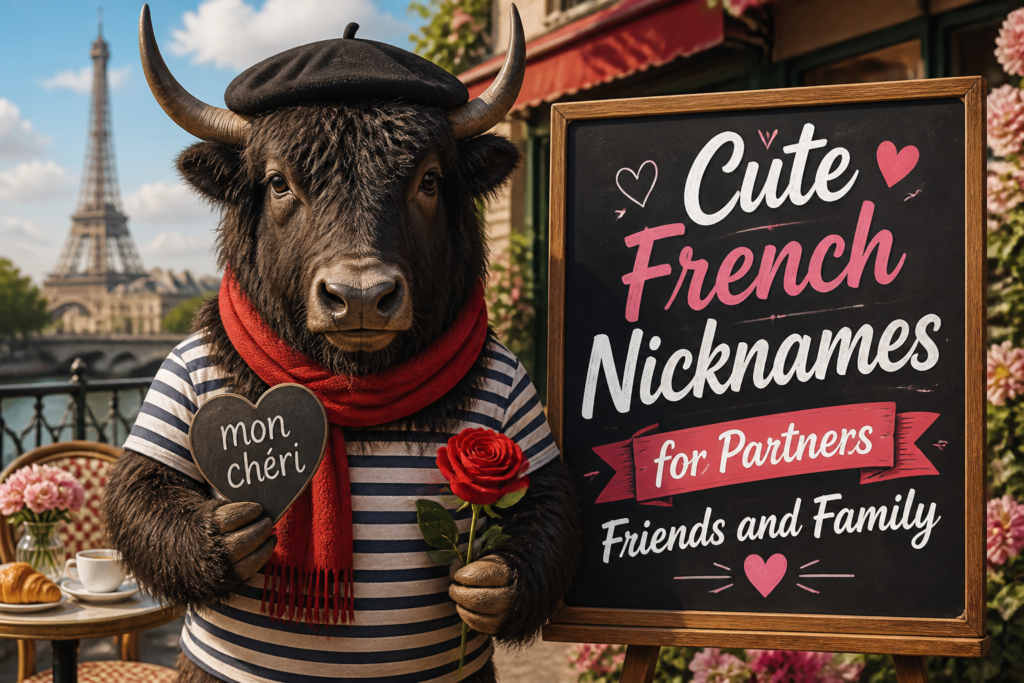
Surnoms mignons pour les gens que tu aimes sounds sweet already, doesn’t it? French is full of affectionate little nicknames people use with partners, kids, close friends, and family. Some are adorable. Some are a bit ridiculous. A few sound like they should belong to a pastry or a farm animal, and yet somehow they still work.
If you have ever heard a French person say mon cœur, ma puce, or mon lapin and wondered why romance suddenly involved insects and rabbits, welcome. You are in exactly the right place.
By the end of this guide, you will know which cute French nicknames sound natural, who you can say them to, and which ones should probably stay far away from your boss unless you enjoy chaos.
For a wider look beyond the cutest options, including terms for partners, family, friends, and pets, the full French terms of endearment article sorts them by relationship and situation.
If you want more French help after this, you can also explore the French learning hub, check your level with the French placement test, or see how much everyday vocabulary you already know with the French vocabulary test.
How French Nicknames Work
French nicknames are often built with possessives like mon and ma, meaning “my.” So you will hear things like mon cœur (“my heart”) and ma chérie (“my darling”).
A very important note: the possessive does not always match the gender of the person. It matches the gender of the noun. So:
- mon cœur is used for a man or a woman, because cœur is masculine
- ma puce is used for a man or a woman, because puce is feminine
- mon amour works for anyone, because amour is masculine in the singular
That little detail saves learners from many weird guesses. French is romantic, yes, but also very committed to grammatical gender doing whatever it wants.
Most Common Cute French Nicknames
Let’s start with the ones you are most likely to hear in real life. These are common, warm, and generally safe for close relationships.
| French | Pronunciation | Meaning | Example Sentence | Translation | Learner Note |
|---|---|---|---|---|---|
| mon amour | moh-na-MOOR | my love | Mon amour, tu rentres à quelle heure ? | My love, what time are you coming home? | Very common for romantic partners. |
| mon cœur | mohn-KUHR | my heart | Mon cœur, n’oublie pas ton manteau. | Sweetheart, don’t forget your coat. | Common and affectionate; works for partners and children too. |
| chéri / chérie | sheh-REE / sheh-REE | dear, darling | Salut, chérie, bien dormi ? | Hi darling, sleep well? | Chéri for a man, chérie for a woman. |
| mon ange | mohn-ahnzh | my angel | Mon ange, tu es adorable aujourd’hui. | My angel, you are adorable today. | Sweet, slightly tender, common with partners or kids. |
| mon bébé | mohn-bay-BAY | my baby | Tu viens, mon bébé ? | Are you coming, baby? | Very affectionate; mostly romantic or for small children. |
| doudou | doo-DOO | sweetie, cuddly one | Bonne nuit, doudou. | Good night, sweetie. | Can be very cute; also means a child’s comfort toy in other contexts. |
Funny But Totally Real French Pet Names
This is where French gets especially entertaining. Some affectionate nicknames sound absurd in direct English translation, but they are perfectly normal in French.
| French | Pronunciation | Meaning | Example Sentence | Translation | Learner Note |
|---|---|---|---|---|---|
| ma puce | mah-pyoos | literally “my flea” | Ma puce, ça va mieux ? | Sweetie, are you feeling better? | Very common and affectionate, especially for children and partners. |
| mon lapin | mohn-la-PAN | my rabbit | Viens ici, mon lapin. | Come here, my bunny. | Cute and playful. |
| mon poussin | mohn-poo-SAN | my chick | Mon poussin, tu veux manger quoi ? | Sweetie, what do you want to eat? | Very common with kids; can also be romantic in a playful way. |
| ma biche | mah-BEESH | my doe | Merci, ma biche. | Thanks, sweetheart. | Old-school but still heard; often feminine. |
| mon chat | mohn-sha | my cat | Ça va, mon chat ? | You okay, sweetie? | Can sound stylish or affectionate depending on tone. |
| mon loulou | mohn-loo-LOO | my little wolf / cutie | Mon loulou, dépêche-toi. | Come on, cutie, hurry up. | Common with kids; also affectionate for adults. |
French nickname logic: if it sounds like a woodland creature, a pastry, or a tiny household emergency, it may still be romantic.
Cute Nicknames For Romantic Partners
If you want names for a boyfriend, girlfriend, spouse, or partner, these are especially useful. Some are tender, some playful, some very classic.
| French | Pronunciation | Meaning | Example Sentence | Translation | Learner Note |
|---|---|---|---|---|---|
| ma moitié | mah-mwah-tee-AY | my other half | Ma moitié arrive ce soir. | My other half is arriving tonight. | Warm and romantic; a bit sentimental. |
| mon trésor | mohn-tray-ZOR | my treasure | Merci pour le café, mon trésor. | Thanks for the coffee, my treasure. | Classic and sweet. |
| mon chou | mohn-shoo | my sweetie | Tu me manques, mon chou. | I miss you, sweetie. | Literally “my cabbage.” Ignore that and keep going. |
| mon chou-chou | mohn-shoo-SHOO | my darling / favorite | Mon chou-chou, tu es prêt ? | Darling, are you ready? | Extra cute, slightly playful. |
| mon canard | mohn-ka-NAR | my duck | Bonjour, mon canard. | Hello, my duck. | Less common than some others, but real and affectionate. |
| ma choupette | mah-shoo-PET | sweetie, cutie | Ça te va bien, ma choupette. | That looks good on you, cutie. | Cute and casual; often feminine. |
Quick Gender Note
- chéri = for a man
- chérie = for a woman
- beau gosse = good-looking guy, very casual
- ma belle = beautiful one, for a woman
- mon beau exists but is much less common as a nickname
Some nicknames change form depending on the person. Others, like mon cœur, stay the same no matter who you are talking to.
Cute Nicknames For Children And Family
French adults constantly use affectionate nicknames with kids. Family speech is full of these soft little expressions.
| French | Pronunciation | Meaning | Example Sentence | Translation | Learner Note |
|---|---|---|---|---|---|
| mon grand / ma grande | mohn-grahn / mah-grahnd | big guy / big girl | Alors, ma grande, ça s’est bien passé à l’école ? | So, big girl, did school go well? | Very common with children; not literally about size. |
| mon petit / ma petite | mohn-puh-TEE / mah-puh-TEET | little one | Viens ici, mon petit. | Come here, little one. | Warm and common in families. |
| loulou | loo-LOO | cutie, kiddo | Loulou, on met les chaussures. | Kiddo, let’s put on your shoes. | Very natural for children. |
| ma princesse | mah-pran-SESS | my princess | Bonne nuit, ma princesse. | Good night, my princess. | Common with daughters; obviously very sweet. |
| mon champion | mohn-shom-pee-ON | my champ | Bravo, mon champion ! | Well done, champ! | Encouraging and playful. |
| mon bonhomme | mohn-bo-nohm | little guy, buddy | Alors, mon bonhomme, on y va ? | So, little guy, shall we go? | Very common with boys, but can sound parental. |
Friendly Nicknames Between Friends
Not every French nickname is romantic. Some are used casually between close friends, especially in relaxed spoken French.
| French | Pronunciation | Meaning | Example Sentence | Translation | Learner Note |
|---|---|---|---|---|---|
| ma belle | mah-BELL | girl, gorgeous, lovely | Ça va, ma belle ? | How are you, gorgeous? | Common between women friends; tone matters. |
| mon vieux / ma vieille | mohn-vyuh / mah-vyay | mate, old friend | Alors, mon vieux, quoi de neuf ? | So, my old friend, what’s new? | Friendly and informal; not actually about age. |
| mon pote | mohn-poht | my buddy | Salut, mon pote ! | Hey, buddy! | Very casual, not romantic. |
| ma poule | mah-pool | sweetie, girlie | Alors, ma poule, raconte. | So, girlie, tell me everything. | Casual and chatty; often feminine and friendly. |
| mon gars | mohn-gar | my guy | Mon gars, t’as oublié tes clés. | My guy, you forgot your keys. | Very casual spoken French. |
| frérot / frangin | fray-RO / fran-ZHAN | bro, brother | Merci, frérot. | Thanks, bro. | Informal slang among friends or brothers. |
Sweet Texting Nicknames In French
In messages, French speakers often shorten or soften nicknames even more. Here are some very common ones you might actually receive in a text.
- Coucou ma chérie — Hey darling
- Bonne nuit mon cœur — Good night my love
- Tu me manques bébé — I miss you, baby
- Merci mon ange — Thanks, my angel
- Salut ma belle — Hi gorgeous
- Bisous mon chou — Kisses, sweetie
Bisous means “kisses” and is a very normal warm sign-off in French messages. It can be romantic, friendly, or family-based depending on context.
Useful Real-Life Sentences
Here are natural mini lines you can actually use. Notice how often the nickname appears at the start or end of the sentence.
| French Example | Translation | Learner Note |
|---|---|---|
| Tu viens, mon cœur ? | Are you coming, sweetheart? | Very natural for partners or children. |
| Merci, ma puce, c’est gentil. | Thanks, sweetie, that’s kind. | Gentil means kind or nice. |
| Bonne nuit, mon amour. | Good night, my love. | Classic and easy. |
| Ça va, ma belle ? | You okay, lovely? | Often between female friends. |
| Mon poussin, mets tes chaussures. | Sweetie, put your shoes on. | Very parent-to-child. |
| Tu me fais rire, mon lapin. | You make me laugh, bunny. | Playful and affectionate. |
| Dépêche-toi, loulou ! | Hurry up, kiddo! | Very spoken and warm. |
| Je pense à toi, chérie. | I’m thinking of you, darling. | Simple romantic line. |
Common Mistakes To Avoid
- Do not translate English pet names word for word. “Honey” does not become a random French word for bee-related sugar panic. Use natural French forms like mon cœur, chéri(e), or mon amour.
- Watch the noun gender. Say ma chérie to a woman, but mon cœur to anyone, because the noun itself is masculine.
- Do not use intimate nicknames with strangers. Calling a cashier ma puce is not charming. It is weird.
- Know the register. Mon pote is friendly and casual. Mon amour is intimate. Frérot is slangy.
- Be careful with irony. Some French people use nicknames jokingly, but if your tone is off, it can sound mocking instead of affectionate.
A Curious Bit: Why So Many Animal Nicknames?
French loves animal-based affection words: lapin, poussin, biche, chat, canard. English does this a bit too with words like “bunny” or “chick,” but French really leans into it.
And yes, mon chou literally comes from “cabbage.” Romance languages sometimes make emotional choices first and logical choices never. That is part of the charm.
Which Nicknames Are Safest For Learners?
If you are not sure where to start, these are your safest high-frequency options:
- mon amour — romantic and clear
- mon cœur — warm and versatile
- chéri / chérie — very common
- ma puce — common but extra cute
- mon petit / ma petite — good in family contexts
- ma belle — useful between close female friends or affectionately to a woman
If you want to keep it simple, start with mon cœur and chéri / chérie. They sound natural, they are common, and they do not require you to explain why you just called someone a cabbage.
Quick Reference Summary
- mon amour = my love
- mon cœur = my heart, sweetheart
- chéri / chérie = darling
- ma puce = sweetie, literally “my flea”
- mon lapin = bunny
- mon poussin = chick, little sweetie
- mon chou = sweetie, literally “my cabbage”
- loulou = cutie, kiddo
- ma belle = gorgeous, lovely
- mon pote = buddy
Practice: Which Nickname Fits Best?
Try matching the situation to a natural nickname:
- Talking to your romantic partner before bed → Bonne nuit, mon amour.
- Talking to your child before school → Allez, mon grand.
- Texting your girlfriend → Coucou ma chérie.
- Greeting a close female friend → Ça va, ma belle ?
- Speaking affectionately to a child → Viens ici, mon poussin.
Want to keep going with this topic? You can revisit this guide anytime here: Cute nicknames in French.
The best French nickname is the one that sounds natural, fits the relationship, and does not accidentally make you sound like a confused vegetable merchant.
Yak Takeaway
French nicknames are affectionate, funny, and gloriously unconcerned with literal logic. Learn a few core ones like mon cœur, chéri(e), mon amour, and ma puce, and you will sound much more natural in warm everyday French. The rest can come later, preferably once you are emotionally ready for cabbage-based romance.