Yak or Yack?
A tiny spelling choice with big consequences.
Learn the difference between yak the animal and yak / yack meaning “talk a lot”—then pick a spelling you can use with confidence.
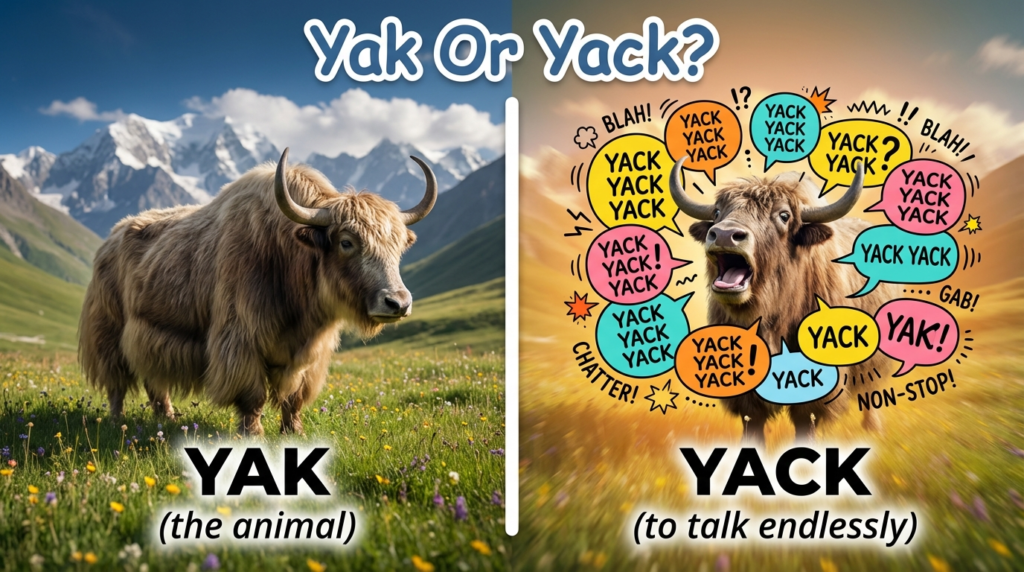
Short answer: If you mean the animal, write yak. If you mean “talk a lot,” yak is the safest default; yack is a casual variant.
Quick rule you can use today.
Three checks. No grammar ceremony required.
01
Animal?
If it has horns, fluff, or a mountain nearby, write yak. Always.
02
Talking a lot?
Yak is still the easiest default. Yack is a real, extra-casual variant.
03
Pick a set.
Once you choose yakking or yacking, match the past tense too.
Yak, yack, and yacker.
Yak
The shaggy mountain animal. “We saw a yak near the trail.”
Yak / yack
Informal slang for talking a lot. “We were just yacking after class.”
Yacker
A talker—someone who yaks. Which is, frankly, an excellent job description.
Which spelling should you choose?
For learners, default to yak. It is clear for the animal and widely understood for the slang verb too.
Verb forms, without the fuss.
Both families appear in real English. The useful thing is to stay consistent.
| What you mean | Common spelling | Example |
|---|---|---|
| Base verb | yak / yack | They yak every morning at the café. |
| -ing form | yakking / yacking | Sorry—were we yakking too long? |
| Past tense | yakked / yacked | We yakked for an hour after class. |
| Person | yacker / yakker | He’s a friendly yacker—you’ll like him. |
Language in action.
Tap, repeat, then steal a sentence for real life.
“We were just yacking.”
Friendly and casual: we were chatting.
“He kept yacking on about it.”
Mildly annoyed: he talked about it too much.
“Can we talk instead of yakking?”
A more serious or polite reset.
“That animal is a yak.”
The animal. Not your coworker. Unless your coworker is very fluffy.
Why we’re called Yak Yacker.
The name started as a teaching joke that stuck. A learner once apologized for speaking “too much.” The answer: today you’re allowed to yak. The point is simple—speak more, shame less, and do not overthink one awkward sentence.
Common mistakes that make things weird.
Calling the animal a “yack”
The animal is always yak.
Using it in formal writing
Choose talk, discuss, or follow up when the tone needs to stay neutral.
Mixing spellings mid-paragraph
Pick yakking → yakked or yacking → yacked and stay with it.
One last takeaway.
If it has hooves, it’s a yak. If it has opinions, it may be yakking. Default to yak when you want clear, confident English.
Mini Quiz
Quick, low-stress yak check. Tap an answer and get instant feedback.
1) “We saw a ___ near the mountain path.”
2) “They were ___ during the whole break.”
3) “We ___ for a while after class.”
Learner default set: yak / yakking / yakked.
FAQ
Is “Yack” Incorrect?
Nope. For the slang meaning “talk a lot,” many sources treat yack as a variant spelling. For learners, yak is the safest default.
Which Spelling Should English Learners Use?
Use yak. It’s clear for the animal and widely recognized for the slang verb meaning. If you choose yack, keep it casual and stay consistent with the forms.
Is It “Yakking” Or “Yacking”?
Both are used. The clean approach: pick one style and match your past tense (yakking → yakked, yacking → yacked).
Does “Yak” Sound Rude?
It can, depending on tone. “Stop yakking” sounds annoyed. If you want friendly, try chat (“We were chatting”).
Can I Use “Yak” In A Work Email?
Usually better not. Use talk, discuss, or follow up. Work English likes neutral words.
What Does “Yacker” Mean?
A yacker is a talker—someone who yaks (talks a lot). It’s informal, and it fits Yak Yacker’s whole “practice speaking” vibe.