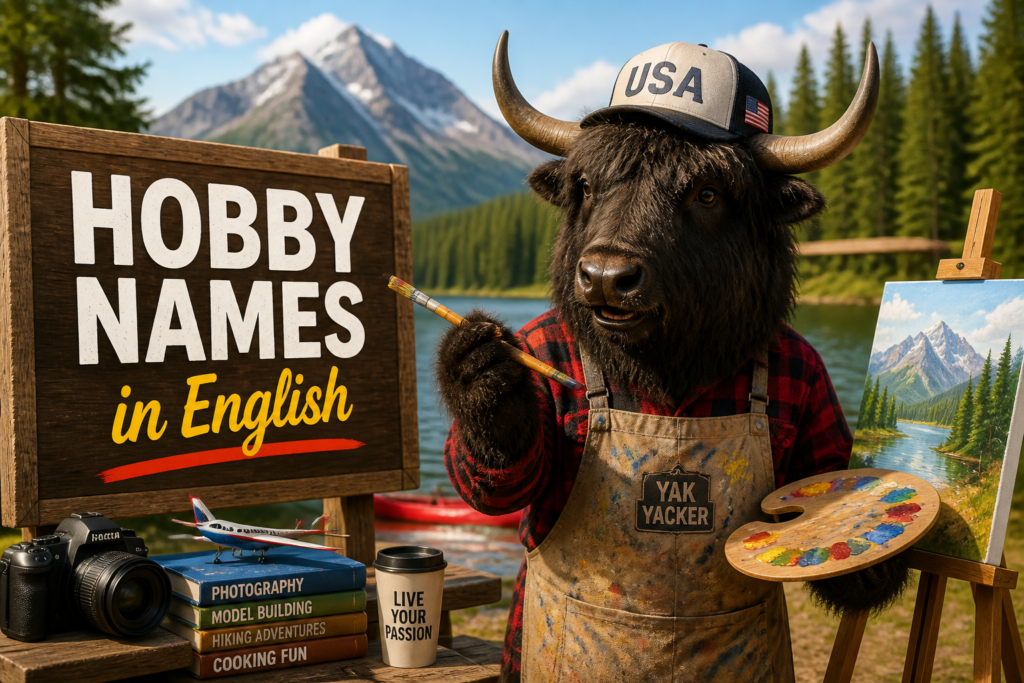
Hobby Names in English, Let’s Get Busy. If you can talk about your hobbies in English, small talk gets easier fast. Suddenly you can answer “What do you like doing?” without freezing like a confused potato.
For the broader learning path, visit our parent guide.
Hobbies are a great topic because they are personal, friendly, and useful in everyday conversation. People ask about them at school, work, travel, language exchanges, dating, and even awkward elevator moments. Yes, those still count as social experiences.
In this guide, you’ll learn common hobby names in English, simple pronunciation help, meanings, example sentences, and a few natural phrases you can actually use. For extra practice, you can also check the English vocabulary test and the English placement test CEFR.
Common Ways To Talk About Hobbies
Before the hobby list, let’s look at the basic phrases people use. These are very common, and they sound natural in conversation.
| English | Pronunciation | Meaning | Example Sentence | Learner Note |
|---|---|---|---|---|
| to have a hobby | HAV-uh HOB-ee | to do an activity for enjoyment | I have a hobby: photography. | Very common and neutral. |
| to do something in your free time | doo SOM-thing in yur free time | to do an activity when you are not working or studying | I like reading in my free time. | Good for beginners. |
| to be into something | bee IN-too | to really like something | She’s into baking and gardening. | Casual and very common. |
| to enjoy doing something | in-JOY DOO-ing | to like an activity | He enjoys playing chess. | Safe for almost any situation. |
| to be interested in | IN-trest-ed in | to want to learn about or do something | I’m interested in learning guitar. | Useful for introductions. |
| to spend time on something | spend time on | to use time doing an activity | She spends a lot of time on crafts. | Good when describing habits. |
| to pick up a hobby | pick up | to start a hobby | I picked up swimming last year. | “Pick up” can mean “start.” |
| to be good at something | bee GOOD at | to have skill in an activity | He’s good at drawing. | Very common structure. |
Hobby Names In English
Here are many common hobby names. Start with the ones you really use in real life. No one needs to memorize “advanced origami mountain folding” to survive a conversation.
| English | Pronunciation | Meaning | Example Sentence | Learner Note |
|---|---|---|---|---|
| reading | REE-ding | looking at and understanding written words | I enjoy reading novels before bed. | Very common and easy to talk about. |
| writing | RY-ting | making words on paper or digitally | She likes writing short stories. | Can mean creative writing or note-taking. |
| drawing | DRAW-ing | making pictures with pencil, pen, or other tools | My son loves drawing animals. | Simple and useful for all ages. |
| painting | PAYN-ting | making art with paint | They spend weekends painting landscapes. | Can also mean house painting, so context matters. |
| photography | fuh-TOG-ruh-fee | taking photographs | Photography is one of my favorite hobbies. | Stress on the third syllable. |
| cooking | KOO-king | making food | Cooking helps me relax after work. | Very common in conversation. |
| baking | BAY-king | making bread, cakes, cookies, and similar food in an oven | She loves baking cookies for her friends. | Baking is more specific than cooking. |
| gardening | GAR-den-ing | growing plants, flowers, or vegetables | My grandfather enjoys gardening every morning. | Common in home and family talk. |
| fishing | FISH-ing | catching fish as a sport or hobby | We went fishing by the lake. | Often used with “go fishing.” |
| hiking | HY-king | walking long distances, usually in nature | Hiking is popular in the mountains. | Use “go hiking.” |
| running | RUN-ing | moving quickly on foot for exercise or sport | She goes running every Saturday. | Usually used with “go running.” |
| walking | WAW-king | moving on foot for exercise, pleasure, or travel | I enjoy walking in the evening. | Simple, everyday hobby. |
| cycling | SY-kling | riding a bicycle as exercise or recreation | He’s into cycling on the weekends. | In the U.S., people also say “biking.” |
| swimming | SWIM-ing | moving through water for exercise or fun | Swimming is great in hot weather. | Use “go swimming.” |
| dancing | DAN-sing | moving to music for fun or performance | She loves dancing with her friends. | Can be social or formal. |
| singing | SING-ing | making musical sounds with your voice | He enjoys singing in a choir. | Great for music lovers. |
| playing music | PLAY-ing MYOO-zik | using an instrument to make music | She spends hours playing music on her guitar. | Common with instruments. |
| playing guitar | PLAY-ing gih-TAR | using a guitar as a hobby | I started playing guitar last year. | Use “play the guitar” or “play guitar.” |
| playing piano | PLAY-ing pee-AN-oh | using a piano as a hobby | My sister is good at playing piano. | More common: “play the piano.” |
| playing chess | play-ing CHESS | playing the strategy board game chess | He likes playing chess online. | Good for brain-game talk. |
| board games | bord gaymz | games played on a board, like Monopoly or Scrabble | We play board games on Friday nights. | Plural form is common. |
| video games | VID-ee-oh gaymz | electronic games played on a console, computer, or phone | Many teenagers enjoy video games. | Very common modern hobby. |
| puzzles | PUZ-uhlz | games or tasks you solve by thinking | My dad likes crossword puzzles. | Includes jigsaw puzzles and word puzzles. |
| crafts | KRAFTS | handmade creative activities | She makes cards and other crafts. | Often used as a plural noun. |
| knitting | NIT-ing | making fabric with yarn and needles | My aunt enjoys knitting scarves. | Common in home hobby talk. |
| sewing | SOH-ing | making or repairing clothes with a needle and thread | She is learning sewing at school. | Useful for fashion and repair talk. |
| traveling | TRAV-uh-ling | going to different places for pleasure or work | Traveling is her favorite hobby. | In British English, “travelling” has two Ls. |
| camping | KAM-ping | staying outdoors in a tent or camper | They go camping every summer. | Often used with “go camping.” |
| collecting | kuh-LEK-ting | gathering items as a hobby | He enjoys collecting stamps. | Always say what you collect. |
| stamp collecting | stamp kuh-LEK-ting | collecting postage stamps | Stamp collecting used to be very popular. | Classic hobby, still around. |
| coin collecting | koyn kuh-LEK-ting | collecting coins | Coin collecting is a relaxing hobby for him. | Often called “numismatics” in formal contexts. |
| birdwatching | BURD-wach-ing | watching and identifying birds | Birdwatching is popular in parks and forests. | Very natural compound word. |
| yoga | YOH-guh | exercise that uses movement, breathing, and focus | Yoga helps her feel calm. | Common wellness hobby. |
| meditation | med-uh-TAY-shun | quiet focus or mindfulness practice | He practices meditation every morning. | Used in wellness and mental health talk. |
| blogging | BLOG-ing | writing posts online | She started blogging about travel. | Very modern and useful online hobby. |
| gaming | GAY-ming | playing video games | Gaming is a huge hobby for many people. | Broad word for video-game culture. |
| watching movies | WACH-ing MOO-veez | seeing films for fun | Watching movies is how I relax. | Very common everyday phrase. |
| watching TV | WACH-ing tee-vee | viewing television programs | She likes watching TV after dinner. | Simple and natural. |
Useful Hobby Phrases For Real Conversations
These phrases help you talk about hobbies in a more natural way. They are simple, but they do a lot of work. Like a good pair of shoes, they quietly make life easier.
| English Phrase | Pronunciation | Meaning | Example Sentence | Learner Note |
|---|---|---|---|---|
| What do you like to do in your free time? | wut doo yoo lyk tuh doo in yur free time | a common question about hobbies | What do you like to do in your free time? | Good question for meeting new people. |
| My hobby is… | my HOB-ee iz | used to name a hobby | My hobby is baking. | Clear and simple. |
| I’m into… | aim IN-too | I really like this activity | I’m into photography and design. | Casual and natural. |
| I spend a lot of time… | spend uh lot uhv time | this activity takes much of your time | I spend a lot of time reading. | Useful for habits. |
| I’ve been doing it for years. | ive bin DOO-ing it fer yeerz | I have done this hobby for a long time | I’ve been doing it for years. | Good with present perfect. |
| I started last year. | eye STAR-tid last yeer | I began this hobby one year ago | I started running last year. | Very common for new hobbies. |
| I do it to relax. | eye doo it tuh ree-LAKS | I do this activity to feel calm | I do it to relax after work. | Great for lifestyle talk. |
| I do it for fun. | eye doo it fer fun | I do it because I enjoy it | I play chess for fun, not for competition. | Very natural. |
| I’m learning how to… | aim LUR-ning how tuh | I am studying this hobby now | I’m learning how to play guitar. | Use with new skills. |
| I’m not very good at it yet. | aim not VER-ee good at it yet | I am still a beginner | I’m not very good at it yet, but I’m improving. | Polite and honest. |
| I’d love to try… | id luv tuh try | I would like to try this hobby | I’d love to try painting. | Friendly and positive. |
| It’s a great way to meet people. | its uh grayt way tuh meet pee-puhl | the hobby helps you make friends | Joining a club is a great way to meet people. | Very useful social phrase. |
Hobbies That Use The Verb “Go”
Some hobbies use go + activity. This is a common English pattern, especially for exercise and outdoor activities.
| Pattern | Meaning | Example | Learner Note |
|---|---|---|---|
| go hiking | walk in nature for fun or exercise | We go hiking on Sundays. | “Go” is very common here. |
| go swimming | swim as a sport or hobby | I want to go swimming this afternoon. | Use the base form after “go.” |
| go fishing | fish as a hobby | My uncle goes fishing every weekend. | Very common phrase. |
| go camping | stay outdoors in a tent | They go camping in the summer. | Natural with outdoor life. |
| go running | run for exercise | She goes running in the morning. | “Go for a run” is also common. |
| go cycling | ride a bicycle for exercise or fun | We go cycling near the river. | In casual American English, “biking” is also common. |
American And British English Differences
Most hobby words are the same in American and British English, but a few spelling and word choices change. Nothing dramatic. English just enjoys making life slightly annoying.
| American English | British English | Example | Note |
|---|---|---|---|
| traveling | travelling | I like traveling/travelling. | British English often uses two Ls. |
| biking | cycling | I go biking every weekend. | “Biking” is more casual in the U.S. |
| soccer | football | He enjoys soccer/football. | This matters if the hobby is watching or playing the sport. |
| french fries | chips | No hobby example here, but useful for food-talk classes. | Not a hobby word, but a classic difference. |
Verb Patterns With Hobby Names
English hobby talk often uses a few patterns again and again. Learn these, and your sentences will sound much more natural.
| Pattern | Meaning | Example | Learner Note |
|---|---|---|---|
| like + verb-ing | enjoy an activity | I like swimming. | Use -ing after “like” for activities. |
| enjoy + verb-ing | find pleasure in an activity | She enjoys cooking. | “Enjoy to cook” is not natural. |
| be interested in + noun / verb-ing | want to know more or do more | I’m interested in photography. | Use “in,” not “on.” |
| be good at + noun / verb-ing | have skill in an activity | He’s good at drawing. | Very common with hobbies. |
| start + verb-ing | begin a hobby | I started gardening last spring. | “Start gardening” is fine. |
| learn to + verb | study a new skill | She’s learning to play the piano. | Use the base verb after “to.” |
Yak wisdom: When talking about hobbies, simple beats fancy. “I like reading” is better than a dramatic speech about your deep emotional bond with paperback fiction.
Common Mistakes And Easy Fixes
| Wrong | Correct | Why |
|---|---|---|
| I enjoy to read. | I enjoy reading. | Use verb-ing after enjoy. |
| I am interested on photography. | I am interested in photography. | Use interested in, not on. |
| I like play chess. | I like playing chess. | Use verb-ing after like when talking about activities. |
| I am good in drawing. | I am good at drawing. | Use good at. |
| I go to swimming. | I go swimming. | Usually no to with these hobby expressions. |
| My hobby are cooking. | My hobby is cooking. | Hobby is singular. |
| I have a lot hobby. | I have a lot of hobbies. | Use of and plural hobbies. |
| I start to paint last year. | I started painting last year. | Past time needs past tense. |
Quick Practice
Try these short exercises. No panic. Just a little language gym for your brain.
- Complete the sentence: I like _____ in my free time. (read / reading)
- Choose the correct phrase: I’m interested in / on gardening.
- Fix the sentence: She enjoy cooking.
- Choose the natural phrase: go swimming / go to swimming
- Complete the sentence: He is good at _____. (draw / drawing)
- Say one hobby you started last year or recently.
- Say one hobby you do to relax.
- Say one hobby you do with friends.
Answers
- reading
- interested in
- She enjoys cooking.
- go swimming
- drawing
Mini Conversation Practice
Here’s a short, natural conversation about hobbies. Notice how simple the English is. Simple is not boring. Simple is useful.
A: What do you like to do in your free time? B: I’m into baking and reading. A: Nice. Do you do either one often? B: Yes, I bake on weekends and read every night. A: Cool. I’m trying to pick up photography. B: That sounds fun. It’s a great hobby.Helpful Extra Words For Hobby Talk
| English | Pronunciation | Meaning | Example Sentence | Learner Note |
|---|---|---|---|---|
| pastime | PAST-tym | something you do for pleasure in your free time | Reading is a popular pastime. | Slightly more formal. |
| interest | IN-trest | something you like and want to know more about | Music is one of my interests. | Useful on forms and profiles. |
| skill | skil | an ability you can learn and improve | Cooking is a useful skill. | Not every hobby is a skill, but many are. |
| activity | ak-TIV-uh-tee | something you do | Yoga is a relaxing activity. | Very general word. |
| club | klub | a group of people who share an interest | I joined a chess club. | Great for social hobbies. |
| class | klas | a lesson or group meeting for learning | She takes a pottery class. | Useful for beginner hobbies. |
Hobbies are one of the easiest ways to build English conversation skills, because they give you something real to say. Start with a few simple phrases, add a few favorite hobbies, and you’re already ahead of the “I just stare at the wall” conversation strategy.
Yak takeaway: Learn the hobby name, learn one useful phrase, and use it in a real sentence. That’s how English stops being a list of words and starts becoming your language.