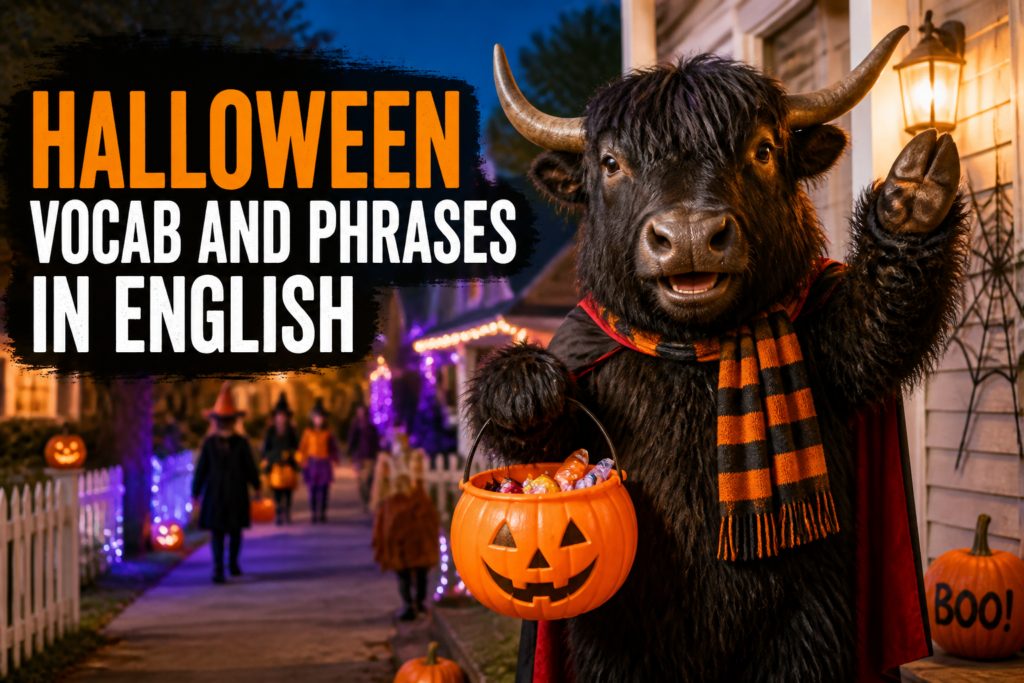
Trick or Treat! Halloween is one of those English-language holidays that shows up with costumes, candy, and a suspiciously large number of pumpkins. If you want to talk about Halloween like a real English speaker, you need the words people actually use in class, at work, in parties, and in neighborhood small talk.
For the broader learning path, visit our parent guide.
Some Halloween words are playful, some are creepy, and some are just useful if you do not want to stare blankly when someone says, “We’re carving a jack-o’-lantern later.” That would be a very Halloween way to discover you need vocabulary.
In this guide, you will learn common Halloween vocabulary, phrases, pronunciation help, and easy example sentences. You will also see a few notes about usage, because English likes to dress up in costumes too.
Halloween Words You Will Hear A Lot
Here are the most common Halloween words and phrases in everyday English. The pronunciation help is simple, so you do not need a phonetics cape and a flashlight.
| English | Pronunciation | Meaning | Example Sentence | Learner Note |
|---|---|---|---|---|
| Halloween | HAL-oh-ween | October 31, a holiday with costumes, candy, and spooky fun | We decorate the house for Halloween every year. | Spelled with two Ls and two Es. |
| costume | KOSS-toom | Special clothes worn for Halloween or a party | My niece wore a witch costume to school. | Common in American English. In British English, people also say fancy dress. |
| Trick or treat | TRIK or TREET | A phrase children say when they ask for candy | The kids shouted, “Trick or treat!” at the door. | Very common in the U.S. and Canada. |
| candy | KAN-dee | Sweet food, especially Halloween sweets | We bought too much candy for the party. | American English. British English often says sweets. |
| pumpkin | PUMP-kin | A large orange vegetable used in Halloween decorations and pies | She bought a pumpkin for the front steps. | Very common with Halloween. |
| jack-o’-lantern | JAK-uh-LAN-tern | A carved pumpkin with a face and a light inside | We made a jack-o’-lantern last night. | Stress is on the first syllable of lantern. |
| ghost | GOHST | The spirit of a dead person; also a common Halloween character | The old house is said to have a ghost. | Used in stories, decorations, and jokes. |
| witch | WICH | A woman with magical powers in stories and costumes | She dressed as a witch for the party. | Common Halloween costume. |
| vampire | VAM-py-er | A fictional creature that drinks blood | He wore a vampire costume with fake teeth. | Pronunciation can be tricky for learners. |
| monster | MON-ster | A scary creature, real or imaginary | The kids made a monster mask at school. | Can be scary, funny, or playful. |
| haunted house | HAWN-tid hows | A place that is believed to have ghosts or scary events | We visited a haunted house at the fair. | Very common Halloween activity. |
Useful Halloween Phrases
These are the phrases people actually say. Not every Halloween conversation sounds like a horror movie trailer, thankfully.
| English | Pronunciation | Meaning | Example Sentence | Learner Note |
|---|---|---|---|---|
| We’re going trick-or-treating. | TRIK-er-TREET-ing | We are going door to door to collect candy | The children are going trick-or-treating after dinner. | Use this for the activity, not just the phrase “trick or treat.” |
| What are you going as? | what are yoo GO-ing as | What costume are you wearing? | What are you going as this year? | Very natural question at Halloween parties. |
| I’m dressed as a vampire. | DREST az | I am wearing a vampire costume | I’m dressed as a vampire for the office party. | “Dressed as” is a common pattern for costumes. |
| Let’s carve a pumpkin. | CARV | Let’s cut a design into a pumpkin | We usually carve a pumpkin on the weekend. | “Carve” means cut into shape, not just slice. |
| Turn out the lights. | TURN out thuh LITES | Switch off the lights | Turn out the lights for the spooky effect. | Useful in haunted house or party settings. |
| That’s spooky. | SPOO-kee | That is scary in a fun or creepy way | That old hallway looks spooky at night. | More playful than truly frightening. |
| It gave me the creeps. | the KREEPS | It made me feel nervous or uncomfortable | The basement gave me the creeps. | Common informal phrase. |
| It’s just a costume. | JUST uh KOSS-toom | No need to worry; it is only a costume | Don’t panic—it’s just a costume. | Good for calming someone down. |
| Happy Halloween! | HAP-ee HAL-oh-ween | A friendly greeting for the holiday | Happy Halloween! Have fun tonight. | Safe, simple, and always useful. |
| Do you have any candy? | DOO yoo HAV EN-ee KAN-dee | Asking if someone has candy to give | Do you have any candy left? | Very natural in Halloween situations. |
| That’s a scary movie. | SKAIR-ee MOO-vee | A film that is frightening | We watched a scary movie on Friday. | “Scary” is the everyday word. |
Extra Halloween Vocabulary
Once you know the basic words, you can start sounding more natural. These words show up in decorations, stories, parties, and school activities.
- spooky — scary in a fun or creepy way
- creepy — causing an uneasy or strange feeling
- frightening — making you feel afraid
- terrifying — extremely frightening
- decorations — objects used to make a place look special for a holiday
- mask — something you wear over your face
- fake blood — pretend blood used in costumes or decorations
- graveyard — a place where dead people are buried; also called a cemetery
- skeleton — the bones inside a body, often used in decorations
- zombie — a fictional walking dead person
- full moon — when the moon looks completely round
- moonlight — light from the moon
Small usage note: creepy is often about a feeling, while frightening and terrifying are stronger and more direct. English loves its little mood differences.
How To Talk About Halloween Fun
Here are natural sentence patterns you can use with Halloween vocabulary. These are handy for speaking, writing, and understanding other people.
| Pattern | Meaning | Example | Learner Note |
|---|---|---|---|
| be dressed as + costume | Wear a costume that represents someone or something | She is dressed as a witch. | Very common and easy to use. |
| decorate with + things | Add Halloween items to make a place look festive | We decorated the classroom with pumpkins and ghosts. | Use with after decorate. |
| go as + character | Choose a costume character | I went as a vampire last year. | Useful in conversation about costumes. |
| be scared of + noun | Feel fear about something | Many children are scared of spiders. | Follow of with the thing. |
| get candy | Receive sweets or candy | The kids got a lot of candy tonight. | Simple and natural in American English. |
| look like + noun | Appear similar to something | Your costume looks like a zombie. | Good for describing costumes. |
| have a party | Host or attend a social event | We’re having a Halloween party on Friday. | Common with holidays. |
American English Vs British English
Halloween is bigger in the United States, so American English has more everyday Halloween talk. British English uses many of the same words, but a few choices are different.
| American English | British English | Note |
|---|---|---|
| candy | sweets | Both mean sugary treats, but candy is American. |
| costume | fancy dress | British English often says fancy dress party. |
| trick-or-treating | trick-or-treating | The phrase exists in both, but it is more common in the U.S. |
| jack-o’-lantern | jack-o’-lantern | Used in both varieties. |
If you want a quick dictionary check for pronunciation and examples, see Cambridge Dictionary. It is boring in the best possible way.
Pronunciation Tips For Tricky Halloween Words
- Halloween = HAL-oh-ween. Stress the first part.
- costume = KOSS-toom. Many learners say “cost-yoom,” but native speakers do not.
- trick-or-treating = TRIK-er-TREET-ing. The middle part is fast and weak.
- jack-o’-lantern = JAK-uh-LAN-tern. It has three main beats.
- vampire = VAM-py-er. Say the first syllable strongly.
- spooky = SPOO-kee. Long oo sound.
A small pronunciation note: in natural speech, people often say trick or treat quickly, almost like one little phrase. That is normal. English likes to run, especially when candy is involved.
Common Mistakes And Easy Fixes
- Wrong: I am dress as a witch.
Correct: I am dressed as a witch.
Why: Use the past participle dressed after am. - Wrong: We go for trick or treat.
Correct: We go trick-or-treating.
Why: Trick-or-treating is the activity. - Wrong: I have many candys.
Correct: I have a lot of candy.
Why: Candy is usually uncountable in American English. - Wrong: She is scary of spiders.
Correct: She is scared of spiders.
Why: Use scared for feelings. - Wrong: The movie was very creeps.
Correct: The movie was very creepy.
Why: Creepy is the adjective.
Mini Practice
Try these quick practice questions. No pressure. Halloween already provides enough drama.
- Fill in the blank: We carved a __________ last night. (pumpkin / costume / candy)
- Choose the correct phrase: “What are you going ______?” (as / to / with)
- Rewrite correctly: She is dress as a vampire.
- Choose the best word: The old house was very __________. (spooky / sweet / polite)
- Translate into English: “I’m going trick-or-treating with my friends.”
Answer key: pumpkin, as, She is dressed as a vampire, spooky, I’m going trick-or-treating with my friends.
Yak Takeaway: If you can say Trick or treat!, What are you going as?, and We’re going trick-or-treating, you already have the core Halloween English you need. The rest is just spooky decoration. If you want more practice, try the English Vocabulary Test or check your level with the English Placement Test CEFR.