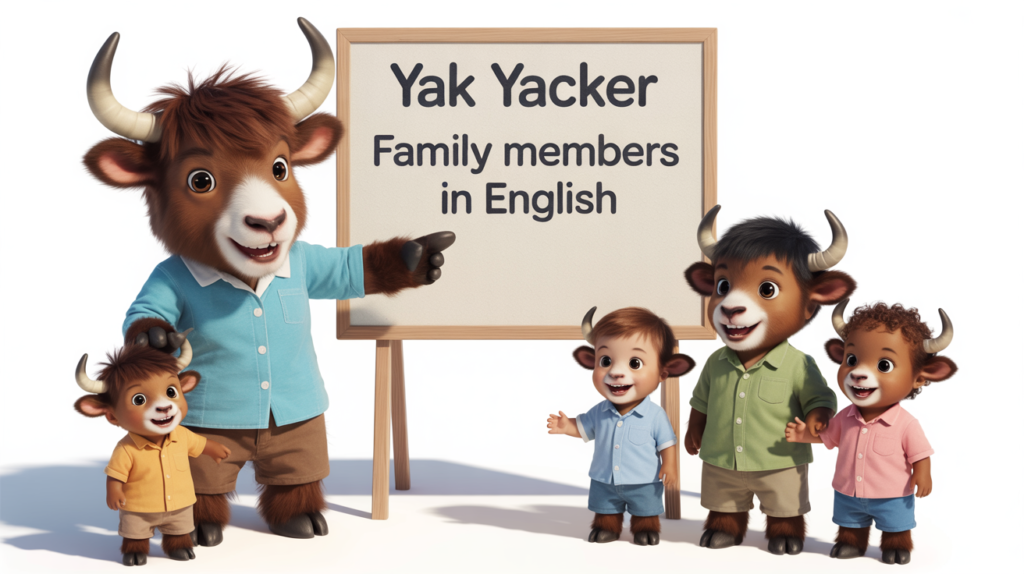
Family members in English
From “mom” to “second cousin once removed” (yes, that’s a real thing).
Talking about family is easy… until you meet someone’s in-laws, step-siblings, and a mysterious “cousin once removed.” Then your brain tries to exit the group chat.
This list gives you the common words, the extended-family chaos, and the modern family phrases you actually hear in real life. Every term has an example sentence so you can steal it confidently.
Quick visuals: the core crew
These are the “you’ll use them constantly” family words. Tap Hear to practice.
mother
Your female parent. Informal: mom (US), mum (UK).
father
Your male parent. Informal: dad.
sister
A female sibling.
brother
A male sibling.
grandmother
Your mother’s mother or your father’s mother. Informal: grandma, nan.
grandfather
Your mother’s father or your father’s father. Informal: grandpa.
aunt
Your parent’s sister (or your uncle’s wife).
uncle
Your parent’s brother (or your aunt’s husband).
The full list: family words and phrases
All the related terms you’ll actually see and hear: immediate family, extended family, marriage, stepfamily, and more.
| Word / phrase | Meaning | Example | Hear |
|---|---|---|---|
| parent mother or father | A mother or a father. | For example: One parent will pick you up after school. | |
| child | A son or a daughter. | For example: They have one child and two dogs. | |
| son | A male child. | For example: Their son just started kindergarten. | |
| daughter | A female child. | For example: Her daughter loves reading. | |
| sibling | Your brother or sister. | For example: I have two siblings. | |
| older brother | A brother who is older than you. | For example: My older brother gave me advice. | |
| younger sister | A sister who is younger than you. | For example: My younger sister is in middle school. | |
| grandparent | Grandmother or grandfather. | For example: My grandparents visit every summer. | |
| grandparents | Both grandmothers/grandfathers as a group. | For example: My grandparents live nearby. | |
| grandchild | A grandparent’s child’s child. | For example: She has three grandchildren. | |
| grandson | A male grandchild. | For example: Her grandson is learning to swim. | |
| granddaughter | A female grandchild. | For example: His granddaughter made him a card. | |
| cousin | Your aunt or uncle’s child. | For example: My cousin is visiting this weekend. | |
| niece | Your sibling’s daughter. | For example: My niece loves cartoons. | |
| nephew | Your sibling’s son. | For example: My nephew is learning English. | |
| relative | A family member (general word). | For example: We are visiting relatives during the holidays. | |
| distant relative | A relative you are not closely related to. | For example: He is a distant relative from my dad’s side. | |
| husband | A married man (partner). | For example: Her husband works downtown. | |
| wife | A married woman (partner). | For example: His wife speaks three languages. | |
| spouse | Your husband or wife (gender-neutral). | For example: Please bring your spouse to the dinner. | |
| partner | A romantic partner (often not specifying marriage). | For example: My partner will join us later. | |
| fiance | A man you are engaged to. | For example: Her fiance proposed last month. | |
| fiancee | A woman you are engaged to. | For example: His fiancee is planning the wedding. | |
| in-laws | Your spouse’s family. | For example: We are having dinner with my in-laws. | |
| mother-in-law | Your spouse’s mother. | For example: My mother-in-law is very kind. | |
| father-in-law | Your spouse’s father. | For example: My father-in-law loves hiking. | |
| sister-in-law | Your spouse’s sister (or your sibling’s wife). | For example: My sister-in-law works in marketing. | |
| brother-in-law | Your spouse’s brother (or your sibling’s husband). | For example: My brother-in-law is visiting tomorrow. | |
| stepmother | Your parent’s new wife (not your biological mother). | For example: My stepmother and I get along well. | |
| stepfather | Your parent’s new husband (not your biological father). | For example: My stepfather taught me how to cook. | |
| stepsister | Your stepparent’s daughter (or parent’s spouse’s daughter). | For example: My stepsister is the same age as me. | |
| stepbrother | Your stepparent’s son (or parent’s spouse’s son). | For example: My stepbrother plays basketball. | |
| stepchild | Your spouse’s child from a previous relationship. | For example: She treats her stepchildren like her own. | |
| half sister | A sister who shares one parent with you. | For example: My half sister and I share the same dad. | |
| half brother | A brother who shares one parent with you. | For example: My half brother lives overseas. | |
| adopted son | A son legally adopted. | For example: They adopted a son two years ago. | |
| adopted daughter | A daughter legally adopted. | For example: Her adopted daughter loves music. | |
| adoptive parents | The parents who adopted a child. | For example: His adoptive parents supported him a lot. | |
| godmother | A person chosen to support a child (often in a religious tradition). | For example: My godmother sends me a birthday message every year. | |
| godfather | The male version of godmother. | For example: My godfather helped me move apartments. | |
| great-grandmother | Your grandparent’s mother. | For example: My great-grandmother lived to 98. | |
| great-grandfather | Your grandparent’s father. | For example: My great-grandfather was a farmer. | |
| only child | A child with no siblings. | For example: She is an only child, so she grew up with lots of adult conversations. | |
| twins | Two children born at the same time. | For example: They have twins, and both are loud. | |
| single parent | A parent raising a child alone. | For example: He is a single parent with two kids. | |
| blended family | A family formed when partners bring children from previous relationships. | For example: They are a blended family, so holidays take planning. | |
| extended family | Family beyond parents and children (aunts, uncles, cousins, etc.). | For example: My extended family is huge. | |
| close-knit family | A family that is very close and supportive. | For example: They are a close-knit family who helps each other. | |
| family tree | A diagram showing family relationships. | For example: We made a family tree for a school project. | |
| next of kin | The closest living relative (often used in hospitals or legal contexts). | For example: Please list your next of kin on the form. | |
| family reunion | A big gathering of relatives. | For example: We have a family reunion every two years. |
Optional variants: what people actually say
Same person, different vibes. These are common across global English.
| More standard | Common variants | Example | Hear |
|---|---|---|---|
| mother | mom (US), mum (UK), mama (many places) | For example: Mum will call you after dinner. | |
| father | dad, daddy (kid talk), pops (casual) | For example: My dad is picking me up. | |
| grandmother | grandma, granny, nan, nana | For example: Grandma makes the best noodles. | |
| grandfather | grandpa, granddad | For example: Grandpa loves gardening. | |
| spouse | husband, wife, partner | For example: I will check with my partner. |