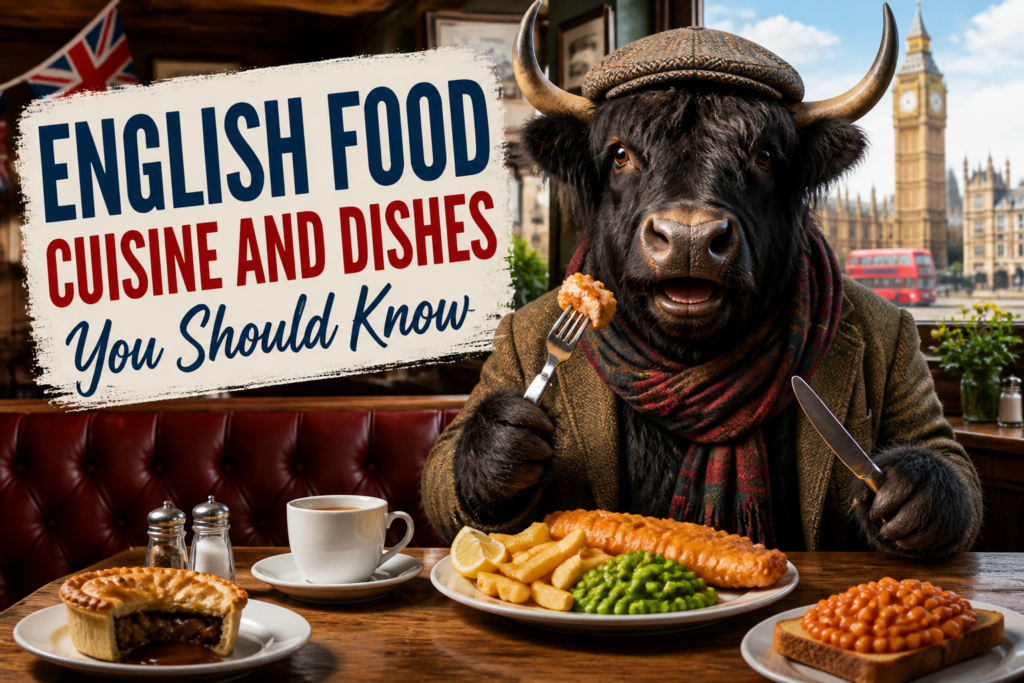
If you hear “English food” and immediately think of tea and toast, well, that is not exactly wrong, but it is definitely not the whole story. English food includes cozy pub meals, hearty breakfasts, roast dinners, pies, puddings, and plenty of everyday dishes people still order, cook, and argue about with surprising passion.
This guide teaches practical food vocabulary for English learners. You will learn common dishes, how to talk about them, how to pronounce them, and how to use them naturally in real life. No fancy food snobbery required. Just the useful stuff.
Also, yes, the British and American meanings of some food words can be a little annoying. English loves a small trap. Very on brand.
Quick Meaning: What Counts As English Food?
English food usually means food from England, especially traditional dishes like roast beef, fish and chips, shepherd’s pie, and Yorkshire pudding. In everyday conversation, people may also use it to mean food commonly eaten in England, including pub classics and breakfast dishes.
For a general background on English cuisine, you can also look at Wikipedia’s overview of English cuisine. For pronunciation help with food words, the boring-but-useful Cambridge Dictionary is a solid friend.
Essential English Food Vocabulary
Here are the most useful English dishes and food words to know first. These are the kinds of words you will see on menus, in pub conversations, and in everyday chat about dinner.
| English | Pronunciation | Meaning | Example Sentence | Learner Note |
|---|---|---|---|---|
| fish and chips | fish and chips | Fried fish with fried potato strips | I had fish and chips at the pub. | Very common in England; a classic takeaway dish. |
| roast dinner | rohst DIN-er | A meal with roasted meat, potatoes, vegetables, and gravy | We usually have a roast dinner on Sundays. | Also called a Sunday roast. |
| Yorkshire pudding | YORK-sher PUD-ing | A baked batter side dish served with roast dinner | Yorkshire pudding goes well with gravy. | Not a sweet pudding. That confuses many learners. |
| shepherd’s pie | SHEP-erdz pie | Meat pie topped with mashed potatoes, usually made with lamb | Shepherd’s pie is warm and filling. | If it is made with beef, it is often called cottage pie. |
| pie | pie | Savory food with filling and pastry crust | I ordered a steak pie for lunch. | Savory pies are very common in British English. |
| sausage roll | SAW-sij rohl | Sausage meat wrapped in pastry | She bought a sausage roll from the bakery. | Popular as a snack or lunch item. |
| bangers and mash | BANG-ers and mash | Sausages with mashed potatoes | He ordered bangers and mash at the pub. | Casual, traditional, and very British. |
| full English breakfast | fool ING-glish BREAK-fust | A large cooked breakfast with eggs, bacon, sausages, beans, and more | I only want a full English breakfast on weekends. | Heavy but popular. Not exactly a tiny snack. |
| beans on toast | beenz on tohst | Baked beans served on toast | Beans on toast is an easy dinner. | Simple comfort food; common in the UK. |
| Sunday roast | SUN-day rohst | Traditional Sunday meal with roast meat and sides | My family gathers for Sunday roast. | Very cultural; often linked with family meals. |
| gravy | GRAY-vee | Sauce made from meat juices or stock | Can I have extra gravy, please? | Essential with roast dinners and pies. |
| mash | mash | Mashed potatoes | The chicken came with mash and peas. | Short for mashed potatoes in British English. |
More Common English Dishes And Foods
| English | Pronunciation | Meaning | Example Sentence | Learner Note |
|---|---|---|---|---|
| toad in the hole | tohd in thuh hohl | Sausages baked in batter | Toad in the hole is a classic comfort meal. | Funny name, no toads involved. Thankfully. |
| cornish pasty | KOR-nish PASS-tee | Handheld pastry filled with meat and vegetables | We bought a Cornish pasty at the train station. | Good for travel and easy lunch vocabulary. |
| steak and kidney pie | stayk and KID-nee pie | Savory pie with steak and kidney filling | He always orders steak and kidney pie in winter. | Traditional pub food; not for everyone’s taste. |
| ploughman’s lunch | PLOW-munz lunj | Cold lunch with cheese, bread, pickles, and salad | We had a ploughman’s lunch in the countryside. | Common in pubs; spelling looks strange because English enjoys chaos. |
| crumpet | KRUM-pit | Small round bread cake, usually toasted with butter | I like crumpets with butter and jam. | Very British breakfast or tea-time food. |
| scone | skon / skohn | Small baked cake or bread, often with jam and cream | She ordered a scone with tea. | Pronunciation varies by region; both are heard. |
| jam | jam | Sweet fruit spread | I put jam on my scone. | In British English, “jam” is very common with tea-time food. |
| custard | KUSS-terd | Sweet creamy sauce or dessert base | Apple pie with custard is popular. | Can be dessert sauce or a dessert itself. |
| trifle | TRY-fuhl | Layered dessert with sponge, fruit, custard, and cream | My aunt made a big trifle for Christmas. | Traditional dessert, often for holidays. |
| sticky toffee pudding | STIK-ee TOH-fee PUD-ing | Rich dessert with toffee sauce | Sticky toffee pudding is very popular in pubs. | Despite the name, it is usually a dessert, not a pudding cup. |
| tea | tee | Hot drink made from tea leaves; also a meal in British English | Would you like a cup of tea? | In the UK, “tea” can also mean the evening meal in some regions. |
| chips | chips | Thick fried potatoes | Fish and chips comes with salt and vinegar. | In British English, chips are American fries. Different word, same potato drama. |
Useful Phrases For Ordering And Talking About English Food
These phrases will help you at a restaurant, pub, café, or market. They are practical, natural, and not weirdly formal like a robot in a suit.
| English | Pronunciation | Meaning | Example Sentence | Learner Note |
|---|---|---|---|---|
| What do you recommend? | what doo yoo reh-kuh-MEND | Asking for advice on what to order | What do you recommend if I want a classic British dish? | Polite and very useful in restaurants. |
| I’ll have the… | айл hav thuh | Ordering food politely | I’ll have the fish and chips, please. | Very common in American and British English. |
| Can I get the bill? | kan eye get thuh bil | Asking for the check/bill | Can I get the bill, please? | In the US, people often say “check.” In the UK, “bill” is standard. |
| Do you serve vegetarian options? | doo yoo سرو… | Asking whether vegetarian food is available | Do you serve vegetarian options? | Use at cafés and pubs. |
| Could we have extra gravy? | kood wee hav EK-struh GRAY-vee | Polite request for more gravy | Could we have extra gravy, please? | “Could we have…” sounds polite and natural. |
| It’s quite filling. | its kwyte FILL-ing | It makes you feel full | This pie is quite filling. | Useful for describing heavy meals. |
| It tastes homemade. | it taysts HOHM-mayd | It tastes like home cooking | The soup tastes homemade. | Positive, warm, and common in food reviews. |
| It goes well with… | it gohz wel with | It matches nicely with another food | Gravy goes well with roast potatoes. | Great collocation for food talk. |
| Would you like a try? | wood yoo like uh try | Offering someone a taste | Would you like a try of my pudding? | More natural in some settings than “Would you like to taste?” |
| It’s not really my thing. | its not ree-lee my thing | I do not especially like it | Black pudding is not really my thing. | Polite way to say you do not like something. |
| That was delicious. | that wuz dih-LISH-us | The food was very good | That was delicious. Thank you. | Simple and always appropriate. |
| Do you have anything lighter? | doo yoo hav EN-ee-thing LYE-ter | Asking for less heavy food | Do you have anything lighter than the roast? | Useful if the menu feels a little too enthusiastic. |
Food Words That Confuse Learners
Some English food words look easy but behave in sneaky ways. A few quick notes can save you from awkward menu moments.
- Pudding in British English can mean a dessert in general, not only a creamy sweet cup.
- Chips in British English are thick fried potatoes. In American English, chips are thin snack chips.
- Biscuits in British English are what Americans call cookies. A British biscuit is usually sweet and dry, not a fluffy bread roll.
- Tea in the UK can mean the drink, but it can also mean a meal, especially in some regions and family settings.
- Pie in British English often means a savory dish, not just a sweet dessert pie.
- Scone may be pronounced skon or skohn. Both are common, so do not panic. English pronunciation is already doing enough damage elsewhere.
British English Vs American English Food Words
| British English | American English | Example | Note |
|---|---|---|---|
| chips | fries | Fish and chips / Fish and fries | “Fish and chips” is the normal British phrase. |
| crisps | chips | I bought a bag of crisps / chips | Different snack words, same crunchy trouble. |
| biscuits | cookies | Would you like a biscuit? / cookie? | British biscuits are usually sweet baked snacks. |
| courgette | zucchini | Courgette soup / zucchini soup | Common in grocery and recipe vocabulary. |
| aubergine | eggplant | Aubergine curry / eggplant curry | More common in British English and menus influenced by it. |
| pudding | dessert | What’s for pudding? / dessert? | British usage is broader and more casual. |
| takeaway | takeout | We ordered takeaway / takeout | Useful for talking about food you carry home. |
Common Meal And Menu Vocabulary
These words are useful when reading menus or talking about meals in English. They are not limited to England, but they come up all the time with English food.
| English | Pronunciation | Meaning | Example Sentence | Learner Note |
|---|---|---|---|---|
| starter | STAR-ter | First course of a meal | For my starter, I had soup. | British English; American English often says “appetizer.” |
| main course | mayn kawrs | The main part of the meal | The roast chicken was my main course. | Also called “main” in British English. |
| dessert | dih-ZURT | Sweet course after the main meal | Would you like dessert? | Universal and very useful. |
| side dish | side dish | Smaller food served with the main dish | Do you want vegetables as a side dish? | Helpful on menus and in recipes. |
| takeaway | TAYK-away | Food bought to eat elsewhere | We got takeaway after work. | British English; in the US, “takeout” is more common. |
| pub | puhb | Bar/restaurant serving drinks and food | We had lunch at a pub. | A very British place for food vocabulary. |
| bakery | BAYK-ree | A shop that sells bread, cakes, and pastries | I stopped at the bakery for a sausage roll. | Very useful for everyday shopping. |
| greasy spoon | GREE-see spoon | Informal café serving simple fried food | We ate breakfast at a greasy spoon. | Casual, a little slangy, often humorous. |
How To Talk About Taste And Texture
When you describe English food, you do not always need fancy adjectives. Simple words often sound the most natural.
| Word | Pronunciation | Meaning | Example | Learner Note |
|---|---|---|---|---|
| salty | SAWL-tee | Has a lot of salt | The chips were a bit salty. | Common for fried food and snacks. |
| savory | SAY-vuh-ree | Not sweet; salty or meaty | English pies are often savory. | Very useful for traditional British dishes. |
| crispy | KRIS-pee | Crunchy and firm on the outside | The roast potatoes were crispy. | Great for fried or baked foods. |
| soft | soft | Not hard | The bread was soft and warm. | Simple but useful in food descriptions. |
| rich | rich | Heavy, full, and strong in flavor | The pudding was rich and sweet. | Often used for desserts and sauces. |
| hearty | HAR-tee | Big, filling, and satisfying | Roast dinners are hearty meals. | Very common for comfort food. |
Mini Grammar Note: Countable And Uncountable Food Words
Food vocabulary often uses both countable and uncountable nouns. This matters when you order, describe, or ask for more food.
| Pattern | Meaning | Example | Learner Note |
|---|---|---|---|
| a pie | One complete pie | I bought a pie for dinner. | Pie can be countable when it means one whole item. |
| some gravy | An amount of gravy | Can I have some gravy? | Gravy is usually uncountable. |
| a potato / potatoes | One or more potatoes | The roast came with potatoes. | Countable noun. |
| some rice | An amount of rice | There was some rice on the side. | Rice is usually uncountable. |
| an egg / eggs | One or more eggs | He had eggs and toast for breakfast. | Countable noun. |
| some toast | Pieces of toasted bread | I only want some toast. | Toast is usually uncountable as food. |
Common Mistakes And Easy Fixes
English food words can be a little tricky because they do not always match American usage. Here are the mistakes learners make most often.
- Mistake: “I want chips” when you mean American-style potato chips in the UK.
- Fix: In British English, say crisps for snack chips.
- Mistake: “I ate a pudding” when you mean dessert in a general way.
- Fix: In British English, pudding can mean dessert, but not always a single type of dessert.
- Mistake: “Can I have the check?” in a British restaurant.
- Fix: Say bill in the UK.
- Mistake: “I like spicy taste”
- Fix: Say I like spicy food or I like the spicy flavor.
- Mistake: “I had many gravy”
- Fix: Say I had a lot of gravy or some gravy.
- Mistake: “English food is only fish and chips.”
- Fix: English food includes many dishes, especially roast meals, pies, breakfasts, and desserts.
Practice: Make These Sentences Natural
Try changing the sentences below into more natural English. Simple practice, no drama.
- “I want the food with meat and potatoes.” → I’ll have the roast dinner.
- “Give me more sauce, please.” → Could I have more gravy, please?
- “I ate a dessert after dinner.” → I had pudding after dinner. / I had dessert after dinner.
- “The restaurant sells potato fries.” → The restaurant serves chips. (British English)
- “This meal makes me full.” → This meal is quite filling.
- “I do not like this food very much.” → It is not really my thing.
Quick Food Conversation Examples
These short dialogues show how English food words sound in real life.
A: What do you recommend?
B: The fish and chips are really good.
A: Great, I’ll have that.
A: Is the roast dinner served with gravy?
B: Yes, and you can ask for extra gravy too.
A: Perfect. That’s exactly what I want.
A: Would you like a scone with your tea?
B: Yes, please. Do you have jam and cream?
A: Of course.
Useful Links For More English Practice
If you want to keep learning, try a quick check of your vocabulary and level here: English Vocabulary Test and English Placement Test CEFR. For broader English lessons, visit the Learn English page.
Yak Takeaway
English food vocabulary is not just about meals; it is about culture, comfort, and the small words people actually use every day. Learn the classics like fish and chips, roast dinner, gravy, and pudding, and you will understand much more of real English conversation. Tiny menu words, surprisingly useful power. Fancy that.