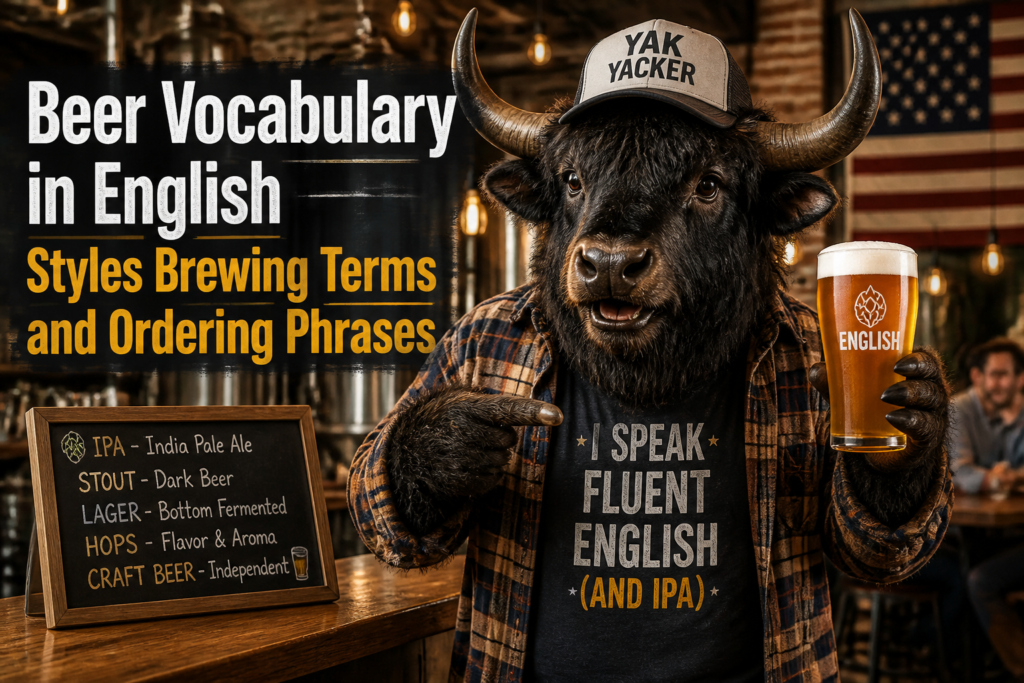
Beer language can feel a little like a secret club. One minute you hear lager, then IPA, then someone is arguing about draft versus draught like it matters to the fate of civilization. It does matter a little, honestly. At least if you want to order a beer without sounding like you fell off a barstool and into the dictionary.
This guide teaches practical beer vocabulary in English for styles, brewing, ordering, and describing taste. You will learn the words people actually use in bars, restaurants, breweries, and casual conversations.
If you want a broader English learning path too, the main hub is Learn English. And if you want to test your level after this lesson, try the English Vocabulary Test or the English Placement Test CEFR.
Beer Styles: The Most Useful Words
First, a tiny truth bomb: not all beer is the same. That sounds obvious, but many learners only know beer and maybe light beer. In real life, people talk about styles, flavor, alcohol strength, and how the beer was served.
| English | Pronunciation | Meaning | Example Sentence | Learner Note |
|---|---|---|---|---|
| beer | beer | An alcoholic drink made from grain, water, hops, and yeast. | I’d like a beer, please. | General word. Very common. |
| lager | LAH-ger | A beer style that is usually crisp, clean, and cold. | This bar has a good lager on tap. | Common in the U.S. and U.K. |
| ale | ayl | A beer style that is often fuller in flavor than lager. | They brew a dark ale here. | Common in beer menus and breweries. |
| IPA / India pale ale | eye-pee-ay | A hoppy beer style, often bitter and aromatic. | I like IPAs, but not the super bitter ones. | Very common in craft beer talk. |
| stout | stowt | A dark beer, often with roasted flavors. | He ordered a stout after dinner. | Think dark, rich, and sometimes coffee-like. |
| porter | POR-ter | A dark beer similar to stout, usually a bit lighter. | She tried a chocolate porter. | Often appears on craft beer menus. |
| wheat beer | weet beer | Beer made with a high amount of wheat. | A wheat beer is nice in summer. | Often cloudy and refreshing. |
| pilsner | PILZ-ner | A pale, crisp lager style. | She ordered a pilsner with lunch. | Often shortened to pils. |
For a boring but reliable definition of beer and related brewing language, Cambridge Dictionary is a good reference. Boring sources are useful. They rarely lie, and they never try to be “crafty.”
Useful Beer Words You’ll Hear In Real Life
| English | Pronunciation | Meaning | Example Sentence | Learner Note |
|---|---|---|---|---|
| draft beer | draft beer | Beer served from a tap, not a bottle or can. | The draft beer is cheaper during happy hour. | American English spelling. In British English, you may see draught beer. |
| bottle | BOT-l | Beer served in a glass bottle. | Do you want a bottle or a draft? | Very common ordering word. |
| can | kan | Beer served in a metal can. | This IPA comes in a can. | Casual, normal word. |
| tap | tap | The thing beer comes out of in a bar. | What’s on tap today? | Common question in bars and breweries. |
| brewery | BROO-uh-ree | A place where beer is made. | We visited a local brewery last weekend. | Very common travel and food word. |
| microbrewery | MY-kroh-BROO-uh-ree | A small brewery. | The town has a popular microbrewery. | Used for small craft producers. |
| craft beer | kraft beer | Beer made by a small or independent brewery, often with unique flavors. | He loves trying new craft beers. | Very common modern phrase. |
| session beer | SEH-shun beer | A beer with lower alcohol, easy to drink for a longer time. | This is a good session beer for a long meal. | Useful in beer reviews and menus. |
| light beer | layt beer | A beer with fewer calories, alcohol, or a lighter taste. | She usually drinks light beer. | Common in the U.S. |
| non-alcoholic beer | non al-kuh-HOL-ik beer | Beer with little or no alcohol. | I’ll have a non-alcoholic beer, thanks. | Useful if you are not drinking alcohol. |
Ordering Beer: Phrases You Can Actually Use
Bars are not the place for complicated essays. Short, clear phrases work best. Good news: ordering beer in English is usually easy. Bad news: the menu may try to humble you with weird names.
| English | Pronunciation | Meaning | Example Sentence | Learner Note |
|---|---|---|---|---|
| Could I get a beer? | kood eye get uh beer | A polite way to ask for beer. | Could I get a beer, please? | Neutral and natural. |
| I’ll have a lager. | eye’ll hav uh LAH-ger | A simple ordering phrase. | I’ll have a lager, thanks. | Very common in restaurants and bars. |
| What do you have on tap? | what doo yoo hav on tap | Asks what draft beers are available. | What do you have on tap tonight? | Great question at a bar or brewery. |
| Do you have any local beer? | doo yoo hav enee LOH-kul beer | Asks for beer made nearby. | Do you have any local beer? | Friendly and common. |
| What’s the strongest beer? | whats thuh STRONG-est beer | Asks which beer has the highest alcohol content. | What’s the strongest beer here? | Useful if you want to avoid surprises. |
| Can I try a sample? | kan eye try uh SAM-pul | Asks for a small taste before choosing. | Can I try a sample of the IPA? | Common at breweries. |
| One more, please. | wun mor pleez | Asks for another beer. | One more, please. Same one. | Very natural and casual. |
| Same again. | saym uh-GEN | Means “the same drink again.” | I’ll take the same again. | Very common in bars. |
| On draft, please. | on draft pleez | Asks for beer from the tap. | Can I get that one on draft, please? | Useful if the beer comes in bottle and draft. |
| In a pint, please. | in uh pynt pleez | Asks for a pint glass size. | I’ll have that one in a pint, please. | More common in the U.K., but understood widely. |
| To go | tuh goh | For takeaway service. | Can I get this beer to go? | More common with cans/bottles; rules vary by place. |
How To Describe Beer Taste
Beer fans love taste words. If you know a few, you can sound more natural at a bar, brewery, or dinner table. You do not need to become a professional beer critic. Relax. Nobody is handing out awards for “most dramatic beer adjectives.”
| English | Pronunciation | Meaning | Example Sentence | Learner Note |
|---|---|---|---|---|
| bitter | BIT-er | Sharp, strong taste, common in hoppy beer. | This IPA is very bitter. | Often used for IPAs and pale ales. |
| hoppy | HOP-ee | Tasting or smelling like hops. | I like hoppy beers. | Very common craft beer word. |
| malty | MAWL-tee | Tasting like malt, often sweet or toasted. | This beer tastes malty and smooth. | Useful contrast with hoppy. |
| crisp | krisp | Clean, fresh, and refreshing. | The lager is crisp and cold. | Very common for light lagers and pilsners. |
| smooth | smoodh | Easy to drink, not harsh. | This stout is surprisingly smooth. | Good general word. |
| creamy | KREE-mee | Soft, rich, and smooth like cream. | The head is creamy and thick. | Often used for stout and porter. |
| fruity | FROO-tee | Tasting or smelling like fruit. | This beer has a fruity aroma. | Often used in tasting notes. |
| dry | dry | Not sweet; finishes with little sweetness. | The beer finishes dry. | Common in beer reviews. |
| sweet | sweett | Having sugar-like flavor. | This beer is a little sweet for me. | Use carefully; many beers are not very sweet. |
| refreshing | rih-FRESH-ing | Feels pleasant and cooling. | A cold beer is refreshing on a hot day. | One of the most common beer compliments. |
| aroma | uh-ROH-muh | Smell of the beer. | The aroma is full of citrus and pine. | More formal than “smell.” |
| aftertaste | AF-ter-tayst | Taste that remains after you swallow. | The aftertaste is bitter but pleasant. | Useful in tasting descriptions. |
Brewing Terms You’ll See On Labels And Menus
Some beer words are not about drinking at all. They describe how the beer is made. This is where menus start acting like science class, but the useful words are still manageable.
| English | Pronunciation | Meaning | Example Sentence | Learner Note |
|---|---|---|---|---|
| brew | broo | To make beer; also, the beer itself. | They brew beer in small batches. | Very common verb and noun. |
| brewery | BROO-uh-ree | A place where beer is made. | The brewery offers tours. | Useful for travel and tourism. |
| batch | batch | A group of beer made at one time. | This batch tastes different from the last one. | Common in craft beer talk. |
| ferment | fur-MENT | To change sugar into alcohol using yeast. | The beer ferments for several days. | Basic brewing process word. |
| yeast | yeest | A living ingredient that helps make alcohol and carbonation. | Yeast is essential in brewing. | Very important brewing noun. |
| malt | mawlt | Germinated grain used in brewing. | The beer has a strong malt flavor. | Common in flavor descriptions. |
| hops | hops | A plant used to add bitterness, aroma, and flavor. | This beer uses American hops. | Usually plural. |
| carbonation | kar-buh-NAY-shun | The bubbles in beer. | This beer has high carbonation. | Useful when describing texture. |
| ABV | ay-bee-vee | Alcohol by volume; the alcohol percentage. | This beer has an ABV of 6.5%. | Very common on labels and menus. |
| filter | FIL-ter | To remove particles from beer; also the process itself. | Some beers are filtered, others are not. | Often used in brewing descriptions. |
| unfiltered | un-FIL-terd | Not filtered; may look cloudy. | I tried an unfiltered wheat beer. | Common in craft beer marketing. |
How Beer Is Served
A few serving words are surprisingly useful. They help you order exactly what you want, without pointing at the menu like a stressed tourist in a food court.
| English | Pronunciation | Meaning | Example Sentence | Learner Note |
|---|---|---|---|---|
| pint | pynt | A large beer glass; also a measure in some countries. | I’ll have a pint of lager. | Very common in the U.K. and also used in the U.S. |
| glass | glahs | The container you drink from. | Do you want it in a glass or a bottle? | General, safe word. |
| mug | muhg | A thick cup or beer mug. | He ordered his beer in a mug. | Less common than glass or pint. |
| head | hed | The foam on top of beer. | This beer has a nice head. | Very common beer word. Context matters. |
| foam | fohm | The bubbly layer on top of beer. | The foam went down quickly. | Easy beginner word. |
| pour | por | To serve liquid by pouring it into a glass. | He poured the beer carefully. | Useful verb in bars and restaurants. |
| serve | surb | To give food or drink to a customer. | This beer is served cold. | Common passive structure. |
| cold | kohld | Low temperature. | Beer is usually served cold. | Simple but essential. |
Real-Life Beer Phrases By Situation
Here are practical phrases for bars, breweries, parties, and casual talk. Use them as ready-made chunks. English speakers love chunks. It saves everyone from improvising badly.
- What do you recommend? — Ask for a good choice.
- Do you have anything light? — Ask for a beer that is not too strong or heavy.
- Something not too bitter, please. — Useful if you do not like strong hops.
- What’s popular here? — Great at a new bar or brewery.
- I’m not sure what to get. — Honest and natural.
- Can I see the beer list? — Ask for the menu.
- Do you have any seasonal beers? — Ask about special beers for the time of year.
- Is this beer local? — Good at restaurants and breweries.
- That’s smooth. — Simple comment about taste.
- It’s a little too hoppy for me. — Polite way to say you don’t like strong bitterness.
- I like darker beers. — Easy way to show preference.
- I’m looking for something refreshing. — Good warm-weather phrase.
Learner note: In a bar, being simple is better than trying to sound fancy. “I like darker beers” works much better than a dramatic speech about roasted notes and emotional bitterness.
Common Beer Adjectives And What They Mean
| English | Pronunciation | Meaning | Example Sentence | Learner Note |
|---|---|---|---|---|
| light | lyt | Not heavy in taste or body. | This is a light, easy beer. | Often means mild flavor, not only low calories. |
| strong | strong | High in alcohol or intense in flavor. | This beer is strong. | Very common and useful. |
| rich | rich | Full and deep in flavor. | The stout is rich and dark. | Often used for darker beers. |
| dense | dens | Heavy, thick, full-bodied. | This beer feels dense and complex. | More advanced, but common in reviews. |
| balanced | BAL-uhnstd | No one flavor is too strong; flavors work well together. | It’s a balanced beer with mild bitterness. | Very common in tasting notes. |
| smooth | smoodh | Easy to drink; not rough. | The beer is smooth from the first sip. | Positive, general praise. |
| refreshing | rih-FRESH-ing | Cooling and pleasant. | This pilsner is refreshing after work. | Very natural everyday word. |
American Vs British Beer Words
Most beer vocabulary is shared, but a few words change by region. It is a small difference, but small differences are exactly how English likes to waste your time.
| American English | British English | Meaning | Example Sentence | Learner Note |
|---|---|---|---|---|
| draft beer | draught beer | Beer served from a tap. | Do you have the beer on draft? | Same meaning, different spelling. |
| bar | pub | A place to drink beer. | Let’s meet at the pub. | “Pub” is especially common in the U.K. |
| french fries | chips | Common food with beer. | Beer and chips go together nicely. | Food pairing word, not beer itself. |
| growler | growler | A large container for takeaway draft beer. | They filled a growler at the brewery. | Common in the U.S.; less common in the U.K. |
Mini Grammar Note: Countable And Uncountable Beer Words
Some beer words are countable, and some are usually uncountable. This matters when you order or describe them.
| Pattern | Meaning | Example | Learner Note |
|---|---|---|---|
| a beer | One serving of beer | I’ll have a beer. | Very common and natural. |
| some beer | An unspecified amount | There’s some beer in the fridge. | Use when the amount is not important. |
| beers | More than one serving or type | We tried three local beers. | Use for different beers or multiple drinks. |
| beer as a general drink | The drink in general | Beer is popular worldwide. | No article needed when speaking generally. |
Helpful rule: Use a beer for one drink, beer for the drink in general, and beers for several different beers or servings.
Quick Practice
Try these. Short and useful, like beer should be.
- Choose the best word: lager, stout, or IPA.
“This beer is dark and roasted.” → stout - Choose the best word: draft or bottle.
“Beer served from a tap” → draft - Choose the best word: bitter or sweet.
“A strong hoppy taste” → bitter - Choose the best phrase: What do you have on tap? or How are you today?
At a bar, the best choice is What do you have on tap? - Fill in the blank: “I’ll have ___ beer, please.”
Possible answer: a - Fill in the blank: “This lager is very ___.”
Possible answer: crisp - Fix the sentence: “I want beer on tap, please.”
Better: I’d like a beer on tap, please. - Fix the sentence: “Give me one beer.”
More polite: Could I get one beer, please?
Pronunciation practice: Say these words out loud: lager, pint, bitter, brewery, carbonation. The goal is not perfection. The goal is not accidentally ordering “a bitter paint.”
Common Mistakes And Fixes
- Wrong: “I want a draft beer.”
Better: “I’d like a draft beer, please.”
Why: “I’d like” sounds more polite and natural. - Wrong: “I like very bitter beer.”
Better: “I like very bitter beer.” or “I like very bitter beers.”
Why: If you mean beer in general, singular can work. If you mean types, use plural. - Wrong: “Can I have beer?”
Better: “Can I have a beer?”
Why: Usually one serving = a beer. - Wrong: “I want a beer strong.”
Better: “I want a strong beer.”
Why: English adjective order matters. - Wrong: “What beer on tap?”
Better: “What do you have on tap?”
Why: This is the natural question form.
If you want the official meaning of IPA, brewery, or other beer terms, a dictionary such as Merriam-Webster is a safe place to check. Dry? Yes. Reliable? Also yes.
Quick Reference Summary
- Common styles: lager, ale, IPA, stout, porter, wheat beer, pilsner
- Ordering phrases: I’d like…, Could I get…, What do you have on tap?
- Taste words: bitter, hoppy, malty, crisp, smooth, refreshing
- Brewing words: brew, brewery, yeast, hops, malt, ferment, ABV
- Serving words: draft, bottle, can, pint, head, foam
Yak Takeaway: If you can say “I’d like a beer”, “What do you have on tap?”, and “This one is pretty hoppy”, you already know enough beer English to survive a bar, a brewery, and probably a slightly too enthusiastic beer nerd.