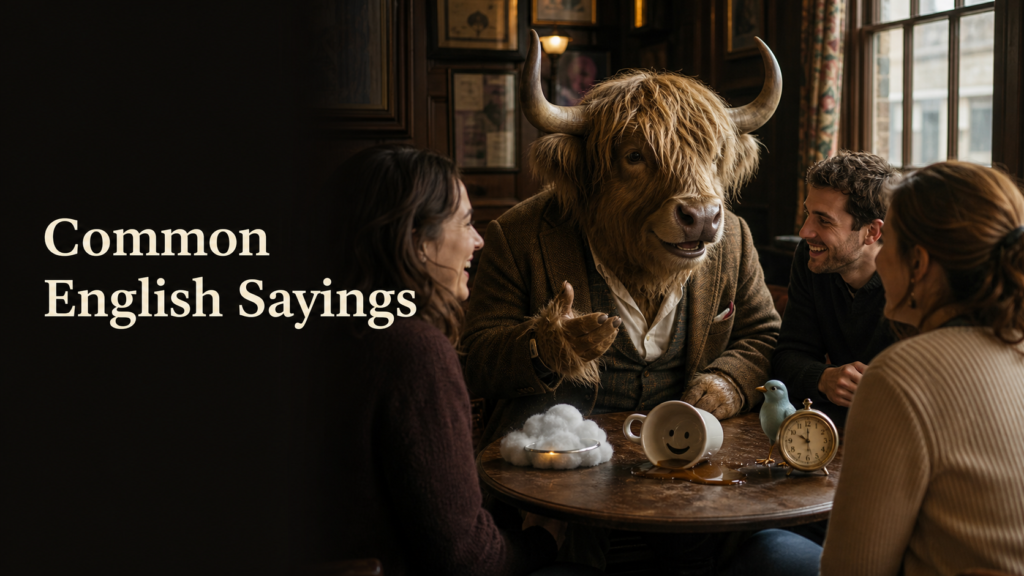
Sayings are the spice in everyday English — you catch them in films, overhear them at the coffee shop, and maybe even use a few without knowing their full flavor. This list gathers around 250 common English sayings so you can stop guessing and start using them naturally. Whether you’re a beginner hungry for real-world phrases or a confident learner aiming to sound more like a local, these expressions will add color to your conversations.
What makes sayings so useful for learners? They pack a whole idea into a few quick words. That means you can express yourself faster and sound more natural without memorizing lengthy grammar rules. Browse the table, play the audio, and steal these little bundles of wisdom for your own chats.
Ready for a quick stroll through everyday English? Scroll to the bottom of the article to grab the free printable common English sayings vocabulary list PDF and the free downloadable printable common English sayings flashcards — because memorizing idioms is easier when your study stack is doing a little of the work for you.
Phrases are handy, but real talk flows better when you have flexible chunks — not just single words. Our free chunk-based English lessons teach you natural expressions with clear audio and speaking practice. Start with Lesson 1 — First Greetings and hear the difference chunking makes.
English Sayings Quiz
Fancy a quick challenge? Jump into the quiz below and see how many sayings you already know cold. It’s a low-pressure way to spot which ones need a second look.
Keep building your English
Choose a practical next step when you are ready.
English Sayings List with Meanings
| Expression | IPA | Meaning | Example |
|---|---|---|---|
| Mind if I join you | maɪnd ɪf aɪ dʒɔɪn juː | Polite request to sit with someone. | Mind if I join you? All other tables are full. |
| More or less | mɔr ɔr lɛs | Approximately; mostly. | The project is more or less finished. |
| More to come | mɔːr tuː kʌm | Additional things will follow. | That's the first episode. More to come next week. |
| Move on | muv ɑn | To stop dwelling on the past and continue with life. | The relationship is over. It's time to move on. |
| My bad | /maɪ bæd/ | My fault; I apologize. | I forgot to call you. My bad. |
| My treat | maɪ trit | Used to say that one will pay for something. | Let's go out for dinner, my treat. |
| Need to know basis | niːd tuː noʊ ˈbeɪsɪs | Information shared only with those who require it. | The details are on a need-to-know basis. |
| News to me | nuz tu mi | I didn't know that; that's surprising information. | A: The meeting is canceled. B: That's news to me. |
| Nice talking to you | naɪs ˈtɔkɪŋ tu ju | Pleasant conversation; used when ending a conversation. | A: I have to go now. Nice talking to you. B: You too. |
| No big deal | noʊ bɪɡ dil | Used to say that something is not important. | I made a mistake, but it's no big deal. |
| No hard feelings | noʊ hɑrd ˈfilɪŋz | No resentment or anger after a disagreement. | A: I'm sorry I beat you. B: No hard feelings, good game. |
| No offense | noʊ əˈfɛns | Said before a potentially insulting comment. | No offense, but your cooking needs improvement. |
| No offense meant | noʊ əˈfɛns mɛnt | Clarifying that no insult was intended. | I didn't mean to hurt your feelings. No offense meant. |
| No way | /noʊ weɪ/ | That is impossible or surprising. | A: She's moving to Japan. B: No way! |
| No worries | /noʊ ˈwʌriz/ | It's not a problem; don't worry. | A: Sorry I'm late. B: No worries. |
| None taken | nʌn ˈteɪkən | Response indicating no offense was felt. | Q: No offense, but that's ugly. A: None taken. |
| Not bad at all | nɑt bæd æt ɔl | Quite good; surprisingly good. | The movie was not bad at all. |
| Not gonna lie | /nɑt ˈgʌnə laɪ/ | To be honest. | Not gonna lie, that was scary. |
| Not my circus, not my monkeys | nɑt maɪ ˈsɜrkəs, nɑt maɪ ˈmʌŋkiz | Used to say that a situation is not one's concern. | Their argument is not my circus, not my monkeys. |
| Not my problem | nɑt maɪ ˈprɑbləm | Used to say that something is not one's responsibility. | If he's late, that's not my problem. |
| Not now | nɑt naʊ | I am busy or unwilling at this moment. | A: Can we talk? B: Not now, I'm in a meeting. |
| Not really | /nɑt ˈrɪli/ | No, not exactly. | A: Are you hungry? B: Not really. |
| Not to burst your bubble | nɑːt tuː bɜːrst jɔːr ˈbʌbl | Said before shattering someone's illusion or excitement. | Not to burst your bubble, but that 'antique' is a replica. |
| Not today | nɑt təˈdeɪ | I decline for today. | A: Want to grab coffee? B: Not today, thanks. |
| Not too shabby | nɑt tu ˈʃæbi | Pretty good; not bad. | Your score is not too shabby. |