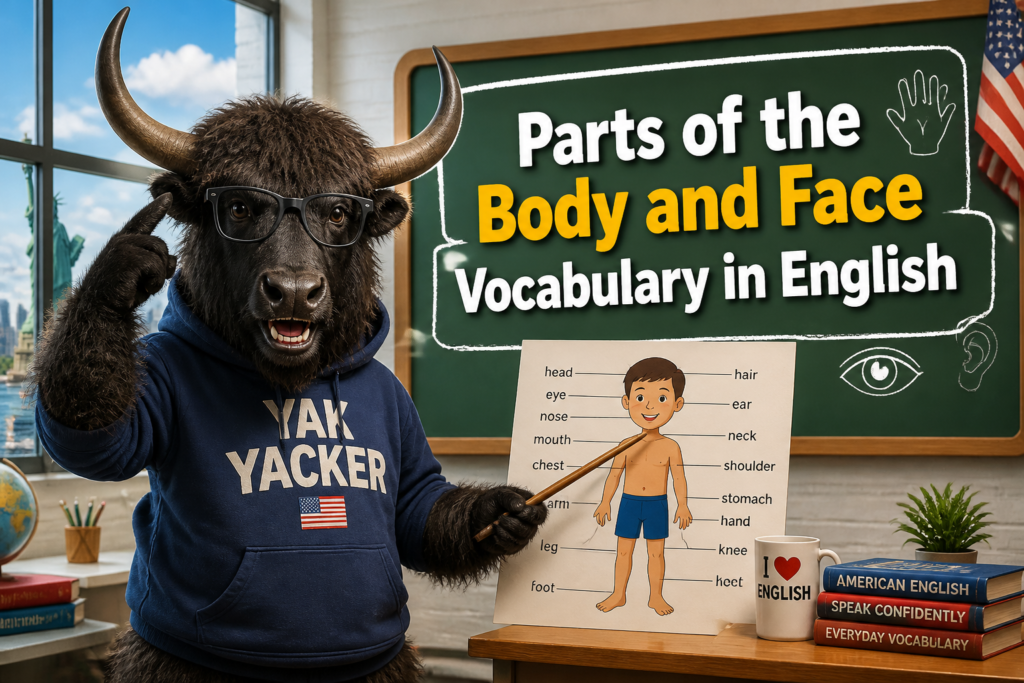
English learners meet body and face words very early, because, well, your face is hard to avoid in real life. You use these words when talking to a doctor, describing a person, reading a story, shopping for glasses, or just saying, “My head hurts.” Very glamorous. Very useful.
For the broader learning path, visit our parent guide.
This guide teaches the most common parts of the body and face in natural English, with pronunciation help, example sentences, and learner notes. By the end, you should feel more confident naming body parts, understanding descriptions, and using everyday health and appearance vocabulary.
If you want to check your English level after this lesson, try the English Placement Test CEFR or the English Vocabulary Test.
Core Body Vocabulary
Let’s start with the body words you will hear all the time. These are neutral, common, and useful in daily conversation.
| English | Pronunciation | Meaning | Example Sentence | Learner Note |
|---|---|---|---|---|
| head | hed | The top part of the body, including the face and brain area. | I bumped my head on the door. | Common in health and injury talk. |
| face | fays | The front part of the head with eyes, nose, and mouth. | She washed her face before bed. | Use “face” for appearance and expressions. |
| eye | ai | One of the two parts used for seeing. | My eyes feel tired after reading. | Plural is usually “eyes.” |
| ear | eer | One of the two parts used for hearing. | He has music in his ears all day. | Often used with “listen” and “hear.” |
| nose | nohz | The part used for breathing and smelling. | Her nose is cold in winter. | Also used in expressions like “lead by the nose.” |
| mouth | mawth | The opening in the face used for speaking and eating. | Open your mouth and say “ah.” | Pronunciation is a little tricky: it ends with a soft “th.” |
| English | Pronunciation | Meaning | Example Sentence | Learner Note |
|---|---|---|---|---|
| neck | nek | The part between the head and the shoulders. | He wears a scarf around his neck. | Very common in clothing and health vocabulary. |
| shoulder | SHOHL-der | The upper part of the body where the arm joins. | She put the bag on her shoulder. | Plural shoulders is common in everyday speech. |
| arm | arm | The part between the shoulder and the hand. | He raised his arm to ask a question. | Not the same as “hand.” |
| elbow | EL-boh | The joint in the middle of the arm. | Rest your elbow on the table. | Useful in sports, desks, and movement instructions. |
| hand | hand | The part at the end of the arm with fingers and thumb. | Please wash your hands before dinner. | Very common in health advice. |
| finger | FING-ger | One of the five parts on the hand. | She cut her finger while cooking. | Thumb is not usually called a finger in everyday English. |
| English | Pronunciation | Meaning | Example Sentence | Learner Note |
|---|---|---|---|---|
| thumb | thum | The short thick finger on the side of the hand. | I gave him a thumbs up. | Used a lot in gestures and expressions. |
| chest | chest | The front upper part of the body. | He has pain in his chest. | Common in medical contexts. |
| back | bak | The rear part of the body from shoulders to hips. | My back hurts after sitting all day. | Also used for “the back of something.” |
| stomach | STUH-muk | The area where food goes; also the belly area in everyday speech. | I have a stomach ache. | In medical English, “stomach” and “abdomen” can differ, but everyday speech is simpler. |
| belly | BEL-ee | Informal word for the stomach area. | The baby rubbed her belly. | Casual; common in child talk and friendly conversation. |
| waist | wayst | The middle part of the body between the ribs and hips. | This belt is too tight around my waist. | Important for clothing sizes. |
| English | Pronunciation | Meaning | Example Sentence | Learner Note |
|---|---|---|---|---|
| hip | hip | The side area of the body near the waist and upper leg. | She hurt her hip in the fall. | Common in health and movement language. |
| leg | leg | The part of the body used for standing and walking. | My leg is tired after hiking. | Often used with “run,” “walk,” and “stretch.” |
| knee | nee | The joint in the middle of the leg. | He fell and scraped his knee. | Common in sports and injury talk. |
| ankle | ANG-kuhl | The joint between the leg and the foot. | I twisted my ankle yesterday. | Often used in sports injuries. |
| foot | foot | The part at the end of the leg used for standing and walking. | My foot is sore. | Plural is feet, not “foots.” English likes chaos. |
| toe | toh | One of the five small parts on the foot. | She painted her toes pink. | Plural is toes. |
Face Vocabulary For Describing People
When you describe a person, these face words are especially useful. Some are neutral, and some are more about appearance or expression.
| English | Pronunciation | Meaning | Example Sentence | Learner Note |
|---|---|---|---|---|
| hair | hair | The strands that grow on the head. | Her hair is long and curly. | Use with countable styles or uncountable general talk. |
| forehead | FOR-id or FOR-hed | The flat area above the eyes. | He has a wrinkle in his forehead. | Pronunciation varies, which is typical English mischief. |
| eyebrow | AI-brow | The line of hair above the eye. | She raised one eyebrow. | Used often for expressions and emotions. |
| eyelash | AI-lash | The small hairs on the edge of the eyelid. | She has long eyelashes. | Usually plural in natural speech. |
| eyelid | AI-lid | The skin that covers the eye when closed. | My eyelid feels tired. | Less common than eye, but useful in medical talk. |
| cheek | cheek | The side of the face below the eye. | The child kissed her mother on the cheek. | Also used in expressions like “cheeky.” |
| English | Pronunciation | Meaning | Example Sentence | Learner Note |
|---|---|---|---|---|
| chin | chin | The lower part of the face below the mouth. | He scratched his chin while thinking. | Common in descriptions and gestures. |
| jaw | jaw | The lower part of the face, including the bone used for chewing. | She has a strong jaw. | Useful in appearance and medical contexts. |
| lip | lip | One of the two soft parts around the mouth. | She put on red lipstick. | Plural lips is common. |
| teeth | teeth | The hard white parts used for biting and chewing. | I need to brush my teeth. | Singular is tooth; plural is teeth. |
| tongue | TUNG | The soft part in the mouth used for tasting and speaking. | The soup was too hot, so I burned my tongue. | Also used in language names, like “mother tongue.” |
| skin | skin | The outside layer of the body. | My skin is dry in winter. | Common in beauty, health, and weather talk. |
Useful Phrases With Body And Face Words
These are the phrases learners actually need in real life. Not just isolated words sitting in a dictionary like they’re waiting for a bus.
| English | Pronunciation | Meaning | Example Sentence | Learner Note |
|---|---|---|---|---|
| break an arm / leg | brayk an arm / leg | An injury where a bone is broken. | He broke his arm playing soccer. | “Break” is common, even when the person is not literally cut in half. Thankfully. |
| have a headache | hav uh HED-ake | Feel pain in the head. | I have a headache after working on the computer. | Very common health phrase. |
| have a sore throat | hav uh sor throht | Feel pain or irritation in the throat. | She has a sore throat and a cough. | Useful during colds and flu. |
| twist an ankle | twist an ANG-kuhl | Injure the ankle by turning it badly. | I twisted my ankle on the stairs. | Common in sports and accidents. |
| ache all over | ayk awl OH-ver | Feel pain in many parts of the body. | After the long hike, I ached all over. | Often used after exercise or illness. |
| feel under the weather | feel UN-der thuh WETH-er | Feel a little sick. | I’m staying home today because I feel under the weather. | Friendly idiom; common in spoken English. |
| English | Pronunciation | Meaning | Example Sentence | Learner Note |
|---|---|---|---|---|
| raise your hand | rayz yoor hand | Lift your hand up. | Please raise your hand if you have a question. | Common in class and meetings. |
| cross your arms | kros yor armz | Fold your arms across your chest. | He crossed his arms and waited. | Can suggest patience, boredom, or annoyance. |
| shake hands | shayk handz | Greet someone by holding and moving hands briefly. | They shook hands after the interview. | Common in formal and business situations. |
| nod your head | nod yor hed | Move your head up and down to show agreement. | She nodded her head to say yes. | Useful for body language. |
| shake your head | shayk yor hed | Move your head side to side to show no or disagreement. | He shook his head when he heard the news. | Very common gesture. |
| make eye contact | mayk ai KON-takt | Look directly at another person’s eyes. | Good speakers make eye contact. | Important in communication and interviews. |
Body Part Collocations You’ll Hear Often
Collocations are words that naturally go together. English loves these little word couples and expects you to just know them, like a magician hiding cards up his sleeve.
- upper arm — the part above the elbow
- lower arm — the part below the elbow
- lower back — the lower part of the back
- inner ear — the deeper part of the ear
- upper lip — the lip on top
- lower lip — the lip on bottom
- big toe — the largest toe
- index finger — the finger next to the thumb
- ring finger — the finger often used for rings
- body language — communication using movement and posture
American And British Notes
Most body and face vocabulary is the same in American and British English. Still, a few differences are worth knowing.
| American English | British English | Note |
|---|---|---|
| pants | trousers | Both mean the outer clothing on your legs. In the U.S., “pants” is normal. In the U.K., “pants” often means underwear. |
| sweater | jumper | Clothing word, often used when talking about the upper body in cool weather. |
| tummy | tummy | Both varieties use this informal word, especially with children. |
| fanny in the U.S. | fanny in the U.K. | Be careful: this word means different body parts and can sound rude or silly depending on the country. |
Little language warning: some body words are polite, some are medical, and some are casual. If you are unsure, choose the common neutral word first. Neutral is your safest friend.
Common Grammar Patterns With Body Words
Body vocabulary often appears with possessive pronouns, prepositions, and common verbs. That means English learners should watch the structure, not just the word itself.
| Pattern | Meaning | Example | Learner Note |
|---|---|---|---|
| my / your / his / her + body part | Shows who the body part belongs to. | He hurt his knee. | Use possessives, not articles: “my hand,” not “the my hand.” |
| have + body part + pain | Describes discomfort. | She has ear pain. | Also say “My ear hurts.” |
| in + the + body part | Location of pain or touch. | There is a pain in the chest. | Very common in medical English. |
| on + the + body part | Something touching the body part. | He has a bandage on his arm. | Use “on” for surface contact. |
| with + body part | Using a body part to do something. | Write with your hand. | Common in instructions. |
Quick Pronunciation Tips
Some body words cause trouble because English spelling is a little rude and not always honest.
- teeth rhymes a little with “seethe” and is the plural of tooth.
- feet rhymes with “meet” and is the plural of foot.
- throat has a clear th sound at the start.
- shoulder starts with “SH,” not “SK.”
- stomach is usually pronounced STUH-muk, not “stow-mack.”
Practice
Try these quick exercises. Say the answers out loud if possible. That’s how your mouth learns the words, not just your eyes.
- 1. Fill in the blank: I have a pain in my ________ after running.
- 2. Fill in the blank: She washed her ________ before breakfast.
- 3. Choose the correct plural: one foot / two ________
- 4. Choose the correct plural: one tooth / many ________
- 5. Rewrite with a body word: “I feel pain in my head.” → “I have a ________.”
- 6. Say this sentence with the correct pronunciation: “Raise your hand if you know the answer.”
- 7. Swap the body part: “He hurt his arm.” → “He hurt his ________.”
- 8. Say this naturally: “I’m feeling a little sick.” → “I feel ________ the weather.”
Suggested Answers
- 1. knee, back, or leg depending on the meaning
- 2. face
- 3. feet
- 4. teeth
- 5. headache
- 6. raise = rayz, hand = hand
- 7. any body part: leg, finger, shoulder, etc.
- 8. under
Common Mistakes And Fixes
| Wrong | Correct | Why |
|---|---|---|
| I have pain on my head. | I have pain in my head. / I have a headache. | We usually say pain in a body part, or use the natural phrase headache. |
| She hurt her feet. | She hurt her foot. | Use singular for one foot; plural only if both feet are hurt. |
| My hair are long. | My hair is long. | Hair is usually uncountable in English. |
| He has brown eye. | He has brown eyes. | Most people have two eyes, so plural is normal. |
| I washed my face and hands. | I washed my face and hands. | This one is correct already. Sometimes English gives a free point, which feels suspicious. |
Quick Reference Summary
- Head, face, eyes, ears, nose, mouth = basic face and head words
- Neck, shoulder, arm, hand, finger, thumb = upper body and arm words
- Chest, back, stomach, waist, hip = middle body words
- Leg, knee, ankle, foot, toe = lower body and feet words
- Hair, forehead, eyebrow, cheek, chin, jaw, lip, teeth, tongue, skin = useful face description words
- Use my / your / his / her with body parts in normal speech.
- Learn common phrases like have a headache, twist an ankle, and make eye contact.
Yak takeaway: body and face words are simple on the surface, but they show up everywhere in real English. Learn the common ones first, practice the plurals, and your English will stop sounding like it got lost in a medical textbook.