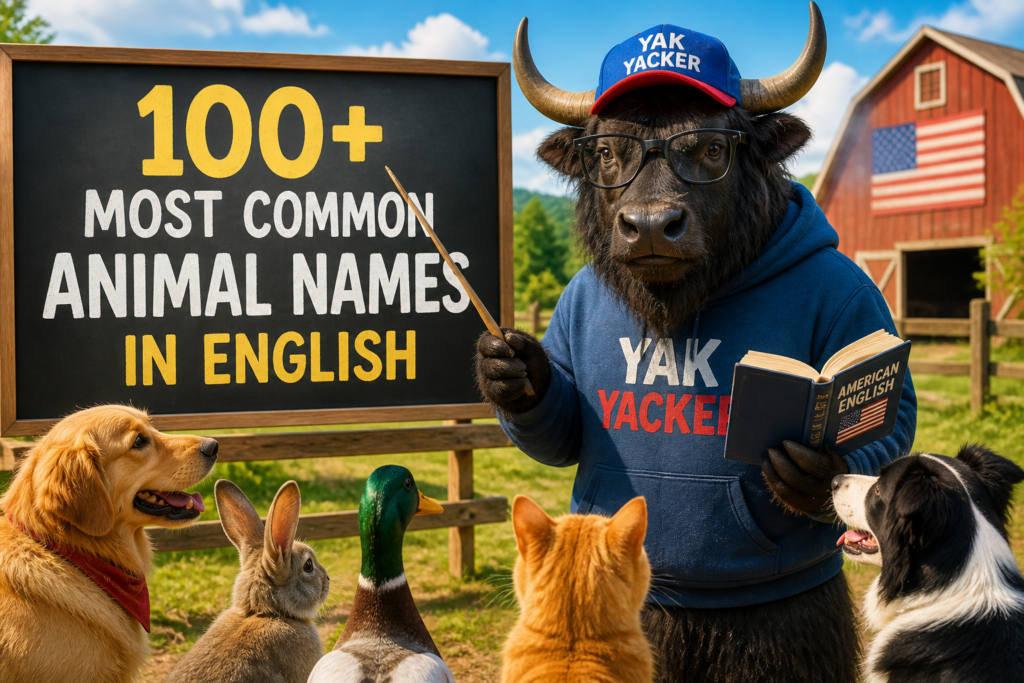
Animals show up everywhere in English: in books, in jokes, in idioms, in children’s songs, and in those awkward moments when someone says, “Look, a squirrel!” and suddenly no one is talking about the meeting anymore. If you want to build practical English vocabulary, animal names are a great place to start.
For the broader learning path, visit our parent guide.
In this guide, you’ll learn common animal names in English with simple pronunciation help, clear meanings, and example sentences. You’ll also see a few useful notes about plural forms, American vs. British spelling, and common learner mistakes. Because yes, English loves making simple things weird.
By the end, you should be able to name many common animals, understand them in real conversations, and use them in everyday sentences with more confidence.
| English | Pronunciation | Meaning | Example Sentence | Learner Note |
|---|---|---|---|---|
| animal | AN-uh-muhl | a living thing such as a dog, cat, or horse | Animals need food, water, and care. | General word for living creatures like pets and wild animals. |
| pet | pet | an animal kept at home for companionship | My pet is very friendly. | Common word for dogs, cats, fish, and other home animals. |
| wild animal | wyld AN-uh-muhl | an animal that lives in nature, not at home | Do not feed wild animals. | Use for animals in forests, parks, jungles, and oceans. |
One quick note: in English, the singular and plural forms can change in simple ways, but a few animal names are irregular. Don’t panic. English does this sort of thing for entertainment, apparently.
Everyday Pets And Farm Animals
These are some of the most common animal names in daily English. You will see them in stories, classrooms, conversations, and beginner textbooks.
| English | Pronunciation | Meaning | Example Sentence | Learner Note |
|---|---|---|---|---|
| dog | dog | a common pet animal | My dog loves to run outside. | Very common pet word. Plural: dogs. |
| cat | kat | a small pet animal that meows | The cat is sleeping on the sofa. | Very common. Plural: cats. |
| bird | burd | an animal with feathers and wings | I heard a bird singing this morning. | Use for sparrows, parrots, pigeons, and many others. |
| fish | fish | an animal that lives in water | There are three fish in the tank. | Plural can be fish or fishes in special contexts. |
| rabbit | RAB-it | a small animal with long ears | The rabbit ate carrots in the garden. | Common in stories and nature vocabulary. |
| hamster | HAM-ster | a small furry pet | Her hamster sleeps during the day. | Common pet in many countries. |
| guinea pig | GIN-ee pig | a small pet animal | My sister has a guinea pig. | Spelled with two words. |
| mouse | mows | a small rodent | A mouse ran across the floor. | Plural is mice. |
| rat | rat | a larger rodent like a mouse | Some people are afraid of rats. | Singular and plural are regular: rat, rats. |
| horse | hors | a large animal people ride | We saw horses in the field. | Common in travel, farm, and sport vocabulary. |
| cow | kow | female cattle, often raised for milk or meat | The cow is eating grass. | Plural: cows. Common farm word. |
| bull | bool | an adult male cow | The bull is much bigger than the calf. | Often used in farm and wildlife contexts. |
| calf | kaf | a young cow or other large animal | The calf stayed close to its mother. | Plural: calves. |
| pig | pig | a farm animal with a round body and snout | The pig rolled in the mud. | Plural: pigs. |
| sheep | sheep | a woolly farm animal | Sheep eat grass in the pasture. | Plural is also sheep. |
| goat | goht | a farm animal with horns and a beard | The goat climbed the rocks. | Very common on farms and in nature. |
| chicken | CHIK-in | a common farm bird | We had chicken for dinner. | Can mean the animal or the meat, so context matters. |
| duck | duhk | a water bird with a flat bill | The ducks swam in the pond. | Plural: ducks. |
| goose | gooss | a large water bird | We saw a goose near the lake. | Plural is geese. |
For dictionary help, you can also check the Cambridge Dictionary. It is a very boring website in the best possible way, which is exactly what learners need sometimes.
Common Wild Animals
These names appear a lot in stories, documentaries, travel discussions, and nature topics. Some are cute. Some are not. Nature has range.
| English | Pronunciation | Meaning | Example Sentence | Learner Note |
|---|---|---|---|---|
| lion | LY-uhn | a big wild cat with a mane | The lion is called the king of the jungle. | Common in stories and documentaries. |
| tiger | TY-ger | a large wild cat with stripes | We saw a tiger at the zoo. | Pronounce the first syllable clearly: TY-. |
| bear | bear | a large heavy wild animal | A bear was walking near the river. | One-syllable word. Rhymes with “care.” |
| wolf | woolf | a wild animal like a dog | Wolves often live in groups. | Plural: wolves. |
| fox | foks | a small wild animal with red fur | The fox ran into the forest. | Common in folktales and nature writing. |
| deer | deer | a graceful wild animal with antlers | We saw a deer in the woods. | Plural is also deer. |
| rabbit | RAB-it | a small hopping animal | A rabbit crossed the path. | Can be a pet or a wild animal. |
| elk | elk | a large deer-like animal | We saw an elk in the national park. | More common in North America. |
| moose | mooss | a very large deer-like animal | A moose walked near the road. | Plural is also moose. |
| bear cub | bear kuhb | a young bear | The bear cub followed its mother. | Cub means a young animal. |
| fox cub | foks kuhb | a baby fox | The fox cub stayed hidden in the grass. | Use cub for many young wild animals. |
| skunk | skuhngk | a small animal that gives off a bad smell | A skunk crossed the yard at night. | Common in North America. |
| raccoon | ra-KOON | a small wild animal with a striped tail | The raccoon looked into the trash can. | Stress is on the second syllable. |
| opossum | uh-POS-um | a small nocturnal mammal | We saw an opossum near the fence. | In American English, people often say possum informally. |
| squirrel | SKWUR-uhl | a small tree animal with a bushy tail | The squirrel hid a nut in the ground. | Tricky pronunciation. Say it slowly at first. |
Ocean And Water Animals
These names are useful for travel, science class, documentaries, and everyday conversation. Some are common sea animals; others live in rivers or lakes.
| English | Pronunciation | Meaning | Example Sentence | Learner Note |
|---|---|---|---|---|
| whale | whayl | a very large sea mammal | We saw a whale from the boat. | Not a fish. It is a mammal. |
| dolphin | DOL-fin | a smart sea mammal | Dolphins often swim near boats. | Stress is on the first syllable. |
| shark | shark | a large fish with sharp teeth | Sharks live in many oceans. | Common in movies and nature programs. |
| octopus | OK-tuh-pus | a sea animal with eight arms | The octopus changed color. | Plural can be octopuses in modern English. |
| starfish | STAR-fish | a sea animal shaped like a star | The child picked up a starfish gently. | Also called a sea star. |
| crab | krab | a sea animal with a hard shell and claws | The crab moved sideways on the sand. | Useful for beach vocabulary. |
| lobster | LOB-ster | a sea animal with claws | We ate lobster at the restaurant. | Common in food and ocean vocabulary. |
| shrimp | shrimp | a small sea animal often eaten as food | I ordered shrimp and rice. | Same word for the animal and the food. |
| seal | seel | a sea mammal that lives near the shore | We watched seals on the rocks. | Different from a stamp or official mark. |
| walrus | WAL-rus | a large sea mammal with tusks | The walrus rested on the ice. | Often seen in cold climates. |
| frog | frog | a small jumping animal that lives near water | A frog jumped into the pond. | Common in nature and children’s stories. |
| turtle | TUR-tl | an animal with a hard shell | The turtle moved very slowly. | American English often says turtle for many shell animals. |
| tortoise | TOR-tis | a land turtle | The tortoise walked across the garden. | More common in British English and formal contexts. |
For a simple, reliable overview of animal classification, Britannica’s article on animals is a solid place to wander if you enjoy dry facts with your vocabulary.
Birds, Insects, And Small Creatures
These words are useful in daily life, especially when talking about nature, gardens, parks, and weather. Also, yes, some insects are tiny but still manage to be extremely memorable.
| English | Pronunciation | Meaning | Example Sentence | Learner Note |
|---|---|---|---|---|
| eagle | EE-guhl | a large bird of prey | An eagle flew over the mountain. | Stress on the first syllable. |
| owl | owl | a bird that hunts at night | We heard an owl outside. | Very common in stories and symbols. |
| parrot | PAIR-rot | a colorful bird that can copy sounds | The parrot repeated my words. | Two syllables. Clear stress on the first. |
| crow | kroh | a black bird | A crow sat on the fence. | Common in nature descriptions. |
| sparrow | SPAIR-oh | a small brown bird | Small sparrows are common in cities. | Useful in everyday observation. |
| bee | bee | an insect that makes honey | A bee landed on the flower. | Plural: bees. |
| butterfly | BUT-er-fly | a colorful insect with wings | A butterfly rested on my hand. | Very common beginner word. |
| ant | ant | a very small insect that lives in groups | Ants were carrying crumbs away. | Plural: ants. |
| mosquito | muh-SKEE-toh | a small flying insect that bites | Use spray to stop mosquito bites. | Stress on the second syllable. |
| fly | fly | a small insect with wings | A fly buzzed around the room. | Don’t confuse with the verb fly. |
| spider | SPY-der | a small creature with eight legs | There is a spider in the bathroom. | Common in home and nature vocabulary. |
| snail | snayl | a slow small animal with a shell | The snail moved across the wet path. | Often used to describe slow movement. |
| worm | wurm | a long thin small creature | Birds eat worms after rain. | Simple but useful nature word. |
| caterpillar | KAT-er-pil-er | a larva that becomes a butterfly | The caterpillar was on the leaf. | Stress the first syllable. |
| dragonfly | DRAG-uhn-fly | a flying insect with a long body | A dragonfly flew near the water. | Common in garden and pond vocabulary. |
Reptiles And Amphibians
These words often appear in science, nature documentaries, zoos, and travel situations. A few of them also show up in scary movies, because of course they do.
| English | Pronunciation | Meaning | Example Sentence | Learner Note |
|---|---|---|---|---|
| snake | snayk | a long legless reptile | A snake was hiding under the rock. | Very common in stories and warnings. |
| lizard | LIZ-erd | a small reptile with four legs | The lizard sat in the sun. | Stress on the first syllable. |
| crocodile | KROK-uh-dyle | a large reptile with strong jaws | We saw a crocodile in the river. | Three syllables, stress on the first. |
| alligator | AL-uh-gay-ter | a large reptile similar to a crocodile | The alligator was near the water. | Common in North America. |
| frog | frog | a small jumping amphibian | Frogs sing near ponds at night. | Can live near water and on land. |
| toad | tohd | a frog-like amphibian with dry skin | A toad sat near the garden path. | Often used with “frog,” but they are not the same. |
| newt | noot | a small salamander | We found a newt under the log. | Less common, but useful in nature topics. |
| salamander | SAL-uh-man-der | a small amphibian with a long body | Salamanders live in damp places. | More advanced nature vocabulary. |
More Common Animals You Should Know
This section gives you extra useful animal names so you can go beyond the basic beginner list. These words come up in conversation, movies, travel, and reading.
| English | Pronunciation | Meaning | Example Sentence | Learner Note |
|---|---|---|---|---|
| elephant | EL-uh-fuhnt | a very large animal with a trunk | The elephant sprayed water with its trunk. | Stress on the first syllable. |
| giraffe | juh-RAF | a tall animal with a long neck | The giraffe ate leaves from the tree. | Stress on the second syllable. |
| hippopotamus | hip-uh-POT-uh-muhs | a large heavy river animal | The hippopotamus stayed in the water. | Long word, but common in children’s books and zoos. |
| rhino | RY-noh | short for rhinoceros; a large animal with a horn | The rhino moved slowly across the field. | Informal but very common. |
| zebra | ZEE-bruh | a horse-like animal with stripes | We saw a zebra at the zoo. | American English usually says ZEE-bruh. |
| kangaroo | kan-guh-ROO | a jumping animal from Australia | The kangaroo carried a baby in its pouch. | Stress on the last syllable. |
| koala | koh-AH-luh | a tree-dwelling animal from Australia | The koala was sleeping in the tree. | Three syllables, stress in the middle. |
| monkey | MUN-kee | a small to medium primate | The monkey climbed the tree quickly. | Very common in stories and zoos. |
| gorilla | guh-RIL-uh | a large powerful ape | The gorilla sat quietly. | Stress on the second syllable. |
| chimpanzee | chim-pan-ZEE | a type of ape | Chimpanzees are very intelligent. | Stress on the last syllable. |
| ape | ayp | a primate like a gorilla or chimpanzee | Apes are not monkeys. | Useful in science and zoo vocabulary. |
| bat | bat | a flying mammal | A bat flew out of the cave. | Not a bird. Not even close. |
| hedgehog | HEDJ-hog | a small animal with spines | The hedgehog curled into a ball. | Common in British English and children’s books. |
| ferret | FER-it | a long narrow pet animal | Some families keep a ferret as a pet. | Less common, but useful. |
| donkey | DON-kee | an animal related to a horse | The donkey carried the bags. | Very common in farm and travel stories. |
Useful Animal Words For Describing Age And Groups
Animal names are not just about the animals themselves. English also uses special words for young animals and groups of animals. This is where English starts acting like it has a secret hobby.
| English | Pronunciation | Meaning | Example Sentence | Learner Note |
|---|---|---|---|---|
| baby animal | BAY-bee AN-uh-muhl | a very young animal | The baby animal stayed close to its mother. | Very safe general phrase. |
| cub | kuhb | a baby bear, lion, fox, or similar animal | The lion cub played in the grass. | Useful for wild animals. |
| kitten | KIT-n | a baby cat | The kitten is very small. | Very common pet word. |
| puppy | PUH-pee | a baby dog | The puppy chewed my shoe. | Very common and cute, because English cannot help itself. |
| foal | fohl | a baby horse | The foal walked beside its mother. | Used in farm and horse vocabulary. |
| lamb | lam | a baby sheep | The lamb stayed with the flock. | Also used in food and religious vocabulary. |
| flock | flok | a group of birds or sheep | A flock of birds flew overhead. | Common group word. |
| herd | herd | a group of cows, elephants, or similar animals | A herd of cows crossed the road. | Useful for farm and wildlife topics. |
| pack | pak | a group of wolves or dogs | A pack of wolves was hunting. | Common in wildlife writing. |
| school | skool | a group of fish | A school of fish swam past us. | Different meaning from “school” as a place for study. |
Words That Often Confuse Learners
Some animal words are easy to mix up. Here are a few quick fixes so your English stays sharp instead of vaguely zoo-shaped.
- Fish is both singular and plural in many cases: one fish, two fish.
- Sheep is the same in singular and plural: one sheep, three sheep.
- Mouse becomes mice, not “mouses.”
- Goose becomes geese, not “gooses.”
- Turtle and tortoise are not exactly the same. In American English, turtle is used more broadly. In British English, tortoise often means a land one.
- Bat is a mammal, not a bird.
- Octopus is not usually “octopi” in modern everyday English. Octopuses is common and safe.
If you want to test your vocabulary after learning these names, try the English Vocabulary Test or check your level with the English Placement Test CEFR. Tiny challenge, no zoo admission required.
Quick Pronunciation Tips
| Word | Easy Pronunciation Help | Common Issue | Example |
|---|---|---|---|
| raccoon | ra-KOON | Stress the second syllable | We saw a raccoon at night. |
| elephant | EL-uh-fuhnt | Stress the first syllable | The elephant is huge. |
| kangaroo | kan-guh-ROO | Stress the last syllable | The kangaroo jumped away. |
| giraffe | juh-RAF | Stress the second syllable | The giraffe ate leaves. |
| squirrel | SKWUR-uhl | Say it slowly; the middle sound is tricky | The squirrel climbed the tree. |
| mosquito | muh-SKEE-toh | Stress the second syllable | Mosquitoes bite in summer. |
Yak Wisdom: If you can say the animal name clearly, you are already halfway to sounding natural. If not, just say it slowly and confidently. English learners do not need to apologize to a squirrel.
Practice Time
Try these quick exercises. Simple practice helps the words stick, which is annoying for anyone who enjoys forgetting things, but excellent for learning.
- Fill in the blank: A baby cat is a __________.
- Fill in the blank: Two __________ were swimming in the lake. (fish)
- Fill in the blank: The __________ is a large animal with a trunk.
- Choose the correct word: One sheep / sheeps
- Choose the correct word: one mouse / one mouses
- Say the word aloud: raccoon
- Say the word aloud: squirrel
- Make a sentence with dog.
- Make a sentence with bird.
- Make a sentence with lion.
Answers: kitten, fish, elephant, sheep, mouse. For the speaking items, say each word three times slowly, then once naturally. Repetition is boring. It also works.
Common Learner Mistakes And Fixes
| Wrong | Correct | Why |
|---|---|---|
| three mouses | three mice | Mouse has an irregular plural. |
| many sheeps | many sheep | Sheep stays the same in plural. |
| a fishes | a fish / two fish | Fish is often the same in singular and plural. |
| an dog | a dog | Use a before consonant sounds. |
| an elephant | an elephant | Use an before vowel sounds. |
| The birds is flying. | The birds are flying. | Plural subject needs are. |
| I saw many deers. | I saw many deer. | Deer is irregular. |
Quick Reference Summary
- Pets: dog, cat, bird, rabbit, hamster, guinea pig, fish
- Farm animals: cow, bull, calf, pig, sheep, goat, horse, chicken, duck, goose
- Wild animals: lion, tiger, bear, wolf, fox, deer, raccoon, squirrel, skunk
- Sea animals: whale, dolphin, shark, octopus, crab, lobster, shrimp, seal, walrus
- Birds and insects: eagle, owl, parrot, crow, sparrow, bee, butterfly, ant, mosquito, spider
- Reptiles and amphibians: snake, lizard, crocodile, alligator, frog, toad, salamander
- Irregular plurals to remember: mouse → mice, goose → geese, sheep → sheep, deer → deer, fish → fish
If you keep learning animal names in real sentences, you’ll remember them faster than by memorizing random word lists. English likes context. Memory likes context too, which is rare and helpful.
Yak Takeaway: Learn the common animal names first, then practice them in sentences. Start with dog, cat, bird, fish, horse, cow, lion, and elephant, and build from there. One small zoo of words at a time.