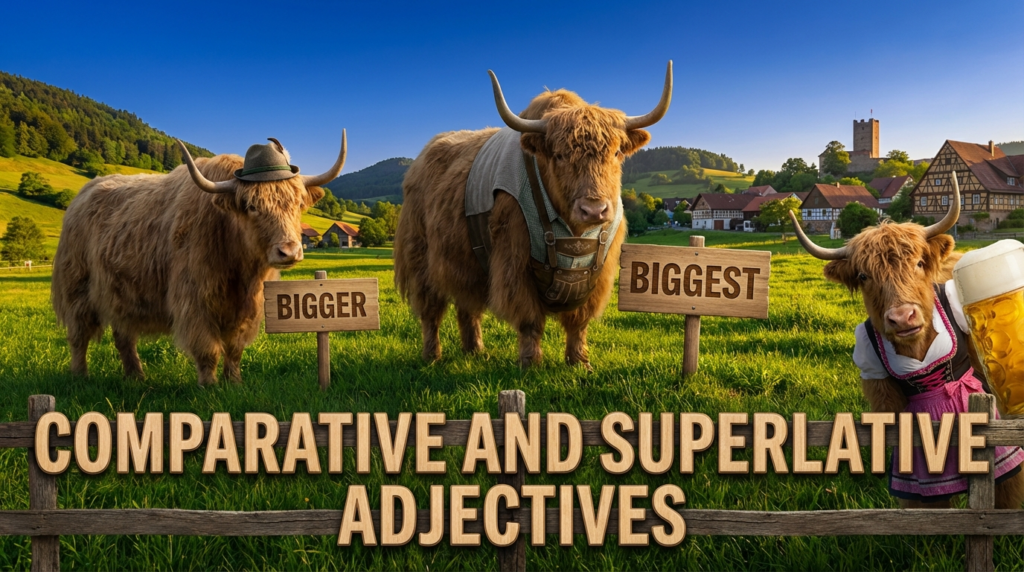
German Comparative And Superlative Adjectives
Learn how to say bigger, better, and the best in German without turning your brain into mashed potatoes.
Comparative and superlative adjectives are what you need when one thing is faster, smaller, or more expensive than another. German is actually pretty reasonable here. Most of the time, you just add a new ending and move on with your life.
In this lesson, you will learn the basic pattern, the most useful irregular forms, when to use als and wie, and how to build the superlative both after a verb and before a noun. Yes, German found a way to make that a thing too.
Yak Box: The Core Pattern
- Positive: schnell = fast
- Comparative: schneller = faster
- Superlative: am schnellsten = fastest
That basic pattern works with lots of German adjectives: klein → kleiner → am kleinsten, langsam → langsamer → am langsamsten, teuer → teurer → am teuersten.
How The Comparative Works
The comparative is used when you compare two things. In English, that is usually “faster,” “older,” or “more interesting.” In German, you usually make it by adding -er to the adjective.
| Rule | Meaning | Example 1 | Example 2 |
|---|---|---|---|
| Adjective + -er | comparative form | Der Bus ist schneller. English: The bus is faster. | Dieses Buch ist interessanter. English: This book is more interesting. |
| Use als | than | Mein Auto ist kleiner als dein Auto. English: My car is smaller than your car. | Anna ist älter als Leo. English: Anna is older than Leo. |
als means than after a comparative. That part matters. German wants größer als, not größer wie in standard German.
Useful Model
X ist + comparative + als Y.
Deutsch ist schwieriger als Englisch.
English: German is more difficult than English.
Another Model
Heute ist es + comparative + als gestern.
Heute ist es wärmer als gestern.
English: Today it is warmer than yesterday.
How The Superlative Works
The superlative is used when something is at the top of the pile: the fastest, the oldest, the most interesting. In German, you will see two very common patterns.
- am + adjective + -sten/-esten when the adjective comes after the verb
- der/die/das + adjective + -ste when the adjective comes before a noun
| Pattern | Meaning | Example | English |
|---|---|---|---|
| am schnellsten | fastest | Der Zug fährt am schnellsten. | The train goes the fastest. |
| der schnellste Zug | the fastest train | Das ist der schnellste Zug. | That is the fastest train. |
So the big difference is this:
- Mein Bruder läuft am schnellsten. = My brother runs the fastest.
- Mein Bruder ist der schnellste Läufer. = My brother is the fastest runner.
When German Adds An Umlaut
Some common one-syllable adjectives often change their vowel in the comparative and superlative. Not all of them. Because that would be too tidy.
| Positive | Comparative | Superlative | Example Sentence |
|---|---|---|---|
| alt old | älter older | am ältesten oldest | Meine Schwester ist älter als ich. English: My sister is older than I am. |
| groß big, tall | größer bigger, taller | am größten biggest, tallest | Berlin ist größer als Dresden. English: Berlin is bigger than Dresden. |
| jung young | jünger younger | am jüngsten youngest | Er ist der jüngste Bruder. English: He is the youngest brother. |
| kalt cold | kälter colder | am kältesten coldest | Im Januar ist es kälter als im März. English: In January it is colder than in March. |
You do not need to memorize a giant theory here. Just learn the common forms as vocabulary and notice the vowel change when you read or listen.
The Most Important Irregular Forms
A few adjectives and adverbs are so common that you should learn them early. These do not behave like the regular pattern.
gut
gut = good
besser = better
am besten = best
Dieser Kaffee ist besser.
English: This coffee is better.
Der kleine Laden ist am besten.
English: The small shop is the best.
viel
viel = much, a lot
mehr = more
am meisten = most
Heute habe ich mehr Zeit.
English: Today I have more time.
Sie arbeitet am meisten.
English: She works the most.
gern
gern = gladly, like doing
lieber = prefer, rather
am liebsten = most preferably
Ich trinke lieber Tee als Kaffee.
English: I prefer tea to coffee.
Am liebsten bleibe ich zu Hause.
English: Most of all, I like staying at home.
| Word | English Meaning | Comparative | Superlative | Example |
|---|---|---|---|---|
| hoch | high, tall | höher | am höchsten | Der Berg ist höher als der Hügel. English: The mountain is higher than the hill. |
| nah | near | näher | am nächsten | Die Apotheke ist näher als der Supermarkt. English: The pharmacy is nearer than the supermarket. |
When German Uses -esten
Some adjectives need an extra -e- in the superlative so the word is easier to pronounce. This often happens with adjectives ending in -d, -t, -s, -ß, -sch, -z, or with longer adjectives where -sten would sound awkward.
- laut → lauter → am lautesten
English: loud → louder → loudest - heiß → heißer → am heißesten
English: hot → hotter → hottest - interessant → interessanter → am interessantesten
English: interesting → more interesting → most interesting
Dieser Film ist am interessantesten.
English: This film is the most interesting.
Comparing Equals: Wie vs Als
This is one of the biggest beginner traps, so let’s fix it now.
| Pattern | Use | Example | English |
|---|---|---|---|
| so … wie | as … as | Mein Zimmer ist so groß wie dein Zimmer. | My room is as big as your room. |
| comparative + als | than | Mein Zimmer ist größer als dein Zimmer. | My room is bigger than your room. |
so … wie = equal comparison
-er + als = stronger comparison
Using The Superlative Before A Noun
When the superlative comes before a noun, it behaves like a normal adjective and takes an adjective ending.
- der schnellste Zug = the fastest train
- die schönste Stadt = the most beautiful city
- das teuerste Hotel = the most expensive hotel
Das ist das teuerste Hotel in der Stadt.
English: That is the most expensive hotel in the city.
Sie hat den schönsten Garten.
English: She has the most beautiful garden.
At beginner level, the important thing is to recognize -ste before the noun and am … -sten after the verb. Full adjective ending charts can wait until your coffee is stronger.
Quick Reference Table
| German | English Meaning | Example 1 | Example 2 | Example 3 |
|---|---|---|---|---|
| klein → kleiner → am kleinsten | small → smaller → smallest | Der Hund ist klein. The dog is small. | Der Hund ist kleiner als die Katze. The dog is smaller than the cat. | Der Hund ist am kleinsten. The dog is the smallest. |
| schnell → schneller → am schnellsten | fast → faster → fastest | Das Fahrrad ist schnell. The bike is fast. | Das Fahrrad ist schneller als der Bus. The bike is faster than the bus. | Das Fahrrad ist am schnellsten. The bike is the fastest. |
| alt → älter → am ältesten | old → older → oldest | Mein Opa ist alt. My grandpa is old. | Mein Opa ist älter als meine Oma. My grandpa is older than my grandma. | Mein Opa ist am ältesten. My grandpa is the oldest. |
| gut → besser → am besten | good → better → best | Die Suppe ist gut. The soup is good. | Die Suppe ist besser als gestern. The soup is better than yesterday. | Heute ist sie am besten. Today it is the best. |
| viel → mehr → am meisten | much/many → more → most | Ich habe viel Arbeit. I have a lot of work. | Heute habe ich mehr Arbeit. Today I have more work. | Am Montag habe ich am meisten Arbeit. On Monday I have the most work. |
Practice Section
Try these before peeking at the answers. Your future German-speaking self will be smug about it.
- Make the comparative: kalt
- Make the superlative: laut
- Complete the sentence: Mein Bruder ist größer ___ ich.
- Complete the sentence: Dieses Hotel ist ___ teuerste in der Stadt.
- Choose the correct form: gut / besser / am besten
Dieser Kuchen ist ___ als der andere.
Answers
- kälter
- am lautesten
- als
- das
- besser
Common Mistakes And Fast Fixes
- Mistake: größer wie
Fix: Use größer als in standard German. - Mistake: am bessersten
Fix: The correct form is am besten. German already suffered enough without bessersten. - Mistake: forgetting the umlaut in common words like älter or größer
Fix: Learn the full form as one chunk. - Mistake: using am größten Hund
Fix: Before a noun, use der größte Hund. - Mistake: using so groß als for equal comparisons
Fix: Use so groß wie.
Final Yak
The main German pattern is beautifully boring in the best way: adjective → adjective + -er → am + adjective + -sten. Then you add the small survival kit: als for “than,” wie for equal comparisons, and the irregular stars besser, mehr, and lieber.
Once you can say größer als, so groß wie, and am größten, you are already doing real German comparison. Which is, frankly, more useful than memorizing twelve poetic ways to say “the fog is melancholy.”