


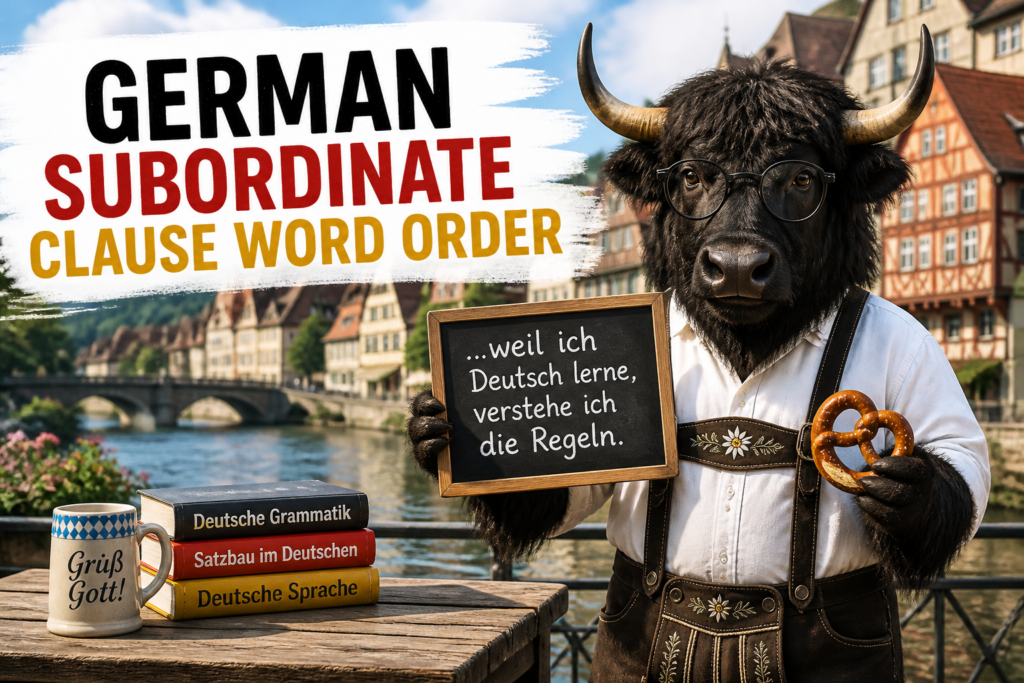
German subordinate clause word order is one of those topics that looks innocent, then quietly tries to eat your confidence for lunch. The good news: once you know the pattern, it becomes very predictable. And German does love a pattern, even when it pretends otherwise.
By the end of this guide, you will understand where the verb goes in German subordinate clauses, how to spot a subordinate clause fast, and how to build correct sentences without the usual word-order chaos. You will also learn the most common words that trigger subordinate clauses, plus the mistakes English speakers make again and again.
If you want a quick reference later, the related Yak Yacker guide is here: German Subordinate Clause Word Order. For a broader learning path, the main German hub is Learn German.
The Big Rule
In a German subordinate clause, the conjugated verb usually goes to the very end.
Main clause: Ich bleibe zu Hause.
Subordinate clause: weil ich zu Hause bleibe.
That means the same verb idea is still there, but the word order changes because the clause is no longer standing on its own. It depends on another part of the sentence.
| Pattern | Meaning | German Example | English Translation | Learner Note |
|---|---|---|---|---|
| …, weil + subject + other parts + verb | because … | Ich bleibe zu Hause, weil ich müde bin. | I am staying home because I am tired. | The verb bin goes to the end. |
| …, dass + subject + other parts + verb | that … | Ich glaube, dass er heute kommt. | I think that he is coming today. | dass is a very common subordinate-clause trigger. |
| …, wenn + subject + other parts + verb | if / when … | Wenn es regnet, bleiben wir drin. | If it rains, we stay inside. | At the start of the sentence, the subordinate clause comes first, and the main clause follows. |
| …, obwohl + subject + other parts + verb | although … | Obwohl ich spät bin, gehe ich noch einkaufen. | Although I am late, I am still going shopping. | Same verb-at-the-end rule. |
Yes, the verb travels to the end like it has a strict appointment. German grammar is not subtle about this.
What Counts As A Subordinate Clause?
A subordinate clause is a sentence part that cannot stand alone. It needs the main clause to make full sense. In English, the word order often stays pretty normal. In German, the verb usually gets pushed to the end.
Common words that start subordinate clauses include weil, dass, wenn, obwohl, damit, ob, als, bevor, nachdem, bis, and während.
| German | Pronunciation | Meaning | Example Sentence | Translation | Learner Note |
|---|---|---|---|---|---|
| weil | vile | because | Ich gehe nach Hause, weil ich müde bin. | I am going home because I am tired. | Very common in speech and writing. |
| dass | dass | that | Ich hoffe, dass alles klappt. | I hope that everything works out. | Do not confuse with das. |
| wenn | ven | if / when | Wenn du Zeit hast, ruf mich an. | If you have time, call me. | Used for repeated or future situations. |
| obwohl | op-vohl | although | Obwohl es kalt ist, gehen wir spazieren. | Although it is cold, we are going for a walk. | Introduces contrast. |
| damit | dah-mit | so that / in order that | Ich spreche langsam, damit du mich besser verstehst. | I am speaking slowly so that you understand me better. | Often followed by a different subject in the clause. |
| ob | op | whether / if | Ich weiß nicht, ob er heute kommt. | I do not know whether he is coming today. | Used for indirect yes/no questions. |
| bevor | beh-fohr | before | Bevor wir gehen, trinken wir noch Kaffee. | Before we go, we drink coffee first. | Time clause with verb at the end. |
| nachdem | nahkh-daym | after | Nachdem ich gegessen habe, gehe ich arbeiten. | After I have eaten, I go to work. | Often uses a perfect tense structure. |
| bis | biss | until | Warte, bis ich fertig bin. | Wait until I am finished. | Simple but very useful. |
| während | veh-rent | while / during | Während ich lerne, höre ich Musik. | While I study, I listen to music. | Careful: the verb still goes to the end. |
How The Word Order Changes
Here is the core pattern:
Subordinating word + subject + other information + conjugated verb
German loves to place everything before the verb in subordinate clauses: subject, objects, time phrases, place phrases, little comments, emotional baggage, the whole lot. Only the conjugated verb waits at the end.
| Pattern | Meaning | German Example | English Translation | Learner Note |
|---|---|---|---|---|
| weil + ich + heute keine Zeit + habe | because I have no time today | Ich gehe nicht raus, weil ich heute keine Zeit habe. | I am not going out because I have no time today. | The verb is the last thing in the subordinate clause. |
| dass + er + den Film + kennt | that he knows the film | Ich glaube, dass er den Film kennt. | I think that he knows the film. | Objects can appear before the final verb. |
| wenn + wir + morgen + früher + kommen | if we come earlier tomorrow | Wenn wir morgen früher kommen, können wir helfen. | If we come earlier tomorrow, we can help. | Time words often sit before the verb, but still after the subject or object. |
One useful habit: when you see a subordinating word, start mentally building the sentence until the very end. Do not stop halfway and panic. German is waiting for the verb like a dramatic actor waiting for applause.
Main Clause vs Subordinate Clause
In a main clause, the conjugated verb usually takes second position. In a subordinate clause, it goes to the end. That is the whole fight, honestly.
| Type | Word Order | German Example | English Translation |
|---|---|---|---|
| Main clause | Verb second | Ich gehe heute ins Kino. | I am going to the cinema today. |
| Subordinate clause | Verb last | …, weil ich heute ins Kino gehe. | …, because I am going to the cinema today. |
| Main clause after subordinate clause | Verb second in the main clause | Wenn ich Zeit habe, gehe ich heute ins Kino. | If I have time, I am going to the cinema today. |
Notice the second example carefully: when the subordinate clause comes first, the main clause still follows normal verb-second order. So the comma is not the only thing doing the heavy lifting.
Examples You Will Actually Use
Here are practical sentence patterns from everyday life: planning, excuses, opinions, and the useful art of sounding more polished than your emotions probably deserve.
| German | Pronunciation | Meaning | Example Sentence | Translation | Learner Note |
|---|---|---|---|---|---|
| weil | vile | because | Ich bleibe zu Hause, weil ich krank bin. | I am staying home because I am sick. | Classic and useful. |
| dass | dass | that | Ich glaube, dass der Zug Verspätung hat. | I think that the train is delayed. | Verspätung means delay. |
| wenn | ven | if / when | Wenn du willst, komme ich mit. | If you want, I will come with you. | Great for polite offers. |
| obwohl | op-vohl | although | Obwohl es spät ist, arbeiten wir weiter. | Although it is late, we keep working. | Common in more formal writing, too. |
| damit | dah-mit | so that | Ich schreibe es auf, damit ich es nicht vergesse. | I am writing it down so that I do not forget it. | Very natural in everyday speech. |
| bevor | beh-fohr | before | Bevor wir essen, waschen wir uns die Hände. | Before we eat, we wash our hands. | Time clause. |
| nachdem | nahkh-daym | after | Nachdem ich den Text gelesen habe, schreibe ich die Antwort. | After I have read the text, I write the answer. | Often appears in writing and instructions. |
| ob | op | whether / if | Ich weiß nicht, ob sie heute Zeit hat. | I do not know whether she has time today. | Used for uncertainty. |
| als | als | when / at the time that | Als ich klein war, hatte ich einen Hund. | When I was little, I had a dog. | Use als for one past event or period. |
| bis | biss | until | Wir warten, bis der Bus kommt. | We are waiting until the bus comes. | Simple, frequent, and very handy. |
| während | veh-rent | while / during | Während ich koche, hört mein Bruder Musik. | While I cook, my brother listens to music. | Two actions happen at the same time. |
| so dass | zoh dass | so that / with the result that | Es war dunkel, so dass wir kaum etwas sahen. | It was dark, so that we could hardly see anything. | More formal than simple damit in some contexts. |
Two Common Word Order Patterns
There are two very common ways subordinate clauses appear.
- Pattern 1: main clause + comma + subordinate clause
- Pattern 2: subordinate clause + comma + main clause
| Pattern | German Example | English Translation | Learner Note |
|---|---|---|---|
| Main clause first | Ich gehe nach Hause, weil ich müde bin. | I am going home because I am tired. | Very common in conversation. |
| Subordinate clause first | Weil ich müde bin, gehe ich nach Hause. | Because I am tired, I am going home. | Main clause after the comma still uses verb-second order. |
| Main clause first | Ich rufe dich an, wenn ich Zeit habe. | I will call you if I have time. | Natural and frequent. |
| Subordinate clause first | Wenn ich Zeit habe, rufe ich dich an. | If I have time, I will call you. | Useful for emphasis. |
German likes flexibility in clause order, but the verb rules do not become flexible just because the rest of the sentence feels social. Sadly.
Subordinate Clauses With More Than One Verb
When there is more than one verb, only the conjugated verb goes to the end. Other verb parts usually stay together near the end too.
| Pattern | Meaning | German Example | English Translation | Learner Note |
|---|---|---|---|---|
| …, weil + subject + … + gekommen ist | because he has come | Ich bin froh, weil er früh gekommen ist. | I am happy because he has come early. | In perfect tense, the participle and auxiliary stay together at the end. |
| …, dass + subject + … + helfen kann | that she can help | Ich denke, dass sie uns morgen helfen kann. | I think that she can help us tomorrow. | Modal verbs also go to the end in subordinate clauses. |
| …, weil + subject + … + hören will | because he wants to hear | Er bleibt leise, weil er nichts hören will. | He stays quiet because he does not want to hear anything. | The infinitive usually sits after the modal verb. |
So if you see a perfect tense or modal verb, do not only hunt for one verb. Look for the whole verb chunk at the end.
Rule Of Thumb For Sentence Building
Try this simple method:
- Start with the subordinating word: weil, dass, wenn, and so on.
- Add the subject.
- Add the rest of the information in a natural order.
- Put the conjugated verb at the end.
Example:
weil + ich + heute keine Lust + habe
weil ich heute keine Lust habe
Translation: because I do not feel like it today.
That tiny formula can save you from a lot of “I know this is wrong, but I cannot see why” moments.
Common Mistakes And Fixes
| Wrong | Correct | Why |
|---|---|---|
| Ich gehe nach Hause, weil ich bin müde. | Ich gehe nach Hause, weil ich müde bin. | The conjugated verb goes to the end of the subordinate clause. |
| Weil ich müde bin, ich gehe nach Hause. | Weil ich müde bin, gehe ich nach Hause. | After a fronted subordinate clause, the main clause still needs verb-second order. |
| Ich weiß, dass kommt er heute. | Ich weiß, dass er heute kommt. | The subject goes before the verb in the subordinate clause. |
| Ich glaube, weil er ist krank. | Ich glaube, weil er krank ist. | Same rule: verb at the end. |
| Wenn ich habe Zeit, rufe ich dich an. | Wenn ich Zeit habe, rufe ich dich an. | Natural word order usually places the object before the verb at the end. |
| Ich gehe ins Bett, nachdem ich habe gearbeitet. | Ich gehe ins Bett, nachdem ich gearbeitet habe. | In perfect tense, the participle goes before the auxiliary at the end. |
One more sneaky trap: dass and das. dass means “that” and introduces a subordinate clause. das means “the” or “that” as a pronoun or article. Different job, different spelling, same annoying amount of confusion.
Pronunciation Notes For The Most Common Clause Words
| German | Pronunciation | Meaning | Example | Translation | Learner Note |
|---|---|---|---|---|---|
| weil | vile | because | weil ich müde bin | because I am tired | The ei sounds like English “eye.” |
| wenn | ven | if / when | wenn du Zeit hast | if you have time | The w sounds like English v. |
| dass | dass | that | dass er kommt | that he is coming | The final ss is sharp and short. |
| obwohl | op-vohl | although | obwohl es kalt ist | although it is cold | Say it smoothly; do not stress every syllable too hard. |
| bevor | beh-fohr | before | bevor wir gehen | before we go | v again sounds like English f. |
If you are unsure about a word like weil or obwohl, it can help to listen to a reliable dictionary or learner site. DW Learn German has solid explanations, and Duden is the boring-but-useful standard reference for German usage.
Spot The Difference
Read the pairs below and notice how the verb moves.
| Sentence Type | German | Translation |
|---|---|---|
| Main clause | Ich lerne Deutsch. | I am learning German. |
| Subordinate clause | …, weil ich Deutsch lerne. | …, because I am learning German. |
| Main clause | Wir gehen jetzt. | We are leaving now. |
| Subordinate clause | …, wenn wir jetzt gehen. | …, when we leave now. |
| Main clause | Er weiß das. | He knows that. |
| Subordinate clause | …, dass er das weiß. | …, that he knows that. |
The basic idea is simple: in the subordinate clause, the verb stops trying to be the center of attention and moves to the back of the line. Very polite of it.
Practice Section
Try these quick drills. Say them out loud if possible. German word order gets much easier when your mouth has done the pattern a few times, rather than just your eyes staring at it like it owes you money.
1) Put The Verb In The Right Place
- Ich gehe nach Hause, weil ich müde ____.
- Wir bleiben drin, weil es regnet ____.
- Ich weiß, dass er morgen ____.
- Wenn du Zeit ____ , rufe ich dich an.
- Obwohl sie krank ____ , arbeitet sie heute.
Answers: bin, ist, kommt, hast, ist
2) Rewrite The Sentence
Change the sentence so the subordinate clause comes first.
- Ich lerne heute nicht, weil ich arbeiten muss.
- Ich kaufe Brot, wenn ich zum Bäcker gehe.
- Wir gehen früher, weil der Zug bald kommt.
Possible answers:
- Weil ich arbeiten muss, lerne ich heute nicht.
- Wenn ich zum Bäcker gehe, kaufe ich Brot.
- Weil der Zug bald kommt, gehen wir früher.
3) Fix The Word Order
- Ich glaube, dass kommt er später.
- Weil ich bin krank, bleibe ich zu Hause.
- Wenn regnet es, bleiben wir drinnen.
- Obwohl hat er viel zu tun, hilft er uns.
Correct versions:
- Ich glaube, dass er später kommt.
- Weil ich krank bin, bleibe ich zu Hause.
- Wenn es regnet, bleiben wir drinnen.
- Obwohl er viel zu tun hat, hilft er uns.
Mini Grammar Note: One Exception That Helps
There is one slightly comforting thing: in subordinate clauses, the verb is at the end, but the exact order before it can still feel flexible.
For example:
| German | English Translation | Note |
|---|---|---|
| …, weil ich heute arbeiten muss. | …, because I have to work today. | Normal order. |
| …, weil ich heute noch lange arbeiten muss. | …, because I still have to work for a long time today. | Extra details can fit before the final verb. |
| …, weil ich heute mit meinem Kollegen arbeiten muss. | …, because I have to work with my colleague today. | Prepositional phrases also appear before the final verb. |
The key is not memorizing one frozen template. It is learning the rule: subordinate clause, verb at the end.
Quick Reference Summary
- Subordinate clauses often start with words like weil, dass, wenn, obwohl, damit, and ob.
- In a subordinate clause, the conjugated verb usually goes to the end.
- If the subordinate clause comes first, the main clause still uses verb-second order.
- With more than one verb, the full verb chunk usually stays together at the end.
- dass means “that”; das is a different word.
- Do not copy English word order into German subordinate clauses. German is very specific about this, because apparently verbs enjoy being dramatic.
Yak takeaway: In German subordinate clauses, find the trigger word first, then send the conjugated verb to the end. Once that clicks, the sentence stops feeling like a puzzle with missing pieces.