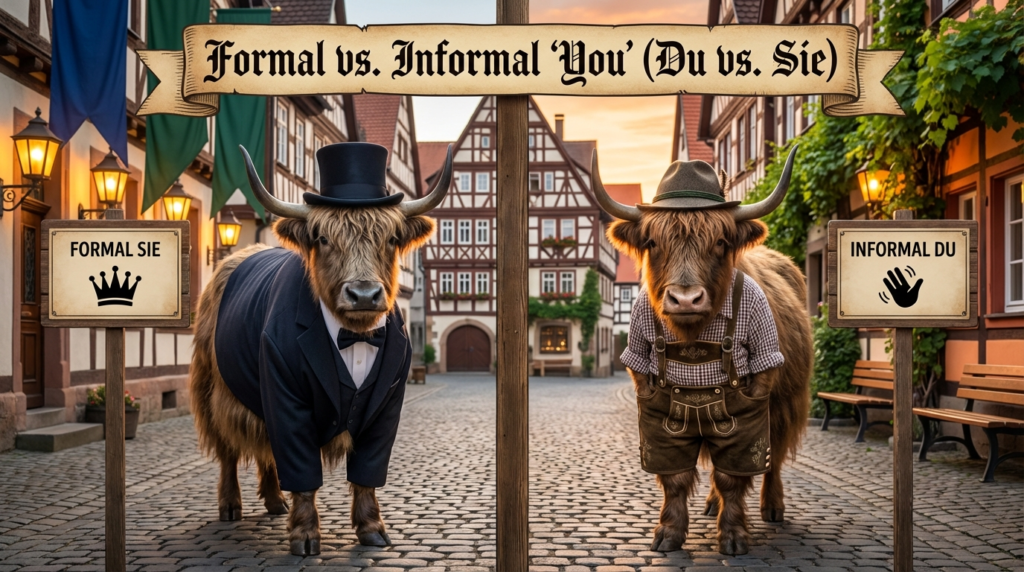
Formal vs. Informal “You” In German: Du vs. Sie
German has two main ways to say “you,” and yes, picking the wrong one can make things awkward faster than showing up to a wedding in beach flip-flops.
This guide shows you when to use du and when to use Sie, how the verbs change, which phrases you will hear in real life, and how to stop second-guessing yourself every time you open your mouth.
Here is the basic idea: du is informal and friendly. Sie is formal and polite. Both mean “you,” but they are used in different social situations.
If you are talking to friends, family, children, or people your age in a casual setting, du is usually the right choice. If you are talking to a stranger, a customer, a teacher, a doctor, a boss, or someone in a professional setting, Sie is usually safer.
The Yak Box: The Fast Rule
Use Sie until the situation clearly becomes du. In other words, when you are unsure, be polite first. German speakers do this all the time. Nobody gets offended because you were too respectful. The opposite can definitely happen.
When To Use Du
du is the informal singular “you.” You use it with one person when the relationship is casual, warm, or familiar.
- friends
- family members
- children
- classmates
- many coworkers in relaxed workplaces
- young people speaking to each other
In many apps, ads, and modern brands, you will also see du because it feels friendly and direct. German marketing loves pretending it is your buddy sometimes.
Wie heißt du? = What is your name?
Wo wohnst du? = Where do you live?
When To Use Sie
Sie is the formal singular and plural “you.” You use it when speaking politely to one person or a group in formal situations.
- strangers
- shop staff and customers
- teachers and professors
- doctors
- older people you do not know well
- business contacts
- official situations, emails, and appointments
The key detail: Sie is always capitalized when it means formal “you.” Lowercase sie can mean she or they. Tiny letter, big difference.
Wie heißen Sie? = What is your name?
Wo wohnen Sie? = Where do you live?
The Verb Changes Too
You do not just swap du for Sie. The verb changes as well. That is where many beginners trip over their own shoelaces.
| Pronoun | Use | Verb Pattern | Example |
|---|---|---|---|
| du | informal, one person | usually ends in -st | du kommst = you come |
| Sie | formal, one person or group | same form as sie/Sie plural | Sie kommen = you come |
| ihr | informal, more than one person | usually ends in -t | ihr kommt = you all come |
That third one, ihr, is worth knowing. It is the informal plural “you” when you speak to several people casually. Not the star of today’s show, but definitely not a random background extra either.
Rule To Example: The Core Patterns
Rule: Use Du For Familiar People
English meaning: informal “you” for one person.
Example: Hast du Zeit?
Do you have time?
Example: Du bist sehr nett.
You are very nice.
Rule: Use Sie For Polite Distance
English meaning: formal “you” for one person or more than one person.
Example: Haben Sie Zeit?
Do you have time?
Example: Sie sind sehr nett.
You are very nice.
Useful Phrases And Real-Life Sentences
These are the phrases that actually matter in conversations, emails, shops, and awkward first meetings where everyone is trying to be normal.
| German | English Meaning | Example Sentence |
|---|---|---|
| du | informal you | Du lernst schnell. = You learn quickly. |
| Sie | formal you | Sie lernen schnell. = You learn quickly. |
| Darf ich du sagen? | May I use du with you? | Wir arbeiten jetzt oft zusammen. Darf ich du sagen? = We work together often now. May I use du with you? |
| Wollen wir uns duzen? | Shall we use du with each other? | Wir kennen uns schon lange. Wollen wir uns duzen? = We have known each other for a long time. Shall we use du with each other? |
| Ich heiße … | My name is … | Hallo, ich heiße Nina. = Hello, my name is Nina. |
| Wie heißt du? | What is your name? (informal) | Hi, wie heißt du? = Hi, what is your name? |
| Wie heißen Sie? | What is your name? (formal) | Guten Tag, wie heißen Sie? = Good day, what is your name? |
| Wo wohnst du? | Where do you live? (informal) | Wo wohnst du jetzt? = Where do you live now? |
| Wo wohnen Sie? | Where do you live? (formal) | Wo wohnen Sie in Berlin? = Where do you live in Berlin? |
| Kannst du mir helfen? | Can you help me? (informal) | Kannst du mir kurz helfen? = Can you help me for a moment? |
| Können Sie mir helfen? | Can you help me? (formal) | Können Sie mir bitte helfen? = Can you please help me? |
| Was machst du? | What are you doing? (informal) | Was machst du heute Abend? = What are you doing this evening? |
| Was machen Sie? | What are you doing? / What do you do? (formal) | Was machen Sie beruflich? = What do you do for work? |
| Hast du Zeit? | Do you have time? (informal) | Hast du morgen Zeit? = Do you have time tomorrow? |
| Haben Sie Zeit? | Do you have time? (formal) | Haben Sie kurz Zeit? = Do you have a moment? |
| Entschuldigung | excuse me / sorry | Entschuldigung, können Sie mir helfen? = Excuse me, can you help me? |
| Guten Tag | good day / hello | Guten Tag, Frau Weber. = Good day, Ms. Weber. |
| Hallo | hello | Hallo, wie geht’s? = Hello, how’s it going? |
| Bitte | please / you’re welcome | Können Sie bitte langsamer sprechen? = Could you please speak more slowly? |
| Danke | thank you | Danke, du bist nett. = Thanks, you are nice. |
Quick Social Guide: Which One Should You Choose?
Usually Du
- a friend at a café
- your brother
- a child
- a classmate
- someone on a first-name basis in a relaxed setting
Usually Sie
- a receptionist
- a doctor
- a manager you just met
- an older stranger
- someone in a formal email or official letter
Modern German is becoming more casual in some places, especially startups, online spaces, and younger groups. Still, Sie first is the safest choice in professional or unfamiliar situations.
How Germans Switch From Sie To Du
At some point, one person may suggest using du instead of Sie. This is called das Du anbieten, literally “offering the du.” It is a small social ritual, and yes, German made a whole concept out of it.
- Wollen wir uns duzen? = Shall we use du with each other?
- Wir können gern du sagen. = We can happily use du.
- Sag einfach du. = Just say du.
Once both people agree, you switch fully. Do not mix du with Sie in the same relationship unless you are joking, confused, or having a very weird day.
Common Mistakes And Fast Fixes
- Mistake: saying Sie bist.
Fix: use Sie sind. Formal Sie takes plural-style verb forms. - Mistake: writing formal sie with a lowercase s.
Fix: write Sie when it means polite “you.” - Mistake: using du with a stranger in a business email.
Fix: start with Sie. - Mistake: translating English “you” automatically as one German word every time.
Fix: always ask: friendly and familiar, or polite and formal? - Mistake: forgetting ihr for casual plural.
Fix: use ihr when talking informally to more than one person.
Practice Section
Pick the better option: du or Sie. Then check the answers below.
- You are speaking to your new dentist.
- You are texting your best friend.
- You are asking a stranger at the train station for help.
- You are talking to your little cousin.
- You are writing to a company about a job interview.
- You are chatting with two close friends.
Answers
- Sie
- du
- Sie
- du
- Sie
- ihr
Try a second round by changing the verb:
- du haben → du hast
- Sie haben → Sie haben
- du sein → du bist
- Sie sein → Sie sind
- du können → du kannst
- Sie können → Sie können
Quick Reference Summary
| German Form | Meaning | Use It With | Example |
|---|---|---|---|
| du | you (informal singular) | friends, family, children, casual contacts | Wie heißt du? |
| Sie | you (formal singular/plural) | strangers, professional settings, polite situations | Wie heißen Sie? |
| ihr | you all (informal plural) | more than one friend or casual contact | Wo wohnt ihr? |
Final Yak
Remember this one sentence and you will survive most conversations just fine: Use du for familiar people, use Sie for polite distance, and use Sie first when you are not sure. That alone fixes a huge chunk of beginner mistakes.
Then learn the matching verb forms, especially du bist vs. Sie sind and du hast vs. Sie haben. Once those feel natural, the whole du/Sie system becomes much less dramatic.