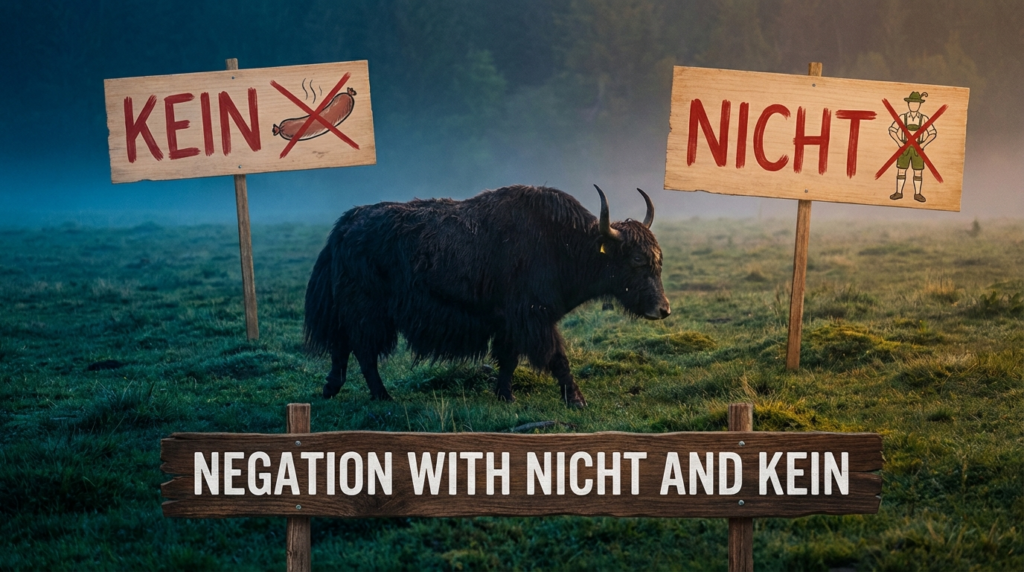
German Negation With Nicht And Kein
Two tiny words. One surprisingly rude amount of confusion. This guide shows you when to use nicht and when to use kein, with simple rules, real-life examples, and practice that does not feel like punishment.
In German, nicht usually means not, and kein usually means no or not a. That sounds innocent enough. Then German adds word order, case endings, and little traps. Cute.
The good news is that the core idea is very simple: use kein with nouns and use nicht for almost everything else. Once you see that pattern, the rest gets much easier.
Yak Box: Ask This First
Are you negating a noun like “a car,” “money,” or “time”? Use kein. Are you negating a verb, adjective, adverb, or the whole idea? Use nicht. That one question solves most beginner mistakes.
The Fast Difference
| Word | English Meaning | Use It For | Example |
|---|---|---|---|
| nicht | not | verbs, adjectives, adverbs, whole sentences, specific parts | Ich komme nicht. I am not coming. |
| kein | no / not a / not any | nouns with an indefinite idea | Ich habe kein Auto. I do not have a car. |
Use Nicht When You Negate The Action Or Description
Nicht means not. You use it when you are not negating a noun, but the action, the description, the time, the place, or the whole sentence.
Nicht + Verb Idea
German: nicht
English meaning: not
Example: Er arbeitet nicht.
He is not working.
Nicht + Adjective
German: nicht
English meaning: not
Example: Das Wetter ist nicht gut.
The weather is not good.
Nicht + Adverb
German: nicht
English meaning: not
Example: Sie fährt nicht schnell.
She does not drive fast.
Very common uses of nicht:
- Ich schlafe nicht. — I am not sleeping.
- Der Kaffee ist nicht heiß. — The coffee is not hot.
- Wir wohnen nicht hier. — We do not live here.
- Heute arbeite ich nicht. — I am not working today.
Use Kein When You Negate A Noun
Kein means no, not a, or not any. You use it with nouns when English would often use no or not a.
Think of kein as the negative partner of ein. If a noun could use ein, it can usually use kein when it becomes negative.
Kein
German: kein
English meaning: no / not a
Example: Ich habe kein Problem.
I have no problem.
Keine
German: keine
English meaning: no / not a / not any
Example: Sie hat keine Zeit.
She has no time.
Keinen
German: keinen
English meaning: no / not a
Example: Er braucht keinen Kaffee.
He does not need coffee.
| German | English Meaning | Example Sentence |
|---|---|---|
| kein Auto | no car / not a car | Ich habe kein Auto. I do not have a car. |
| keine Ahnung | no idea | Ich habe keine Ahnung. I have no idea. |
| keinen Hunger | no hunger / not hungry | Ich habe keinen Hunger. I am not hungry. |
| keine Zeit | no time | Wir haben keine Zeit. We have no time. |
Where Nicht Usually Goes
The position of nicht matters. German likes structure almost as much as it likes long compound nouns. Here are the beginner-safe patterns.
| Pattern | Meaning | Example 1 | Example 2 |
|---|---|---|---|
| nicht + adjective | not + description | Das Essen ist nicht kalt. The food is not cold. | Der Film ist nicht langweilig. The movie is not boring. |
| nicht + adverb | not + manner/time | Er spricht nicht langsam. He does not speak slowly. | Ich komme nicht heute. I am not coming today. |
| nicht + place/time phrase | not there / not then | Sie arbeitet nicht im Büro. She does not work in the office. | Wir fahren nicht am Montag. We are not going on Monday. |
| sentence-final nicht | negates the whole verbal idea | Ich rauche nicht. I do not smoke. | Er versteht mich nicht. He does not understand me. |
Easy memory trick: kein usually sits right before the noun. nicht usually sits before the thing it specifically negates, or near the end if it negates the whole action.
Nicht Vs Kein In Real-Life Pairs
These pairs show the difference clearly. Same general topic, different target of negation.
| German | English Meaning | Why It Uses This Form |
|---|---|---|
| Ich habe kein Auto. | I do not have a car. | Auto is a noun, so use kein. |
| Das Auto ist nicht neu. | The car is not new. | neu is an adjective, so use nicht. |
| Sie hat keine Zeit. | She has no time. | Zeit is a noun, so use keine. |
| Sie arbeitet heute nicht. | She is not working today. | The action is negated, so use nicht. |
| Wir trinken keinen Kaffee. | We do not drink coffee. | Kaffee is the noun being negated. |
| Wir trinken Kaffee nicht schwarz. | We do not drink coffee black. | schwarz is the description being negated. |
Useful Phrases You Will Hear All The Time
| German | English Meaning | Example 1 | Example 2 | Example 3 |
|---|---|---|---|---|
| nicht so gut | not so good | Mir geht es heute nicht so gut. I am not feeling so good today. | Das klingt nicht so gut. That does not sound so good. | Das Wetter ist nicht so gut. The weather is not so good. |
| nicht mehr | not anymore | Ich wohne dort nicht mehr. I do not live there anymore. | Er arbeitet hier nicht mehr. He does not work here anymore. | Wir brauchen das nicht mehr. We do not need that anymore. |
| noch nicht | not yet | Ich bin noch nicht fertig. I am not finished yet. | Sie ist noch nicht da. She is not here yet. | Wir wissen es noch nicht. We do not know it yet. |
| gar nicht | not at all | Das gefällt mir gar nicht. I do not like that at all. | Ich verstehe das gar nicht. I do not understand that at all. | Er schläft gar nicht. He is not sleeping at all. |
| kein Problem | no problem | Kein Problem, ich helfe dir. No problem, I will help you. | Das ist kein Problem. That is no problem. | Für uns ist das kein Problem. For us, that is no problem. |
| keine Ahnung | no idea | Ich habe keine Ahnung. I have no idea. | Er hat keine Ahnung von Autos. He has no idea about cars. | Wir haben keine Ahnung, wo sie ist. We have no idea where she is. |
| kein Geld | no money | Ich habe heute kein Geld dabei. I do not have any money with me today. | Sie hat kein Geld für ein Taxi. She has no money for a taxi. | Ohne Job hat er kein Geld. Without a job, he has no money. |
| keine Zeit | no time | Ich habe keine Zeit. I have no time. | Heute haben wir keine Zeit zum Kochen. Today we have no time to cook. | Sie hat am Morgen keine Zeit. She has no time in the morning. |
| keinen Hunger | not hungry / no appetite | Ich habe keinen Hunger. I am not hungry. | Nach dem Frühstück hat er keinen Hunger. After breakfast he is not hungry. | Die Kinder haben keinen Hunger. The children are not hungry. |
| nicht wahr | isn’t it / right? | Das ist einfach, nicht wahr? That is easy, isn’t it? | Du kommst morgen, nicht wahr? You are coming tomorrow, right? | Schönes Wetter, nicht wahr? Nice weather, isn’t it? |
Common Mistakes And Fast Fixes
- Wrong: Ich habe nicht Auto.
Right: Ich habe kein Auto.
Because Auto is a noun. - Wrong: Das ist kein gut.
Right: Das ist nicht gut.
Because gut is an adjective. - Wrong: Ich bin kein müde.
Right: Ich bin nicht müde.
Because müde describes how you feel. - Wrong: Ich gehe kein heute.
Right: Ich gehe heute nicht.
Because the action is negated, not a noun. - Wrong: Wir haben nicht Zeit.
Right: Wir haben keine Zeit.
Because Zeit is a noun used without a definite article here.
Quick Rule About Articles
Kein is used where a noun would normally have ein or no article in a general sense.
| Positive | Negative | English |
|---|---|---|
| Ich habe ein Auto. | Ich habe kein Auto. | I have a car. / I do not have a car. |
| Sie hat Zeit. | Sie hat keine Zeit. | She has time. / She has no time. |
| Er trinkt Kaffee. | Er trinkt keinen Kaffee. | He drinks coffee. / He does not drink coffee. |
Mini Forms Of Kein You Will Meet Early
You do not need every ending on day one, but these three show up constantly:
| German Form | English Meaning | Use | Example |
|---|---|---|---|
| kein | no / not a | often masculine or neuter singular in nominative/accusative contexts | Das ist kein Problem. That is no problem. |
| keine | no / not a / not any | often feminine singular or plural | Sie hat keine Tasche. She does not have a bag. |
| keinen | no / not a | often masculine accusative | Ich brauche keinen Termin. I do not need an appointment. |
Small But Useful Nuance
You can sometimes negate a noun with nicht ein, but that usually adds emphasis, contrast, or surprise. Beginners should mostly stick with kein.
Er hat kein Auto. — He does not have a car.
Er hat nicht ein Auto, sondern zwei. — He does not have one car, but two.
Practice Section
Choose nicht or the correct form of kein.
- Ich habe ___ Hund.
- Das Essen ist ___ kalt.
- Wir haben ___ Zeit.
- Er kommt heute ___.
- Sie braucht ___ Kaffee.
- Ich bin ___ müde.
- Das ist ___ gute Idee.
- Wir wohnen ___ in Berlin.
Show The Answers
- keinen — Ich habe keinen Hund. — I do not have a dog.
- nicht — Das Essen ist nicht kalt. — The food is not cold.
- keine — Wir haben keine Zeit. — We have no time.
- nicht — Er kommt heute nicht. — He is not coming today.
- keinen — Sie braucht keinen Kaffee. — She does not need coffee.
- nicht — Ich bin nicht müde. — I am not tired.
- keine — Das ist keine gute Idee. — That is not a good idea.
- nicht — Wir wohnen nicht in Berlin. — We do not live in Berlin.
Quick Reference Summary
- Use kein to negate a noun: kein Auto, keine Zeit, keinen Kaffee.
- Use nicht to negate verbs, adjectives, adverbs, places, times, or the whole sentence: nicht gut, nicht heute, ich komme nicht.
- If English says not a or no before a noun, German often uses kein.
- If English says not before an action or description, German usually uses nicht.
- When in doubt, ask: “Am I negating a noun?” If yes, start with kein.
Final Yak
Kein is for nouns. Nicht is for pretty much everything else. That is the big win. The fancy details can come later, wearing their little grammar costumes.
Master this one contrast and your German will sound much more natural right away. Also, you will stop saying things like Ich habe nicht Auto, which is lovely for everyone involved.