German Regular Verb Conjugation Basics
Learn how regular German verbs change in the present tense, without staring at a grammar chart like it insulted your family.
Regular verbs are the friendly ones. They follow a clear pattern, which means you do not need to memorize a hundred random forms right away. Once you learn the endings, you can use them with loads of common German verbs.
This guide focuses on the present tense. You will learn the basic endings, how to find the verb stem, and how to build simple real-life sentences like Ich lerne Deutsch and Wir wohnen in Berlin.
Yak Box: The Big Idea
Most regular German verbs work like this:
verb stem + ending
Take machen (to do, to make). Remove -en and you get the stem mach-. Then add the correct ending: ich mache, du machst, wir machen. Nice, tidy, and far less dramatic than irregular verbs.
Step 1: Find The Verb Stem
The infinitive is the basic dictionary form of the verb. In German, many regular verbs end in -en.
| German Verb | English Meaning | Stem | Example Sentence |
|---|---|---|---|
| machen | to do, to make | mach- | Ich mache meine Hausaufgaben. (I do my homework.) |
| lernen | to learn | lern- | Wir lernen German. (We learn German.) |
| wohnen | to live, to reside | wohn- | Sie wohnen in Hamburg. (They live in Hamburg.) |
| spielen | to play | spiel- | Die Kinder spielen im Park. (The children play in the park.) |
| kaufen | to buy | kauf- | Ich kaufe Brot. (I buy bread.) |
Step 2: Learn The Present Tense Endings
These are the basic endings for regular German verbs in the present tense:
| Subject Pronoun | English Meaning | Ending | Full Form With machen |
|---|---|---|---|
| ich | I | -e | ich mache |
| du | you (one person, informal) | -st | du machst |
| er / sie / es | he / she / it | -t | er macht / sie macht / es macht |
| wir | we | -en | wir machen |
| ihr | you (plural, informal) | -t | ihr macht |
| sie / Sie | they / you (formal) | -en | sie machen / Sie machen |
Quick memory trick: wir and formal Sie use the full infinitive ending -en. That means wir lernen and Sie lernen look just like the dictionary form lernen. Convenient, for once.
Step 3: Build A Full Conjugation
Now let’s conjugate one regular verb from top to bottom.
| German | English Meaning | Example Sentence |
|---|---|---|
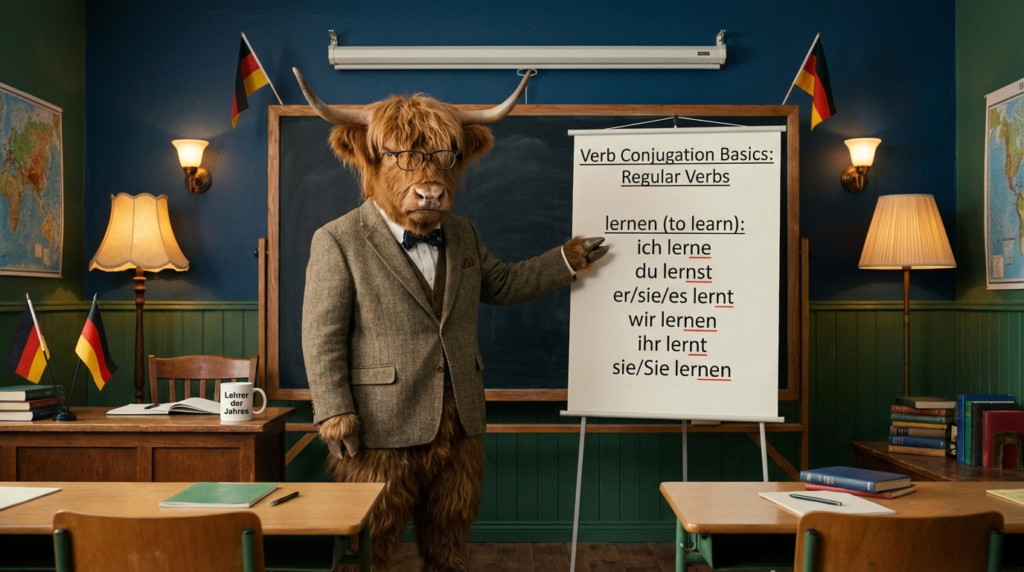
| ich lerne | I learn | Ich lerne jeden Abend German. (I learn German every evening.) |
| du lernst | you learn | Du lernst sehr schnell. (You learn very quickly.) |
| er / sie / es lernt | he / she / it learns | Sie lernt in der Bibliothek. (She learns in the library.) |
| wir lernen | we learn | Wir lernen zusammen. (We learn together.) |
| ihr lernt | you all learn | Ihr lernt heute neue Wörter. (You all learn new words today.) |
| sie / Sie lernen | they learn / you learn (formal) | Sie lernen German für die Arbeit. (They learn German for work. / You learn German for work.) |
Rule To Example: The Pattern In Real Life
Ich + -e
ich wohne = I live
Ich wohne in München.
(I live in Munich.)
Du + -st
du spielst = you play
Du spielst Fußball.
(You play soccer.)
Er / Sie / Es + -t
er arbeitet = he works
Er arbeitet heute zu Hause.
(He works from home today.)
Wir + -en
wir kaufen = we buy
Wir kaufen Kaffee.
(We buy coffee.)
Ihr + -t
ihr macht = you all do
Ihr macht das sehr gut.
(You all do that very well.)
Sie / sie + -en
Sie arbeiten = you work (formal)
Sie arbeiten sehr schnell.
(You work very quickly.)
Common Regular Verbs You Will Actually Use
| German Verb | English Meaning | Example 1 | Example 2 |
|---|---|---|---|
| arbeiten | to work | Ich arbeite viel. (I work a lot.) | Wir arbeiten im Büro. (We work in the office.) |
| fragen | to ask | Ich frage den Lehrer. (I ask the teacher.) | Sie fragt nach dem Preis. (She asks about the price.) |
| kochen | to cook | Er kocht Pasta. (He cooks pasta.) | Wir kochen zusammen. (We cook together.) |
| reisen | to travel | Ich reise im Sommer. (I travel in summer.) | Sie reisen nach Wien. (They travel to Vienna.) |
| sagen | to say | Du sagst die Wahrheit. (You tell the truth.) | Er sagt nichts. (He says nothing.) |
| lernen | to learn | Ihr lernt schnell. (You all learn quickly.) | Wir lernen jeden Tag. (We learn every day.) |
Common Mistakes And Fast Fixes
- Using the infinitive after a subject
Ich lernen German. ❌
Ich lerne German. ✅ - Forgetting the -st with du
Du lern Deutsch. ❌
Du lernst Deutsch. ✅ - Mixing up ihr and wir
Wir spielt Fußball. ❌
Wir spielen Fußball. ✅ - Missing the capital letter in formal Sie
sie lernen German = they learn German
Sie lernen German = you learn German (formal)
German regular verbs are not trying to ruin your day. Learn the endings, spot the stem, and the whole thing gets much less scary.
Practice Section
Try these quick drills before your brain wanders off for a snack.
Fill In The Correct Form
- ich _______ (machen)
- du _______ (lernen)
- wir _______ (wohnen)
- ihr _______ (spielen)
- Sie _______ (arbeiten)
Answers: mache, lernst, wohnen, spielt, arbeiten
Change The Subject
- Ich arbeite heute. → change to wir
- Du spielst Tennis. → change to er
- Sie lernen German. → change to ich
Answers: Wir arbeiten heute. / Er spielt Tennis. / Ich lerne German.
Quick FAQ
Are all German verbs regular?
No. Many common verbs are irregular. That is German being German. But regular verbs give you the base pattern you need.
Is Sie always formal?
Capital Sie is formal “you.” Lowercase sie can mean “she” or “they,” depending on context.
Do I always need the subject pronoun?
Yes, in normal sentences you usually say the subject: ich lerne, wir spielen, and so on.
Quick Reference Summary
| Pattern | Meaning | Example 1 | Example 2 |
|---|---|---|---|
| stem + -e | ich form | ich spiele | ich wohne |
| stem + -st | du form | du lernst | du kaufst |
| stem + -t | er / sie / es / ihr form | er arbeitet | ihr fragt |
| stem + -en | wir / sie / Sie form | wir reisen | Sie lernen |
Final Yak
To conjugate a regular German verb in the present tense, remove -en, keep the stem, and add the right ending: -e, -st, -t, -en, -t, -en. Start with a few common verbs like lernen, machen, wohnen, and arbeiten, and repeat them in simple sentences until the pattern feels boring. Boring is good here. Boring means it is finally sticking.