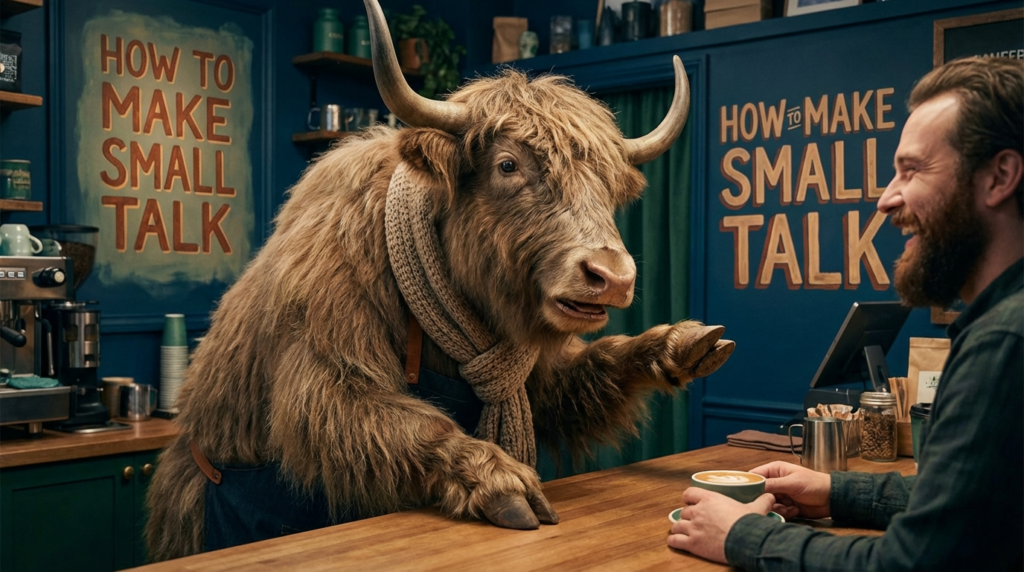
A personified yak English teacher that teaches small talk in English with friendly conversation starters.

How To Make Small Talk In English

Real-life American phrases to start, continue, and end a friendly conversation—without feeling awkward.

Small talk is the friendly “warm-up” talk you do with coworkers, neighbors, classmates, baristas, and strangers in line. The goal is simple: sound friendly and keep the conversation moving—not deliver a TED Talk.

This guide gives you ready-to-use American English phrases, plus follow-up questions, topic ideas, and polite ways to exit. (Yes, you’re allowed to leave. Politely.)

Yak Box: The One Rule That Saves You

Rule: Make a small comment, then ask a small question.

  • Comment: “This line is moving fast today.”
  • Question: “Are you heading to work or just running errands?”

That’s it. Comment + question = you sound social, not scripted.

What Small Talk Is (And Isn’t)

Small Talk Is…

  • Light and friendly
  • Short (often 30 seconds to 5 minutes)
  • About safe topics: weather, weekend plans, food, the place you’re in
  • A way to build comfort and connection


Small Talk Isn’t…


  • A deep debate
  • A job interview (usually)
  • A place for very personal questions
  • A time to “win” the conversation


Fast Vocabulary You’ll Use A Lot


Catch Up


Meaning: talk to someone you haven’t seen in a while.


Example: “We should catch up sometime this week.”


No Worries


Meaning: it’s fine; don’t stress.


Example: “Sorry I’m late.” “No worries!”


Kind Of


Meaning: somewhat; not fully yes or no.


Example: “Do you like spicy food?” “Kind of—medium spice is my limit.”


Sounds Good


Meaning: I agree; that plan is fine.


Example: “Want to grab coffee later?” “Sounds good!”


By The Way


Meaning: a smooth way to change the topic.


Example: “By the way, how’s your new job going?”


Good To See You


Meaning: a warm greeting (even if you’re tired inside).


Example: “Hey! Good to see you.”


Conversation Starters That Actually Work


Each starter includes the meaning (what it’s doing socially) and an example you can copy.


Friendly Openers


  • “How’s it going?” Meaning: casual “How are you?” Example: “Hey, how’s it going?”

  • “How’s your day going?” Meaning: friendly check-in. Example: “How’s your day going so far?”

  • “Long time no see!” Meaning: you haven’t met in a while. Example: “Long time no see! How have you been?”

  • “Good to see you!” Meaning: warm greeting. Example: “Good to see you—how’ve you been?”


Quick note: In American English, “How are you?” is often just a greeting. A normal answer is “Good, thanks. How about you?”


Easy Comment Starters


  • “It’s beautiful out today.” Meaning: light weather talk. Example: “It’s beautiful out today—finally!”

  • “This place is packed.” Meaning: talk about the situation. Example: “This place is packed—guess everyone had the same idea.”

  • “That smells amazing.” Meaning: friendly observation. Example: “That smells amazing—what did you order?”

  • “I like your (shoes/jacket/bag).” Meaning: a simple compliment. Example: “I like your jacket—where’d you get it?”


British English note: In the UK, you might hear “You alright?” as a greeting. In the US, that can sound like something is wrong, so stick with “How’s it going?”


Follow-Up Questions That Keep It Going


QuestionMeaningExample Answer
“How about you?”Return the question (very common in the US).“Pretty good. How about you?”
“What do you do?”Ask about work/study (polite with adults).“I’m in marketing. How about you?”
“How do you know (Name)?”Ask about the connection at a party/event.“We worked together last year.”
“What brings you here today?”Ask why they’re at the place/event.“Just meeting a friend for lunch.”
“Have you been here before?”Easy question for restaurants/events.“Yeah, once. The coffee’s great.”
“Any plans for the weekend?”Safe topic, lots of possible answers.“Nothing big—just relaxing.”
“How was your weekend?”Good for Mondays.“Pretty chill. I just caught up on sleep.”
“What do you like to do for fun?”Find shared interests.“I’m into hiking and cooking.”


Friendly Reactions That Make You Sound Natural


Show Interest


  • “No way!” Meaning: friendly surprise. Example: “No way! You met him in person?”

  • “That’s awesome.” Meaning: positive reaction. Example: “That’s awesome. Congrats!”

  • “That’s wild.” Meaning: surprised/amazed (casual). Example: “That’s wild—how did that happen?”

  • “Good for you!” Meaning: supportive praise. Example: “You finished the marathon? Good for you!”


Keep Them Talking


  • “Tell me more.” Meaning: invite details. Example: “Tell me more—what was it like?”

  • “How so?” Meaning: ask for explanation. Example: “You said it was stressful—how so?”

  • “What happened next?” Meaning: continue the story. Example: “Okay, and what happened next?”

  • “That makes sense.” Meaning: show understanding. Example: “Yeah, that makes sense.”


Polite Ways To Change The Topic


  • “By the way, …” Meaning: smooth topic switch. Example: “By the way, did you ever try that new place downtown?”

  • “Speaking of (topic), …” Meaning: connect topics. Example: “Speaking of movies, have you seen anything good lately?”

  • “That reminds me, …” Meaning: gentle change. Example: “That reminds me, I need to text my sister back.”

  • “On a totally different note, …” Meaning: clear switch (still friendly). Example: “On a totally different note, are you traveling anywhere soon?”


Polite Ways To End Small Talk (Without Disappearing)


Use this simple exit formula: Warm line + Reason + (Optional) Future line


  • “It was great talking to you.” Meaning: warm ending. Example: “It was great talking to you—hope you have a good one.”

  • “I’m going to grab a drink, but I’ll catch you later.” Meaning: polite exit with reason. Example: “I’m going to grab a drink, but I’ll catch you later.”

  • “I should get back to work.” Meaning: common workplace exit. Example: “I should get back to work—nice chatting!”

  • “I don’t want to keep you.” Meaning: respectful exit (slightly formal). Example: “I don’t want to keep you—good luck with the rest of your day.”

  • “Let’s catch up soon.” Meaning: friendly future connection. Example: “Let’s catch up soon—text me!”


Small Talk Cheat Sheet: Copy-Paste Phrases


Here are extra high-utility phrases (with meanings and examples) you’ll hear all over the US.


PhraseMeaningExample 1Example 2Example 3
“Pretty good.”A common, casual “I’m fine.”“How are you?” “Pretty good.”“Pretty good—can’t complain.”“Pretty good. You?”
“Not bad.”Also means “fine.”“How’s it going?” “Not bad.”“Not bad for a Monday.”“Not bad. How about you?”
“Can’t complain.”Things are okay.“How’ve you been?” “Can’t complain.”“Busy, but can’t complain.”“Can’t complain—life’s good.”
“I’m swamped.”Very busy (work/life).“How’s work?” “I’m swamped.”“I’m swamped this week.”“Totally swamped—deadlines.”
“Just chilling.”Relaxing (casual).“What are you up to?” “Just chilling.”“Just chilling at home.”“Just chilling—nothing big.”
“What’s up?”Casual greeting: “Hi.”“What’s up?” “Not much.”“Hey, what’s up?”“What’s up with you?”
“Not much.”“Nothing special.”“What’s up?” “Not much.”“Not much—just working.”“Not much. You?”
“Same here.”I feel/do that too.“I’m tired.” “Same here.”“I love tacos.” “Same here.”“I’ve been busy.” “Same here.”
“Totally.”Strong agreement (casual).“That’s a good idea.” “Totally.”“Totally agree.”“Yeah, totally.”
“I hear you.”I understand (empathetic).“Work’s been rough.” “I hear you.”“I hear you—it’s stressful.”“I hear you. That’s tough.”
“That’s fair.”Your point is reasonable.“I’m not ready.” “That’s fair.”“That’s fair—I get it.”“Yeah, that’s fair.”
“Maybe.”Soft, polite uncertainty.“Want dessert?” “Maybe.”“Maybe later.”“Maybe—let’s see.”
“I’m down.”I’m willing / I want to.“Want to go?” “I’m down.”“I’m down for coffee.”“I’m down—what time?”
“I’ll pass.”Polite “no” (casual).“Want a drink?” “I’ll pass.”“I’ll pass—thanks though.”“I’ll pass this time.”
“Maybe another time.”Soft decline (polite).“Want to hang out?” “Maybe another time.”“Maybe another time—busy week.”“Another time for sure.”
“I’d better get going.”Polite exit phrase.“I’d better get going—nice talking!”“I’d better get going—see you!”“I’d better get going—take care.”
“Take care.”Friendly goodbye.“Take care!”“Take care—see you soon.”“You too, take care.”
“Have a good one.”Friendly goodbye (US).“Thanks—have a good one!”“Have a good one!”“You too—have a good one.”


Practice: Say It Like You Mean It


Drill 1: Fill The Blank


  • “Hey! How’s it ______?”

  • “It’s ______ out today.”

  • “Any plans for the ______?”

  • “That’s ______. Tell me more.”

  • “I’d better get ______. Nice talking to you.”


Suggested answers: going, beautiful/nice/cold, weekend, awesome/wild, going


Drill 2: Choose A Natural Reply


  • A: “How are you?” B: (a) “I am 80% happy.” (b) “Pretty good, thanks. How about you?”

  • A: “That’s a long commute.” B: (a) “I hear you.” (b) “My commute is 42 minutes and 12 seconds.”

  • A: “Want to grab coffee sometime?” B: (a) “Sounds good!” (b) “I consume beverages periodically.”


Answers: b, a, a


Drill 3: Mini Role-Plays


  • In A Coffee Shop: Comment about the smell or the line, then ask what they recommend.

  • At Work: Ask about their weekend, then share one small thing you did.

  • At A Party: “How do you know (Name)?” then follow up with “How long have you known them?”


Keep it to 3 turns each: you → them → you. Short is powerful.


Common Mistakes (And Quick Fixes)


Mistake


  • Answering “How are you?” with a long life story

  • Asking very personal questions too early

  • Only asking questions (feels like an interview)

  • Ending the conversation by vanishing


Fix


  • Keep it short: “Good, thanks! How about you?”

  • Stay safe: weekend, food, hobbies, the place you’re in

  • Use comment + question: “That’s a great idea. How did you get into it?”

  • Exit politely: “Nice talking to you—I’d better get going.”


Quick Reference: The Small Talk Recipe


  • Start: Greeting + simple comment (“Hey! Nice day, right?”)

  • Build: Follow-up question (“Any plans for the weekend?”)

  • Connect: Small share (“Same here—I’m just relaxing.”)

  • Keep Going: Reaction + one more question (“That’s awesome. How long have you been doing that?”)

  • Exit: Warm line + reason (“Great talking to you—I should get back to work.”)


FAQ: “What If I Don’t Know What To Say?”

Use a safe backup: “How’s your day going?” Then listen for a keyword (work, food, weekend, travel) and ask a simple follow-up: “Oh nice—how was it?”


FAQ: “What Topics Should I Avoid?”

If you don’t know the person well, avoid heavy topics like politics, religion, very personal money questions, and health details. Keep it light until you have rapport.


Final Yak


If you can do one thing today, do this: say one friendly comment and ask one easy question. Small talk isn’t about being perfect—it’s about being pleasant. (Yes, that counts as a skill.)