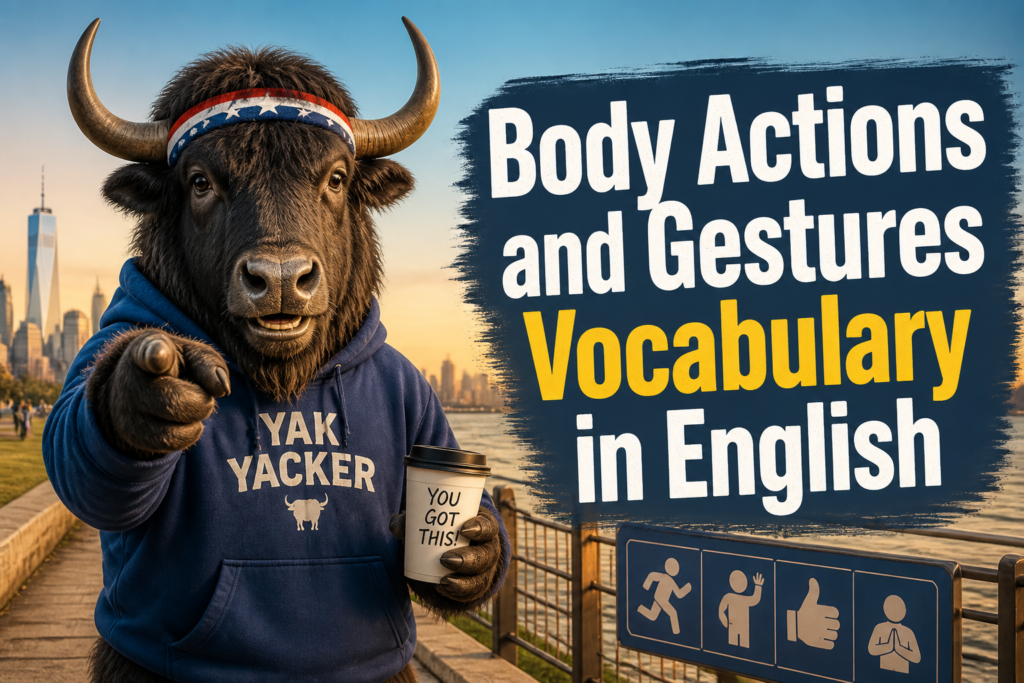
Body language talks before your mouth does. That sounds dramatic, but it is annoyingly true. A shrug, a wave, a nod, or a glare can say a lot in English, even when the words are very simple.
This guide teaches practical English for common body actions and gestures. You will learn everyday vocabulary, pronunciation help, meanings, example sentences, and little learner notes so you can understand people better and describe actions naturally.
Some gestures are friendly. Some are rude. Some are so universal that people barely think about them. Others can be a tiny cultural trap waiting to ruin your day. Fun.
For a larger English-learning path, you can also explore Learn English. If you want to check your level, try the English Placement Test CEFR or the English Vocabulary Test.
Useful Body Actions And Gestures
Here are common words and phrases you will hear in real life, from conversations to movies to “why is that person waving both hands like that?” situations.
| English | Pronunciation | Meaning | Example Sentence | Learner Note |
|---|---|---|---|---|
| nod | naad | move your head up and down, usually to say yes | She nodded when I asked if she understood. | Common and useful in conversation. |
| shake your head | shayk yoor hed | move your head from side to side, usually to say no | He shook his head and walked away. | Do not confuse this with “shake hands.” |
| wave | wayv | move your hand to say hello or goodbye | I waved at my friend from across the street. | Friendly and very common. |
| point | poynt | show something by directing your finger or hand toward it | Can you point to the nearest station? | Be careful in some cultures; pointing can feel rude. |
| shrug | shrug | lift your shoulders to show uncertainty, indifference, or “I don’t know” | He shrugged when I asked about the problem. | Very natural in informal English. |
| smile | smyl | make a happy or friendly face | The teacher smiled at the class. | Can show warmth, politeness, or amusement. |
| frown | frown | make an unhappy or concerned face | She frowned when she saw the bill. | Often shows confusion, worry, or annoyance. |
| stare | stair | look at someone or something for a long time | He stared at the screen in surprise. | Can feel rude if it lasts too long. |
| glance | glans | look quickly at something | I glanced at my phone during lunch. | Short look; common in daily English. |
| gaze | gayz | look at something steadily, often with interest or emotion | They gazed at the mountains in silence. | More poetic or literary than look. |
More Common Actions People Use Every Day
| English | Pronunciation | Meaning | Example Sentence | Learner Note |
|---|---|---|---|---|
| cross your arms | kraws yoor ahrmz | put one arm over the other across your chest | He crossed his arms and waited for an answer. | Can suggest impatience or defensiveness. |
| fold your arms | fohld yoor ahrmz | bring your arms across your body and rest them there | She folded her arms and looked annoyed. | Often used in descriptions of body language. |
| clap | klap | hit your hands together to show approval or rhythm | The audience clapped after the speech. | Common for applause. |
| snap your fingers | snap yoor fing-gerz | press your fingers together to make a sharp sound | He snapped his fingers to get the waiter’s attention. | May sound rude in some situations. |
| raise your hand | rayz yoor hand | lift your hand to ask a question or get attention | Students raised their hands to answer. | Very useful in school or meetings. |
| lower your voice | loh-er yoor voyss | speak more quietly | Please lower your voice in the library. | Useful for polite requests. |
| whisper | HWIS-per | speak very quietly | They whispered during the movie. | Use when you do not want others to hear. |
| beckon | BEK-uhn | signal someone to come closer with your hand | She beckoned me over with one finger. | A little more formal than wave over. |
| tap | tap | touch lightly and quickly | He tapped me on the shoulder. | Often used for getting attention. |
| pat | pat | touch gently with the hand | She patted the dog on the head. | Usually gentle and friendly. |
Face And Mouth Gestures
| English | Pronunciation | Meaning | Example Sentence | Learner Note |
|---|---|---|---|---|
| smirk | smurk | slight smile that often shows self-satisfaction or sarcasm | He smirked when he knew the answer. | Can sound a bit annoying or smug. |
| grimace | GRIM-iss | make a face because of pain, embarrassment, or dislike | She grimaced after tasting the medicine. | Good for describing discomfort. |
| raise an eyebrow | rayz an EYE-brow | show surprise, doubt, or interest by lifting an eyebrow | He raised an eyebrow at the strange comment. | Very common in storytelling. |
| pout | powt | push your lips out to show annoyance or sadness | The child pouted when he did not get dessert. | Often used for mild frustration. |
| purse your lips | pers yoor lips | press your lips together tightly | She pursed her lips before answering. | Can show thought, disapproval, or tension. |
| yawn | yawn | open your mouth wide, usually when tired or bored | He yawned during the long meeting. | Very common; also contagious, unfortunately. |
| lick your lips | lik yoor lips | move your tongue over your lips | She licked her lips before tasting the soup. | Can show hunger, nerves, or anticipation. |
| bite your lip | bite yoor lip | press your lip with your teeth, often when nervous or holding back emotion | He bit his lip and stayed quiet. | Common in descriptions of anxiety. |
| laugh | laf | make sounds because something is funny | Everyone laughed at the joke. | One of the most universal human actions. |
| cry | kry | produce tears because of sadness, pain, or strong emotion | The baby cried all night. | Can also mean emotional relief. |
Hands, Arms, And Body Movements
| English | Pronunciation | Meaning | Example Sentence | Learner Note |
|---|---|---|---|---|
| gesture | JES-cher | movement of the hands, head, or body to communicate meaning | He made a small gesture to ask for quiet. | Broad word for body communication. |
| signal | SIG-nuhl | use a movement or sign to communicate | She signaled for the taxi to stop. | Can be physical or nonverbal. |
| gesture to someone | JES-cher too | move your hand to show or invite someone | The guard gestured to us to come forward. | Common in directions and instructions. |
| wink | wingk | close one eye briefly, often to show friendliness, humor, or secret meaning | He winked at her after the joke. | Can be playful, flirtatious, or teasing. |
| nudge | nuj | push lightly with your elbow or hand | I nudged him to pay attention. | Useful in casual conversation. |
| grab | grab | take hold of something quickly | She grabbed her bag and ran. | Can sound sudden or energetic. |
| hold out | hohl dout | extend your hand or something toward another person | He held out his hand for a handshake. | Very common with offers and greetings. |
| reach for | reech fer | stretch your hand toward something | She reached for the glass on the table. | Useful with objects and actions. |
| stretch | strech | extend your body or arms to become longer or looser | I stretched after sitting too long. | Often used after waking up or exercise. |
| lean forward | leen FOR-werd | move your body slightly toward the front | He leaned forward to hear better. | Shows interest or attention. |
Social Gestures And Everyday Phrases
These are the kinds of phrases people actually use when they describe actions in real situations. Nice, useful, and much less dramatic than a dictionary’s mood.
| English | Pronunciation | Meaning | Example Sentence | Learner Note |
|---|---|---|---|---|
| shake hands | shayk handz | hold someone’s hand and move it briefly up and down as a greeting or agreement | They shook hands after the interview. | Common in business and formal meetings. |
| give a thumbs up | giv uh THUMZ up | raise your thumb to show approval | She gave me a thumbs up after reading the message. | Friendly and widely understood. |
| thumbs down | THUMZ down | gesture showing dislike or disapproval | The crowd gave the idea a thumbs down. | Simple, but a bit informal. |
| high-five | hy-fyv | slap palms together to celebrate | The team high-fived after the win. | Very casual and positive. |
| blow a kiss | bloh uh kis | send a kiss by touching your lips and moving your hand away | She blew a kiss to her children. | Warm, affectionate, and often used in families. |
| cover your mouth | kuhv-er yoor mowth | put your hand over your mouth, often when surprised, embarrassed, or coughing | She covered her mouth when she laughed. | Used a lot in polite or emotional situations. |
| rub your eyes | ruhb yoor eyez | move your hands over your eyes, often because you are tired | He rubbed his eyes after waking up. | Common in morning routines. |
| tap your foot | tap yoor foot | move your foot quickly up and down, often because you are impatient or keeping time | She tapped her foot while waiting for the bus. | Can show impatience or rhythm. |
| cross your fingers | kraws yoor FING-gerz | cross two fingers to hope for luck | I’m crossing my fingers for good weather. | Very common for hope or luck. |
| hold your breath | hohld yoor breth | stop breathing for a short time | We held our breath during the final seconds. | Often used literally and figuratively. |
Useful Collocations And Short Expressions
These combinations sound natural in English. A collocation is just a word partnership that native speakers use without thinking too hard. Annoying for learners, normal for everyone else.
- make a face — to show emotion with your face
Example: He made a face when he saw the spoiled milk. - give someone a look — to look at someone in a particular way
Example: My boss gave me a serious look. - gesture wildly — to move your hands a lot while speaking
Example: She gestured wildly while telling the story. - nod in agreement — to nod because you agree
Example: Everyone nodded in agreement. - shake with laughter — to move because you are laughing hard
Example: The whole room shook with laughter. - stare blankly — to look with no clear expression
Example: He stared blankly at the exam paper. - smile politely — to smile in a formal or friendly way
Example: She smiled politely and left the room. - lean in — to move closer
Example: He leaned in to hear the whisper. - wave someone over — to signal for someone to come closer
Example: The cashier waved me over. - point out — to show or mention something
Example: She pointed out the mistake in the report.
American And British Differences
Most body-action vocabulary is the same in American and British English. Nice for once. But a few gesture-related phrases can feel a little more common in one variety than the other.
| American English | British English | Meaning | Note |
|---|---|---|---|
| thumbs up | thumbs up | approval | Used in both varieties. |
| high-five | high-five | celebratory palm slap | Common in both, especially informal speech. |
| give someone a look | give someone a look | look at someone in a particular way | Very natural in both. |
| raise your hand | put your hand up | signal that you want to speak | British English often says put your hand up. |
| rubberneck | rubberneck | stare at something curious or unusual | More slangy; not for beginner use. |
Pronunciation Tips
Some of these words are easy to read but a little tricky to say. English enjoys this kind of nonsense.
- gesture is pronounced JES-cher, not “gest-yer.”
- shrug has one short sound: shruhg.
- wink should be clear and quick. It is not wink with extra syllables.
- grimace is usually pronounced GRIM-iss in everyday American English.
- beckon has stress on the first syllable: BEK-uhn.
- purse your lips means to press them together, not to “push” them out.
Yak wisdom: Body language is part vocabulary, part situation, and part “please do not stare like that.”
Common Mistakes And Fixes
| Common Mistake | Better English | Why |
|---|---|---|
| He nodded his head yes. | He nodded. / He nodded yes. | nod already means a yes gesture, so “his head” is often unnecessary. |
| She looked me. | She looked at me. | Use look at for the direction of the eyes. |
| He smiled his mouth. | He smiled. | Smile does not need “his mouth.” |
| I pointed with my finger to him. | I pointed at him. | Point at is the natural pattern. |
| She was waving me. | She was waving to me. | Use wave to when greeting someone. |
| He made a gesture with his hands. | He gestured. / He made a hand gesture. | The shorter version often sounds more natural. |
Quick Practice
Choose the best word or phrase for each sentence. Simple, useful, and much less painful than pretending body language is “obvious.”
- She ______ when she heard the good news.
Answer: smiled - He ______ his head to say no.
Answer: shook - I ______ at the clock during class.
Answer: glanced - They ______ hands after the meeting.
Answer: shook - She ______ for me to come closer.
Answer: beckoned - He ______ his arms because he was annoyed.
Answer: crossed - The audience ______ after the performance.
Answer: clapped - She ______ her lips before answering.
Answer: pursed
Now try this transformation practice:
- Rewrite: “He made a quick look at his phone.” → He glanced at his phone.
- Rewrite: “She moved her head down and up.” → She nodded.
- Rewrite: “I moved my hand to call him over.” → I waved him over.
Mini Reference Summary
- Nod = yes
- Shake your head = no
- Wave = hello / goodbye / come here
- Point = show direction
- Shrug = I do not know / I do not care much
- Stare = look for a long time
- Glance = look quickly
- Raise your hand = ask to speak or get attention
- Cross your fingers = hope for luck
- Shake hands = greet or agree formally
For more word practice, a solid external reference is Cambridge Dictionary, which gives clear meanings and pronunciation help without acting mysterious about it.
Yak takeaway: Body actions and gestures are everyday English gold. Learn them, and suddenly conversations, movies, and weird human behavior make a lot more sense.