“Can / Can’t” In Chinese: 看得懂 vs 看不懂
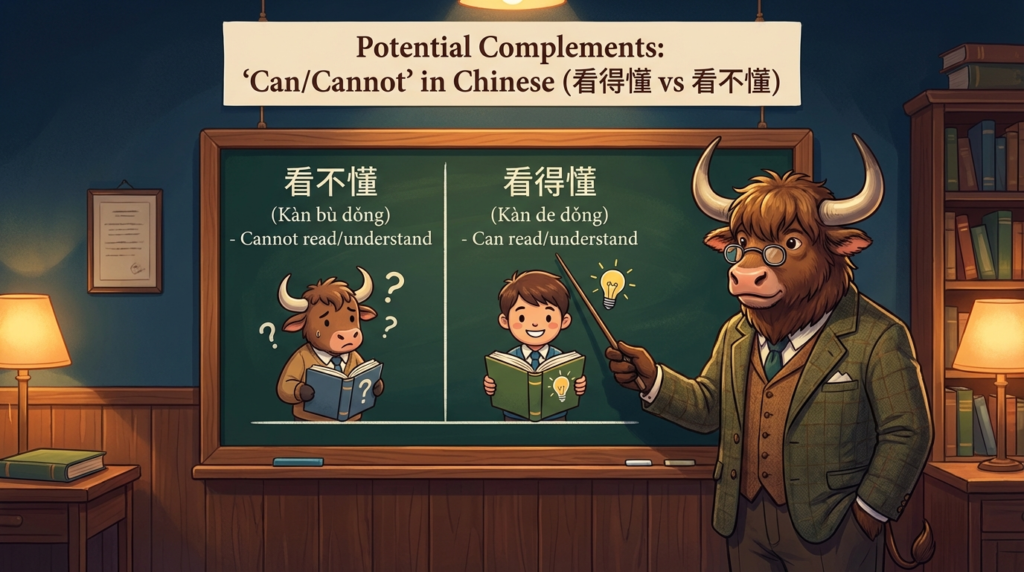
Your real-life guide to 可能補語 kěnéng bǔyǔ (potential complements) — especially 看得懂 kàn de dǒng vs 看不懂 kàn bù dǒng.
In English, “can/can’t” feels simple. In Chinese, you often don’t use a single “can” word — you say whether a result is achievable.
So instead of “I can understand,” you’ll naturally say: “I can understand after looking/listening” → 看得懂 kàn de dǒng, 聽得懂 tīng de dǒng. And if you can’t? Flip it to 不: 看不懂 kàn bù dǒng.
Yak Snark (Friendly Edition): If you say 我不能懂 wǒ bùnéng dǒng, people will still guess your meaning… but it sounds like you assembled Chinese with spare IKEA parts. Use 看得懂 / 聽得懂 like a normal human.
What 看得懂 / 看不懂 Actually Means
看得懂 kàn de dǒng = “(I) can understand it by looking (at it).”
看不懂 kàn bù dǒng = “(I) can’t understand it by looking (at it).”
Key Vocabulary: 懂 dǒng — “to understand.”
Example (ZH): 我懂了。
Example (Pinyin): Wǒ dǒng le.
Example (EN): I get it now.
The Pattern You Need: Verb + 得 / 不 + Result
This is the core “can/can’t (achieve a result)” structure:
| Pattern | Meaning | Example (ZH) | Pinyin | EN |
| V + 得 + Result | can achieve the result | 我看得懂。 | Wǒ kàn de dǒng. | I can understand it (by reading/looking). |
| V + 不 + Result | can’t achieve the result | 我看不懂。 | Wǒ kàn bù dǒng. | I can’t understand it. |
| V + 得 + 了 / 到 | can do it / can reach it | 我買得到。 | Wǒ mǎi de dào. | I can get/buy it (it’s obtainable). |
| V + 不 + 了 / 到 | can’t do it / can’t reach it | 今天我吃不了辣。 | Jīntiān wǒ chī bù liǎo là. | Today I can’t handle spicy food. |
看懂 vs 看得懂 vs 看不懂 vs 沒看懂
These look similar, but they live in different “time zones” (ability vs completed result).
| Form | Pinyin | What It Means | When To Use |
| 看懂 | kàn dǒng | understand (result complement) | You did understand (often with 了 / already context) |
| 看得懂 | kàn de dǒng | can understand (potential) | General ability / this is readable for me |
| 看不懂 | kàn bù dǒng | can’t understand (potential) | It’s too hard / not readable for me |
| 沒看懂 | méi kàn dǒng | didn’t understand (completed attempt) | You tried, but the result didn’t happen |
Examples that make the difference obvious:
Example (ZH): 這篇新聞我看得懂。
Example (Pinyin): Zhè piān xīnwén wǒ kàn de dǒng.
Example (EN): I can understand this news article.
Example (ZH): 剛剛那句我沒看懂。
Example (Pinyin): Gānggāng nà jù wǒ méi kàn dǒng.
Example (EN): I didn’t understand that sentence just now.
Visual Mini-Cards: High-Use “Can/Can’t” Phrases
看得懂
kàn de dǒng — can understand (by reading)
Example (ZH): 這個字我看得懂。
Example (Pinyin): Zhège zì wǒ kàn de dǒng.
Example (EN): I can understand this character/word.
看不懂
kàn bù dǒng — can’t understand
Example (ZH): 字太小,我看不懂。
Example (Pinyin): Zì tài xiǎo, wǒ kàn bù dǒng.
Example (EN): The text is too small; I can’t read/understand it.
聽得懂
tīng de dǒng — can understand (by listening)
Example (ZH): 你說慢一點,我就聽得懂。
Example (Pinyin): Nǐ shuō màn yīdiǎn, wǒ jiù tīng de dǒng.
Example (EN): If you speak a bit slower, I can understand.
聽不懂
tīng bù dǒng — can’t understand (by listening)
Example (ZH): 你講太快了,我聽不懂。
Example (Pinyin): Nǐ jiǎng tài kuài le, wǒ tīng bù dǒng.
Example (EN): You’re speaking too fast; I can’t understand.
說得清楚
shuō de qīngchǔ — can explain clearly
Example (ZH): 這個我說得清楚,你放心。
Example (Pinyin): Zhège wǒ shuō de qīngchǔ, nǐ fàngxīn.
Example (EN): I can explain this clearly—don’t worry.
看得見 / 看不見
kàn de jiàn / kàn bù jiàn — can see / can’t see
Example (ZH): 太暗了,我看不見。
Example (Pinyin): Tài àn le, wǒ kàn bù jiàn.
Example (EN): It’s too dark; I can’t see.
Useful Phrases You’ll Actually Say
Each one is a ready-to-steal sentence. Keep the pattern; swap the verb/result as needed.
- 你看得懂嗎? nǐ kàn de dǒng ma — Can you understand it (by reading)?
Example (ZH): 這段說明你看得懂嗎?
Example (Pinyin): Zhè duàn shuōmíng nǐ kàn de dǒng ma?
Example (EN): Can you understand this section of instructions? - 我看不懂這個意思。 wǒ kàn bù dǒng zhège yìsi — I can’t understand what this means.
Example (ZH): 這句話太繞了,我看不懂這個意思。
Example (Pinyin): Zhè jù huà tài rào le, wǒ kàn bù dǒng zhège yìsi.
Example (EN): This sentence is too twisty; I can’t understand the meaning. - 你可以說慢一點嗎?我聽不懂。 nǐ kěyǐ shuō màn yīdiǎn ma? wǒ tīng bù dǒng — Can you speak slower? I can’t understand.
Example (ZH): 你可以說慢一點嗎?我聽不懂。
Example (Pinyin): Nǐ kěyǐ shuō màn yīdiǎn ma? Wǒ tīng bù dǒng.
Example (EN): Can you speak slower? I can’t understand. - 我大概聽得懂。 wǒ dàgài tīng de dǒng — I can mostly understand (by listening).
Example (ZH): 口音有點重,但我大概聽得懂。
Example (Pinyin): Kǒuyīn yǒudiǎn zhòng, dàn wǒ dàgài tīng de dǒng.
Example (EN): The accent is a bit strong, but I can mostly understand. - 這個字我念得出來。 zhège zì wǒ niàn de chūlái — I can pronounce this character.
Example (ZH): 給我一秒,這個字我念得出來。
Example (Pinyin): Gěi wǒ yī miǎo, zhège zì wǒ niàn de chūlái.
Example (EN): Give me a second—I can pronounce this character. - 這個字我念不出來。 zhège zì wǒ niàn bù chūlái — I can’t pronounce this character.
Example (ZH): 這個字太難了,我念不出來。
Example (Pinyin): Zhège zì tài nán le, wǒ niàn bù chūlái.
Example (EN): This character is too hard; I can’t pronounce it. - 這題我做得完。 zhè tí wǒ zuò de wán — I can finish this problem/task.
Example (ZH): 時間夠的話,這題我做得完。
Example (Pinyin): Shíjiān gòu de huà, zhè tí wǒ zuò de wán.
Example (EN): If there’s enough time, I can finish this task. - 今天我做不完。 jīntiān wǒ zuò bù wán — I can’t finish today.
Example (ZH): 太多了,今天我做不完。
Example (Pinyin): Tài duō le, jīntiān wǒ zuò bù wán.
Example (EN): It’s too much; I can’t finish today. - 這裡我聽得清楚。 zhèlǐ wǒ tīng de qīngchǔ — I can hear clearly here.
Example (ZH): 換到前面一點,這裡我聽得清楚。
Example (Pinyin): Huàn dào qiánmiàn yīdiǎn, zhèlǐ wǒ tīng de qīngchǔ.
Example (EN): Move a bit closer to the front; I can hear clearly here. - 太吵了,我聽不清楚。 tài chǎo le, wǒ tīng bù qīngchǔ — It’s too noisy; I can’t hear clearly.
Example (ZH): 太吵了,我聽不清楚你在說什麼。
Example (Pinyin): Tài chǎo le, wǒ tīng bù qīngchǔ nǐ zài shuō shénme.
Example (EN): It’s too noisy; I can’t hear what you’re saying clearly. - 我看得到那個招牌。 wǒ kàn de dào nàge zhāopái — I can see that sign.
Example (ZH): 在路口停一下,我看得到那個招牌。
Example (Pinyin): Zài lùkǒu tíng yīxià, wǒ kàn de dào nàge zhāopái.
Example (EN): Stop at the intersection; I can see that sign. - 我看不到。 wǒ kàn bù dào — I can’t see it / can’t find it visually.
Example (ZH): 你傳的連結我看不到。
Example (Pinyin): Nǐ chuán de liànjiē wǒ kàn bù dào.
Example (EN): I can’t see the link you sent.
When To Use 會 / 能 Instead
Use 會 huì for learned skills, and 能 néng for general ability/conditions. Use potential complements when you care about achieving a result (懂 / 到 / 完 / 見 / 出來…).
| What You Mean | Best Choice | Example (ZH) | Pinyin | EN |
| I know how to swim (skill) | 會 huì | 我會游泳。 | Wǒ huì yóuyǒng. | I can swim. |
| I’m able to go today (condition) | 能 néng | 我今天能去。 | Wǒ jīntiān néng qù. | I can go today. |
| I can understand this text (result) | 看得懂 | 這篇我看得懂。 | Zhè piān wǒ kàn de dǒng. | I can understand this one. |
Practice: Quick Drills
Fill in the blank with the best choice: 得 or 不. Read the sentence out loud (yes, actually out loud).
- 字太小了,我看___見。
kàn ___ jiàn — can/can’t see - 你說慢一點,我就聽___懂。
tīng ___ dǒng — can/can’t understand - 這個名字我念___出來。
niàn ___ chūlái — can/can’t pronounce - 今天工作太多,我做___完。
zuò ___ wán — can/can’t finish - 這個 app 我下載___到。
xiàzǎi ___ dào — can/can’t download/get - 太暗了,我看___懂說明書。
kàn ___ dǒng — can/can’t understand (by reading) - 你寫得很清楚,我看___懂。
kàn ___ dǒng — can/can’t understand - 這道菜太辣,我吃___了。
chī ___ liǎo — can/can’t handle (spice)
Answers
1 不 (看不見 kàn bù jiàn) / 2 得 (聽得懂 tīng de dǒng) / 3 得 (念得出來 niàn de chūlái) / 4 不 (做不完 zuò bù wán) / 5 得 (下載得到 xiàzǎi de dào) / 6 不 (看不懂 kàn bù dǒng) / 7 得 (看得懂 kàn de dǒng) / 8 不 (吃不了 chī bù liǎo)
Common Mistakes And Fast Fixes
- Mistake: 我不能懂 wǒ bùnéng dǒng
Fix: 我聽不懂 wǒ tīng bù dǒng / 我看不懂 wǒ kàn bù dǒng - Mistake: 我不看懂 wǒ bù kàn dǒng (sounds off for “can’t understand”)
Fix: 我看不懂 wǒ kàn bù dǒng (ability/result not achievable) - Mistake: Confusing 看不懂 (can’t) with 沒看懂 (didn’t)
Fix: Use 看不懂 for general “it’s too hard,” and 沒看懂 for “I tried just now, but didn’t get it.” - Mistake: Forgetting what “result” you want
Fix: Pick a result word: 懂 dǒng (understand), 見 jiàn (see), 到 dào (reach/get), 完 wán (finish), 出來 chūlái (come out/pronounce)
Quick Reference Cheat Sheet
- Can achieve a result: V + 得 + Result → 看得懂 kàn de dǒng
- Can’t achieve a result: V + 不 + Result → 看不懂 kàn bù dǒng
- Completed result happened: V + Result (+了) → 看懂了 kàn dǒng le
- Completed attempt but failed: 沒 + V + Result → 沒看懂 méi kàn dǒng
- Ask a question: 看得懂嗎?kàn de dǒng ma?
Final Yak Box: The One Sentence To Remember
Memorize this: If English says “can/can’t,” Chinese often says “can/can’t reach the result.” That’s why 看得懂 / 看不懂 sounds so natural — you’re literally saying whether “understanding” happens.