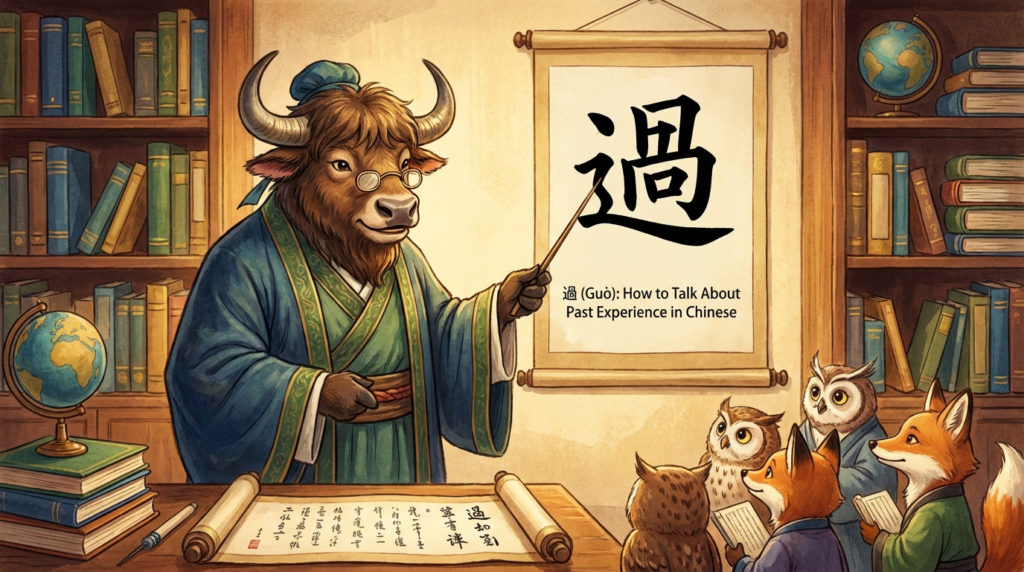
過 (Guò) Grammar: How to Talk About Past Experience in Traditional Chinese
Learn how to say “have you ever…?” in real life with 「過 (guò)」—past experience without locking it to a specific time.
Topic in Chinese: 過(guò)—經驗(jīngyàn, experience)
「過 (guò)」is the Chinese grammar move you use when you want to say you’ve done something before (experience), not necessarily when it happened. It’s perfect for travel, food, dating apps, job interviews, and humblebragging about concerts.
By the end, you’ll be able to build “I’ve ever…” / “I’ve never…” sentences, ask “Have you ever…?”, and stop accidentally using 了 like it’s duct tape.
Yak Snark Box
If you say 我去了台北 (Wǒ qù le Táiběi) when you mean “I’ve been to Taipei before,” you just told people you went (like, a specific trip). Not wrong… just not what you meant. 「過」is your “life experience” badge.
What 過 (guò) Actually Means
過 (guò) = “have done (before),” “have experienced.” It marks that an action happened at least once in your life experience.
Key idea: 「過」doesn’t focus on “finished” or “at that time.” It focuses on “this has happened before.”
我吃過臭豆腐。
Wǒ chī guò chòudòufu.
I’ve eaten stinky tofu (before).
你看過《悲慘世界》嗎?
Nǐ kàn guò “Bēicǎn Shìjiè” ma?
Have you ever seen Les Misérables?
8 Quick “Experience” Cards You’ll Actually Use
去過
qù guò — have been (to)
我去過高雄。
Wǒ qù guò Gāoxióng.
I’ve been to Kaohsiung.
吃過
chī guò — have eaten (before)
你吃過鹹豆漿嗎?
Nǐ chī guò xián dòujiāng ma?
Have you ever had savory soy milk?
看過
kàn guò — have watched/seen
我看過那部電影。
Wǒ kàn guò nà bù diànyǐng.
I’ve seen that movie.
聽過
tīng guò — have heard/listened to
我聽過他的歌。
Wǒ tīng guò tā de gē.
I’ve heard his songs.
做過
zuò guò — have done/made
我做過這道菜。
Wǒ zuò guò zhè dào cài.
I’ve made this dish before.
用過
yòng guò — have used (before)
我用過這個 App。
Wǒ yòng guò zhège App.
I’ve used this app before.
住過
zhù guò — have lived/stayed
我住過這附近。
Wǒ zhù guò zhè fùjìn.
I’ve lived around here before.
學過
xué guò — have studied/learned
我學過一點日文。
Wǒ xué guò yìdiǎn Rìwén.
I’ve studied a bit of Japanese.
見過
jiàn guò — have met/seen
我見過他一次。
Wǒ jiàn guò tā yí cì.
I’ve met him once.
Core Patterns You Need (With Real Sentences)
| Pattern | Meaning | Example (ZH) | Example (Pinyin) | Translation (EN) |
|---|---|---|---|---|
| 主語 + V + 過 (+ 受詞) | Have ever done (experience) | 我去過台南。 | Wǒ qù guò Táinán. | I’ve been to Tainan. |
| 主語 + 沒(有) + V + 過 | Have never done | 我沒吃過生蠔。 | Wǒ méi chī guò shēngháo. | I’ve never eaten oysters. |
| 主語 + V + 過 + 次/遍 | Have done X times | 我看過三遍。 | Wǒ kàn guò sān biàn. | I’ve watched it three times. |
| 你 + V + 過 + 嗎? | Have you ever…? | 你坐過高鐵嗎? | Nǐ zuò guò gāotiě ma? | Have you ever taken the HSR? |
| 我 + V + 過 + 一次/一下 | I’ve tried it (casual) | 我試過一次。 | Wǒ shì guò yí cì. | I’ve tried it once. |
| 以前/曾經 + V + 過 | “Back then / once” + experience | 我以前學過法文。 | Wǒ yǐqián xué guò Fǎwén. | I studied French before. |
過 Vs 了: The Difference In One Breath
過 (guò) = Life Experience
Focus: “This happened before (at least once).”
我去過日本。
Wǒ qù guò Rìběn.
I’ve been to Japan (before).
我沒看過這部。
Wǒ méi kàn guò zhè bù.
I’ve never seen this one.
了 (le) = Change/Completion In Context
Focus: “It happened (and the situation changed / it’s done)”, often tied to a specific moment or narrative.
我去了日本。
Wǒ qù le Rìběn.
I went to Japan (that trip happened).
我看了這部。
Wǒ kàn le zhè bù.
I watched this one (completed watching / in this story).
Useful Phrases & Real-Life Sentences
Each one is built around 「過」 so you can copy-paste it into your actual human life.
- 你去過夜市嗎?
Nǐ qù guò yèshì ma?
Have you ever been to a night market? - 我沒去過這家店。
Wǒ méi qù guò zhè jiā diàn.
I’ve never been to this shop. - 你吃過這個口味嗎?
Nǐ chī guò zhège kǒuwèi ma?
Have you tried this flavor before? - 我吃過一次,還不錯。
Wǒ chī guò yí cì, hái búcuò.
I’ve had it once—pretty good. - 我聽過這首歌,但不知道歌名。
Wǒ tīng guò zhè shǒu gē, dàn bù zhīdào gēmíng.
I’ve heard this song, but I don’t know the title. - 你看過他的 YouTube 嗎?
Nǐ kàn guò tā de YouTube ma?
Have you ever watched his YouTube? - 我見過你嗎?你看起來很眼熟。
Wǒ jiàn guò nǐ ma? Nǐ kàn qǐlái hěn yǎnshú.
Have we met? You look familiar. - 我以前住過台中。
Wǒ yǐqián zhù guò Táizhōng.
I used to live in Taichung. - 我學過一點中文。
Wǒ xué guò yìdiǎn Zhōngwén.
I’ve studied a little Chinese. - 你用過這種相機嗎?
Nǐ yòng guò zhè zhǒng xiàngjī ma?
Have you used this kind of camera? - 我試過了,但不太適合我。
Wǒ shì guò le, dàn bú tài shìhé wǒ.
I tried it (at least once), but it doesn’t suit me much. - 我做過類似的工作。
Wǒ zuò guò lèisì de gōngzuò.
I’ve done similar work. - 你坐過摩天輪嗎?
Nǐ zuò guò mótiānlún ma?
Have you ever ridden a Ferris wheel? - 我從來沒看過雪。
Wǒ cónglái méi kàn guò xuě.
I’ve never seen snow (in my life). - 你跟他聊過嗎?
Nǐ gēn tā liáo guò ma?
Have you talked with him before? - 我忘了我有沒有說過。
Wǒ wàng le wǒ yǒu méiyǒu shuō guò.
I forgot whether I’ve said it before. - 你有沒有去過澎湖?
Nǐ yǒu méiyǒu qù guò Pénghú?
Have you ever been to Penghu? - 我看過很多次了。
Wǒ kàn guò hěn duō cì le.
I’ve seen it many times (and that’s the current situation).
A Quick Nuance That Saves You
「V 過 了」can happen. It often means “I’ve had that experience, and now things are different / that stage is over / we’ve moved on.”
我考過了。
Wǒ kǎo guò le.
I’ve taken the exam (and that part is done now).
我也痛過了,就放下吧。
Wǒ yě tòng guò le, jiù fàngxià ba.
I’ve been through pain too—let it go.
Practice: Use 過 Like A Normal Person
Fill in the blanks with 過 (and add 沒(有) if needed). Say them out loud—yes, even if your cat judges you.
- 我 ______ 去 ______ 台東。 (I’ve been to Taitung before.)
- 我 ______ 吃 ______ 榴槤。 (I’ve never eaten durian.)
- 你 ______ 看 ______ 這部劇嗎? (Have you seen this drama before?)
- 我 ______ 用 ______ 這個功能一次。 (I’ve used this feature once.)
- 他 ______ 做 ______ 類似的專案。 (He’s done similar projects before.)
- 你有沒有 ______ 過 潛水? (Have you ever gone diving?)
Answer Key (Click To Reveal)
1) 我去過台東。
Wǒ qù guò Táidōng.
I’ve been to Taitung before.
2) 我沒吃過榴槤。
Wǒ méi chī guò liúlián.
I’ve never eaten durian.
3) 你看過這部劇嗎?
Nǐ kàn guò zhè bù jù ma?
Have you seen this drama before?
4) 我用過這個功能一次。
Wǒ yòng guò zhège gōngnéng yí cì.
I’ve used this feature once.
5) 他做過類似的專案。
Tā zuò guò lèisì de zhuān’àn.
He’s done similar projects before.
6) 你有沒有潛水過?
Nǐ yǒu méiyǒu qiánshuǐ guò?
Have you ever gone diving?
Common Mistakes (And Fast Fixes)
- Mistake: Using 了 when you mean “ever.”
Fix: Use 過 for experience.
我去過台北。
Wǒ qù guò Táiběi.
I’ve been to Taipei (before). - Mistake: Forgetting the negative form.
Fix: 沒(有) + V + 過.
我沒有看過。
Wǒ méiyǒu kàn guò.
I’ve never seen it. - Mistake: Treating 過 like a time stamp (“yesterday”).
Fix: 過 is about experience; if you want “yesterday,” add time + 了 / narrative context.
我昨天去了台北。
Wǒ zuótiān qù le Táiběi.
I went to Taipei yesterday. - Mistake: Overstuffing sentences with 過 + already + time words.
Fix: Keep it clean; add only what you need.
我以前吃過。
Wǒ yǐqián chī guò.
I’ve eaten it before.
Quick Reference Summary
| Use This | When You Mean | Mini Example (ZH) | Pinyin | EN |
|---|---|---|---|---|
| V + 過 | Have ever done (experience) | 我去過。 | Wǒ qù guò. | I’ve been (before). |
| 沒(有) + V + 過 | Have never done | 我沒看過。 | Wǒ méi kàn guò. | I’ve never seen it. |
| V + 過 + 次/遍 | Have done X times | 我聽過兩次。 | Wǒ tīng guò liǎng cì. | I’ve listened twice. |
| V + 了 | Did it / completed it (context/story) | 我看了。 | Wǒ kàn le. | I watched it. |
Final Yak Box: Your One-Line Rule
If you can swap your English sentence to “Have you ever…?” or “I’ve (done it before),” then 「過 (guò)」is probably the right tool. If you’re telling a story about what happened on Tuesday… 了 is waiting over there, sipping tea.
Try these today:
你吃過這個嗎?
Nǐ chī guò zhège ma?
Have you tried this?