Homophones in English
60 common word pairs and trios with meanings, memory tricks, and real-life examples of words that sound the same in English.
The first time homophones embarrassed me, I texted a friend, “I’m over hear,” while I was literally standing outside the coffee shop. He replied, “I can’t hear you, but I can see you.” Rude? A little. Useful? Very. That tiny spelling mistake stuck in my brain much better than any boring grammar rule ever did.
That is why this guide does more than dump a giant word list in your lap and run away. You will learn the most useful English homophones in groups, see what each word means, get real example sentences, and practice the words that cause the most chaos in emails, texts, homework, and everyday conversation.
Yak Tip
These examples follow standard American English pronunciation. A few pairs may sound a little different in some regional accents, because English enjoys making simple things weird.
What Homophones Are
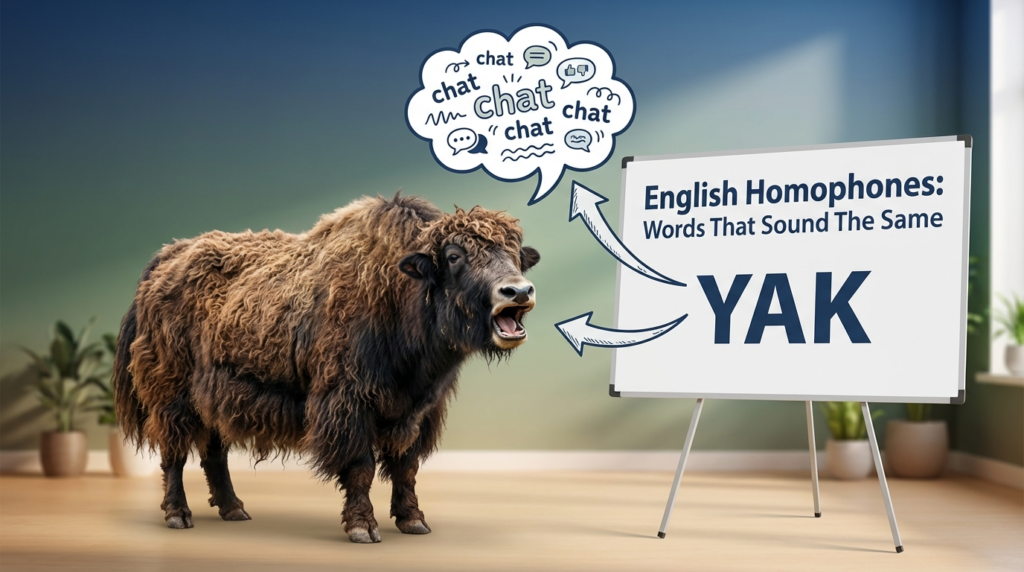
Homophones are words that sound the same but have different meanings. They are often spelled differently too. The key idea is sound, not spelling. That is why right and write are homophones, even though one is about correctness and the other is about putting words on a page.
| Term | Simple Meaning | Example |
|---|---|---|
| Homophone | Words that sound the same but have different meanings. | see / sea |
| Homograph | Words that are spelled the same but may have different meanings or pronunciations. | lead (to guide) / lead (a metal) |
| Homonym | A broad label often used for words that share the same sound, spelling, or both. | bat (animal) / bat (sports tool) |
Visual Cards For The Most Confusing Homophones
There / Their / They’re
there = place, their = belonging to them, they’re = they are.
Sentence: They’re sitting over there with their dog.
Your / You’re
your = belonging to you, you’re = you are.
Sentence: You’re wearing your new jacket.
To / Too / Two
to = direction or verb marker, too = also or excessively, two = number 2.
Sentence: I want to go too, but I only have two dollars.
Its / It’s
its = belonging to it, it’s = it is.
Sentence: It’s funny when the dog chases its tail.
Hear / Here
hear = receive sound, here = in this place.
Sentence: Come here so you can hear the speaker.
Right / Write
right = correct or the opposite of left, write = put words on paper or a screen.
Sentence: Please write the right answer.
By / Buy / Bye
by = near or next to, buy = purchase, bye = goodbye.
Sentence: I stopped by to buy bread, then said bye.
No / Know
no = negative answer, know = understand or be aware of.
Sentence: No, I do not know the answer.
Real-Life Sentences You Will Actually Use
- They’re over there with their backpacks. This is the classic trio, and yes, it still attacks perfectly smart people.
- You’re too late for the two o’clock bus. One sentence, three traps, one tiny panic.
- I can hear the music from here. Use this pair constantly in daily conversation.
- Please write the right address. Great for school, work, and forms.
- I need to buy milk before I say bye. Ridiculous little sentence, very memorable.
- No, I do not know his number. Easy to say, easy to spell wrong when tired.
- Our meeting starts in an hour. This pair shows up in calendars, emails, and late excuses.
- Where did you wear that coat? Silly sentence, useful contrast.
- The sun warmed our son at the park. Excellent for family vocabulary.
- She ate eight strawberries. Short, common, and weirdly satisfying.
- We need peace, not just a piece of quiet. Meaning matters a lot here.
- The plane flew over the plain. Same sound, very different picture.
Fast Memory Tricks
| Pattern | What It Usually Signals | Quick Example |
|---|---|---|
| Apostrophe | Often shows a contraction. | you’re = you are, it’s = it is, they’re = they are |
| Extra Letter | Sometimes hints at an extra meaning. | too has an extra o, so it can mean “also” or “more than enough.” |
| Possessive Pronouns | Usually do not use apostrophes. | your, their, its |
| Place Words | Often connect to location. | here, there, where |
| Number Words | Need context, not sound, to choose the right spelling. | one, two, eight |
How To Study Homophones Without Losing Your Mind
- Learn homophones in families, not as lonely little words. There / their / they’re makes more sense as a team.
- Write one personal sentence for each set. Your own examples stick better than textbook wallpaper.
- Say the words out loud, then check the meaning in context. Homophones are about sound, but writing needs meaning.
- Watch for contractions. If you can replace the word with you are, it is, or they are, the apostrophe version is probably right.
- Proofread slowly when you type. Spell-check often misses homophones because the wrong word can still be a real word. Thanks, English.
Homophones List By Theme
Everyday Must-Know Homophones
| Vocabulary | Meaning | Example 1 | Example 2 | Example 3 |
|---|---|---|---|---|
| to / too / two | to = direction or part of a verb; too = also or excessively; two = number 2. | I want to leave now. | I am coming too. | We need two chairs. |
| there / their / they’re | there = in that place; their = belonging to them; they’re = they are. | Put the bags over there. | Their apartment is small. | They’re waiting outside. |
| your / you’re | your = belonging to you; you’re = you are. | Your coffee is on the table. | You’re late again. | You’re holding your keys. |
| its / it’s | its = belonging to it; it’s = it is. | The cat licked its paw. | It’s a nice day. | It’s funny how the dog chases its tail. |
| here / hear | here = in this place; hear = receive sound. | Please sit here. | Can you hear me? | Come here so you can hear better. |
| by / buy / bye | by = near; buy = purchase; bye = goodbye. | The lamp is by the sofa. | I need to buy soap. | She said bye and left. |
| no / know | no = negative answer; know = understand or be aware of. | No, that is not mine. | I know her name. | No, I do not know the password. |
| one / won | one = number 1; won = past tense of win. | I only need one ticket. | Our team won the game. | One player won the prize. |
Daily Life And People
| Vocabulary | Meaning | Example 1 | Example 2 | Example 3 |
|---|---|---|---|---|
| wear / where | wear = have clothes on; where = in what place. | What will you wear tonight? | Where is your jacket? | Where did you wear that hat? |
| hour / our | hour = 60 minutes; our = belonging to us. | The movie starts in an hour. | Our table is ready. | Our lesson lasts an hour. |
| sun / son | sun = the star in the sky; son = a male child. | The sun is bright today. | Their son is five years old. | The sun warmed their son at the beach. |
| week / weak | week = seven days; weak = not strong. | I will call you next week. | He felt weak after the flu. | After a weak start, the week improved. |
| mail / male | mail = letters or packages; male = boy or man, or the masculine sex. | The mail arrived early. | The male duck stayed near the pond. | The mail carrier saw a male dog at the gate. |
| meet / meat | meet = come together; meat = animal flesh used as food. | Let’s meet after class. | He does not eat meat. | We will meet at a restaurant that serves meat. |
| pair / pear / pare | pair = two matching things; pear = a fruit; pare = cut off the outer layer. | I bought a pair of socks. | She ate a ripe pear. | Please pare the apple before cooking. |
| sale / sail | sale = special lower price; sail = travel on water using a boat or sail cloth. | The shoes are on sale. | They will sail across the lake. | We found a boat sale before we learned to sail. |
School, Work, And Writing
| Vocabulary | Meaning | Example 1 | Example 2 | Example 3 |
|---|---|---|---|---|
| right / write | right = correct or the opposite of left; write = put words on paper or a screen. | You are right about the time. | Please write your name. | Write the right answer neatly. |
| break / brake | break = damage or stop; brake = device that slows a vehicle. | Do not break the glass. | Press the brake gently. | The driver used the brake so he would not break anything. |
| peace / piece | peace = calm or no war; piece = one part of something. | Everyone wants peace. | Take one piece of cake. | A small piece of quiet can feel like peace. |
| plain / plane | plain = simple or a flat area of land; plane = airplane. | I chose a plain white shirt. | The plane landed safely. | The plane flew over the plain. |
| allowed / aloud | allowed = permitted; aloud = spoken so people can hear. | Food is not allowed here. | Please read the sentence aloud. | Students are allowed to read aloud during practice. |
| course / coarse | course = class, route, or part of a meal; coarse = rough, not smooth. | I signed up for a writing course. | The fabric feels coarse. | The course packet had a coarse paper cover. |
| which / witch | which = asks about a choice; witch = magical character. | Which bus goes downtown? | The witch in the movie was funny, not scary. | Which witch costume do you like best? |
Nature, Food, And Extra Tricky Ones
| Vocabulary | Meaning | Example 1 | Example 2 | Example 3 |
|---|---|---|---|---|
| flour / flower | flour = powder used in baking; flower = bloom on a plant. | We need flour for the bread. | The flower smells sweet. | She drew a flower on the flour bag. |
| ate / eight | ate = past tense of eat; eight = number 8. | He ate too fast. | I woke up at eight. | She ate eight grapes. |
| new / knew | new = not old; knew = past tense of know. | I bought a new notebook. | I knew the answer yesterday. | She knew her new teacher would be strict. |
| knight / night | knight = armored soldier in old stories; night = time after sunset. | The knight rode into town. | It was a quiet night. | The knight traveled all night. |
| hole / whole | hole = an opening; whole = complete or entire. | The sock has a hole. | I ate the whole sandwich. | The whole roof leaked through one hole. |
| berry / bury | berry = a small fruit; bury = put into the ground. | That berry is very sweet. | They will bury the time capsule. | Do not bury the basket with the berry seeds. |
| see / sea | see = use your eyes; sea = large body of salt water. | I can see the moon. | The sea looks calm today. | We went to the sea to see the sunset. |
Practice Section
Fill in each blank with the correct homophone. No cheating. Your brain needs the workout.
- _____ going to leave _____ bags over _____.
- I can _____ you from _____.
- Please _____ the _____ answer.
- We need _____ more chairs.
- Is this _____ notebook, or are _____ borrowing it?
- Press the _____ so you do not _____ the lamp.
- Let’s go to the _____ so we can _____ the sunset.
- She _____ breakfast at _____ o’clock.
- Please read the rule _____ . Phones are not _____ in class.
- The baker needs _____, not a _____.
Answer Key
- They’re / their / there
- hear / here
- write / right
- two
- your / you’re
- brake / break
- sea / see
- ate / eight
- aloud / allowed
- flour / flower
Common Mistakes And Fast Fixes
- Mistake: Using it’s when you mean possession. Fix: Try it is. If that works, use it’s. If not, use its.
- Mistake: Writing the word that “looks nicer.” Fix: Ignore looks. Check the job the word does in the sentence.
- Mistake: Memorizing a list once and expecting magic. Fix: Review five sets a day and write your own sentence for each.
- Mistake: Trusting spell-check too much. Fix: Read important messages slowly before sending them.
- Mistake: Learning only the famous pairs. Fix: Add practical ones like allowed / aloud, course / coarse, and pair / pear / pare.
Final Yak
Homophones are not random little monsters. They make more sense when you learn them in families, connect each word to its job, and use each one in a real sentence. Do that for a week, and words like there, their, and they’re stop feeling like a trap and start feeling predictable. Well, mostly. This is still English.