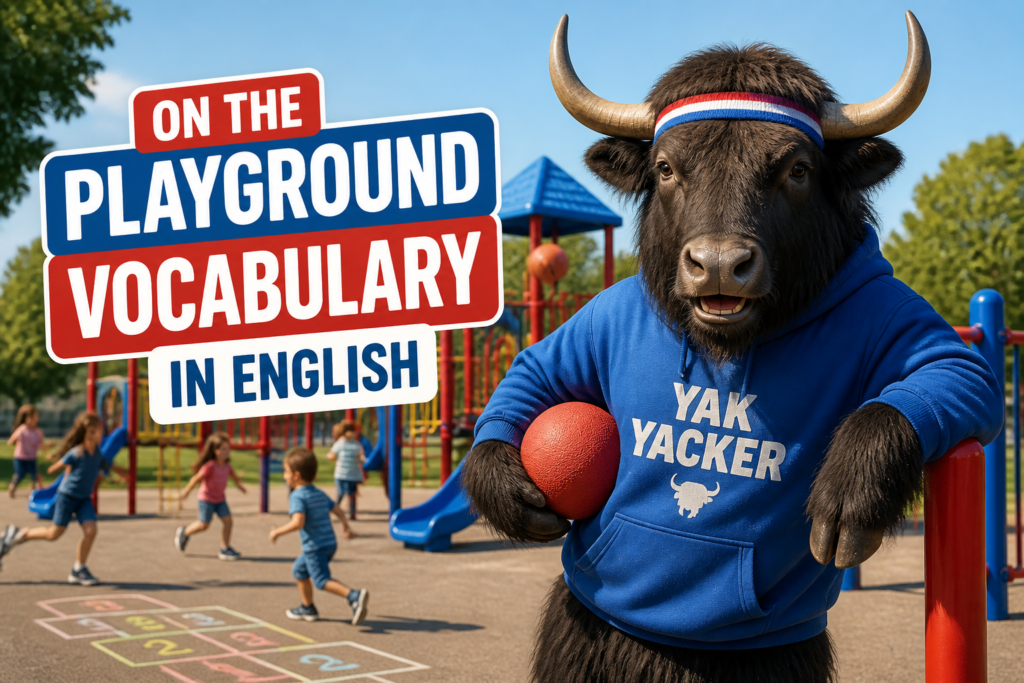
Playgrounds are full of action, noise, and the occasional dramatic shout of “I was first!” If you have ever watched kids play, you already know the language can be surprisingly useful: climbing, swinging, sliding, balancing, and negotiating who gets the next turn like tiny lawyers with sneakers.
For the broader learning path, visit our parent guide.
This lesson teaches practical playground vocabulary in English, with simple meanings, pronunciation help, and real example sentences. It is great for parents, teachers, babysitters, travelers, and English learners who want to talk about play areas without pointing at the sky and hoping for the best.
You will also see a few common American and British differences. Because yes, even playgrounds need a little international drama.
For more practice after this lesson, you can also try the English Vocabulary Test or check your level with the English Placement Test CEFR.
Useful Playground Words And Phrases
These are the words and phrases you will hear most often at a playground in everyday English.
| English | Pronunciation | Meaning | Example Sentence | Learner Note |
|---|---|---|---|---|
| playground | PLAY-ground | a place where children play outdoors, often with swings, slides, and climbing equipment | The children are playing on the playground after school. | Common word in American English and British English. |
| slide | slyd | a smooth sloping surface you sit on and go down | She went down the slide three times. | Very common playground word. |
| swing | swing | a seat hanging from chains or ropes that moves back and forth | He pushed the swing gently. | Also a verb: “to swing.” |
| seesaw | SEE-saw | a long board that goes up and down when two people sit on it | The two boys played on the seesaw. | British English often says teeter-totter in some places in the U.S., but seesaw is very common. |
| climbing frame | KLY-ming fraym | equipment for climbing, often with bars or ropes | The kids ran to the climbing frame. | More common in British English. |
| jungle gym | JUN-guhl jim | a playground structure for climbing, hanging, and moving around | He is hanging from the jungle gym. | Common in American English. |
| sandbox | SAND-boks | a box or area filled with sand where children play | She is building a castle in the sandbox. | British English often says sandpit. |
| bench | bench | a long seat for people to sit on | Grandma is sitting on the bench and watching the children. | Useful for parents and caregivers too. |
| swingset | SWING-set | a frame with one or more swings attached | The new park has a swingset near the trees. | Very common in American English. |
| play structure | PLAY struk-chur | a large set of playground equipment | The park has a big play structure with slides and ladders. | Useful in school and park conversations. |
More Playground Vocabulary
| English | Pronunciation | Meaning | Example Sentence | Learner Note |
|---|---|---|---|---|
| bar | bar | a metal rod you can hold or climb on | She held the bar with both hands. | Can be part of monkey bars or climbing frames. |
| monkey bars | MUN-kee barz | a set of overhead bars for climbing and hanging | He can cross the monkey bars very fast. | Usually plural in English. |
| ladder | LAD-er | a series of steps or rungs used for climbing up | Careful on the ladder. | Common in playgrounds, homes, and many other places. |
| rung | rung | one of the flat steps on a ladder | She put one foot on the next rung. | Helpful word for describing climbing equipment. |
| ramp | ramp | a sloping surface that helps people or objects go up or down | The wheelchair ramp is next to the playground entrance. | Useful for accessibility and safety. |
| gate | gayt | a door or movable barrier that opens and closes | Please close the gate behind you. | Often used in playground safety signs. |
| fence | fens | a barrier around an area | The playground is surrounded by a fence. | Often used to keep children inside a safe area. |
| surface | SUR-fis | the top layer of the ground or material under the equipment | The playground surface is soft rubber. | Important for safety vocabulary. |
| rubber mat | RUB-er mat | soft material on the ground to help prevent injury | The new playground has rubber mats under the swings. | Very useful safety phrase. |
| shade | shayd | a cool area away from direct sun | Let’s sit in the shade for a few minutes. | Handy word in hot weather. |
Action Words You Need At The Playground
These verbs help you describe what people do at the playground. Strong little words. Very busy little words.
| English | Pronunciation | Meaning | Example Sentence | Learner Note |
|---|---|---|---|---|
| climb | klym | go up using hands and feet | The children climb the ladder carefully. | Common with up: climb up the slide steps. |
| slide | slyd | move smoothly down a surface | He slid down the slide. | Past tense: slid. |
| swing | swing | move back and forth, or play on a swing | She loves to swing high. | Can be a noun or a verb. |
| push | push | use your hands to move something away from you | Please do not push on the swing too hard. | Important for playground safety. |
| pull | puhl | use your hands to bring something toward you | He pulled the wagon across the playground. | Common with ropes, doors, and equipment. |
| jump | jump | move up and down using your feet | The kids jump off the small steps. | Useful with “over,” “down,” and “up.” |
| run | run | move quickly with your feet | The children ran to the swings. | Regular verb in the past: ran. |
| sit | sit | be in a resting position with your body on a seat or the ground | Please sit on the bench. | Often used in playground instructions. |
| stand | stand | be on your feet | She stood near the slide and waited. | Useful for rules and directions. |
| balance | BAL-ans | stay steady without falling | He tried to balance on the beam. | Very useful with climbing and sports. |
People And Safety Words
| English | Pronunciation | Meaning | Example Sentence | Learner Note |
|---|---|---|---|---|
| adult | uh-DULT | grown-up person | An adult should stay nearby. | Very important in safety conversations. |
| caregiver | CARE-giv-er | a person who takes care of a child | The caregiver is watching the children. | Neutral and useful in schools and clinics. |
| parent | PAIR-ent | mother or father | The parent is sitting on the bench. | Common, simple, and useful. |
| teacher | TEE-chur | a person who teaches | The teacher brought the class to the playground. | Common with school outings. |
| supervise | SOO-per-vyz | watch and take care of someone or something | Adults should supervise young children. | Formal but very useful. |
| safe | sayf | not in danger | The playground looks safe. | Opposite: unsafe. |
| unsafe | un-SAYF | not safe | That broken ladder is unsafe. | Often used in warnings. |
| injury | IN-juh-ree | harm to the body | Rubber ground helps prevent injury. | Useful in health and safety talk. |
| warning | WAR-ning | a statement that tells people about danger | The sign gives a warning about wet steps. | Common on signs and notices. |
| rule | rool | an instruction people should follow | The first rule is: no pushing. | Very common with children. |
Useful Playground Phrases
These phrases are practical, natural, and easy to use. They are the kind of lines people say without thinking too hard, which is often the goal in real life.
| English Phrase | Pronunciation | Meaning | Example Sentence | Learner Note |
|---|---|---|---|---|
| It’s your turn. | its yur turn | you can go now | Okay, it’s your turn on the swing. | Very common for sharing equipment. |
| Wait in line. | wayt in lyn | stand behind other people and wait your turn | Please wait in line for the slide. | American English usually says line; British English often says queue. |
| Take turns. | tayk turnz | let different people do something one by one | The children take turns on the seesaw. | Very useful for play and fairness. |
| Be careful. | bee CARE-fuhl | watch out and do not get hurt | Be careful on the ladder. | Simple, common safety phrase. |
| Hold on. | hohld on | grip something tightly | Hold on when you climb the steps. | Often said on swings and climbing equipment. |
| Don’t push. | dohnt push | do not use force against someone | Don’t push in line. | Important playground rule. |
| Stay inside the fence. | stay in-SYD the fens | remain inside the safe area | Stay inside the fence until the teacher says go. | Useful in school settings. |
| Watch your step. | woch yur step | be careful where you place your feet | Watch your step near the rocks. | Common warning phrase. |
| Let’s go down the slide. | lets go down the slyd | suggest using the slide | Let’s go down the slide together. | Natural, simple, and friendly. |
| Can I have a turn? | kan eye hav uh turn | polite way to ask for a chance to play | Can I have a turn on the swing? | Excellent sentence for children and learners. |
| It’s too crowded. | its too KROW-did | there are too many people | The playground is too crowded today. | Useful when the park is busy. |
| Let’s go to the park. | lets go too thee park | suggest going to a playground or park | After lunch, let’s go to the park. | Very common everyday invitation. |
Common Playground Collocations
Collocations are words that often go together. English loves these little partnerships, because apparently even words have favorite friends.
| English | Pronunciation | Meaning | Example Sentence | Learner Note |
|---|---|---|---|---|
| playground equipment | PLAY-ground ee-KWIP-ment | the structures and objects children play on | The playground equipment is new and colorful. | Useful in school and city descriptions. |
| play area | PLAY AIR-ee-uh | an area where children can play | This restaurant has a small play area. | Useful in malls, restaurants, and parks. |
| climbing wall | KLY-ming wawl | a wall designed for climbing | She tried the climbing wall at the park. | Not every playground has one. |
| soft landing | soft LAN-ding | ground that is made safer to fall on | The rubber floor gives a soft landing. | Common in safety descriptions. |
| play safely | play SAYF-lee | play in a way that avoids danger | Please play safely and follow the rules. | Useful phrase for adults and teachers. |
| go down the slide | go down the slyd | move from the top to the bottom of the slide | The little boy went down the slide again. | Very natural phrase. |
| push on the swing | push on the swing | move a swing forward and back | Can you push on the swing gently? | Be careful with the verb + preposition pattern. |
| climb up the ladder | klym up the LAD-er | go upward using the ladder | She climbed up the ladder slowly. | “Up” is common, but sometimes it is not needed if the meaning is clear. |
| take a turn | tayk uh turn | get one chance to do something | He took a turn on the monkey bars. | Very common and useful. |
| have fun | hav fun | enjoy yourself | Have fun at the playground! | Friendly, positive, universal. |
American English And British English Differences
Most playground words are shared, but a few are different depending on where you are. Tiny vocabulary differences. Same playground energy.
| American English | British English | Example |
|---|---|---|
| swing set | swings or play swing | American English often says: “The children are on the swingset.” |
| sandbox | sandpit | British English often says: “She is playing in the sandpit.” |
| line | queue | American English: “Wait in line.” British English: “Queue up.” |
| jungle gym | climbing frame | Both describe climbing equipment, but the names differ. |
| teeter-totter in some regions | seesaw | Seesaw is widely understood in both varieties. |
Quick Grammar Notes For Playground English
A few grammar patterns show up again and again in playground talk. Nothing scary. Just useful little habits.
| Pattern | Meaning | Example | Learner Note |
|---|---|---|---|
| Can I…? | polite request | Can I go on the swing? | Very common for children and adults. |
| Let’s + verb | make a suggestion | Let’s play on the slide. | Friendly and natural. |
| Don’t + verb | negative instruction | Don’t run near the steps. | Used for rules and safety. |
| Be careful + preposition | warning with location | Be careful on the monkey bars. | Common with on, near, and with. |
| Take turns | share by waiting | We take turns on the swing. | “Turns” is plural because there are several chances. |
Mini Practice
Try these quick exercises. Fast practice is better than staring at the page and hoping grammar improves by magic.
- Fill in the blank: “Please __________ in line.”
- Fill in the blank: “Be __________ on the ladder.”
- Choose the correct word: “sandbox / sandpit” for British English.
- Choose the correct word: “line / queue” for American English.
- Say the sentence: “Can I have a turn?” with a polite tone.
- Say the sentence: “Don’t push.” in a firm but calm voice.
- Change the sentence: “She is on the swing.” → use the verb swing.
- Change the sentence: “He goes down the slide.” → make it past tense.
Answer Key
- wait
- careful
- sandpit
- line
- She swings on the swing.
- He went down the slide.
Common Mistakes And Fixes
Here are a few mistakes English learners often make when talking about playgrounds.
- Wrong: “He play on the swing.”
Right: “He plays on the swing.”
Why: Third person singular needs -s in the present tense. - Wrong: “She is in the swing.”
Right: “She is on the swing.”
Why: We usually say on for a swing, slide, bench, or seesaw. - Wrong: “Wait the line.”
Right: “Wait in line.”
Why: English needs the preposition in. - Wrong: “Take a turn on the line.”
Right: “Take a turn on the swing.”
Why: You take turns on the equipment, not on the line. - Wrong: “Don’t to push.”
Right: “Don’t push.”
Why: After don’t, use the base verb.
Pronunciation Tips
These words are common enough that it helps to say them naturally.
| Word | Simple Pronunciation | Tip |
|---|---|---|
| playground | PLAY-ground | Stress the first part: PLAY. |
| caregiver | CARE-giv-er | Say it in three easy parts. |
| monkey bars | MUN-kee barz | Keep it quick and natural. |
| seesaw | SEE-saw | Two clear parts, with stress on the first part. |
| equipment | ih-KWIP-ment | The middle syllable is strongest. |
If you want a simple dictionary check for pronunciation, meaning, and example sentences, Cambridge Dictionary is a useful boring friend: Cambridge Dictionary.
Quick Yak Takeaway
At the playground, the most useful English is simple, clear, and practical: slide, swing, climb, take turns, and be careful. Learn those first, and suddenly a park trip becomes much easier to describe. Not bad for a place with so many moving parts and so few quiet moments.