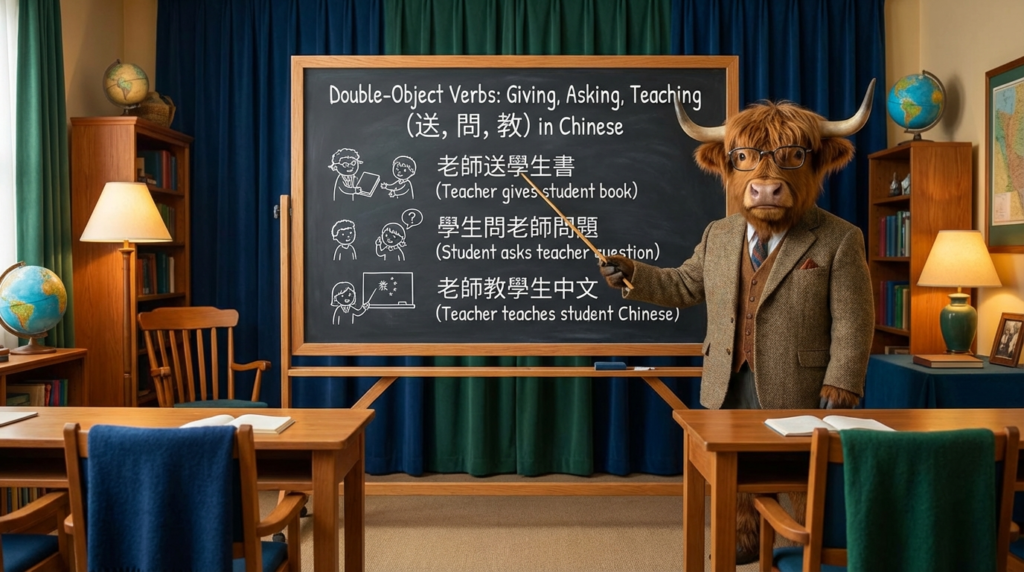
Traditional Chinese Double-Object Verbs: Giving, Asking, Teaching (送、問、教)
Master the “two objects” pattern (雙賓語 shuāng bīnyǔ) so you can say things like “I gave you coffee” naturally—without sounding like a textbook robot.
Topic In Chinese: 雙賓語動詞 (shuāng bīnyǔ dòngcí) — 送 (sòng) / 問 (wèn) / 教 (jiāo)
Double-object verbs are the ones that love two things at once: a person (who receives) and a thing (what’s given / asked / taught).
In this guide you’ll learn the clean, everyday Taiwanese Mandarin patterns for 送 (give/send), 問 (ask), and 教 (teach)—with lots of real sentences you can steal.
Yak Snark Box: If you can handle “I gave you coffee,” you can handle this. If you can’t… congratulations, you’re about to level up.
The Big Idea: Two Objects, Two Common Word Orders
In English we often do Verb + Person + Thing (“give you coffee”). Mandarin can do that too—especially with 送 and 教.
The other super common pattern is to put the thing first, then use 給 (gěi) to introduce the receiver.
| Pattern | Meaning | Example (ZH) | Example (Pinyin) | Translation (EN) |
|---|---|---|---|---|
| V + 人 + 物 | verb + receiver + thing | 我送你一杯咖啡。 | wǒ sòng nǐ yì bēi kāfēi. | I’ll give you a cup of coffee. |
| V + 物 + 給 + 人 | verb + thing + to + receiver | 我送一杯咖啡給你。 | wǒ sòng yì bēi kāfēi gěi nǐ. | I’ll give a cup of coffee to you. |
| 把 + 物 + V + 給 + 人 | emphasize the thing/action | 我把咖啡送給你。 | wǒ bǎ kāfēi sòng gěi nǐ. | I’ll hand the coffee to you. |
Quick feel: If the receiver is super important (like “YOU, not anyone else”), V + 人 + 物 is often great. If the thing is the focus (the gift, the document, the info), V + 物 + 給 + 人 or 把 is super natural.
Meet The Three Verbs (Quick Cards)
送 (sòng)
Meaning: to give (as a gift), to send
Core Pattern: 送 + 人 + 物 / 送 + 物 + 給 + 人
我送你一份禮物。
wǒ sòng nǐ yí fèn lǐwù.
I’m giving you a gift.
問 (wèn)
Meaning: to ask (a person) (a question)
Core Pattern: 問 + 人 + 問題/事情 / 跟(向) + 人 + 問 + 問題
我想問你一個問題。
wǒ xiǎng wèn nǐ yí gè wèntí.
I want to ask you a question.
教 (jiāo)
Meaning: to teach
Core Pattern: 教 + 人 + 內容 / 教 + 人 + 怎麼 + V / 教給 + 人
他教我中文。
tā jiāo wǒ Zhōngwén.
He teaches me Chinese.
送 (sòng): “Give/Send” With Two Objects
送 is the cleanest double-object verb: receiver + thing is super normal.
Pattern 1: 送 + 人 + 物
我送你一張卡片。
wǒ sòng nǐ yì zhāng kǎpiàn.
I’m giving you a card.
她送我一個生日蛋糕。
tā sòng wǒ yí gè shēngrì dàngāo.
She gave me a birthday cake.
Pattern 2: 送 + 物 + 給 + 人
我送禮物給老師。
wǒ sòng lǐwù gěi lǎoshī.
I’m giving a gift to the teacher.
你可以把文件送給我嗎?
nǐ kěyǐ bǎ wénjiàn sòng gěi wǒ ma?
Can you send/hand the document to me?
Handy Vocabulary With 送 (Each With A Real Sentence)
禮物 lǐwù — gift
我送你一份禮物。
wǒ sòng nǐ yí fèn lǐwù.
I’m giving you a gift.
文件 wénjiàn — document
我等一下把文件送給你。
wǒ děng yíxià bǎ wénjiàn sòng gěi nǐ.
I’ll send you the document in a bit.
卡片 kǎpiàn — card
他送我一張卡片。
tā sòng wǒ yì zhāng kǎpiàn.
He gave me a card.
外送 wài sòng — delivery (food delivery)
我用外送把晚餐送到你家。
wǒ yòng wài sòng bǎ wǎncān sòng dào nǐ jiā.
I’m using delivery to send dinner to your place.
問 (wèn): Asking A Person A Thing (But Not With 給)
問 is also double-object-ish: you ask someone something. But you usually don’t use 給 (gěi) the way you do with 送.
Pattern 1: 問 + 人 + 問題 / 事情
我想問你一件事。
wǒ xiǎng wèn nǐ yí jiàn shì.
I want to ask you something.
你可以問他價格嗎?
nǐ kěyǐ wèn tā jiàgé ma?
Can you ask him the price?
Pattern 2: 跟 / 向 + 人 + 問 + 問題 (Extra Polite / Clear)
我想跟你問一下路。
wǒ xiǎng gēn nǐ wèn yíxià lù.
I’d like to ask you for directions (real-life common).
他向老師問了很多問題。
tā xiàng lǎoshī wèn le hěn duō wèntí.
He asked the teacher a lot of questions.
Super Useful 問 Phrases (Each With An Example)
- 問一下 wèn yíxià — ask for a moment (softens the request)
我想問一下,你今天有空嗎?
wǒ xiǎng wèn yíxià, nǐ jīntiān yǒu kòng ma?
I want to ask—are you free today? - 問清楚 wèn qīngchǔ — ask until it’s clear
這件事我一定要問清楚。
zhè jiàn shì wǒ yídìng yào wèn qīngchǔ.
I need to get this clarified. - 問路 wèn lù — ask for directions
不好意思,我想問路。
bù hǎoyìsi, wǒ xiǎng wèn lù.
Excuse me, I’d like to ask for directions. - 請問 qǐng wèn — excuse me / may I ask (polite opener)
請問,捷運站怎麼走?
qǐng wèn, jiéyùn zhàn zěnme zǒu?
Excuse me, how do I get to the MRT station? - 請教 qǐng jiào — ask for guidance (very polite, “teach me”)
我想請教你一個問題。
wǒ xiǎng qǐngjiào nǐ yí gè wèntí.
I’d like to ask you for advice on a question.
教 (jiāo): Teaching Someone Something (Skills, Content, Or “How To”)
教 naturally takes two “objects”: the learner (person) and the content (skill/knowledge). You’ll hear 教你中文 way more than anything with 給.
Pattern 1: 教 + 人 + 內容 (A Subject / Skill / Trick)
我教你注音。
wǒ jiāo nǐ zhùyīn.
I’ll teach you Zhuyin.
她教我做菜。
tā jiāo wǒ zuò cài.
She teaches me to cook.
Pattern 2: 教 + 人 + 怎麼 + V (Step-By-Step “How To”)
你可以教我怎麼點餐嗎?
nǐ kěyǐ jiāo wǒ zěnme diǎn cān ma?
Can you teach me how to order food?
我教你怎麼用這個 app。
wǒ jiāo nǐ zěnme yòng zhè gè app.
I’ll teach you how to use this app.
Pattern 3: 教給 + 人 (When You “Pass On” A Skill/Secret)
這一招我只教給你。
zhè yì zhāo wǒ zhǐ jiāo gěi nǐ.
I’m only teaching this trick to you.
他把經驗教給新人。
tā bǎ jīngyàn jiāo gěi xīnrén.
He passes his experience on to the newbies.
Useful Phrases You Can Use Today (10+)
Each one includes the key double-object feel (who + what), with a ready-to-use sentence.
- 送你 sòng nǐ — give you (something)
我送你一杯奶茶。
wǒ sòng nǐ yì bēi nǎichá.
I’ll treat you to a milk tea. - 送給你 sòng gěi nǐ — give to you (thing first or implied)
這個小禮物送給你。
zhè gè xiǎo lǐwù sòng gěi nǐ.
This little gift is for you. - 把…送給… bǎ … sòng gěi … — hand/transfer clearly
我把票送給你,你去吧。
wǒ bǎ piào sòng gěi nǐ, nǐ qù ba.
I’ll give you the ticket—go for it. - 我想問你… wǒ xiǎng wèn nǐ … — I want to ask you…
我想問你,你明天有沒有時間?
wǒ xiǎng wèn nǐ, nǐ míngtiān yǒu méiyǒu shíjiān?
I want to ask—are you free tomorrow? - 可以問你一下嗎? kěyǐ wèn nǐ yíxià ma? — can I ask you something (soft)
可以問你一下嗎?這裡怎麼走?
kěyǐ wèn nǐ yíxià ma? zhèlǐ zěnme zǒu?
Can I ask you? How do I get there? - 跟…問… gēn … wèn … — ask someone (very natural)
你去跟櫃台問一下價錢。
nǐ qù gēn guìtái wèn yíxià jiàqián.
Go ask the front desk the price. - 向…請教… xiàng … qǐngjiào … — ask someone for guidance (polite)
我想向你請教一個做法。
wǒ xiǎng xiàng nǐ qǐngjiào yí gè zuòfǎ.
I’d like to ask you for advice on a method. - 教我… jiāo wǒ … — teach me…
你可以教我這個詞怎麼用嗎?
nǐ kěyǐ jiāo wǒ zhè gè cí zěnme yòng ma?
Can you teach me how to use this word? - 教你怎麼… jiāo nǐ zěnme … — teach you how to…
我教你怎麼用筷子。
wǒ jiāo nǐ zěnme yòng kuàizi.
I’ll teach you how to use chopsticks. - 這個我教給你 zhè gè wǒ jiāo gěi nǐ — I’ll pass this on to you
這個技巧我教給你,但要多練習。
zhè gè jìqiǎo wǒ jiāo gěi nǐ, dàn yào duō liànxí.
I’ll teach you this technique, but you need practice. - 麻煩你… máfan nǐ … — could you please… (soft request)
麻煩你把地址傳給我。
máfan nǐ bǎ dìzhǐ chuán gěi wǒ.
Could you please send me the address? - 對…說… duì … shuō … — say (something) to (someone)
我想對你說一聲謝謝。
wǒ xiǎng duì nǐ shuō yì shēng xièxie.
I want to say thank you to you.
Common Mistakes (And The Fix)
- Mistake: 把 “給 (gěi)” everywhere with 問.
Fix: Usually use 問 + 人 + 問題 or 跟/向 + 人 + 問.
我問你一個問題。
wǒ wèn nǐ yí gè wèntí.
I’ll ask you a question. - Mistake: Forgetting the “receiver” when it matters.
Fix: Add the person early: 送你 / 教你 / 問你.
我教你怎麼說。
wǒ jiāo nǐ zěnme shuō.
I’ll teach you how to say it. - Mistake: Using 教 + 給 + 人 for normal “teach you Chinese.”
Fix: Default to 教你中文. Use 教給 when it feels like “pass on.”
他教我中文。
tā jiāo wǒ Zhōngwén.
He teaches me Chinese.
Practice: Swap The Word Order
Try rewriting each sentence in the other common pattern. (Yes, you’re allowed to mumble while doing it.)
- 我送你一張票。
wǒ sòng nǐ yì zhāng piào.
I’m giving you a ticket. - 我想問你一件事。
wǒ xiǎng wèn nǐ yí jiàn shì.
I want to ask you something. - 他教我怎麼點餐。
tā jiāo wǒ zěnme diǎn cān.
He teaches me how to order food.
Answer Key (Tap To Reveal)
1) 我送一張票給你。
wǒ sòng yì zhāng piào gěi nǐ.
I’m giving a ticket to you.
也可以:我把票送給你。
yě kěyǐ: wǒ bǎ piào sòng gěi nǐ.
Also: I’ll hand the ticket to you.
2) 你可以用:我想跟你問一件事。
nǐ kěyǐ yòng: wǒ xiǎng gēn nǐ wèn yí jiàn shì.
You can say: I want to ask you something (soft/polite).
3) 他把點餐的方法教給我。
tā bǎ diǎn cān de fāngfǎ jiāo gěi wǒ.
He taught me the method of ordering food.
Quick Reference Summary
| Verb | Most Natural Daily Pattern | Also Common | Starter Example | Pinyin | EN |
|---|---|---|---|---|---|
| 送 (sòng) | 送 + 人 + 物 | 送 + 物 + 給 + 人 / 把 + 物 + 送給 + 人 | 我送你一杯咖啡。 | wǒ sòng nǐ yì bēi kāfēi. | I’ll give you coffee. |
| 問 (wèn) | 問 + 人 + 問題/事情 | 跟/向 + 人 + 問 + 問題 | 我想問你一件事。 | wǒ xiǎng wèn nǐ yí jiàn shì. | I want to ask you something. |
| 教 (jiāo) | 教 + 人 + 內容 | 教 + 人 + 怎麼 + V / 教給 + 人 | 他教我中文。 | tā jiāo wǒ Zhōngwén. | He teaches me Chinese. |
Mini Word Bank (Grouped, With Examples)
Connectors And Politeness
| Hanzi | Pinyin | Meaning | Example (ZH) | Example (Pinyin) | Translation (EN) |
|---|---|---|---|---|---|
| 給 | gěi | to/for (mark receiver) | 我把照片傳給你。 | wǒ bǎ zhàopiàn chuán gěi nǐ. | I’ll send the photo to you. |
| 跟 | gēn | with; to (ask with) | 我跟你問一下。 | wǒ gēn nǐ wèn yíxià. | I want to ask you (briefly). |
| 向 | xiàng | toward; to (formal) | 我向主管請教。 | wǒ xiàng zhǔguǎn qǐngjiào. | I ask my manager for guidance. |
| 對 | duì | to/toward (say/feel toward) | 我對你說一聲謝謝。 | wǒ duì nǐ shuō yì shēng xièxie. | I say thanks to you. |
| 一下 | yíxià | a bit (softens) | 我想問一下時間。 | wǒ xiǎng wèn yíxià shíjiān. | I want to ask the time. |
| 麻煩 | máfan | please (politely trouble you) | 麻煩你把連結傳給我。 | máfan nǐ bǎ liánjiē chuán gěi wǒ. | Please send me the link. |
| 請問 | qǐng wèn | excuse me / may I ask | 請問,洗手間在哪裡? | qǐng wèn, xǐshǒujiān zài nǎlǐ? | Excuse me, where’s the restroom? |
Objects You’ll Actually Use
| Hanzi | Pinyin | Meaning | Example (ZH) | Example (Pinyin) | Translation (EN) |
|---|---|---|---|---|---|
| 一杯咖啡 | yì bēi kāfēi | a cup of coffee | 我送你一杯咖啡。 | wǒ sòng nǐ yì bēi kāfēi. | I’ll give you a coffee. |
| 一份禮物 | yí fèn lǐwù | a gift | 他送我一份禮物。 | tā sòng wǒ yí fèn lǐwù. | He gave me a gift. |
| 一個問題 | yí gè wèntí | a question | 我想問你一個問題。 | wǒ xiǎng wèn nǐ yí gè wèntí. | I want to ask you a question. |
| 路 | lù | the way; directions | 我可以跟你問一下路嗎? | wǒ kěyǐ gēn nǐ wèn yíxià lù ma? | Can I ask you for directions? |
| 方法 | fāngfǎ | method | 他教我一個方法。 | tā jiāo wǒ yí gè fāngfǎ. | He taught me a method. |
| 技巧 | jìqiǎo | skill/technique | 這個技巧我教給你。 | zhè gè jìqiǎo wǒ jiāo gěi nǐ. | I’ll pass this technique on to you. |
| 經驗 | jīngyàn | experience | 他把經驗教給新人。 | tā bǎ jīngyàn jiāo gěi xīnrén. | He passed experience to the newbies. |
Final Yak Box: Want the fastest win? Memorize these three starters and you’ll sound natural immediately:
- 我送你…
wǒ sòng nǐ …
I’ll give you… - 我想問你…
wǒ xiǎng wèn nǐ …
I want to ask you… - 你可以教我怎麼…嗎?
nǐ kěyǐ jiāo wǒ zěnme … ma?
Can you teach me how to…?