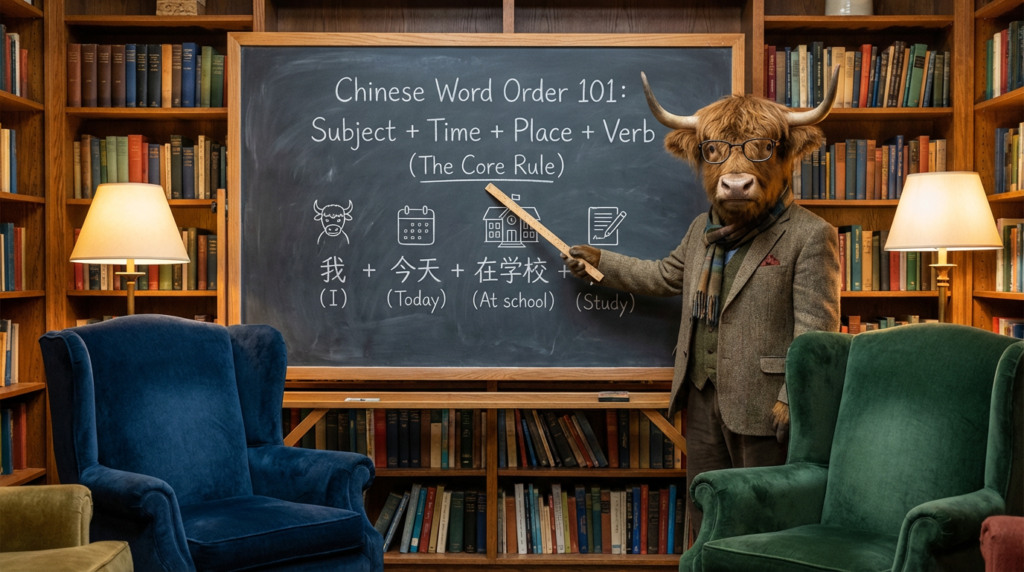
Chinese Word Order 101: Subject + Time + Place + Verb
Traditional Chinese Topic Name: 中文語序:主語+時間+地點+動詞(Zhōngwén yǔxù: zhǔyǔ + shíjiān + dìdiǎn + dòngcí)
If you can build this one sentence skeleton, you’ll sound way more “native-ish” instantly (and you’ll stop accidentally talking like Yoda).
In Mandarin (Taiwan), the most common “clean” sentence order is: Subject + Time + Place + Verb. If there’s an object, it usually comes after the verb: Subject + Time + Place + Verb + Object.
You’ll use this pattern for everyday stuff: working, studying, eating, meeting friends, doing errands—basically the whole “I’m a human with a schedule” package.
Yak Snark Box: English loves “where?” later. Chinese loves “where?” before the action. Tell the listener the time and location first—then do the thing. Your sentences will immediately feel less… scrambled eggs.
The Core Pattern
The most useful beginner template looks like this:
| Part | Traditional Chinese | Pinyin | What It Does | Mini Example |
|---|---|---|---|---|
| Subject | 主語 | zhǔyǔ | Who does it | 我 Wǒ (I) |
| Time | 時間 | shíjiān | When | 今天 jīntiān (today) |
| Place | 地點(常用「在」) | dìdiǎn (chángyòng “zài”) | Where (often with 在 zài) | 在家 zài jiā (at home) |
| Verb | 動詞 | dòngcí | Action | 學習 xuéxí (study) |
| Object (often) | 受詞 | shòucí | What/whom | 中文 Zhōngwén (Chinese) |
Model Sentence (the “default setting”):
我今天在家學中文。
Wǒ jīntiān zài jiā xué Zhōngwén.
I study Chinese at home today.
Micro-Vocab You’ll Actually Use
Here are the building blocks that make the core rule work. Each one includes a real sentence so your brain doesn’t float away.
今天 jīntiān — today
我今天很忙。
Wǒ jīntiān hěn máng.
I’m busy today.
明天 míngtiān — tomorrow
我們明天見。
Wǒmen míngtiān jiàn.
See you tomorrow.
在 zài — at / in
她在公司工作。
Tā zài gōngsī gōngzuò.
She works at the company.
去 qù — to go (to)
我晚上去夜市。
Wǒ wǎnshàng qù yèshì.
I’m going to the night market tonight.
吃 chī — to eat
我中午吃便當。
Wǒ zhōngwǔ chī biàndāng.
I eat a lunchbox at noon.
學習 xuéxí — to study / learn
他每週在圖書館學習。
Tā měi zhōu zài túshūguǎn xuéxí.
He studies at the library every week.
Rule → Example: Put Time Before Place
Chinese usually sets the timeline first, then the location, then the action.
- 我今天在台北工作。
Wǒ jīntiān zài Táiběi gōngzuò.
I work in Taipei today. - 她昨天在咖啡店喝咖啡。
Tā zuótiān zài kāfēidiàn hē kāfēi.
She drank coffee at a café yesterday. - 我們週末在公園散步。
Wǒmen zhōumò zài gōngyuán sànbù.
We take a walk in the park on weekends. - 我早上在家做早餐。
Wǒ zǎoshàng zài jiā zuò zǎocān.
I make breakfast at home in the morning.
Rule → Example: Use 在 zài For “Where The Action Happens”
If you mean “at/in a place,” you’ll often use 在 zài before the place.
- 我下午在公司開會。
Wǒ xiàwǔ zài gōngsī kāihuì.
I have a meeting at the office in the afternoon. - 他晚上在健身房運動。
Tā wǎnshàng zài jiànshēnfáng yùndòng.
He works out at the gym at night. - 我明天在學校考試。
Wǒ míngtiān zài xuéxiào kǎoshì.
I take an exam at school tomorrow. - 我們今晚在餐廳吃飯。
Wǒmen jīnwǎn zài cāntīng chīfàn.
We’re eating at a restaurant tonight.
How To Add Objects (Yes, You Can Say What You’re Eating)
Once you’ve got S + Time + Place + Verb, just add the object after the verb:
Subject + Time + Place + Verb + Object
| Pattern | Meaning | Example (ZH) | Example (Pinyin) | Translation (EN) |
|---|---|---|---|---|
| 我 + 今天 + 在家 + 吃 + 晚餐 | I + today + at home + eat + dinner | 我今天在家吃晚餐。 | Wǒ jīntiān zài jiā chī wǎncān. | I eat dinner at home today. |
| 她 + 下午 + 在圖書館 + 看 + 書 | She + afternoon + at library + read + books | 她下午在圖書館看書。 | Tā xiàwǔ zài túshūguǎn kàn shū. | She reads at the library in the afternoon. |
| 我們 + 週末 + 在市場 + 買 + 水果 | We + weekend + at market + buy + fruit | 我們週末在市場買水果。 | Wǒmen zhōumò zài shìchǎng mǎi shuǐguǒ. | We buy fruit at the market on weekends. |
Important Note: “Go/Come” Verbs Behave A Bit Differently
With movement verbs like 去 qù (go) / 來 lái (come), the destination often goes after the verb (because it’s basically the verb’s “object”). Time still happily goes early.
- 我今天去公司上班。
Wǒ jīntiān qù gōngsī shàngbān.
I’m going to the office to work today. - 他明天來台北。
Tā míngtiān lái Táiběi.
He’s coming to Taipei tomorrow. - 我們週末去夜市吃小吃。
Wǒmen zhōumò qù yèshì chī xiǎochī.
We’re going to the night market to eat snacks this weekend.
Useful Phrases You Can Plug In Immediately
These are plug-and-play pieces that keep your word order clean. Each one comes with a sentence so you can steal it guilt-free.
- 主語 zhǔyǔ — subject
主語通常放在句子的最前面。
Zhǔyǔ tōngcháng fàng zài jùzi de zuì qiánmiàn.
The subject is usually placed at the beginning of the sentence. - 時間 shíjiān — time
時間放前面,聽起來更自然。
Shíjiān fàng qiánmiàn, tīng qǐlái gèng zìrán.
Putting time earlier sounds more natural. - 地點 dìdiǎn — place/location
我每天都會記得地點。
Wǒ měitiān dōu huì jìde dìdiǎn.
I remember the location every day. - 動詞 dòngcí — verb/action word
動詞後面常常接受詞。
Dòngcí hòumiàn chángcháng jiē shòucí.
Verbs are often followed by objects. - 受詞 shòucí — object
我想換一個受詞練習看看。
Wǒ xiǎng huàn yí gè shòucí liànxí kànkan.
I want to swap the object and practice. - 在家 zài jiā — at home
我今晚在家看電影。
Wǒ jīnwǎn zài jiā kàn diànyǐng.
I’m watching a movie at home tonight. - 在公司 zài gōngsī — at the office/company
他早上在公司回信。
Tā zǎoshàng zài gōngsī huíxìn.
He replies to messages at the office in the morning. - 跟 gēn — with
我週末跟朋友在咖啡店聊天。
Wǒ zhōumò gēn péngyǒu zài kāfēidiàn liáotiān.
I chat with friends at a café on weekends. - 一起 yìqǐ — together
我們今天在公園一起跑步。
Wǒmen jīntiān zài gōngyuán yìqǐ pǎobù.
We jog together in the park today. - 常常 chángcháng — often
她常常在家做飯。
Tā chángcháng zài jiā zuòfàn.
She often cooks at home.
Common Mistakes And Fast Fixes
| Oops | Why It Sounds Off | Better |
|---|---|---|
| 我在台北工作今天。 | Time is awkwardly dumped at the end. | 我今天在台北工作。 Wǒ jīntiān zài Táiběi gōngzuò. |
| 我今天工作在台北。 | Place usually comes before the main verb (with 在). | 我今天在台北工作。 Wǒ jīntiān zài Táiběi gōngzuò. |
| 我今天去在公司。 | 去 qù already “takes” a destination; don’t add 在 there. | 我今天去公司。 Wǒ jīntiān qù gōngsī. |
| 我今天台北工作。 | Often missing 在 zài for location (especially beginners). | 我今天在台北工作。 Wǒ jīntiān zài Táiběi gōngzuò. |
Practice: Build Clean Sentences
Do these like LEGO: 我/你/他/她/我們 + 時間 + 在 + 地點 + 動詞 (+ 受詞).
Exercise 1: “I study Chinese at the library tonight.”
Answer
我今晚在圖書館學中文。
Wǒ jīnwǎn zài túshūguǎn xué Zhōngwén.
I study Chinese at the library tonight.
Exercise 2: “She eats breakfast at home every morning.”
Answer
她每天早上在家吃早餐。
Tā měitiān zǎoshàng zài jiā chī zǎocān.
She eats breakfast at home every morning.
Exercise 3: “We buy fruit at the market this weekend.”
Answer
我們這個週末在市場買水果。
Wǒmen zhè gè zhōumò zài shìchǎng mǎi shuǐguǒ.
We buy fruit at the market this weekend.
Exercise 4: “I’m going to the night market tonight.” (movement verb)
Answer
我今晚去夜市。
Wǒ jīnwǎn qù yèshì.
I’m going to the night market tonight.
Quick Reference Summary
- Core: 主語 + 時間 + 在 + 地點 + 動詞 (+ 受詞)
Example: 我今天在家看電影。Wǒ jīntiān zài jiā kàn diànyǐng. I watch a movie at home today. - No Time? 主語 + 在 + 地點 + 動詞 (+ 受詞)
Example: 我在辦公室寫報告。Wǒ zài bàngōngshì xiě bàogào. I write reports in the office. - Movement (去/來): 主語 + 時間 + 去/來 + 地點 (+ 做什麼)
Example: 他明天去台中看朋友。Tā míngtiān qù Táizhōng kàn péngyǒu. He’s going to Taichung tomorrow to see a friend.
Final Yak Box: If you ever freeze, just say it in this order: “Who + when + where + do-what”. Chinese listeners love that clarity. Your future self (and your listeners) will thank you.