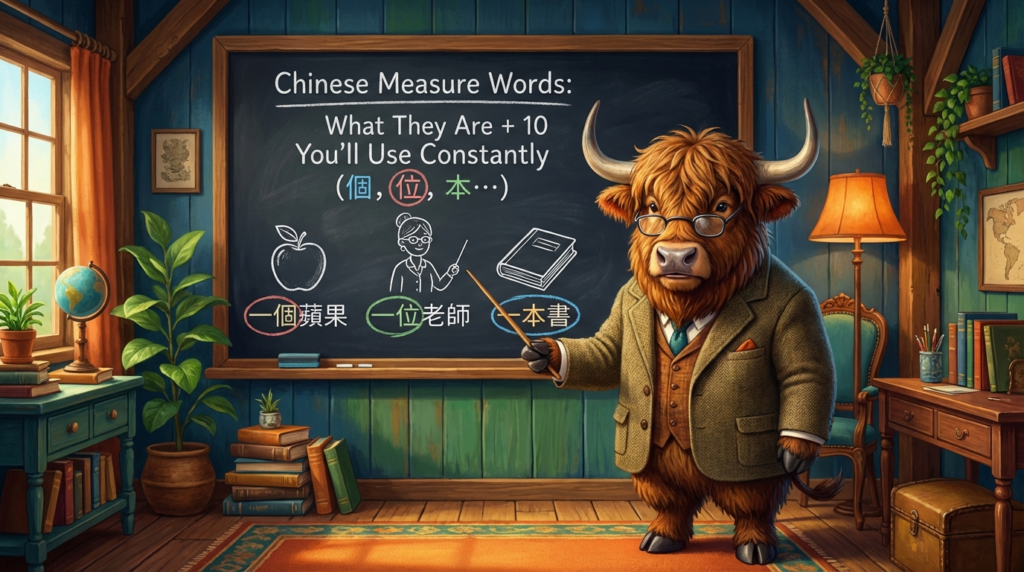
Chinese Measure Words: What They Are + 10 You’ll Use Constantly
Measure words 量詞 liàngcí are the tiny words that make your Chinese sound instantly “real.” You’ll use them every time you count things.
Think of measure words as “units” like two cups of coffee or three pieces of paper—except Chinese uses them all the time, even for “one person” or “this book.”
By the end, you’ll know what measure words are, when to use them, and 10 everyday ones you can drop into real sentences immediately—no grammar suffering required.
Yak Snark: If you say “三書” instead of “三本書,” people will still guess you mean “three books”… but you’ll sound like a robot doing taxes. Use the measure word. Be a human.
The Two Patterns You’ll Use 99% Of The Time
Pattern A: Number + Measure Word + Noun
三本書 sān běn shū — three books
我買了三本書。
Wǒ mǎi le sān běn shū.
I bought three books.
Pattern B: This/That + Measure Word + Noun
這個人 zhè gè rén — this person
那本書 nà běn shū — that book
這杯咖啡很好喝。
Zhè bēi kāfēi hěn hǎo hē.
This coffee is really tasty.
Your Core 10 Measure Words
These 10 cover a shocking amount of daily life in Taiwan. Learn them first, then sprinkle in the fancy ones later when you’re feeling brave.
個
gè — general “one unit” (default for many things)
這是一個好主意。
Zhè shì yí gè hǎo zhǔyì.
This is a good idea.
位
wèi — people (polite/respectful)
那位老師很親切。
Nà wèi lǎoshī hěn qīnqiè.
That teacher is very kind.
本
běn — books, notebooks, magazines (bound things)
我想買兩本雜誌。
Wǒ xiǎng mǎi liǎng běn zázhì.
I want to buy two magazines.
張
zhāng — flat things (paper, tickets, tables, beds)
請給我一張票。
Qǐng gěi wǒ yì zhāng piào.
Please give me one ticket.
杯
bēi — cups/glasses of drinks
我想要一杯奶茶。
Wǒ xiǎng yào yì bēi nǎichá.
I want a milk tea.
瓶
píng — bottles
冰箱裡有兩瓶水。
Bīngxiāng lǐ yǒu liǎng píng shuǐ.
There are two bottles of water in the fridge.
條
tiáo — long/skinny things (roads, fish, pants)
這條路很安靜。
Zhè tiáo lù hěn ānjìng.
This road is very quiet.
份
fèn — portions, sets, copies (food, documents)
我要一份雞排。
Wǒ yào yí fèn jīpái.
I want one portion of fried chicken cutlet.
隻
zhī — many animals (and one of a pair)
我家有一隻貓。
Wǒ jiā yǒu yì zhī māo.
My family has a cat.
輛
liàng — vehicles (cars, buses, bikes)
外面停著一輛車。
Wàimiàn tíng zhe yí liàng chē.
There’s a car parked outside.
Two Quick Power Tips
- 兩 liǎng is the natural “two” before measure words: 兩個 liǎng gè, 兩本 liǎng běn.
- 一 yī often changes sound in real speech: 一個 yí gè, 一張 yì zhāng. (Your mouth is just being efficient.)
Useful Phrases And Real-Life Sentences
Steal these patterns and you’ll be able to order, ask questions, and point at stuff like a functional adult.
- 你有幾個兄弟姐妹?
Nǐ yǒu jǐ gè xiōngdì jiěmèi?
How many siblings do you have? - 這位先生是誰?
Zhè wèi xiānshēng shì shéi?
Who is this gentleman? - 我可以看那本書嗎?
Wǒ kěyǐ kàn nà běn shū ma?
Can I look at that book? - 請給我兩張衛生紙。
Qǐng gěi wǒ liǎng zhāng wèishēngzhǐ.
Please give me two tissues (two sheets). - 我想再來一杯。
Wǒ xiǎng zài lái yì bēi.
I want another cup. - 你要大杯還是小杯?
Nǐ yào dà bēi háishì xiǎo bēi?
Do you want a large cup or a small cup? - 我們買一瓶就好。
Wǒmen mǎi yì píng jiù hǎo.
Let’s just buy one bottle. - 這條褲子很舒服。
Zhè tiáo kùzi hěn shūfú.
These pants are very comfortable. - 我可以點一份套餐嗎?
Wǒ kěyǐ diǎn yí fèn tàocān ma?
Can I order one set meal? - 那隻狗好可愛!
Nà zhī gǒu hǎo kě’ài!
That dog is so cute! - 外面有一輛公車。
Wàimiàn yǒu yí liàng gōngchē.
There’s a bus outside. - 你要哪一個?
Nǐ yào nǎ yí gè?
Which one do you want?
Common Confusions That Trip People Up
個 Vs 位
個 gè is neutral/default. 位 wèi is polite for people (customers, guests, teachers, strangers).
今天有三位客人。
Jīntiān yǒu sān wèi kèrén.
Today there are three guests.
The “Two” Rule: 兩
Before measure words, 兩 liǎng is usually more natural than 二 èr.
我有兩個問題。
Wǒ yǒu liǎng gè wèntí.
I have two questions.
The “One” Sound Change: 一
一 yī often shifts to yí or yì in natural speech. You can still write 一—this is mostly about speaking smoothly.
一個 yí gè, 一張 yì zhāng, 一本 yì běn
Tables Of Words You Can Copy-Paste Into Your Brain
The Core 10 Measure Words Table
| Hanzi | Pinyin | Meaning | Example ZH | Example Pinyin | Translation EN |
|---|---|---|---|---|---|
| 個 | gè | general unit | 我有兩個朋友。 | Wǒ yǒu liǎng gè péngyǒu. | I have two friends. |
| 位 | wèi | polite for people | 請問這位是誰? | Qǐngwèn zhè wèi shì shéi? | Excuse me, who is this? |
| 本 | běn | books/bound items | 我借了一本書。 | Wǒ jiè le yì běn shū. | I borrowed a book. |
| 張 | zhāng | flat items | 這張桌子很大。 | Zhè zhāng zhuōzi hěn dà. | This table is big. |
| 杯 | bēi | cup/glass | 我想喝一杯咖啡。 | Wǒ xiǎng hē yì bēi kāfēi. | I want to drink a cup of coffee. |
| 瓶 | píng | bottle | 你有一瓶水嗎? | Nǐ yǒu yì píng shuǐ ma? | Do you have a bottle of water? |
| 條 | tiáo | long/skinny things | 我走這條路。 | Wǒ zǒu zhè tiáo lù. | I take this road. |
| 份 | fèn | portion/set/copy | 我點了一份便當。 | Wǒ diǎn le yí fèn biàndāng. | I ordered one lunch box. |
| 隻 | zhī | many animals | 那隻鳥在唱歌。 | Nà zhī niǎo zài chànggē. | That bird is singing. |
| 輛 | liàng | vehicles | 他有一輛機車。 | Tā yǒu yí liàng jīchē. | He has a scooter. |
Bonus 12 Super Common Measure Words
Want to hit “everyday fluent” faster? These show up constantly in food, shopping, and life admin.
| Hanzi | Pinyin | Meaning | Example ZH | Example Pinyin | Translation EN |
|---|---|---|---|---|---|
| 碗 | wǎn | bowl | 我想要一碗湯。 | Wǒ xiǎng yào yì wǎn tāng. | I want a bowl of soup. |
| 盤 | pán | plate/dish | 我們點了兩盤菜。 | Wǒmen diǎn le liǎng pán cài. | We ordered two dishes. |
| 顆 | kē | small round things | 這顆蘋果很甜。 | Zhè kē píngguǒ hěn tián. | This apple is very sweet. |
| 件 | jiàn | clothes/matters | 我買了一件外套。 | Wǒ mǎi le yí jiàn wàitào. | I bought a jacket. |
| 支 | zhī | pen/cigarette/branch-like | 我需要一支筆。 | Wǒ xūyào yì zhī bǐ. | I need a pen. |
| 把 | bǎ | handled objects | 給我一把傘。 | Gěi wǒ yì bǎ sǎn. | Give me an umbrella. |
| 雙 | shuāng | pair | 我想買一雙鞋。 | Wǒ xiǎng mǎi yì shuāng xié. | I want to buy a pair of shoes. |
| 門 | mén | courses/subjects | 我這學期修三門課。 | Wǒ zhè xuéqī xiū sān mén kè. | I’m taking three classes this semester. |
| 家 | jiā | businesses (shops) | 附近有一家咖啡店。 | Fùjìn yǒu yì jiā kāfēidiàn. | There’s a café nearby. |
| 次 | cì | times/occurrences | 我去過兩次。 | Wǒ qù guò liǎng cì. | I’ve been there twice. |
| 段 | duàn | sections/periods | 我想休息一段時間。 | Wǒ xiǎng xiūxí yí duàn shíjiān. | I want to rest for a while. |
| 塊 | kuài | chunks/pieces (and money in speech) | 我要一塊蛋糕。 | Wǒ yào yí kuài dàngāo. | I want a piece of cake. |
Practice: Say It Out Loud
Try these. Don’t overthink. Just plug into the pattern.
- two people → ________
- three books → ________
- this ticket → ________
- a bottle of water → ________
- that dog → ________
Answer Key
1) 兩位人 liǎng wèi rén (or more natural: 兩個人 liǎng gè rén)
2) 三本書 sān běn shū
3) 這張票 zhè zhāng piào
4) 一瓶水 yì píng shuǐ
5) 那隻狗 nà zhī gǒu
Final Yak Box: Your No-Panic Strategy
If you don’t know the perfect measure word, start with 個 gè. It’s the Swiss Army knife. Then upgrade later: 本 běn for books, 張 zhāng for flat things, 杯 bēi for drinks. Instant improvement, minimal drama.
我想要那個。
Wǒ xiǎng yào nà gè.
I want that one.