Chinese 就 (jiù) vs 才 (cái): When To Use Each (Timing, Expectations, “Soon vs Only Then”)
Topic in Chinese: 就 (jiù) vs 才 (cái) — two tiny words that quietly judge your timing.
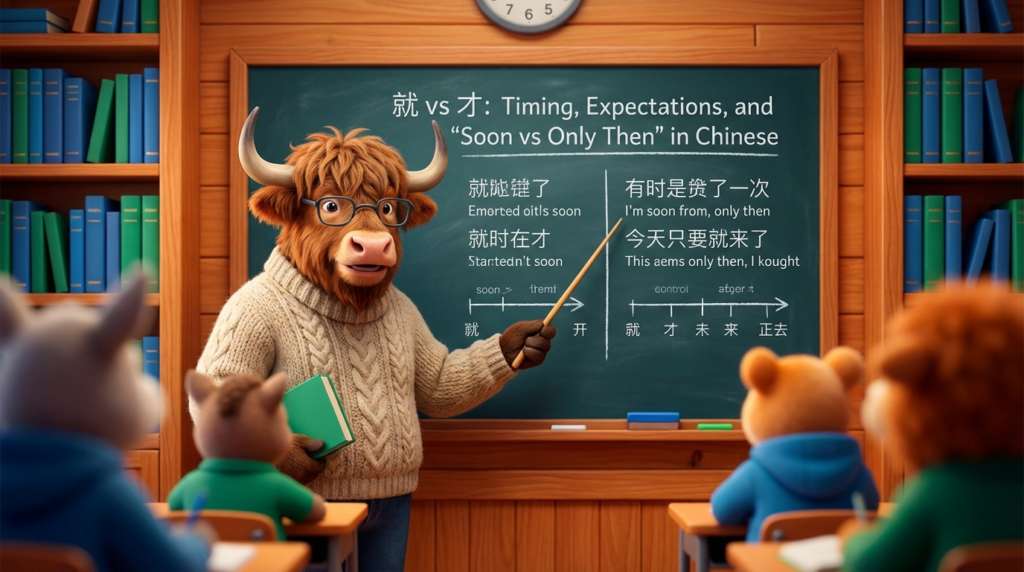
Big idea: 就 often feels “so soon / right away / as expected,” while 才 often feels “only then / not until / later than expected.” Same timeline, different attitude.
If you’ve ever said something like “I only arrived at 9” and accidentally made it sound like you arrived late (or weirdly proud of being late)… yep. That’s 就 vs 才.
By the end, you’ll be able to pick 就 or 才 based on timing and expectations—not vibes, not luck, not “please Chinese gods let this be right.”
Yak Snark Box: If you choose 才 when you mean 就, you’ll sound like you were delayed. If you choose 就 when you mean 才, you’ll sound weirdly early (or impatient). Chinese is polite… but the particles are not.
The Core Vibe: “Soon” vs “Only Then”
就 (jiù)
- Earlier / quickly / right away
- As expected (or “no big deal, it happened fast”)
- Common pattern: 一…就… (yī… jiù…) “as soon as…”
Example:
我一到家就睡著了。
Wǒ yí dào jiā jiù shuìzháo le.
I fell asleep as soon as I got home.
才 (cái)
- Later / not until / only then
- Later than expected (often a mild complaint or surprise)
- Common pattern: …才… “not until…”
Example:
我九點才到家。
Wǒ jiǔ diǎn cái dào jiā.
I didn’t get home until 9. (Feels late.)
A Super Useful Mini Rule
Ask yourself this one question:
Is this “so soon / right away”? → use 就 (jiù)
Is this “only then / not until”? → use 才 (cái)
Patterns You’ll Actually Use
| Pattern | Meaning | Example (ZH) | Example (Pinyin) | Translation (EN) |
|---|---|---|---|---|
| 一…就… yī… jiù… | as soon as… | 我一看到你就笑了。 | Wǒ yí kàn dào nǐ jiù xiào le. | As soon as I saw you, I smiled. |
| …才… … cái … | not until… / only then… | 我等到十點才睡。 | Wǒ děng dào shí diǎn cái shuì. | I didn’t sleep until 10. |
| 還沒…就… hái méi… jiù… | before… even… | 我還沒說完你就走了。 | Wǒ hái méi shuō wán nǐ jiù zǒu le. | Before I even finished, you left. |
| 直到…才… zhídào… cái… | only after… then… | 直到下雨我才帶傘。 | Zhídào xià yǔ wǒ cái dài sǎn. | I only brought an umbrella after it started raining. |
| 才剛… cái gāng… | just (a moment ago) (often “it’s early to judge”) | 我才剛到,你就要走? | Wǒ cái gāng dào, nǐ jiù yào zǒu? | I just got here, and you’re already leaving? |
| 就快要… jiù kuài yào… | about to… / very soon | 電影就快要開始了。 | Diànyǐng jiù kuài yào kāishǐ le. | The movie is about to start. |
Expectation Switch: Same Timeline, Different Feeling
These pairs are the fastest way to “feel” the difference.
Pair 1: Arriving
我八點就到了。
Wǒ bā diǎn jiù dào le.
I already arrived at 8. (Pretty early / sooner than expected.)
我八點才到。
Wǒ bā diǎn cái dào.
I didn’t arrive until 8. (Feels late / later than expected.)
Pair 2: Finishing Work
我十分鐘就寫完了。
Wǒ shí fēnzhōng jiù xiě wán le.
I finished in just 10 minutes. (Fast!)
我十分鐘才寫完。
Wǒ shí fēnzhōng cái xiě wán.
I didn’t finish until 10 minutes later. (Not super fast; could be “finally.”)
Useful Phrases And Real-Life Sentences
Each entry includes: Hanzi + pinyin + meaning, then a real sentence.
Quick “就” Wins
馬上就… (mǎshàng jiù…) — right away
我馬上就回你。
Wǒ mǎshàng jiù huí nǐ.
I’ll reply to you right away.
一下子就… (yíxiàzi jiù…) — in no time
他一下子就懂了。
Tā yíxiàzi jiù dǒng le.
He understood in no time.
才…就…? (cái… jiù…?) — “Already?” (surprised it’s so soon)
才八點你就想睡?
Cái bā diǎn nǐ jiù xiǎng shuì?
It’s only 8 and you already want to sleep?
…就好 (… jiù hǎo) — “then it’s fine / just do that”
你說一聲就好。
Nǐ shuō yì shēng jiù hǎo.
Just let me know and it’s fine.
Honest “才” Moments
你現在才… (nǐ xiànzài cái…) — only now? (late!)
你現在才來?大家都走了。
Nǐ xiànzài cái lái? Dàjiā dōu zǒu le.
You’re only coming now? Everyone already left.
…才發現… (… cái fāxiàn…) — only then realize
我回家才發現忘了帶鑰匙。
Wǒ huí jiā cái fāxiàn wàng le dài yàoshi.
I only realized after getting home that I forgot my keys.
…才行 (… cái xíng) — only then is it acceptable / only then it works
要先預約才行。
Yào xiān yùyuē cái xíng.
You have to book first; only then will it work.
才剛… (cái gāng…) — just (recently), so don’t rush conclusions
我才剛開始學中文。
Wǒ cái gāng kāishǐ xué Zhōngwén.
I only just started learning Chinese.
Two Tricky Notes That Save You Pain
1) English “just” is a trap. “I just arrived” can mean “a moment ago” or “only.” Chinese splits that:
“a moment ago” → 剛(剛) (gāng) or 剛才 (gāngcái)
我剛到。
Wǒ gāng dào.
I just arrived (a moment ago).
“only then / not until” → 才 (cái)
我剛才才到。
Wǒ gāngcái cái dào.
I didn’t get here until just now. (Feels delayed.)
2) 就 can also mean “only/just” (amount)… but the vibe is different. It often feels like “that’s it?” or “no more than.”
就三個 (jiù sān ge) — only three (sounds like “only” in quantity)
就三個人來啊?
Jiù sān ge rén lái a?
Only three people came?
Practice: Pick 就 Or 才
Choose the one that matches the expectation. (Don’t overthink. Overthinking is how particles win.)
- 1) 我_____到公司,老闆就叫我開會。
- 2) 你怎麼_____說?我早就知道了。
- 3) 我等了半小時,你_____回我。
- 4) 他_____看一眼就決定買了。
- 5) 電車_____到站,我們快走。
- 6) 我_____發現今天是你的生日!
- 7) 才九點你_____想回家?
- 8) 我到晚上十一點_____做完。
- 9) 我_____剛起床,腦袋還沒開機。
- 10) 直到他道歉,我_____原諒他。
Answer Key + Natural Readings
1) 一…就… → 我一到公司,老闆就叫我開會。
Wǒ yí dào gōngsī, lǎobǎn jiù jiào wǒ kāihuì.
As soon as I got to the office, the boss told me to meet.
2) 才 (only now) → 你怎麼才說?我早就知道了。
Nǐ zěnme cái shuō? Wǒ zǎo jiù zhīdào le.
Why are you only saying it now? I knew long ago.
3) 才 (late) → 我等了半小時,你才回我。
Wǒ děng le bàn xiǎoshí, nǐ cái huí wǒ.
I waited half an hour—only then you replied.
4) 就 (quickly) → 他就看一眼就決定買了。
Tā jiù kàn yì yǎn jiù juédìng mǎi le.
He decided to buy it after just one glance.
5) 快要…了 often pairs with 就 → 電車就到站,我們快走。
Diànchē jiù dào zhàn, wǒmen kuài zǒu.
The train’s about to arrive—let’s go.
6) 才發現 → 我才發現今天是你的生日!
Wǒ cái fāxiàn jīntiān shì nǐ de shēngrì!
I only just realized today is your birthday!
7) 才…就…? (so soon?) → 才九點你就想回家?
Cái jiǔ diǎn nǐ jiù xiǎng huí jiā?
It’s only 9 and you already want to go home?
8) 才 (not until) → 我到晚上十一點才做完。
Wǒ dào wǎnshàng shíyī diǎn cái zuò wán.
I didn’t finish until 11 p.m.
9) 才剛 → 我才剛起床,腦袋還沒開機。
Wǒ cái gāng qǐchuáng, nǎodài hái méi kāijī.
I just woke up—my brain hasn’t booted yet.
10) 直到…才… → 直到他道歉,我才原諒他。
Zhídào tā dàoqiàn, wǒ cái yuánliàng tā.
Only after he apologized did I forgive him.
Common Mistakes And Fast Fixes
Mistake 1: Using 才 When You Mean “Already”
❌ 我八點才到了。 (sounds late)
✅ 我八點就到了。 (sounds early)
Fix: If you’re proud it happened quickly / early, pick 就.
Mistake 2: Forgetting Expectation
同樣是 “九點到”:
我九點就到。
Wǒ jiǔ diǎn jiù dào.
Early / sooner than expected.
我九點才到。
Wǒ jiǔ diǎn cái dào.
Late / later than expected.
Fix: Add the hidden thought: “早” (early) → 就, “晚” (late) → 才.
Quick Reference Summary
| If You Mean… | Use | Starter Pattern | Example (ZH) | Pinyin | EN |
|---|---|---|---|---|---|
| as soon as / right away | 就 | 一…就… | 我一吃完就走。 | Wǒ yì chī wán jiù zǒu. | I leave as soon as I finish eating. |
| already (so soon?) | 就 | 才…就…? | 才兩天你就放棄? | Cái liǎng tiān nǐ jiù fàngqì? | It’s only been two days and you already quit? |
| not until / only then | 才 | …才… | 我忙到週末才有空。 | Wǒ máng dào zhōumò cái yǒu kòng. | I’m busy and won’t be free until the weekend. |
| only after… | 才 | 直到…才… | 直到你說清楚我才懂。 | Zhídào nǐ shuō qīngchu wǒ cái dǒng. | Only after you explained clearly did I understand. |
Final Yak Box: Your 5-Second Decision
- Feels early / quick / immediate → 就 (jiù)
- Feels late / not until / only then → 才 (cái)
- Want “as soon as”? → 一…就… (yī… jiù…)
- Want “only after”? → 直到…才… (zhídào… cái…)
Say it out loud once and listen for the hidden emotion: “Wow, that was fast.” (就) vs “Finally.” (才)