

This A2 Elementary retelling of 嫦娥奔月 keeps the plot clear for learners while still giving the story some atmosphere and momentum.
This version teaches Traditional Chinese through English and includes clickable word help inside the story, full story audio, and lesson notes after the reading. It is free to use on Yak Yacker and is designed to feel natural, readable, and manageable for learners.
很久很久以前,天上有十個太陽。它們一起發光,大地非常熱。
有一個英雄叫。他,他想。
,"嗖"的一聲,一個太陽。他又,最後只一個太陽。
他對太陽說:"你以後要每天早上出來,晚上回去。"太陽說:"好的,。"
后羿成為了,他得到了一顆。他把藥給妻子看。"這顆藥能讓我們。"后羿說。
有一個。一天,后羿不在家,壞人來。"開門!把不死藥給我!"壞人大喊。
嫦娥很,但是她不把藥給壞人。她,一口藥。她的身體變,慢慢。
后羿回家,看到嫦娥。他大聲喊:"嫦娥!嫦娥!"但是嫦娥已經。
後來,后羿每天晚上月亮。月亮上好像有嫦娥的。人們說,那是嫦娥在。
A long, long time ago, there were ten suns in the sky. They shone together, and the earth was very hot.
There was a hero named Hou Yi. He was skilled at archery and wanted to help everyone.
Hou Yi drew his bow, and with a whoosh, he shot down one sun. He shot down eight more suns, leaving only one.
He said to the sun, 'From now on, you must rise in the morning and set in the evening.' The sun said, 'Okay, I'll remember.'
Hou Yi became a great hero and received an elixir of immortality. He showed it to his wife, Chang'e. 'This elixir can make us immortal,' Hou Yi said.
A villain heard about the elixir. One day, when Hou Yi was not home, the villain came knocking. 'Open up! Give me the elixir of immortality!' the villain shouted.
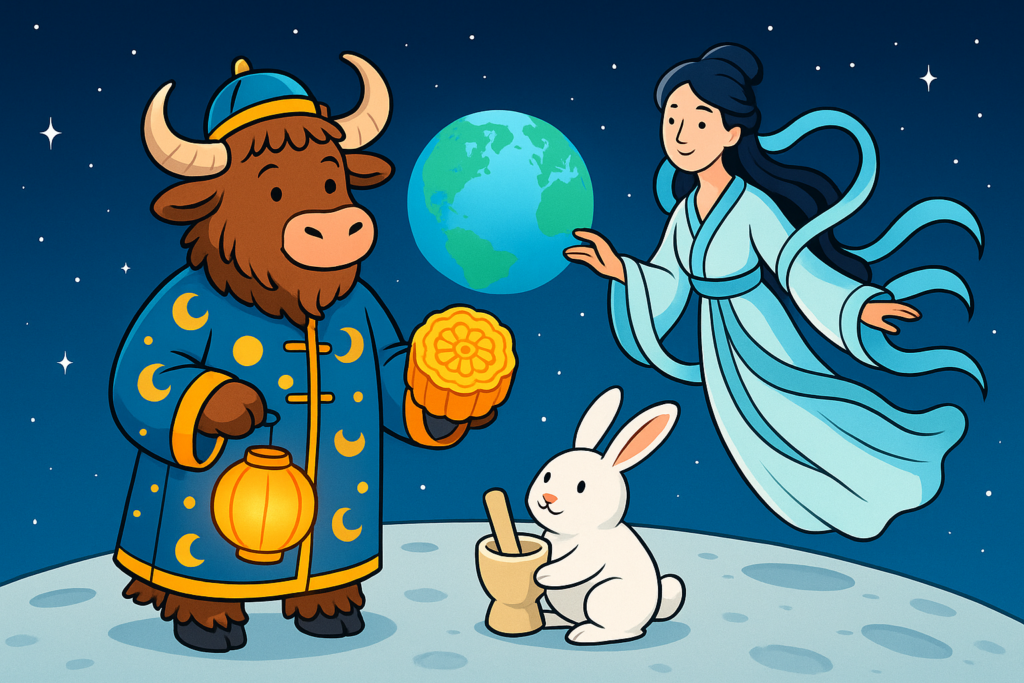
Chang'e was very frightened, but she wouldn't give the elixir to the villain. She opened the bottle and swallowed the elixir in one gulp. Her body became light, and she slowly floated up toward the sky.
Hou Yi returned home and saw Chang'e flying away. He cried out, 'Chang'e! Chang'e!' But Chang'e had already flown to the moon.
Afterward, Hou Yi gazed at the moon every night. On the moon, it seemed there was the shadow of Chang'e. People said that was Chang'e in the Moon Palace.
Let's look at some key words from the legend. You'll see these again and again in Chinese folk tales!
Practice saying them out loud - the pinyin will help you get the tones right.
- 太陽 (tàiyáng) - sun. The story begins with ten suns: 天上有十個太陽。
- 英雄 (yīngxióng) - hero. 后羿是英雄。 (Hou Yi is a hero.)
- 不死藥 (bù sǐ yào) - elixir of immortality. 后羿得到了不死藥。
- 害怕 (hàipà) - scared. 嫦娥很害怕。 (Chang'e was very scared.)
In Chinese, we often add a result word after a verb to show what happened as a result of the action. These are called resultative complements, and they're super common!
Look at these examples from the story: 后羿射下了九個太陽 (Hou Yi shot down nine suns). The verb is 射 (shoot), and 下 (down) tells us the result - the suns came down.
- Verb + 下 (down): 射下 (shoot down), 坐下 (sit down).
- Verb + 走 (away): 飛走 (fly away), 拿走 (take away).
- Verb + 住 (firmly): 記住 (remember - literally "remember firmly"), 站住 (stand still).
- Try making your own: 吃完 (eat - finish eating), 看完 (read - finish reading).
Stories often have dialogue and descriptions. Let's pick up some useful patterns from the legend.
Notice how characters talk to each other: 后羿對太陽說… (Hou Yi said to the sun…). The pattern is 對 + person + 說.
- 大聲喊 (dà shēng hǎn) - shout loudly. 壞人大聲喊:"開門!" (The bad guy shouted, "Open the door!")
- 好像 (hǎoxiàng) - it seems, as if. 月亮上好像有嫦娥的影子。 (On the moon, there seems to be a shadow of Chang'e.)
- 慢慢地 (màn man de) - slowly. 嫦娥慢慢地飛向天空。 (Chang'e slowly flew toward the sky.)
- 把…給…看 (bǎ…gěi…kàn) - show something to someone. 他把藥給妻子看。 (He showed the elixir to his wife.)
Now you've got the words and tools - why not retell the story in your own way? You can use the new vocabulary and resultative complements to make it come alive.
Try writing a short paragraph about what happens after Chang'e reaches the moon. What does she do there? Does she miss Hou Yi? Use at least one resultative complement and one phrase from today.
嫦娥奔月 comes from the Chinese / myth tradition and is best known as a myth. This Yak Yacker article is an original learner retelling based on Traditional Chinese moon myth; public domain, so the wording here is simplified for modern learners rather than copied from one old edition.
Older printings, translations, and retellings of this story can vary quite a bit. The original audience was usually kids/general, but this version is adapted for A2 Elementary learners studying Traditional Chinese. Many variants; choose one simple version.
If you want to look into the source tradition, start with Wikipedia.
If you want to keep going, browse more in our Traditional Chinese section and review the HSK Level 1 Chinese Vocabulary. After that, try Essential Chinese Grammar Words for another useful next step.