This B1 Intermediate retelling of 狂人日記 keeps the plot clear for learners while still giving the story some atmosphere and momentum.
This version teaches Traditional Chinese through English and includes clickable word help inside the story, full story audio, and lesson notes after the reading. It is free to use on Yak Yacker and is designed to feel natural, readable, and manageable for learners.
有一天,一位老朋友。
可是他不在家,
弟弟說:「我哥哥最近生病了,。不過他現在好了,。」
我很好奇,弟弟把日記拿給了我。
第一頁寫著:「今天晚上。我已經三十年沒見過月亮了。,覺得會有。」
他繼續寫:「我在路上趙先生。,像在看一盤菜。」
他走在街上,。他聽見他們在說:「這個人??」
回到家裡,。他覺得他們也在
他翻開歷史書,「仁義道德」,可是他在
他去找哥哥,:「我知道你們想吃我!」。
哥哥說:「這是的規矩,沒什麼奇怪的。」:或許他自己也曾經吃過人。
他哭著說:「你們可以啊!不要再吃人了!」
日記的最後一頁寫著:「沒有吃過人的孩子,
我放下日記,。窗外的月亮仍然很亮,
One day, I went to visit an old friend.
But he wasn't home; his younger brother came out to meet me.
His brother said, 'My older brother was recently ill and acted strangely. Now he's better, but he spends all day writing in a diary.'
I was curious, so I asked if I could see the diary. The brother handed it to me.
The first page read: 'The moonlight is very bright tonight. I haven't seen the moon in thirty years. I feel very uneasy today, as if something bad will happen.'
He continued: 'I met Mr. Zhao on the road. He looked at me oddly, as if looking at a dish. I felt he wanted to eat me!'
He walked down the street, and even children were whispering. He heard them say, 'Is this person fat? Can he be eaten?'
Back home, he heard his family talking in low voices. He felt they were also discussing how to cook him.
He opened a history book; it was full of 'benevolence, righteousness, and morality,' but between the lines he saw only two words: 'Eat people!'
He went to his brother and shouted, 'I know you want to eat me!' His brother's face turned pale instantly.
His brother said, 'This is a tradition of thousands of years; there's nothing strange about it.' The madman suddenly realized: perhaps he himself had once eaten people.
He cried, 'You can change! Stop eating people!'
The last page of the diary read: 'Children who haven't eaten people may still exist. Save the children...'
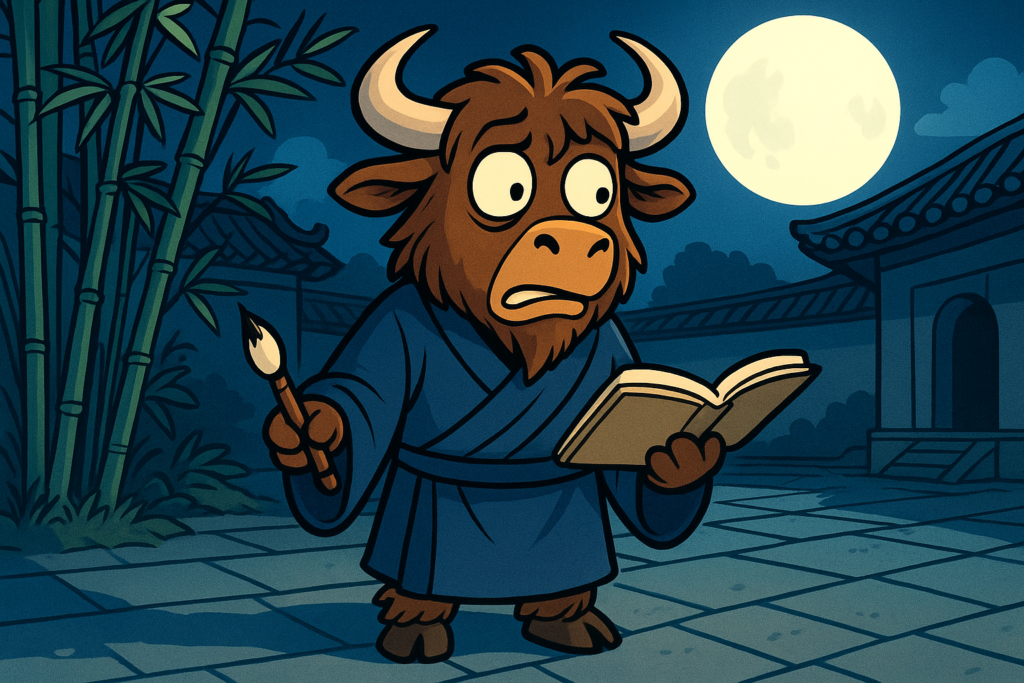
I put down the diary, feeling very sad. The moon outside was still bright, but I felt the world was a bit terrifying.
This diary is full of vivid words that capture the madman's fearful world. Let's pick out some treasures to boost your vocabulary.
Notice how many words relate to secrets, suspicion, and old customs - they set the eerie tone.
- 拜訪 (bàifǎng) - to pay a visit (polite, often used for friends or respected people)
- 日記 (rìjì) - diary; literally "day record"
- 交頭接耳 (jiāo tóu jiē ěr) - to whisper to each other (lit. "cross heads, touch ears")
- 仁義道德 (rényì dàodé) - benevolence, righteousness, and morality (classic Confucian virtues)
- 吃人 (chī rén) - to eat people (literal); but here, a shocking metaphor for exploitation
The madman doesn't just observe - he constantly says 我覺得… (wǒ juéde…, "I feel…"). In Chinese, 覺得 is your go-to verb for expressing subjective feelings, opinions, or suspicions.
It can be followed by a full clause: 我覺得他看我的眼神很奇怪 (I felt his way of looking at me was very strange). Compare with 想 (xiǎng), which leans toward thinking or desiring - 覺得 adds that emotional edge.
- Pattern: Subject + 覺得 + [clause describing the feeling or opinion]
- Example from the story: 「他覺得他們也在商量怎麼煮他」 (He felt they were also discussing how to cook him)
- Try it: How would you say "I feel that Chinese characters are beautiful"?
This story isn't about actual cannibalism. The madman's diary uses 吃人 as a searing metaphor for the way traditional society destroys individuals - through rigid rules, hypocrisy, and the "everyone does it" excuse.
Lu Xun, the author, wrote this in 1918 to wake up a nation. The diary's final line, "救救孩子…" (jiùjiu háizi…, "Save the children…"), is a cry for a future free from such spiritual cannibalism.
- Literal meaning: eating human flesh
- Metaphorical meaning: exploiting, oppressing, or blindly following cruel traditions
- Related phrase: 「吃人的禮教」 (chī rén de lǐjiào) - "cannibalistic ritual teachings," a common phrase in modern Chinese criticism
You've read a piece of literary history - and picked up some powerful Chinese along the way. Why not take it a step further?
Try writing your own short diary entry in Chinese, using 覺得 to describe a suspicion or fear. Or discuss with a friend: can you think of metaphors in your own culture that criticize society as sharply as 吃人?
- Challenge: Write three sentences starting with 我覺得… about a strange experience
- Explore: Watch a movie or read a short story that uses a similar dark metaphor and compare
狂人日記 comes from the Chinese / Lu Xun tradition and is best known as a modern short story. This Yak Yacker article is an original learner retelling based on Lu Xun, 1918; likely public domain in U.S./China, but check edition, so the wording here is simplified for modern learners rather than copied from one old edition.
Older printings, translations, and retellings of this story can vary quite a bit. The original audience was usually adult, but this version is adapted for B1 Intermediate learners studying Traditional Chinese. Adult satire/mental distress; avoid modern translations.
If you want to look into the source tradition, start with Wikisource.
If you want to keep going, browse more in our Traditional Chinese section. After that, try 1,000 Traditional Chinese Phrases and Expressions for another useful next step.