


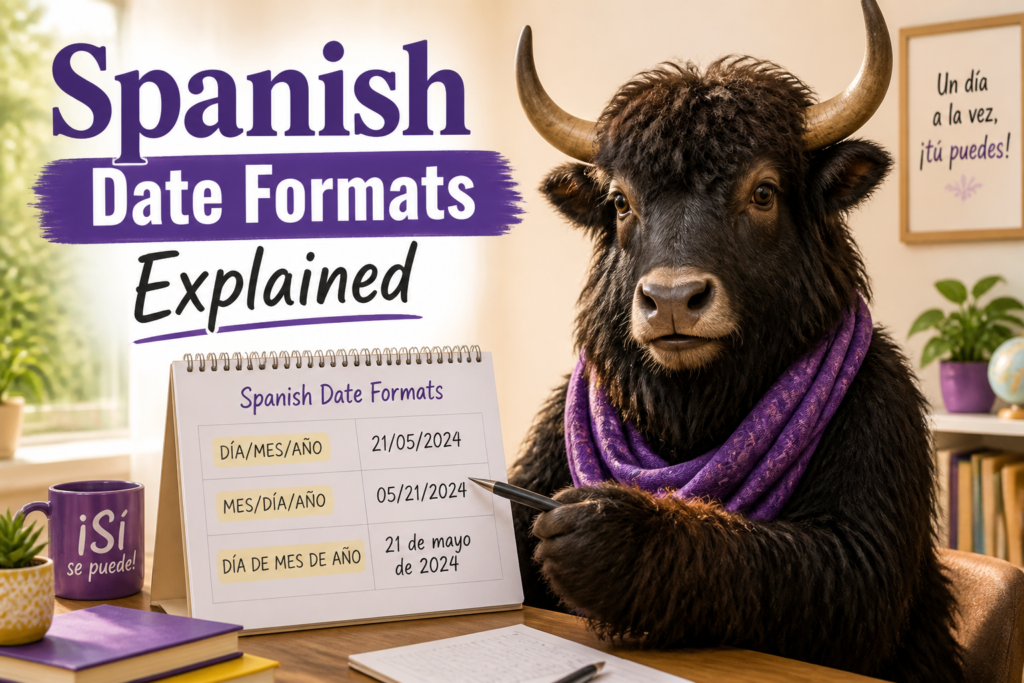
If dates in Spanish have ever made you pause and stare at a calendar like it personally offended you, good news: the system is actually pretty simple once you see the pattern. Spanish dates mostly use day + month + year, and the way people say them out loud is just as practical as it sounds. Not fancy. Not mysterious. Just very Spanish.
For the broader learning path, visit our parent guide.
By the end of this guide, you’ll be able to read, write, and say Spanish dates naturally, without flipping the numbers around like a confused travel app. You’ll also learn the little grammar details that matter, because dates love to hide prepositions, articles, and ordinal forms in plain sight.
And yes, there’s a reason “March 5, 2026” becomes 5 de marzo de 2026. Spanish likes to start with the day. Very organized. Very unbothered.
For a quick companion lesson on the calendar vocabulary around this topic, see What Day Is It Today In Spanish and the related guide on How To Write The Date In Spanish.
The Basic Spanish Date Pattern
The most common Spanish date format is:
- día + de + mes + de + año
- 5 de mayo de 2026 = May 5, 2026
- 12 de enero de 2024 = January 12, 2024
Notice the preposition de repeated twice. That little word does a lot of work here. In English we usually say “May 5, 2026,” but in Spanish the month doesn’t get to move up front and boss everybody around.
| Pattern | Meaning | Spanish Example | English Translation | Learner Note |
|---|---|---|---|---|
| día + de + mes + de + año | Standard date format | 15 de agosto de 2025 | August 15, 2025 | This is the default in most Spanish-speaking countries. |
| el + día + de + mes + de + año | With the article | El 15 de agosto de 2025 | On August 15, 2025 | Very common in writing and speech. |
| day/month/year | Numeric date style | 15/8/2025 | 15/8/2025 | Common in many countries; less confusion than month/day/year. |
In formal writing, you’ll often see the article el before the date: El 3 de abril de 2024. In everyday conversation, people may just say the date directly. The article is not usually translated as “the” in English, so don’t overthink it. Spanish already has enough for you to juggle.
Yak wisdom: In Spanish, the day usually comes first. If the calendar looks “backward” to English eyes, that’s normal. English is just being dramatic again.
How To Say Dates Out Loud
When speaking, Spanish dates are easy to say once you know the month names and how to read numbers. The day is usually a cardinal number, not an ordinal number. So you say uno, dos, tres, not “first,” “second,” “third” in the usual English way.
| Spanish | Pronunciation | Meaning | Example Sentence | Translation | Learner Note |
|---|---|---|---|---|---|
| el 1 de mayo | el uno de MY-oh | May 1 | La reunión es el 1 de mayo. | The meeting is on May 1. | In speech, people often say primero for the first day of the month. |
| el 2 de mayo | el dos de MY-oh | May 2 | El concierto es el 2 de mayo. | The concert is on May 2. | Use the number normally. |
| el 15 de julio | el quin-ce de HOO-lyoh | July 15 | Nací el 15 de julio. | I was born on July 15. | Dates with 15 and other numbers are straightforward. |
| el 31 de diciembre | el trein-ta y UN de dee-THYEM-bre / dee-SYEM-bre | December 31 | La fiesta es el 31 de diciembre. | The party is on December 31. | Spain often says diciembre with a Castilian c/z sound; Latin America usually says dee-SYEM-bre. |
For the first day of the month, Spanish often uses primero instead of uno when speaking or writing the date in full: el primero de mayo. After that, it goes back to regular numbers: dos, tres, cuatro, and so on.
| Spanish | Pronunciation | Meaning | Example Sentence | Translation | Learner Note |
|---|---|---|---|---|---|
| el primero de mayo | el pree-MEH-ro de MY-oh | May 1 | El primero de mayo es feriado en muchos países. | May 1 is a holiday in many countries. | Primero is the usual way to say day 1 of the month. |
| el dos de mayo | el dos de MY-oh | May 2 | El dos de mayo trabajo. | On May 2, I work. | Less elegant in English, perfectly normal in Spanish. |
| el diez de octubre | el dyes de ok-TOO-bre | October 10 | La cita es el diez de octubre. | The appointment is on October 10. | Diez is the number 10; no special date form needed. |
Month Names In Spanish
Spanish month names are lowercase unless they begin a sentence. That means enero, febrero, marzo, and so on. English capitalizes months; Spanish usually does not. Tiny detail, big chance to look more natural.
| Spanish | Pronunciation | Meaning | Example Sentence | Translation | Learner Note |
|---|---|---|---|---|---|
| enero | eh-NEH-ro | January | Mi cumpleaños es en enero. | My birthday is in January. | Month names are masculine: el enero is rare, but the article is masculine if used. |
| febrero | feh-BREH-ro | February | En febrero hace frío. | It’s cold in February. | hace frío = it’s cold. |
| marzo | MAR-thoh / MAR-so | March | Viajo en marzo. | I travel in March. | Spain often has a softer z; Latin America usually says s. |
| abril | ah-BREEL | April | La escuela empieza en abril. | School starts in April. | Short and easy. Enjoy the rare victory. |
| mayo | MY-oh | May | Mi examen es en mayo. | My exam is in May. | Same spelling as the month and the word may in English, but different meaning. |
| junio | HOO-nee-oh | June | Nos mudamos en junio. | We move in June. | j sounds like a strong English h. |
| julio | HOO-lyoh | July | Las vacaciones son en julio. | The vacation is in July. | ll often sounds like y in Latin America. |
| agosto | ah-GOH-stoh | August | Hace calor en agosto. | It’s hot in August. | Simple and common in weather talk. |
| septiembre | sep-TYEM-bre | September | Empiezo la universidad en septiembre. | I start university in September. | Often shortened in text as sept. |
| octubre | ok-TOO-bre | October | La feria es en octubre. | The fair is in October. | Very useful in travel and event dates. |
| noviembre | noh-VYEM-bre | November | Mi hermano nació en noviembre. | My brother was born in November. | v and b sound very similar in Spanish. |
| diciembre | dee-SYEM-bre | December | Las fiestas empiezan en diciembre. | The holidays start in December. | Great month for calendars and chaos. |
All month names are masculine. If you use an article, it’s el enero, el febrero, and so on. In most date phrases, though, the article is usually dropped or appears only before the full date, not before the month alone.
Writing Dates In Spanish: Common Formats
There are a few common ways to write dates, and the right one depends on the situation. In normal prose, the long format is standard. In forms, tickets, receipts, and databases, you may see numeric formats too.
| Format | Example | Where You’ll See It | Notes |
|---|---|---|---|
| Long form | 15 de agosto de 2025 | Letters, articles, everyday writing | Clear and natural. |
| With article | El 15 de agosto de 2025 | Formal writing, announcements | Very common and safe. |
| Numeric day-month-year | 15/08/2025 | Forms, systems, official documents | Common in Spanish-speaking countries. |
| Short numeric without zeros | 15/8/25 | Notes, casual writing | Readable, but less formal. |
If you’re used to U.S. month-day-year formatting, this is where mistakes happen. A date like 03/04/2025 in Spanish usually means 3 April 2025, not March 4. That’s the kind of mix-up that can ruin a reservation faster than you can say “pero yo pensaba…”
In some international contexts, people use ISO-style dates like 2025-04-03. That’s not especially “Spanish” in conversational writing, but it can appear in systems, spreadsheets, and technical contexts. For everyday Spanish, still think day-month-year.
How To Say The Date In A Sentence
Spanish uses a few very common structures with dates. The good news: once you recognize them, you’ll see them everywhere in schedules, invitations, school notices, and work emails.
| Spanish | Pronunciation | Meaning | Example Sentence | Translation | Learner Note |
|---|---|---|---|---|---|
| Es el 5 de mayo. | es el sin-ko de MY-oh | It is May 5. | Hoy es el 5 de mayo. | Today is May 5. | Es is very common for telling the date. |
| Hoy es lunes, 5 de mayo. | oy es LOO-nes, sin-ko de MY-oh | Today is Monday, May 5. | Hoy es lunes, 5 de mayo. | Today is Monday, May 5. | Days of the week are also lowercase in Spanish. |
| La fecha es el 12 de junio. | la FEH-cha es el doo-SE de HOO-nee-oh | The date is June 12. | La fecha del examen es el 12 de junio. | The exam date is June 12. | Fecha means date on a calendar or document. |
| Salimos el 3 de octubre. | sa-LEE-mos el tres de ok-TOO-bre | We leave on October 3. | Salimos el 3 de octubre por la mañana. | We leave on October 3 in the morning. | El is optional in some contexts, but very common. |
When talking about events, appointments, birthdays, or travel plans, the date usually works with es, ser, or a preposition like el or en depending on the sentence. The exact choice depends on the verb and context, not on some mystical calendar law.
Useful Date Phrases You’ll Actually Hear
These are the practical date phrases that show up in real life: at school, at work, in travel plans, and in texts. Some are formal, some are neutral, and some are everyday bits of calendar speech you’ll hear constantly.
| Spanish | Pronunciation | Meaning | Example Sentence | Translation | Learner Note |
|---|---|---|---|---|---|
| ¿Qué fecha es hoy? | keh FEH-cha es oy | What’s today’s date? | ¿Qué fecha es hoy, por favor? | What’s today’s date, please? | Polite and useful. |
| Hoy es… | oy es | Today is… | Hoy es 10 de enero. | Today is January 10. | Super common in everyday speech. |
| El día de hoy | el DEE-ah de oy | Today / on this day | El día de hoy tenemos una reunión. | Today we have a meeting. | More formal or written. |
| Desde el 1 de junio | DES-de el pree-MEH-ro de HOO-nee-oh | From June 1 | Trabajo desde el 1 de junio. | I work from June 1. | Desde = from/since. |
| Hasta el 30 de septiembre | AS-ta el treyn-ta de sep-TYEM-bre | Until September 30 | La oferta es válida hasta el 30 de septiembre. | The offer is valid until September 30. | Hasta = until/to. |
| Para el 20 de noviembre | PA-ra el VYEM-te de noh-VYEM-bre | By November 20 | Necesito el informe para el 20 de noviembre. | I need the report by November 20. | Para often means a deadline here. |
| A partir del 15 de julio | a par-TEER del quin-SE de HOO-lyoh | Starting on July 15 | A partir del 15 de julio cambia el horario. | Starting July 15, the schedule changes. | Very useful in official notices. |
| el próximo 8 de abril | el PROK-si-mo o-CHO de ah-BREEL | next April 8 | Vuelvo el próximo 8 de abril. | I’m coming back next April 8. | Próximo can mean next/upcoming. |
| el pasado 2 de marzo | el pa-SA-do dos de MAR-so | last March 2 | Firmé el contrato el pasado 2 de marzo. | I signed the contract last March 2. | More formal or written. |
| la fecha límite | la FEH-cha LEE-mee-teh | deadline | La fecha límite es el 1 de diciembre. | The deadline is December 1. | Great phrase for school and work. |
One small but important note: de often appears before the year too, especially in full dates. You’ll hear and read 15 de mayo de 2025, not usually just 15 de mayo 2025. Spanish likes its little connectors. A lot.
Days Of The Week And Date Agreement
Days of the week in Spanish are also lowercase: lunes, martes, miércoles, jueves, viernes, sábado, domingo. When used with dates, they often appear with el or after hoy.
| Spanish | Pronunciation | Meaning | Example Sentence | Translation | Learner Note |
|---|---|---|---|---|---|
| el lunes 7 de abril | el LOO-nes syete de ah-BREEL | Monday, April 7 | La clase es el lunes 7 de abril. | Class is on Monday, April 7. | Very common in schedules. |
| el miércoles 12 de junio | el MYER-koh-les doo-SE de HOO-nee-oh | Wednesday, June 12 | La entrevista es el miércoles 12 de junio. | The interview is on Wednesday, June 12. | More Spanish to explore How to Type Spanish Accents on Your Phone and Computer Best graded readers for Spanish The Boy and the Sheep: A1 Beginner Spanish Story with Audio Martina the Little Cockroach: A1 Beginner Spanish Story with Audio |