Ser vs. Estar in Spanish: The Two “To Be” Verbs (Finally Explained)
Spanish has two ways to say “to be,” and yes, it feels like a prank at first. The good news: there are clear patterns you can learn fast—and you’ll stop guessing.
Goal: choose ser or estar confidently in real conversations (Mexican Spanish-friendly).
The One-Sentence Cheat
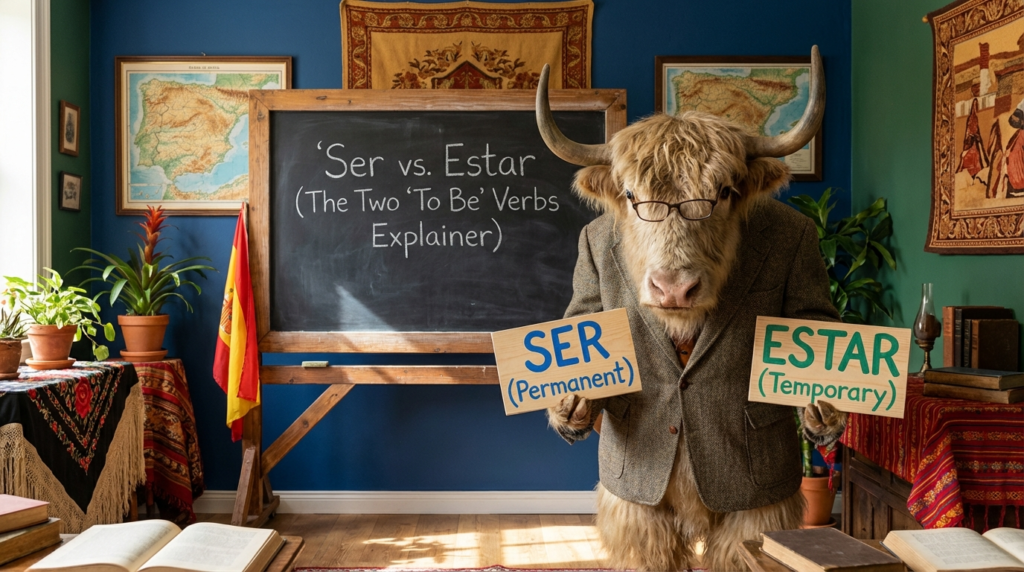
Ser = who/what something is (identity, defining info). Estar = how/where something is (state, condition, location).
If you’re describing the “label,” think ser. If you’re describing the “status,” think estar.
Ser = Identity (The “Label”)
- Who someone is: identity, personality
- What something is: definitions, material
- From where: origin, nationality
- When: time, dates
- Whose: possession/ownership
- Events happen somewhere (important!)
Estar = State (The “Status”)
- How someone feels: emotions, conditions
- Where something is: physical location
- In progress: “-ing” actions
- Result of a change: past participle as an adjective
- Temporary (often, but not always)
Ser: The Most Common Uses (With Real Sentences)
| Pattern | Meaning | Example 1 | Example 2 |
|---|---|---|---|
| ser + noun | Identity / job / role | Soy estudiante. (I’m a student.) | Mi mamá es doctora. (My mom is a doctor.) |
| ser + de | Origin / made of / belonging | ¿Eres de México? (Are you from Mexico?) | La mochila es de cuero. (The backpack is leather.) |
| ser + adjective | Defining trait (often “characteristic”) | Mi hermano es paciente. (My brother is patient.) | La clase es interesante. (The class is interesting.) |
| ser + time/date | Time and dates | Son las dos. (It’s 2:00.) | Hoy es lunes. (Today is Monday.) |
| ser + location (events) | Where an event is | La fiesta es en mi casa. (The party is at my house.) | La junta es en la oficina. (The meeting is in the office.) |
Quick note: That “events use ser for location” rule saves a lot of heartbreak. People and things are located with estar, but events are held with ser.
Estar: The Most Common Uses (With Real Sentences)
| Pattern | Meaning | Example 1 | Example 2 |
|---|---|---|---|
| estar + place | Physical location | Mi celular está aquí. (My phone is here.) | El baño está al fondo. (The bathroom is in the back.) |
| estar + adjective | State/condition | Estoy cansado. (I’m tired.) | La sopa está fría. (The soup is cold.) |
| estar + gerund (-ando/-iendo) | Action in progress | Estoy estudiando. (I’m studying.) | ¿Qué estás haciendo? (What are you doing?) |
| estar + past participle | Result of a change | La puerta está cerrada. (The door is closed.) | El café está hecho. (The coffee is made.) |
Adjectives That Change Meaning (Ser vs Estar)
Same adjective, different vibe. This is where Spanish likes to keep you humble.
1) Listo
ser listo = to be clever/smart.
Example: Mi prima es lista; aprende rápido. (My cousin is smart; she learns fast.)
estar listo = to be ready.
Example: Ya estoy listo. ¿Nos vamos? (I’m ready. Are we leaving?)
2) Aburrido
ser aburrido = to be boring (you cause boredom).
Example: Esa película es aburrida. (That movie is boring.)
estar aburrido = to be bored (you feel boredom).
Example: Estoy aburrido. Vamos por un café. (I’m bored. Let’s go for a coffee.)
3) Bueno
ser bueno = to be good (as a person/thing in general).
Example: Tu amigo es bueno; siempre ayuda. (Your friend is good; he always helps.)
estar bueno = to be tasty / nice / attractive (context matters).
Example: ¡El pozole está bueno! (The pozole tastes great!)
4) Seguro
ser seguro = to be safe/secure (a general trait).
Example: Este barrio es seguro de día. (This neighborhood is safe during the day.)
estar seguro = to be sure/certain.
Example: No estoy seguro. Déjame revisar. (I’m not sure. Let me check.)
High-Frequency Phrases You’ll Actually Use
Each phrase includes the meaning and a real sentence, so your brain stops treating this like trivia.
- ¿Cómo estás? = How are you? (state)
Example: ¿Cómo estás hoy? (How are you today?) - Estoy bien / Estoy más o menos / Estoy mal = I’m fine / so-so / bad
Example: Estoy más o menos, pero ahí voy. (I’m so-so, but I’m getting by.) - ¿De dónde eres? = Where are you from? (origin)
Example: ¿De dónde eres? (Where are you from?) - Soy de… = I’m from…
Example: Soy de Guadalajara. (I’m from Guadalajara.) - ¿Qué eres? = What are you? (job/role—can sound blunt, so use carefully)
Example: ¿Qué eres tú, ingeniero? (So what are you—an engineer?) - Soy… = I am… (identity/job)
Example: Soy maestro. (I’m a teacher.) - Estoy en… = I’m in/at… (location)
Example: Estoy en el centro. (I’m downtown.) - Está aquí / Está allá = It’s here / it’s over there
Example: Tu pedido está aquí. (Your order is here.) - Es para ti = It’s for you (purpose/recipient)
Example: Este mensaje es para ti. (This message is for you.) - Es de mi hermano = It belongs to my brother
Example: Ese coche es de mi hermano. (That car is my brother’s.) - Está abierto / Está cerrado = It’s open / It’s closed (current status)
Example: La tienda está cerrada ahorita. (The store is closed right now.) - Está lleno / Está vacío = It’s full / It’s empty
Example: El camión está lleno. (The bus is full.) - Es tarde / Es temprano = It’s late / It’s early (general statement)
Example: Ya es tarde. Vámonos. (It’s late. Let’s go.) - Estoy tarde = I’m late (yes, you use estar here)
Example: Perdón, estoy tarde. (Sorry, I’m late.) - Está bien = It’s okay / alright / agreed (super common in Mexico)
Example: —Nos vemos a las seis. —Está bien. (—See you at six. —Sounds good.)
Yak Box: A Super Practical Decision Trick
- If you can replace “to be” with “to equal” in English, you probably want ser.
Example: “She equals my sister” → Ella es mi hermana. (She is my sister.) - If you can replace “to be” with “to be feeling/located”, you probably want estar.
Example: “He is (feeling) tired” → Él está cansado. (He is tired.)
Not perfect in every corner case, but it’s ridiculously helpful when you’re speaking fast.
Common Mistakes (And How To Fix Them Fast)
- Mistake: ¿Cómo eres? when you mean “How are you?”
Fix: Use ¿Cómo estás? (state right now).
Extra: ¿Cómo eres? means “What are you like?” (personality).
Example: ¿Cómo eres con tus compañeros? (What are you like with your classmates?) - Mistake: Using estar for event locations.
Fix: Events use ser.
Example: La boda es en Cancún. (The wedding is in Cancun.) - Mistake: Overthinking “temporary vs permanent.”
Fix: Focus on label vs status. Some “statuses” can last a long time.
Example: Está enfermo desde enero. (He’s been sick since January.) - Mistake: Saying soy tarde for “I’m late.”
Fix: Say estoy tarde.
Example: Estoy tarde, pero ya llego. (I’m late, but I’m on my way.)
Practice: Choose Ser Or Estar
Fill the blank with ser or estar (conjugate it!). Don’t peek at the answers yet. Your brain needs the reps.
- Mi amigo ___ muy gracioso. (My friend is very funny.)
- Yo ___ en casa ahorita. (I’m at home right now.)
- La clase ___ en línea hoy. (The class is online today.)
- ¿De dónde ___ ustedes? (Where are you all from?)
- Mi café ___ frío. (My coffee is cold.)
- Ellos ___ estudiando para el examen. (They are studying for the exam.)
- La puerta ___ abierta. (The door is open.)
- Hoy ___ martes. (Today is Tuesday.)
- Mi mamá ___ cansada. (My mom is tired.)
- La oficina ___ en Polanco. (The office is in Polanco.)
Answer Key (Click To Reveal)
- es (Ser = trait)
- estoy (Estar = location)
- es (Ser = event location)
- son / son ustedes de… (Ser = origin)
- está (Estar = condition)
- están (Estar = in progress)
- está (Estar = status/result)
- es (Ser = date/day)
- está (Estar = state)
- está (Estar = physical location)
Quick Reference Summary
| Use This When You Mean… | Pick | Mini Example |
|---|---|---|
| Identity / definition | Ser | Ella es mi amiga. (She is my friend.) |
| Origin / “from” | Ser | Soy de México. (I’m from Mexico.) |
| Time / dates | Ser | Son las cinco. (It’s five.) |
| Event location | Ser | La fiesta es aquí. (The party is here.) |
| Physical location (people/things) | Estar | Mi llave está aquí. (My key is here.) |
| Feelings / conditions | Estar | Estoy feliz. (I’m happy.) |
| In progress (-ing) | Estar | Estoy trabajando. (I’m working.) |
| Result of change | Estar | La ventana está rota. (The window is broken.) |
Final Yak
If you remember only one thing: ser labels, estar statuses. Then build the rest from patterns and real sentences. That’s how you win this “two-to-be” situation without suffering.
Mini challenge: today, answer ¿Cómo estás? with three different responses: Estoy bien, Estoy cansado, Estoy emocionado. Make it automatic.