


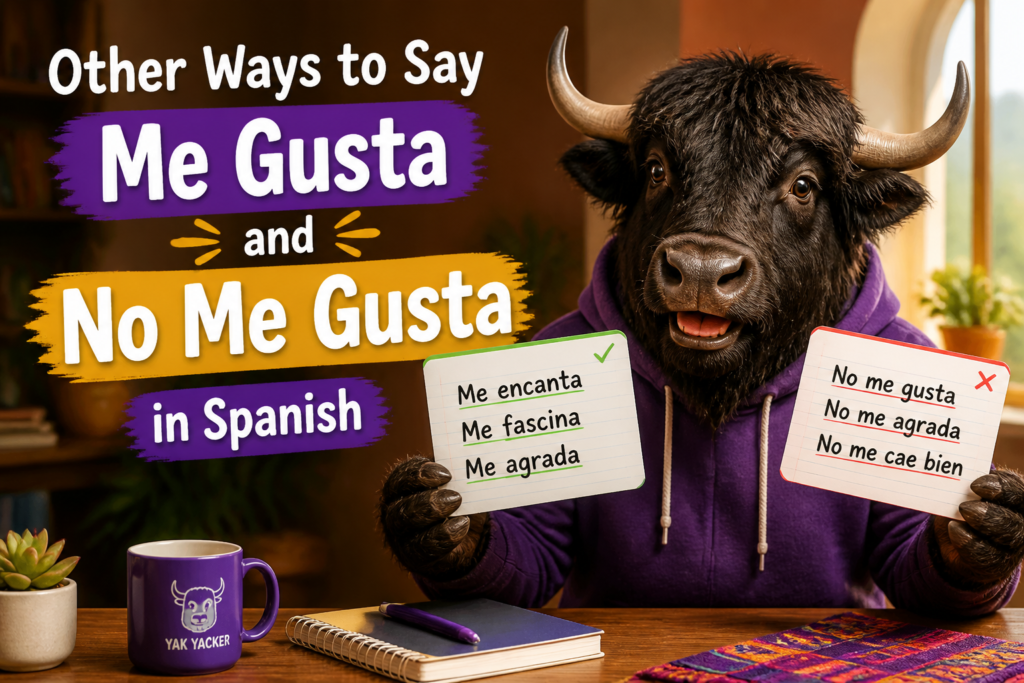
If me gusta is the first Spanish phrase you learned for “I like it,” congratulations: you have unlocked the tiny gateway to expressing opinions like a normal human being. But Spanish has plenty of other ways to say what you enjoy, what you don’t, what you love, what you can’t stand, and what you are politely pretending to tolerate.
For the broader learning path, visit our parent guide.
This guide keeps things practical. You’ll learn natural alternatives for liking and disliking things in modern Spanish, mostly standard Latin American Spanish, with notes when Spain Spanish or other regional usage matters. And yes, Spanish does this lovely little trick where the person who likes something is often not the subject. Very cute. Very Spanish.
By the end, you’ll be able to say more than just me gusta and no me gusta—without sounding like a phrasebook from 1998.
For a broader vocabulary boost, you can also check 100 Essential Spanish Words and Phrases, plus related emotional language like I Love You in Spanish and Terms of Endearment in Spanish.
The Big Idea Behind Me Gusta
Me gusta literally means something closer to “it pleases me,” not “I like.” That’s why the thing you like is the grammatical subject in Spanish: Me gusta el café = “Coffee is pleasing to me” = “I like coffee.”
This is why learners sometimes feel like Spanish is gaslighting them. It isn’t. It just uses a different structure. Once you get used to it, it becomes very handy for talking about preferences, hobbies, food, music, people, and all the delightful stuff that makes life less boring.
Here’s the quick pattern:
| Pattern | Meaning | Spanish Example | English Translation | Learner Note |
|---|---|---|---|---|
| Me gusta + singular noun / infinitive | I like / I enjoy | Me gusta el té. | I like tea. | Use with one thing or an action. |
| Me gustan + plural noun | I like | Me gustan los libros. | I like books. | The verb changes for plural nouns. |
| No me gusta / no me gustan | I don’t like | No me gusta el ruido. | I don’t like noise. | Put no before me. |
Need a quick pronunciation tip? gusta is roughly “GOO-stah,” with a clear u. Spanish vowels stay clean and steady. No weird English mushiness. Very efficient. Very rude to English spelling habits.
Other Ways To Say “I Like” In Spanish
Spanish has a lot of flexible ways to express liking something. Some are neutral and useful everywhere, while others are a little more emotional, casual, or specific. The key is choosing the level of enthusiasm you actually mean. Not every sandwich deserves a dramatic declaration.
| Spanish | Pronunciation | Meaning | Example Sentence | Translation | Learner Note |
|---|---|---|---|---|---|
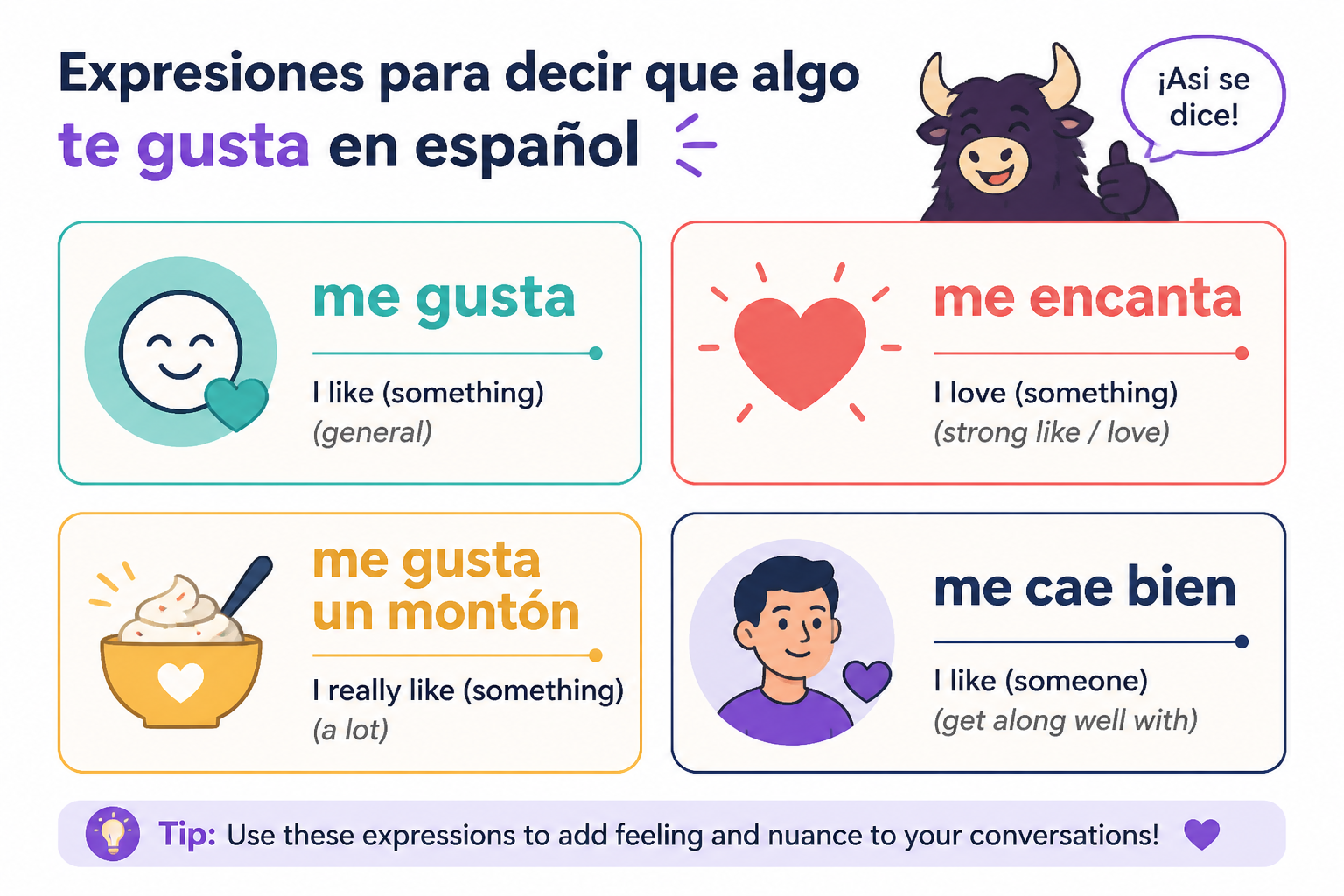
| me encanta | meh ehn-KAHN-tah | I love / I really like | Me encanta esta canción. | I love this song. | Stronger than me gusta, but not always as intense as “I love” in English. |
| me fascina | meh fah-SEE-nah | I’m fascinated by / I really love | Me fascina la historia. | I’m fascinated by history. | More intense and expressive. |
| me gusta mucho | meh GOOS-tah MOO-choh | I like it a lot | Me gusta mucho tu idea. | I really like your idea. | Easy upgrade from plain me gusta. |
| me cae bien | meh KAH-eh BYEN | I like someone; I get along with them | Mi nueva vecina me cae bien. | I like my new neighbor. | Used for people, not usually things. |
| me agrada | meh ah-GRAH-dah | I like / it pleases me | Me agrada tu propuesta. | I like your proposal. | Polite, a bit formal. |
| me interesa | meh een-teh-REH-sah | I’m interested in | Me interesa aprender español. | I’m interested in learning Spanish. | Not exactly “like,” but very useful. |
| me llama la atención | meh YAH-mah lah ah-tehn-SYON | It catches my attention / interests me | Me llama la atención ese libro. | That book catches my attention. | Great for curiosity or first impressions. |
| me gusta un montón | meh GOOS-tah oon mon-TON | I really, really like it | Me gusta un montón la cocina mexicana. | I really like Mexican food. | Very common in Spain; understood elsewhere too. |
Me encanta is one of the most useful upgrades from me gusta. If you want to sound natural and not like a robot repeating the same three words, this is your friend.
Me cae bien deserves special attention. It’s for people you like as people. For example, Me cae bien Ana means “I like Ana / I get along with Ana.” It does not mean she literally fell on you, which is what the words might suggest if Spanish enjoyed being kind.
Other Ways To Say “I Don’t Like” In Spanish
Disliking something in Spanish can be soft, strong, blunt, or beautifully dramatic. Sometimes no me gusta is enough. Other times you want to sound more exact: “I’m not into it,” “I can’t stand it,” or “It’s not my thing.” Spanish gives you options, because apparently people have opinions.
| Spanish | Pronunciation | Meaning | Example Sentence | Translation | Learner Note |
|---|---|---|---|---|---|
| no me gusta | noh meh GOOS-tah | I don’t like it | No me gusta el café amargo. | I don’t like bitter coffee. | Neutral and very common. |
| no me gustan | noh meh GOOS-tahn | I don’t like them / I don’t like plural things | No me gustan las coles de Bruselas. | I don’t like Brussels sprouts. | Use with plural nouns. |
| no me encanta | noh meh ehn-KAHN-tah | I don’t love it / I’m not a big fan | No me encanta trabajar los domingos. | I don’t love working on Sundays. | Softer than no me gusta sometimes. |
| no me cae bien | noh meh KAH-eh BYEN | I don’t like him/her; we don’t get along | Ese tipo no me cae bien. | I don’t like that guy. | Use carefully; it can sound direct. |
| no soporto | noh soh-POR-toh | I can’t stand | No soporto el tráfico. | I can’t stand traffic. | Strong dislike. Very common. |
| me molesta | meh moh-LEHS-tah | It bothers me / irritates me | Me molesta el ruido por la noche. | Noise at night bothers me. | Not always “dislike,” but close. |
| no me va | noh meh vah | It’s not my thing | El reguetón no me va mucho. | Reggaeton isn’t really my thing. | Casual and very natural. |
| me disgusta | meh dees-GOOS-tah | I dislike / it displeases me | Me disgusta la mentira. | I dislike lying. | More formal or strong than everyday speech. |
No me va is especially handy in casual conversation. It’s a relaxed way to say something does not suit your tastes. You might hear it for music, styles, plans, or even personalities. It’s very “eh, not really my vibe,” before that became a whole lifestyle brand.
No soporto is stronger. If you say No soporto la espera, you’re not saying “I mildly dislike waiting.” You’re saying waiting is a personal enemy. Use it when you mean it.
Useful Preference Phrases You’ll Actually Use
Once you move past me gusta, the next step is learning phrases that show shades of preference. These are great for conversations about food, music, movies, hobbies, people, and daily life. They also help you sound less like a textbook and more like someone who has met a sandwich before.
| Spanish | Pronunciation | Meaning | Example Sentence | Translation | Learner Note |
|---|---|---|---|---|---|
| prefiero | preh-FYEH-roh | I prefer | Prefiero el té al café. | I prefer tea to coffee. | Use for clear comparisons. |
| me gusta más | meh GOOS-tah mahs | I like it more | Me gusta más la ciudad. | I like the city more. | Simple, natural comparison. |
| me gusta menos | meh GOOS-tah MEH-nos | I like it less | Me gusta menos el invierno. | I like winter less. | Useful for ranking preferences. |
| soy fan de | soy fahn deh | I’m a fan of | Soy fan de la comida italiana. | I’m a fan of Italian food. | Casual and friendly. |
| no soy fan de | noh soy fahn deh | I’m not a fan of | No soy fan de las reuniones largas. | I’m not a fan of long meetings. | Polite way to disagree. |
| me va | meh vah | It suits me / I like it | Esa camisa me va bien. | That shirt suits me well. | Used for clothes, style, and sometimes plans. |
| me queda bien | meh KEH-dah BYEN | It fits me / suits me | Este color me queda bien. | This color suits me. | Great for clothes and appearance. |
| me parece bien | meh pah-REH-seh byen | Sounds good to me | Me parece bien tu idea. | Your idea sounds good to me. | Agreement, not exactly “like,” but very useful. |
| me parece mal | meh pah-REH-seh mal | I think it’s bad / I don’t approve | Me parece mal llegar tarde. | Being late seems bad to me. | Useful for opinions and judgment. |
| está bien | ehs-TAH byen | It’s fine / okay | Está bien, no pasa nada. | It’s fine, no worries. | Very common in everyday speech. |
| no me importa | noh meh eem-POR-tah | I don’t mind / I don’t care | No me importa esperar. | I don’t mind waiting. | Context matters: can sound neutral or rude. |
| me da igual | meh dah ee-GWAHL | I don’t care either way | Me da igual si vamos hoy o mañana. | I don’t mind whether we go today or tomorrow. | Very common in Spain; also understood in Latin America. |
Prefiero is one of the cleanest alternatives when you want to compare two things. It’s direct, easy, and doesn’t make Spanish jump through any weird grammatical hoops. For more about word choices and meaning nuances, boring-but-reliable references like the Real Academia Española are useful when you want to check how a word is used in standard Spanish.
Me da igual can be a lifesaver in casual conversation. It means you have no preference. Used warmly, it can sound relaxed. Used sharply, it can sound like you do not have time for anyone’s nonsense. Tone matters. Spanish loves tone. Tone is the secret ingredient.
How To Say You Like People, Things, Actions, And Activities
Not every “I like” sentence works the same way in Spanish. Sometimes you like a thing, sometimes a person, and sometimes an activity. The structure changes a little depending on what follows gustar. This is the part that makes learners pause, blink twice, and question their life choices.
| Type | Spanish Pattern | Example | English | Learner Note |
|---|---|---|---|---|
| Thing | Me gusta + singular noun | Me gusta la pizza. | I like pizza. | Use singular verb. |
| Things | Me gustan + plural noun | Me gustan las pizzas artesanales. | I like artisanal pizzas. | Plural noun = plural verb. |
| Activity | Me gusta + infinitive | Me gusta caminar por la playa. | I like walking on the beach. | Infinitive = verb without a subject. |
| Person | Me cae bien / mal | Me cae bien Carlos. | I like Carlos / I get along with Carlos. | More natural than me gusta Carlos. |
| Experience | Me encanta / me interesa / me aburre | Me interesa la ciencia. | I’m interested in science. | Use the feeling or reaction you mean. |
A useful reminder: me gusta Carlos is grammatically possible, but if you mean attraction or affection, Spanish often prefers different expressions. For romantic or affectionate language, you may want to see I Love You in Spanish and related phrases, because love language has its own little ecosystem.
When talking about people, me cae bien is often safer and more natural than trying to force gustar into a job it never wanted. It means you like someone’s personality or you get along with them.
Quick Grammar Note: Me Gusta vs Me Gustan
This is one of the most common beginner traps, so let’s make it painless. Use gusta with a singular noun or an infinitive. Use gustan with a plural noun. That’s it. No dramatic plot twist. No secret extra rule hiding behind the curtain.
| Pattern | Correct | Wrong | English | Why |
|---|---|---|---|---|
| Singular noun | Me gusta el chocolate. | Me gustan el chocolate. | I like chocolate. | Chocolate is singular here. |
| Plural noun | Me gustan los chocolates. | Me gusta los chocolates. | I like the chocolates. | Chocolates is plural. |
| Infinitive | Me gusta bailar. | Me gustan bailar. | I like to dance. | Infinitives take singular gusta. |
If you want a simple memory trick: think one thing = gusta, more than one thing = gustan. Your brain will thank you later instead of filing a complaint.
Pronunciation Help For The Most Common Phrases
Spanish pronunciation is usually friendly to English speakers once you stop expecting it to whisper all its vowels into the shadows. The phrases below are worth saying out loud a few times so they become automatic.
| Spanish | Pronunciation | Meaning | Example | Translation | Learner Note |
|---|---|---|---|---|---|
| me gusta | meh GOOS-tah | I like it | Me gusta el arroz. | I like rice. | Soft g before u sound. |
| me encanta | meh ehn-KAHN-tah | I love it / I really like it | Me encanta tu voz. | I love your voice. | Stress on CAN. |
| no me gusta | noh meh GOOS-tah | I don’t like it | No me gusta el calor. | I don’t like the heat. | Keep noMore Spanish to explore How to Type Spanish Accents on Your Phone and Computer Best graded readers for Spanish The Boy and the Sheep: A1 Beginner Spanish Story with Audio Martina the Little Cockroach: A1 Beginner Spanish Story with Audio |