


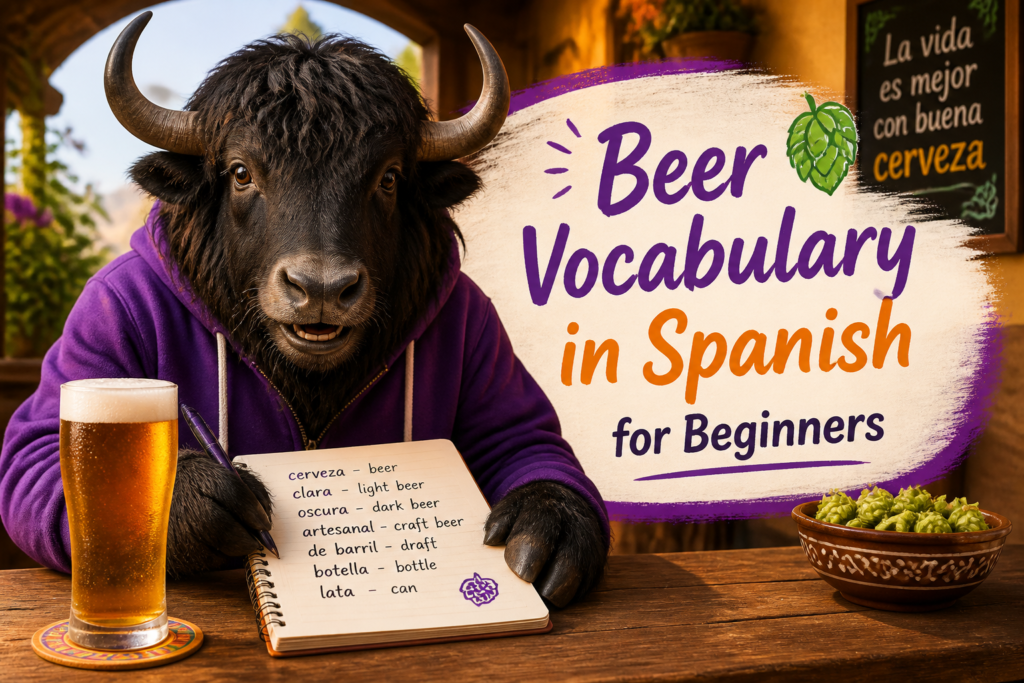
Ordering beer in Spanish is one of those tiny travel skills that makes life noticeably easier. You do not need a flawless accent or a dramatic toast speech. You just need the right words so you can ask for una cerveza without accidentally inventing a whole new drink.
For the broader learning path, visit our parent guide.
This guide keeps things practical: the most useful beer words, bar phrases, pronunciation help, and a few grammar notes that will save you from awkwardly pointing at a menu like a confused magician. We’ll use natural Latin American Spanish by default, and where Spain uses a different everyday word, you’ll see that too.
If you want a broader refresher on core verb patterns, it helps to know a little about common Spanish verbs, especially hacer and haber. And yes, even beer vocabulary likes grammar. Rude, but true.
For a general phrase refresh, you can also peek at popular Spanish phrases. That way your bar Spanish sounds less like a textbook and more like a human being asking for a drink.
One quick note: in Spanish, the “h” in words like hielo is silent. So if someone says una cerveza con hielo, do not try to pronounce the h like you’re clearing your throat in public.
Basic Beer Words You’ll Actually Use
Let’s start with the core vocabulary. These are the words you’ll see on menus, hear at bars, and use when you want to order without improvising a tragic one-man opera.
| Spanish | Pronunciation | Meaning | Example Sentence | Translation | Learner Note |
|---|---|---|---|---|---|
| cerveza | ser-VEH-sah | beer | Quiero una cerveza, por favor. | I want a beer, please. | Very common and neutral. |
| cerveza fría | ser-VEH-sah FREE-ah | cold beer | Me gusta la cerveza fría. | I like cold beer. | Fría means “cold.” |
| una chela | CHEH-lah | beer; casual word for beer | Vamos por unas chelas. | Let’s go for some beers. | Very common in Mexico and some other countries; casual. |
| una birra | BEE-rrah | beer; slang | ¿Tomamos una birra? | Shall we have a beer? | Common in Argentina and nearby areas; informal. |
| pinta | PEEN-tah | pint; a glass of beer | Quisiera una pinta. | I’d like a pint. | Used in many places, especially in bars with international menus. |
| botella | boh-TEH-yah | bottle | Prefiero la cerveza en botella. | I prefer beer in a bottle. | Double ll sounds like a “y” in most Latin American accents. |
| lata | LAH-tah | can | La cerveza viene en lata. | The beer comes in a can. | Useful for store purchases. |
| grifo | GREE-foh | tap; draft beer tap | La cerveza de grifo es más barata. | Draft beer is cheaper. | Common in Spain; in Latin America you may hear de barril more often. |
| de barril | deh bah-REEL | draft; from the keg | La cerveza de barril está muy buena. | The draft beer is really good. | Very natural in Latin America. |
| sin alcohol | seen al-koh-HOL | non-alcoholic | ¿Tienen cerveza sin alcohol? | Do you have non-alcoholic beer? | Useful if you want the beer flavor without the buzz. |
Beer words tend to be friendly, casual, and very regional. That means cerveza is your safest all-purpose word, while chela and birra sound more relaxed and local. If you use the slang word in the wrong place, nobody will explode. Still, the bar may silently judge you, which is basically the same thing in a different key.
Ordering Beer At A Bar Or Restaurant
These are the useful phrases for real life: asking for a beer, choosing a style, and getting the bill before your wallet starts crying. The good news is that Spanish beer orders are usually short and simple.
| Spanish | Pronunciation | Meaning | Example Sentence | Translation | Learner Note |
|---|---|---|---|---|---|
| Quiero una cerveza. | KEE-eh-roh oo-nah ser-VEH-sah | I want a beer. | Quiero una cerveza, por favor. | I want a beer, please. | Direct and common, but a little blunt; still fine in casual settings. |
| Quisiera una cerveza. | kee-see-EH-rah oo-nah ser-VEH-sah | I would like a beer. | Quisiera una cerveza bien fría. | I’d like a very cold beer. | Politer than quiero. |
| Me trae una cerveza, por favor. | meh TRAY-eh oo-nah ser-VEH-sah | Please bring me a beer. | ¿Me trae una cerveza de barril? | Can you bring me a draft beer? | Polite and useful in restaurants. |
| ¿Qué cerveza recomiendas? | keh ser-VEH-sah reh-koh-MYEN-dahs | What beer do you recommend? | ¿Qué cerveza recomiendas para empezar? | What beer do you recommend to start with? | Good question when the menu is a small novel. |
| Una cerveza, por favor. | OO-nah ser-VEH-sah por fah-VOR | A beer, please. | Una cerveza, por favor. Gracias. | A beer, please. Thank you. | Short, safe, and extremely useful. |
| ¿La tienen fría? | lah TYEH-nen FREE-ah | Do you have it cold? | ¿La tienen fría o a temperatura ambiente? | Do you have it cold or at room temperature? | Use this if the beer feels suspiciously warm. |
| Sin hielo, por favor. | seen YEH-loh | No ice, please. | La cerveza, sin hielo, por favor. | The beer, no ice, please. | Important: hielo starts with a silent h. |
| Una cerveza pequeña. | oo-nah ser-VEH-sah peh-KEH-nyah | A small beer. | Quiero una cerveza pequeña. | I want a small beer. | Pequeña means small; agreement matters because cerveza is feminine. |
| Una cerveza grande. | oo-nah ser-VEH-sah GRAHN-deh | A large beer | ¿Tienen cerveza grande? | Do you have a large beer? | Grande stays the same for masculine and feminine nouns. |
| La cuenta, por favor. | lah KWEN-tah | The bill, please. | La cuenta, por favor. Ya terminé. | The bill, please. I’m done. | One of the most useful restaurant phrases in Spanish, beer or no beer. |
| ¿Cuánto cuesta? | KWAHN-toh KWEHS-tah | How much does it cost? | ¿Cuánto cuesta una cerveza? | How much does a beer cost? | Handy in bars, stores, and tourist traps with artistic pricing. |
Notice how often Spanish uses una cerveza instead of just “beer.” Articles matter. Cerveza is feminine, so you use una, not un. Tiny word, big difference. Spanish loves this sort of detail, because apparently peace was not the goal.
Beer Styles And Descriptions
If you like different beer types, these words help you sound less like “I guess beer is beer” and more like someone who can actually read a menu. The terms below are useful in breweries, restaurants, and grocery stores.
| Spanish | Pronunciation | Meaning | Example Sentence | Translation | Learner Note |
|---|---|---|---|---|---|
| rubia | ROO-bee-ah | blonde beer; light beer | Prefiero una rubia. | I prefer a light beer. | Very common way to describe beer color. |
| oscura | oh-SKOO-rah | dark beer | Me gusta la cerveza oscura. | I like dark beer. | Oscura matches the feminine noun cerveza. |
| artesanal | ahr-teh-sah-NAHL | craft, artisanal | Es una cerveza artesanal local. | It’s a local craft beer. | Very common in modern menus. |
| importada | eem-por-TAH-dah | imported | Busco una cerveza importada. | I’m looking for an imported beer. | Useful in stores and bars with international brands. |
| ligera | lee-HEH-rah | light, mild | Quiero una cerveza ligera. | I want a light beer. | Can mean low in body, not always low in alcohol. |
| amarga | ah-MAHR-gah | bitter | Esta cerveza está un poco amarga. | This beer is a little bitter. | Good for taste descriptions. |
| suave | SWAH-veh | smooth, mild | La cerveza es suave y fácil de tomar. | The beer is smooth and easy to drink. | Common in reviews and casual opinions. |
| fuerte | FWEHR-teh | strong | Es una cerveza fuerte. | It’s a strong beer. | Can describe flavor or alcohol strength. |
| espumosa | es-poo-MOH-sah | foamy, bubbly | La cerveza está muy espumosa. | The beer is very foamy. | Helpful when you want to describe the pour. |
| frutal | froo-TAHL | fruity | Esta cerveza tiene un toque frutal. | This beer has a fruity touch. | Common in tasting notes. |
When you describe beer in Spanish, adjectives usually go after the noun: cerveza rubia, cerveza oscura, cerveza artesanal. That order is one of those classic Spanish habits that feels backwards at first, then normal later, then somehow suspicious when English does things differently.
Useful Bar Conversation Phrases
These are the short phrases you hear in real conversations. They are simple, useful, and much better than standing there silently while your brain refreshes like a broken browser tab.
| Spanish | Pronunciation | Meaning | Example Sentence | Translation | Learner Note |
|---|---|---|---|---|---|
| ¿Qué vas a tomar? | keh bahs ah toh-MAHR | What are you going to drink? | ¿Qué vas a tomar: cerveza o vino? | What are you going to drink: beer or wine? | Very common with friends. |
| ¿Tomamos algo? | toh-MAH-mohs AHL-goh | Shall we get something to drink? | ¿Tomamos algo después del trabajo? | Shall we get something after work? | Natural invitation phrase. |
| ¿Otra? | OH-trah | Another one? | ¿Otra cerveza? | Another beer? | Short and common among friends. |
| Otra cerveza, por favor. | OH-trah ser-VEH-sah | Another beer, please. | Otra cerveza, por favor. La misma. | Another beer, please. The same one. | Very useful when you find one you like. |
| La misma. | lah MEES-mah | The same one. | Para mí, la misma. | For me, the same one. | Handy reply at a bar. Efficient. Slightly smug. |
| ¿Tienen cerveza local? | TYEH-nen ser-VEH-sah loh-KAHL | Do you have local beer? | ¿Tienen cerveza local o importada? | Do you have local or imported beer? | Great for travel. |
| ¿Qué tienen de cerveza? | keh TYEH-nen deh ser-VEH-sah | What beers do you have? | ¿Qué tienen de cerveza hoy? | What beers do you have today? | Natural and very useful. |
| Una ronda, por favor. | OO-nah RON-dah | A round, please. | Para todos, una ronda de cerveza. | For everyone, a round of beer. | Good for groups. |
| Yo pago. | yoh PAH-goh | I’ll pay. | Yo pago la cerveza esta vez. | I’ll pay for the beer this time. | Useful in friendly settings. |
| Salud. | sah-LOOD | Cheers; health | ¡Salud! Por el viaje. | Cheers! To the trip. | The classic toast word. Simple and everywhere. |
| ¡Arriba, abajo, al centro, pa’ dentro! | ah-REE-bah ah-BAH-ho al SEN-troh pah DEN-troh | A playful cheers chant | En España, muchos dicen: ¡Arriba, abajo, al centro, pa’ dentro! | In Spain, many people say: Up, down, to the center, in! | Very Spain-specific and playful; not necessary everywhere. |
The Real Academia Española is the boring-but-helpful reference if you want to double-check a word’s standard form. Boring sources are often the best sources. Annoying, but honest.
Spain Vs Latin America: A Few Beer Words
Spanish changes from country to country, and beer vocabulary is no exception. The good news is that most basic phrases work almost everywhere. The slightly annoying news is that slang will vary, because Spanish-speaking countries enjoy being delightfully inconsistent.
| Latin American Spanish | Spain Spanish | Meaning | Quick Note |
|---|---|---|---|
| chela | caña / cerveza | beer | Chela is especially common in Mexico; caña in Spain usually means a small draft beer. |
| de barril | de grifo | draft beer | Both are correct. De grifo is very Spain-centered. |
| ¿Qué cervezas tienen? | ¿Qué cervezas tenéis? | What beers do you have? | Tenéis uses vosotros, common in Spain. |
| unas chelas | unas cañas | some beers | Casual plural drinking language. |
| salud | salud | cheers | Same word in both, so at least one thing stays calm. |
If you’re in Latin America, cerveza is always safe, and slang like chela may be local or regional. In Spain, caña is extremely common for a small draft beer, especially in bars. If you say una cerveza, though, people will still understand you. Nobody is going to fail you for being understandable. That would be rude even by language standards.
Simple Grammar Notes For Beer Phrases
You do not need advanced grammar to order a beer, but a few patterns help everything sound smoother. These little details are often the difference between “nice Spanish” and “my sentences are assembled from chaos.”
| Pattern | Meaning | Spanish Example | English Translation | Learner Note |
|---|---|---|---|---|
| una + feminine noun | Use una with feminine nouns | una cerveza | a beer | Cerveza is feminine, so it takes una. |
| adjective after noun | Common Spanish word order | cerveza fría | cold beer | The adjective usually comes after the noun. |
| quiero / quisiera | Want / would like | Quiero una cerveza. / Quisiera una cerveza. | I want a beer. / I would like a beer. | Quisiera sounds more polite. |
| ¿Tienen…? | Do you have…? | More Spanish to explore How to Type Spanish Accents on Your Phone and Computer Best graded readers for Spanish The Boy and the Sheep: A1 Beginner Spanish Story with Audio Martina the Little Cockroach: A1 Beginner Spanish Story with Audio |