Spanish Grammar For Real Life
Hacer In Spanish: Meaning, Conjugation, Uses, And Examples For Beginners
The beginner-friendly guide to hacer without the usual giant grammar wall glaring at you from across the room.
Every Spanish learner eventually meets one word that seems to have too many jobs. Hacer is that overachiever. One minute it means “to do,” the next it means “to make,” and then it casually wanders into weather and time expressions like nobody asked it to, but here we are.
The good news is that hacer gets much easier once you learn its main jobs in chunks: daily actions, weather, time, and a handful of irregular forms like hago, hice, hizo, hecho, and haz. It is one of the most common irregular verbs in beginner Spanish, but the patterns are very learnable. :contentReference[oaicite:0]{index=0}
The Quick Win
- Use hacer for many everyday actions: hacer la tarea, hacer ejercicio, hacer una llamada.
- Use hace for weather: Hace calor, Hace frío.
- Use hace and desde hace for time: hace dos días, desde hace un año.
- Memorize these forms first: hago, hice, hecho, haz.
- In Mexico and most of Latin America, focus on ustedes more than vosotros.
What Does Hacer Mean?
Most of the time, hacer means “to do” or “to make,” but real Spanish also uses it in weather expressions, time expressions, and fixed phrases that do not translate word for word. That is why it feels huge at first. It kind of is. :contentReference[oaicite:1]{index=1}
| Pattern | English Meaning | Spanish Example | Natural English |
|---|---|---|---|
| hacer + activity | to do | Hago ejercicio antes del trabajo. | I exercise before work. |
| hacer + thing you create | to make | Mi hermana hace un pastel de chocolate. | My sister makes a chocolate cake. |
| hacer + weather word | to be | Hoy hace frío en la mañana. | It’s cold this morning. |
| hacer + infinitive | to make / cause | Esa canción me hace sonreír. | That song makes me smile. |
Present Tense: The Forms You Need First
In the present tense, hacer is irregular in the first person singular only: yo hago. The other present forms follow normal -er endings. For beginners in Mexico, the most useful set is yo, tú, usted, nosotros, ustedes. :contentReference[oaicite:2]{index=2}
| Subject | Form | Example | Meaning |
|---|---|---|---|
| yo | hago | Hago café por la mañana. | I make coffee in the morning. |
| tú | haces | Tú haces muchas preguntas. | You ask a lot of questions. |
| él / ella / usted | hace | Ella hace yoga los sábados. | She does yoga on Saturdays. |
| nosotros | hacemos | Nosotros hacemos la cena juntos. | We make dinner together. |
| ellos / ellas / ustedes | hacen | Ustedes hacen un gran trabajo. | You all do a great job. |
Mexico Note: In Mexico and most of Latin America, people normally use ustedes instead of vosotros. So you can safely learn ustedes hacen first and leave vosotros hacéis for later unless you specifically want Spain Spanish. :contentReference[oaicite:3]{index=3}
Six Everyday Hacer Phrases You’ll Actually Use
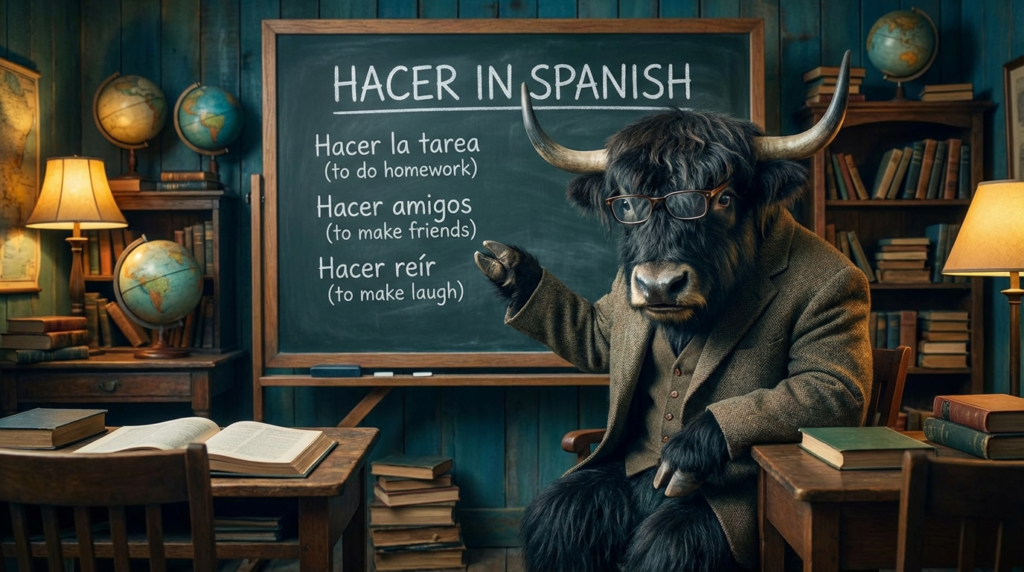
Hacer La Tarea
Meaning: to do homework
Mi sobrino hace la tarea después de merendar.
My nephew does his homework after his snack.
Hacer Ejercicio
Meaning: to exercise
Hacemos ejercicio en el parque los domingos.
We exercise in the park on Sundays.
Hacer Una Pregunta
Meaning: to ask a question
Quiero hacer una pregunta sobre el precio.
I want to ask a question about the price.
Hacer Una Llamada
Meaning: to make a call
Necesito hacer una llamada al doctor.
I need to make a call to the doctor.
Hacer Una Cita
Meaning: to make an appointment
Voy a hacer una cita para el viernes.
I’m going to make an appointment for Friday.
Hacer La Cama
Meaning: to make the bed
Siempre hago la cama antes de salir.
I always make the bed before leaving.
Hacer With Weather
Spanish uses hacer in the third-person singular for many weather expressions. So instead of building these with “is,” you often build them with hace. Yes, Spanish decided weather needed extra drama. :contentReference[oaicite:4]{index=4}
- Hace calor — it’s hot
Hoy hace calor en Mérida. - Hace frío — it’s cold
En la mañana hace frío en Toluca. - Hace sol — it’s sunny
Hace sol, así que vamos al parque.
- Hace viento — it’s windy
Hoy hace mucho viento cerca de la playa. - Hace buen tiempo — the weather is nice
Hace buen tiempo para caminar. - Hace mal tiempo — the weather is bad
No salimos porque hace mal tiempo.
Hacer With Time
Time expressions with hacer are extremely common. The beginner formulas worth memorizing are hace + time for “ago,” desde hace + time for “for / since,” and hace + time + que + verb for “have been doing” or “it was X ago that.” Later, you will also see hacía in past background situations. :contentReference[oaicite:5]{index=5}
| Pattern | What It Means | Spanish Example | Natural English |
|---|---|---|---|
| hace + time | ago | Llegué hace dos horas. | I arrived two hours ago. |
| desde hace + time | for / since | Trabajo aquí desde hace seis meses. | I’ve worked here for six months. |
| hace + time + que + present | have been doing for | Hace un año que estudio español. | I’ve been studying Spanish for a year. |
| hace + time + que + preterite | it was X ago that… | Hace dos semanas que empezó el curso. | The course started two weeks ago. |
| hacía + time + que + imperfect | had been doing for | Hacía una hora que esperaba cuando llegó el camión. | I had been waiting for an hour when the bus arrived. |
Other Must-Know Forms
Once you move past the present tense, these forms matter most: hice and hizo in the preterite, hecho as the irregular past participle, haciendo for progressive forms, and haz / no hagas for informal commands. These are the forms that keep showing up in real conversations, assignments, and messages. :contentReference[oaicite:6]{index=6}
| Form | English Meaning | Example |
|---|---|---|
| hice | I did / I made | Ayer hice la comida. — I made lunch yesterday. |
| hizo | he / she / it did, made | Ella hizo una reservación. — She made a reservation. |
| hacía | used to do / was doing | Cuando era niño, hacía deporte todos los días. — When I was a kid, I used to play sports every day. |
| haré | I will do / make | Mañana haré la compra. — Tomorrow I’ll do the shopping. |
| hecho | done / made | Ya he hecho la tarea. — I’ve already done the homework. |
| haciendo | doing / making | ¿Qué estás haciendo? — What are you doing? |
| haz | do / make! (tú) | Haz tu cama. — Make your bed. |
| no hagas | don’t do / make! (tú) | No hagas ruido. — Don’t make noise. |
| haga / hagan | do / make! (formal / plural) | Hagan sus ejercicios ahora. — Do your exercises now. |
Common Expressions With Hacer
A big part of mastering hacer is learning fixed chunks instead of trying to translate every word separately. Spanish uses many essential expressions with hacer, so memorizing them as phrases will save you a lot of avoidable confusion. :contentReference[oaicite:7]{index=7}
| Spanish | English Meaning | Example |
|---|---|---|
| hacer caso | to pay attention / listen | Hazme caso y lleva agua. — Listen to me and bring water. |
| hacer falta | to be needed | Hace falta más tiempo. — More time is needed. |
| hacer ruido | to make noise | Los vecinos hacen mucho ruido. — The neighbors make a lot of noise. |
| hacer daño | to hurt / cause harm | Ese comentario puede hacer daño. — That comment can hurt. |
| hacer fila | to stand in line | Tuvimos que hacer fila una hora. — We had to stand in line for an hour. |
| hacer una compra | to make a purchase | Hice una compra rápida en la farmacia. — I made a quick purchase at the pharmacy. |
| hacer una cita | to make an appointment | Voy a hacer una cita con el dentista. — I’m going to make an appointment with the dentist. |
| hacer una llamada | to make a call | Necesito hacer una llamada al banco. — I need to make a call to the bank. |
| hacer una pregunta | to ask a question | Ella hizo una pregunta muy buena. — She asked a very good question. |
| hacer una fiesta | to throw / have a party | Vamos a hacer una fiesta el sábado. — We’re going to have a party on Saturday. |
Common Mistakes And Fast Fixes
- Wrong: yo haco
Right: yo hago - Wrong: ayer hací la tarea
Right: ayer hice la tarea - Wrong: he hacido mucho
Right: he hecho mucho - Wrong: está calor
Right: hace calor - Wrong: vivo aquí hace tres años
Better: vivo aquí desde hace tres años or hace tres años que vivo aquí
Practice Time
- Yo ______ la cena los viernes.
- Ayer ella ______ una reservación para ocho personas.
- Hoy ______ frío en la mañana.
- Vivimos aquí desde ______ dos meses.
- No ______ ruido en la biblioteca.
- Ya he ______ la tarea.
Answers: hago, hizo, hace, hace, hagas, hecho.
Quick Reference Summary
| Job Of Hacer | Pattern | Example |
|---|---|---|
| Do / make | hacer + noun / activity | Hacemos la comida juntos. |
| Weather | hace + weather word | Hace calor. |
| Ago | hace + time | Salió hace un minuto. |
| For / since | desde hace + time | Trabajo aquí desde hace un año. |
| Command | haz / no hagas | Haz tu cama. / No hagas ruido. |
| Perfect tense | haber + hecho | He hecho café. |
Final Yak
Hacer is not random. It just has a lot of jobs. Learn it in chunks, keep the high-frequency forms close by, and repeat the phrases you will actually say: hago, hice, hecho, haz, hace calor, hace dos días, desde hace un año. Suddenly the chaos looks a lot less chaotic. Fancy that.