


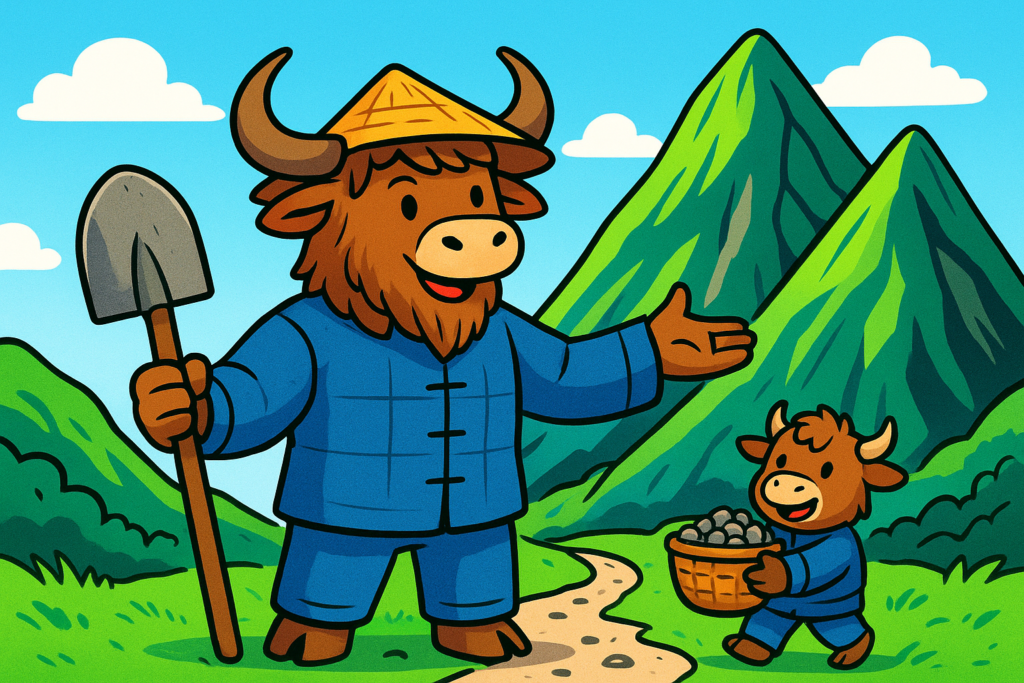
This A1 Beginner retelling of 愚公移山 keeps the plot clear for learners while still giving the story some atmosphere and momentum.
This version teaches Simplified Chinese through English and includes clickable word help inside the story, full story audio, and lesson notes after the reading. It is free to use on Yak Yacker and is designed to feel natural, readable, and manageable for learners.
从前,有一个老人,叫。
他家前面有两座。
大山很,很。
出门很。
愚公说:"我们要这两座山!"
他的家人说:"好,我们一起!"
他们每天,。
邻居也来。
一个的老人笑他:"你太老了,山!"
愚公说:"我死了,有;儿子死了,有。
山不会,我们一定会!"
天神,很。
他们两个神仙把山。
从此,愚公家门前的路很。
他笑了。
Once there was an old man called Yu Gong.
In front of his house were two huge mountains.
The mountains were tall and vast.
It was very inconvenient to go out.
Yu Gong said, "We must move these two mountains!"
His family said, "Okay, let's move them together!"
Every day they dug the mountains and carried the stones.
A neighbor kid came to help too.
A wise old man laughed at him: "You are too old to move the mountains!"
Yu Gong said, "When I die, there will be my sons; when my sons die, there will be grandsons."
"The mountains won't grow taller, and we will eventually move them!"
The gods heard this and were touched.
They sent two deities to carry the mountains away.
After that, the path before Yu Gong's house was level.
He smiled happily.
Let's pick out some friendly words that appear again and again. You'll see these a lot in everyday Chinese too!
These little building blocks will help you tell the story yourself.
- 山 (shān) - mountain
- 老人 (lǎorén) - old man / old person
- 搬 (bān) - to move (something heavy)
- 挖 (wā) - to dig
- 帮忙 (bāngmáng) - to help
In the story, the mountains are 很高 (hěn gāo) and 很大 (hěn dà). 很 (hěn) means "very," and it's one of the easiest ways to describe something in Chinese.
Just put 很 before the adjective - no need for "is" like in English!
- 山很高。 (Shān hěn gāo.) - The mountain is very tall.
- 路很平。 (Lù hěn píng.) - The road is very flat.
- Notice: no word for "is" is needed!
愚公 says: 我们一定会搬走!(Wǒmen yídìng huì bān zǒu!) - "We will definitely move them away!" This short sentence is packed with useful patterns.
我们 (wǒmen) is "we," 一定 (yídìng) adds strong certainty, and 会 (huì) points to the future.
- 我们 + action = "we do something"
- 一定会 + action = "will definitely…"
- Try: 我们一定会帮忙! (Wǒmen yídìng huì bāngmáng!) - We'll definitely help!
Now you have some magic words: 山, 老人, 搬, 挖, and more. Why not tell the story to a friend - in Chinese, of course!
Start with "从前,有一个老人…" (Cóngqián, yǒu yí gè lǎorén…) and see how far you can go. Every retelling makes the language feel more yours.
愚公移山 comes from the Chinese / idiom story tradition and is best known as a idiom/fable. This Yak Yacker article is an original learner retelling based on Ancient Chinese tale; public domain, so the wording here is simplified for modern learners rather than copied from one old edition.
Older printings, translations, and retellings of this story can vary quite a bit. The original audience was usually kids/general, but this version is adapted for A1 Beginner learners studying Simplified Chinese. Excellent perseverance story; use simple mountain/family vocabulary.
If you want to look into the source tradition, start with Wikisource.
If you want to keep going, browse more in our Simplified Chinese section and review the HSK Level 1 Chinese Vocabulary. After that, try 1,000 Chinese Phrases and Expressions for another useful next step.