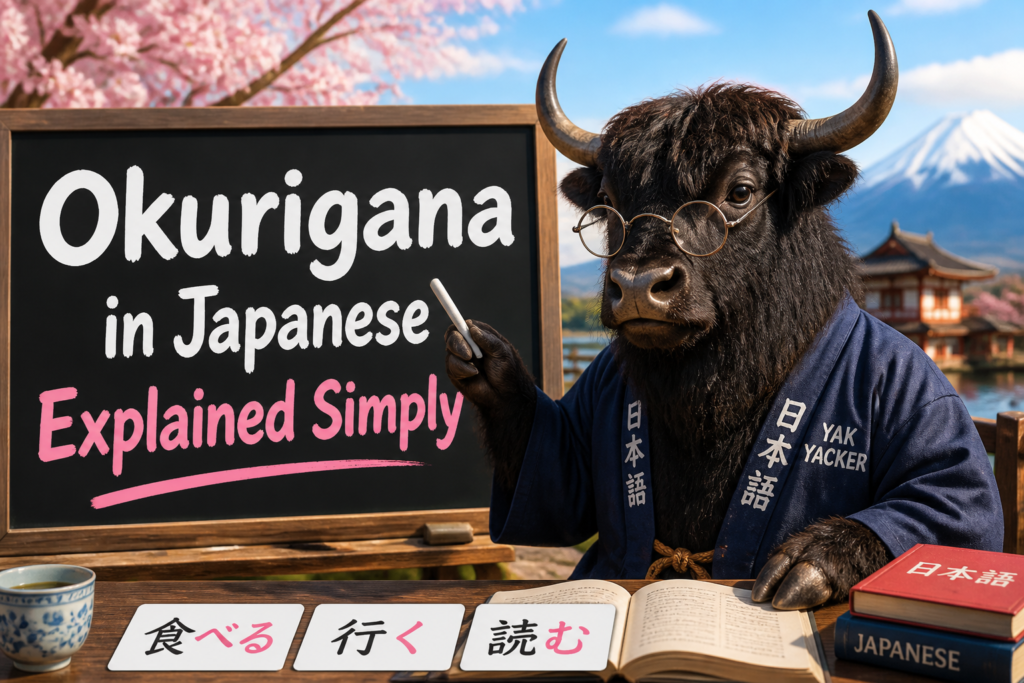
Okurigana are the kana that come after a kanji to show how a word is read and what form it takes. In other words, kanji do the heavy lifting, and okurigana do the cleanup. Quietly. Efficiently. Very Japanese.
If you have ever seen 食べる Taberu “to eat” and wondered why it is not just one lonely kanji, you have already met okurigana. They help beginners read Japanese more safely, and they help native speakers tell words apart when several kanji share the same reading. Sneaky little helpers, really.
You will also see okurigana in common words you meet early in study, from 高い Takai “expensive / high” to 新しい Atarashii “new.” They are not decoration. They are part of the word.
For a broader look at Japanese study paths, you can also check the Learn Japanese page. It is the kind of page that does not try too hard, which is rare and refreshing.
What Okurigana Are
Okurigana 送り仮名 Okurigana means the kana written after kanji inside a word. They often show endings for verbs and adjectives.
Think of them as the part that tells you how the word behaves. The kanji gives the core meaning, and the okurigana tells you the grammar. Japanese likes teamwork, apparently.
| Kanji + Kana | Rōmaji | Meaning |
|---|---|---|
| 食べる | Taberu | to eat |
| 高い | Takai | high; expensive |
| 読んだ | Yonda | read; read it |
Notice how the ending changes. That ending is doing real work. It is not there to be polite decoration for the kanji.
Why Japanese Uses Okurigana
- To show grammar endings for verbs and adjectives
- To make reading easier for learners and native readers
- To help distinguish words with the same kanji reading
- To show pronunciation changes clearly
- To keep written Japanese more readable and less confusing
Japanese can be beautifully compact, but it also enjoys being a little ambiguous when given the chance. Okurigana reduce that chaos.
Okurigana In Common Verbs
Verbs are the easiest place to spot okurigana. The kanji often stays stable, while the ending changes for tense, politeness, or negation.
| Kanji | Rōmaji | Meaning | Example | Rōmaji | English Translation |
|---|---|---|---|---|---|
| 食べる | Taberu | to eat | パンを食べる。 | Pan o taberu. | I eat bread. |
| 見せる | Miseru | to show | 写真を見せる。 | Shashin o miseru. | I show a photo. |
| 書く | Kaku | to write | 手紙を書く。 | Tegami o kaku. | I write a letter. |
| 読む | Yomu | to read | 本を読む。 | Hon o yomu. | I read a book. |
| 話す | Hanasu | to speak | 日本語を話す。 | Nihongo o hanasu. | I speak Japanese. |
| 行く | Iku | to go | 学校へ行く。 | Gakkō e iku. | I go to school. |
| 買う | Kau | to buy | 本を買う。 | Hon o kau. | I buy a book. |
| 飲む | Nomu | to drink | 水を飲む。 | Mizu o nomu. | I drink water. |
See the pattern? The ending after the kanji is not random. It is part of the verb form.
Okurigana In Common Adjectives
Many i-adjectives also use okurigana. The final -い i is a big clue. It tells you the word is an adjective, not just a noun in a fancy hat.
| Kanji | Rōmaji | Meaning | Example | Rōmaji | English Translation |
|---|---|---|---|---|---|
| 高い | Takai | high; expensive | この店は高い。 | Kono mise wa takai. | This store is expensive. |
| 新しい | Atarashii | new | 新しい靴。 | Atarashii kutsu. | New shoes. |
| 安い | Yasui | cheap | この本は安い。 | Kono hon wa yasui. | This book is cheap. |
| 早い | Hayai | early; fast | 朝は早い。 | Asa wa hayai. | Mornings are early. |
| 長い | Nagai | long | 長い道。 | Nagai michi. | A long road. |
| 難しい | Muzukashii | difficult | 日本語は難しい。 | Nihongo wa muzukashii. | Japanese is difficult. |
One small note: some Japanese words look simple until they are not. 早い Hayai can mean “early” or “fast,” and context decides which one you mean. Japanese does enjoy making learners earn their lunch.
How Okurigana Change With Grammar
Okurigana often change when you change tense or form. The kanji stays the same, but the ending shifts.
| Base Form | Rōmaji | Changed Form | Rōmaji | Meaning |
|---|---|---|---|---|
| 食べる | Taberu | 食べた | Tabeta | ate |
| 読む | Yomu | 読んだ | Yonda | read |
| 書く | Kaku | 書いた | Kaita | wrote |
| 高い | Takai | 高かった | Takakatta | was expensive / was high |
| 新しい | Atarashii | 新しかった | Atarashikatta | was new |
The ending changes because the grammar changes. The kanji does not need to repeat itself every time. Efficient. Slightly smug. Very Japanese.
Useful Okurigana Words And Phrases
Here are beginner-friendly words and phrases that show okurigana in action. These are the kind of forms you will keep seeing, so they are worth getting comfortable with early.
| Kanji | Rōmaji | English Meaning | Example Sentence | Rōmaji | English Translation |
|---|---|---|---|---|---|
| 開ける | Akeru | to open | ドアを開ける。 | Doa o akeru. | I open the door. |
| 閉める | Shimeru | to close | 窓を閉める。 | Mado o shimeru. | I close the window. |
| 立つ | Tatsu | to stand | ここに立つ。 | Koko ni tatsu. | I stand here. |
| 座る | Suwaru | to sit | 椅子に座る。 | Isu ni suwaru. | I sit on the chair. |
| 帰る | Kaeru | to go home; to return | 家へ帰る。 | Ie e kaeru. | I go home. |
| 教える | Oshieru | to teach; to tell | 先生が教える。 | Sensei ga oshieru. | The teacher teaches. |
| 覚える | Oboeru | to memorize; to remember | 漢字を覚える。 | Kanji o oboeru. | I memorize kanji. |
| 疲れる | Tukareru | to get tired | 今日は疲れる。 | Kyou wa tsukareru. | Today I get tired. |
| 見える | Mieru | to be visible; can be seen | 山が見える。 | Yama ga mieru. | I can see the mountain. |
| 思う | Omou | to think | そう思う。 | Sō omou. | I think so. |
| 強い | Tsuyoi | strong | 彼は強い。 | Kare wa tsuyoi. | He is strong. |
| 弱い | Yowai | weak | 私は弱い。 | Watashi wa yowai. | I am weak. |
| 美しい | Utsukushii | beautiful | 美しい花。 | Utsukushii hana. | Beautiful flowers. |
| 始める | Hajimeru | to begin | 勉強を始める。 | Benkyō o hajimeru. | I begin studying. |
| 終わる | Owaru | to finish | 仕事が終わる。 | Shigoto ga owaru. | Work ends. |
Common Confusions
Okurigana can feel tricky because the same kanji may appear in different words with different endings. That is normal. The point is to watch the full word, not just the kanji in isolation.
- 食べる Taberu and 食べた Tabeta are the same verb in different forms.
- 高い Takai can mean “high” or “expensive” depending on context.
- 開く Aku and 開ける Akeru are different verbs with related meanings.
- Some words use kanji plus okurigana, while others are written mostly in kana.
- You should not guess the whole meaning from the kanji alone every time. Japanese is less dramatic than that, but only slightly.
For a reading challenge, it helps to compare your kanji knowledge with level-based study lists like JLPT N5 Japanese Kanji, JLPT N4 Japanese Kanji, and JLPT N3 Japanese Kanji. Seeing okurigana in real kanji words is where things start clicking.
Rule Of Thumb For Beginners
Kanji gives the core meaning. Okurigana gives the grammar.
If you remember just that, you are already doing well. It is not a perfect rule for every single Japanese word in the universe, but it works for a lot of beginner reading.
| Pattern | What It Usually Means | Example | Rōmaji | English |
|---|---|---|---|---|
| Kanji + る | Dictionary-form verb | 食べる | Taberu | to eat |
| Kanji + い | i-adjective | 高い | Takai | high; expensive |
| Kanji + た | past tense | 食べた | Tabeta | ate |
| Kanji + かった | past adjective form | 新しかった | Atarashikatta | was new |
Practice: Spot The Okurigana
Try reading these words and notice which part is the kanji and which part is the okurigana. No pressure. Just gentle brain stretching.
- 食べる Taberu — to eat
- 食べた Tabeta — ate
- 高い Takai — expensive; high
- 高かった Takakatta — was expensive; was high
- 読む Yomu — to read
- 読んだ Yonda — read
- 新しい Atarashii — new
- 新しかった Atarashikatta — was new
Now try this one more time without looking at the meanings. Which part changes, and which part stays fixed? That little pattern is the whole game.
Quick Reference Summary
- Okurigana are kana written after kanji inside a word.
- They often show verb and adjective endings.
- The kanji usually carries the main meaning.
- The okurigana usually carries the grammar.
- They help you read words more accurately.
- They also help you tell similar words apart.
If you want to test your reading speed and word recognition next, the Japanese Placement Test JLPT and the Japanese Vocabulary Test are useful next stops. Not glamorous, but useful. Like okurigana itself.
Once you start noticing okurigana, Japanese words become less mysterious and a lot more readable. The kanji stops looking like a code puzzle, and the kana endings start telling you what the word is doing. That is the sweet spot for beginners: clearer reading, fewer wild guesses, and slightly less sighing at your study desk.