JLPT Rōmaji: Jei Eru Pii Tiī Meaning: Japanese Language Proficiency Test
If the JLPT score system has ever made you stare at a results sheet like it personally offended you, welcome to the club. The test looks simple on the outside: a level, a score, a pass or fail. Easy, right? Then the points show up, section scores appear, and suddenly everyone is doing math in their heads like it is a survival skill.
The good news: JLPT scoring is not magic. It is a careful points system that rewards overall performance and also makes sure you cannot “save” one weak section by carrying it with another. Sneaky? A little. Fair? Mostly. Confusing? Absolutely, at first.
This guide breaks it down in plain English, with the Japanese terms you will actually see around the JLPT. You will learn how the scores work, what section scores mean, how the pass line works, and how to read your result without needing a spreadsheet and a small emotional support snack.
Useful JLPT Score Words
| Kanji | Rōmaji | Meaning | Example |
|---|---|---|---|
| 得点 | tokuten | score; points | 私はJLPTの得点を確認しました。 Watashi wa JLPT no tokuten o kakunin shimashita. I checked my JLPT score. |
| 合格 | gōkaku | pass | 今年はN3に合格しました。 Kotoshi wa N3 ni gōkaku shimashita. I passed N3 this year. |
| 不合格 | fugōkaku | fail | 残念ですが、不合格でした。 Zannen desu ga, fugōkaku deshita. Sadly, I failed. |
| 区分得点 | kubun tokuten | section score | 区分得点を見て、弱点が分かりました。 Kubun tokuten o mite, weakuten ga wakarimashita. I looked at my section scores and found my weak point. |
| 総合得点 | sōgō tokuten | overall score | 総合得点は思ったより高かったです。 Sōgō tokuten wa omotta yori takakatta desu. My overall score was higher than I expected. |
| 基準点 | kijunten | passing mark; cutoff | 基準点を超えれば合格です。 Kijunten o koereba gōkaku desu. If you pass the cutoff, you pass. |
| 満点 | manten | perfect score | 満点はなかなか難しいです。 Manten wa nakanaka muzukashii desu. A perfect score is pretty hard. |
| 必要 | hitsuyō | necessary; required | 合格に必要な点数を確認しましょう。 Gōkaku ni hitsuyō na tensū o kakunin shimashō. Let’s check the score needed to pass. |
How JLPT Scoring Works
The JLPT does not use a simple “right answer = one point” system in the way many people expect. Instead, your raw answers are converted into a scale score. That means the number of questions you got right is important, but it is not the final number that decides pass or fail.
In plain English: the test makers want scores that are comparable across different test versions. So they adjust the raw result into a standardized score. This is why two people can finish the test feeling very different and still end up with a similar result. Testing systems love mystery. Humans, less so.
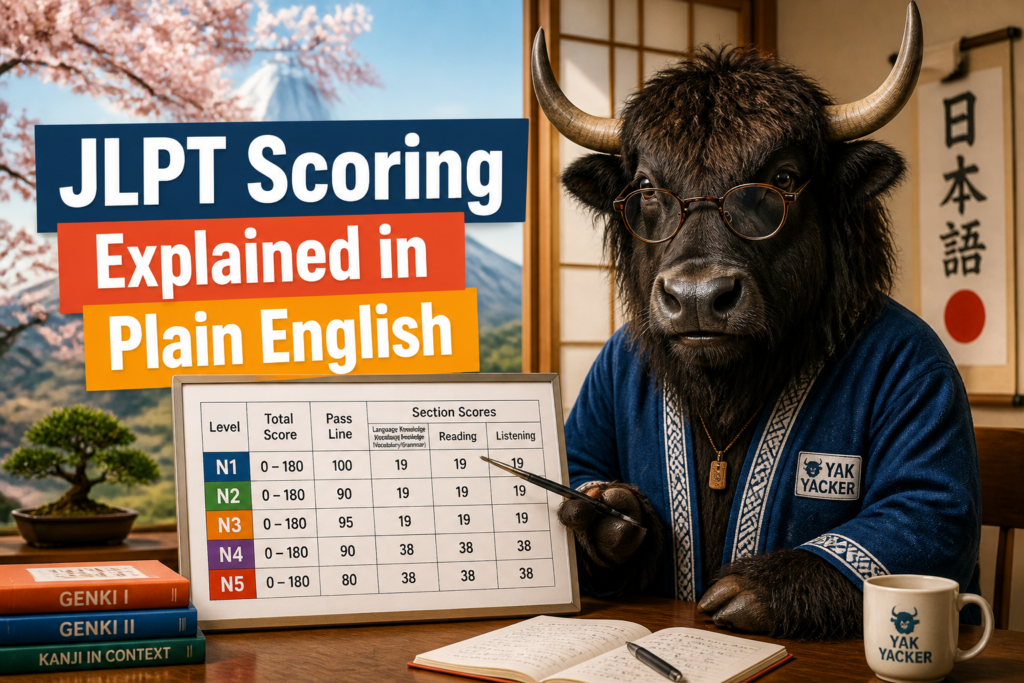
The JLPT score report usually gives you three section scores plus a total score. Those section scores depend on the level, but the idea stays the same: you need enough points overall, and you also need enough points in each required section. One strong part cannot completely rescue another weak part.
For a general overview of the test structure, you can also check the official-style overview on Japanese learning resources and then compare it with the level details on JLPT levels explained.
The Two Score Ideas You Need
| Score Type | What It Means | Simple English |
|---|---|---|
| Raw score | How many answers you got right | The plain count before adjustment |
| Scale score | Converted score used by the JLPT | The score that actually matters on your result |
Raw score is your actual answer count. If you answered 28 questions correctly, that is your raw performance. Scale score is the adjusted number the JLPT uses to compare test versions more fairly. The scale score is what appears on the official result.
得点 Rōmaji: tokuten Meaning: score; points
あなたの得点は十分でした。
Anata no tokuten wa jūbun deshita.
Your score was enough.
What The JLPT Score Report Checks
Most JLPT levels check two big things:
- Your total score must be high enough.
- Your section scores must also clear the minimum in each required part.
That second rule is the part many learners miss. You cannot always “make up for it later” with a huge score in another section. The test wants balance. A dramatic comeback story is cute in movies, less cute in scoring rules.
総合得点 Rōmaji: sōgō tokuten Meaning: overall score
総合得点が高くても、不足していれば合格できません。
Sōgō tokuten ga takakute mo, fusoku shite ireba gōkaku dekimasen.
Even if your overall score is high, you cannot pass if a required section is too low.
区分得点 Rōmaji: kubun tokuten Meaning: section score
区分得点は、分野ごとの点数です。
Kubun tokuten wa, bunya goto no tensū desu.
Section scores are points for each category.
Common JLPT Sections
The JLPT section names change a little by level, but the common ideas are easy to remember:
| Kanji | Rōmaji | Meaning | Example |
|---|---|---|---|
| 言語知識 | gengo chishiki | language knowledge | 言語知識の点数が上がりました。 Gengo chishiki no tensū ga agarimashita. My language knowledge score went up. |
| 読解 | dokkai | reading comprehension | 読解は時間との戦いです。 Dokkai wa jikan to no tatakai desu. Reading is a fight against time. |
| 聴解 | chōkai | listening comprehension | 聴解は慣れると少し楽です。 Chōkai wa nareru to sukoshi raku desu. Listening gets a little easier when you get used to it. |
Some levels combine language knowledge and reading into one section on the report, while listening is separate. The exact breakdown depends on the level, so it is smart to check the level page on JLPT level structure before you start guessing wildly.
Pass Marks: The Short Version
The JLPT pass rule is simple in spirit, even if the numbers look fussy: you need to reach the required overall score and the required minimum section scores. Those minimums are different by level. Very dramatic? No. Very efficient? Yes.
If you want the exact pass mark breakdown for each level, use the dedicated guide on JLPT pass marks. That page is the place for the numbers. This page is for understanding what those numbers actually mean without needing a decoding ring.
JLPT scoring is not “How many did I get right?” It is “How well did I perform across the test as a whole?”
Example: Why Section Scores Matter
Let’s say a learner gets a strong listening score but struggles in reading. Even if the total score looks decent, the reading section may still fall under the minimum. In that case, the test result is not a pass. The JLPT wants a balanced base, not one superhero section and two exhausted sidekicks.
| Situation | Total Score | Section Score Result | Pass? |
|---|---|---|---|
| Strong overall, all sections above minimum | Enough | All good | Yes |
| Strong overall, one section below minimum | Enough | One section too low | No |
| Not enough overall | Too low | Sections may be fine | No |
不合格 Rōmaji: fugōkaku Meaning: fail
読解が足りず、不合格でした。
Dokkai ga tarizu, fugōkaku deshita.
Reading was not enough, so I failed.
How To Read Your Score Report
- Check the total score first.
- Check each section score next.
- Compare the result with the level’s pass marks.
- Do not assume one high score can cancel a low section.
- Use the breakdown to see what to study next.
This is the useful part. Your score report is not just a pass/fail sticker. It tells you where your study habits worked and where they were… let’s say “still getting acquainted.” That is good information, even if it hurts a little.
必要 Rōmaji: hitsuyō Meaning: necessary; required
必要な点数を確認してください。
Hitsuyō na tensū o kakunin shite kudasai.
Please check the required score.
JLPT Vocabulary For Score Talk
| Kanji | Rōmaji | Meaning | Example |
|---|---|---|---|
| 点数 | tensū | score; points | 点数を上げたいです。 Tensū o agetai desu. I want to raise my score. |
| 結果 | kekka | result | 結果はすぐ見ました。 Kekka wa sugu mimashita. I looked at the result right away. |
| 確認 | kakunin | check; confirm | 点数を確認しましょう。 Tensū o kakunin shimashō. Let’s check the score. |
| 平均 | heikin | average | 平均より少し上でした。 Heikin yori sukoshi ue deshita. It was a little above average. |
| 目標 | mokuhyō | goal; target | 次の目標はN2です。 Tsugi no mokuhyō wa N2 desu. The next goal is N2. |
| 強み | tsuyomi | strength | 聴解が私の強みです。 Chōkai ga watashi no tsuyomi desu. Listening is my strength. |
| 弱点 | jakuten | weak point | 読解が弱点です。 Dokkai ga jakuten desu. Reading is my weak point. |
| 改善 | kaizen | improvement | 次は改善できます。 Tsugi wa kaizen dekimasu. I can improve next time. |
Useful Phrases For Talking About Scores
| Kanji | Rōmaji | Meaning | Example |
|---|---|---|---|
| 何点ですか | nan-ten desu ka | What score is it? | JLPTは何点ですか。 JLPT wa nan-ten desu ka. What was the JLPT score? |
| 合格しました | gōkaku shimashita | I passed | やっと合格しました。 Yatto gōkaku shimashita. I finally passed. |
| あと少しでした | ato sukoshi deshita | I was close | 合格まであと少しでした。 Gōkaku made ato sukoshi deshita. I was just short of passing. |
| 思ったより良かった | omotta yori yokatta | It was better than I expected | 結果は思ったより良かったです。 Kekka wa omotta yori yokatta desu. The result was better than I expected. |
| もう少し必要です | mō sukoshi hitsuyō desu | I need a little more | 読解はもう少し必要です。 Dokkai wa mō sukoshi hitsuyō desu. I need a little more reading practice. |
| 次回がんばります | jikai ganbarimasu | I’ll do better next time | 次回がんばります。 Jikai ganbarimasu. I’ll do better next time. |
Small But Important Scoring Facts
- The JLPT score is not a school grade.
- Section scores matter, not just the total.
- Different test versions are adjusted for fairness.
- Passing one level does not mean every skill is equally strong.
- Your result is useful even if you do not pass. Annoying, yes. Useful, also yes.
If you are still building your Japanese base, it can help to pair score study with vocab study. Try the Japanese vocabulary test for a quick reality check, then use the Japanese placement test to estimate where you stand before the next exam.
Common Mistakes And Fixes
| Mistake | Why It Is Wrong | Better Way |
|---|---|---|
| Thinking raw answers are the final score | The JLPT uses scale scores | Check the converted result |
| Ignoring section minimums | You can still fail with a strong total | Watch each section score |
| Comparing scores across different levels without context | N5, N4, N3, N2, and N1 are not the same difficulty | Compare within the same level |
| Panicking over one weak section | A weak section is not the end of the world | Use it as a study target |
Practice: Read The Situation
- Your total score is high, but one section is under the minimum. What happens? You do not pass.
- Your total score is just enough, and every section clears the cutoff. What happens? You pass.
- Your raw answer count looks good, but your official score is lower than you expected. Why? The JLPT uses scale scores.
- Your listening score is excellent, but reading is weak. What should you do next? Study reading more, not just listening.
合格 Rōmaji: gōkaku Meaning: pass
合格するには、全体のバランスが大切です。
Gōkaku suru ni wa, zentai no baransu ga taisetsu desu.
To pass, balance across the whole test matters.
Where To Study Next
If your score report showed weak spots, that is actually helpful. It means your study plan can become more specific instead of “study everything forever,” which is the educational version of shouting into a pillow. A focused plan is much smarter.
For books that can help with each level, take a look at the best Japanese JLPT books. If you want to understand the level ladder before choosing materials, revisit JLPT levels. And if you want to know exactly how many points you need, keep JLPT pass marks open in another tab like a responsible little score detective.
Quick Reference Summary
- 得点 means score or points.
- The JLPT uses scale scores, not just raw correct answers.
- You need both a strong total score and enough section scores.
- Passing depends on the level’s cutoff rules.
- Use your result to find strengths and weak points for the next round.
In short, JLPT scoring is less about raw bragging rights and more about consistent performance. Once you understand that, the score sheet becomes a lot less mysterious and a lot more useful. Still a little annoying? Sure. But at least now it is annoying in a readable way.
点数 Rōmaji: tensū Meaning: score
次は点数を上げましょう。
Tsugi wa tensū o agemashō.
Let’s raise the score next time.