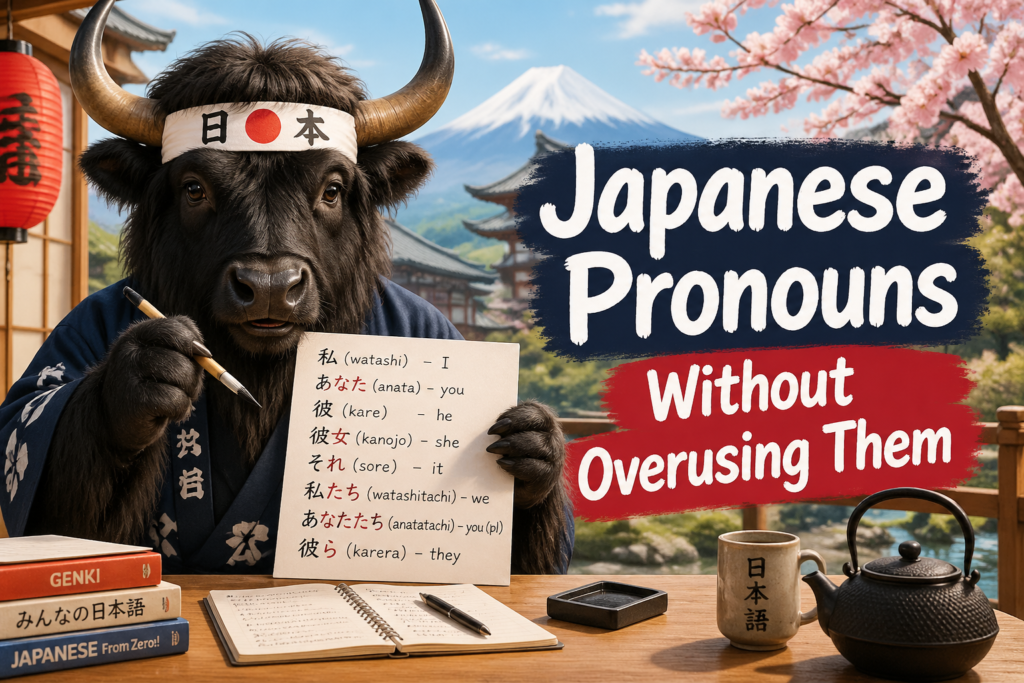
Japanese pronouns are a little sneaky. If you bring them into every sentence like you would in English, the result can sound stiff, overly direct, or just a bit “textbook with a bad haircut.” The good news? Natural Japanese often uses fewer pronouns than English, and that is not missing information. It is usually smart, normal, and very Japanese.
If you have ever heard a sentence and thought, “Wait, who are they talking about?” — yes, that happens. Japanese often lets context do the heavy lifting. Once you get used to it, the language starts feeling cleaner and more elegant. Also, less pronoun repetition means less awkward echoing. Your sentences can finally breathe.
The Big Idea: Use Pronouns When They Help, Not Just Because English Would
In English, pronouns are everywhere. “I,” “you,” “he,” “she,” “they” keep the sentence moving. In Japanese, speakers often skip them when the meaning is already clear from context, topic, or situation.
That does not mean Japanese has no pronouns. It means pronouns are more like backup tools than default furniture. Use them when clarity needs a little push. Otherwise, Japanese happily leaves them out and moves on with its life.
Common Japanese Pronouns And When They Feel Natural
| Kanji | Rōmaji | English Meaning | Notes |
|---|---|---|---|
| 私 | watashi | I; me | Polite and neutral, but often omitted in conversation. |
| 僕 | boku | I; me | Usually male, casual to polite, friendly tone. |
| 俺 | ore | I; me | Very casual, masculine, rougher tone. |
| あなた | anata | you | Can sound overly direct if used too much. |
| 彼 | kare | he; him | Can mean “he” or “boyfriend” depending on context. |
| 彼女 | kanojo | she; her | Can mean “she” or “girlfriend” depending on context. |
| 私たち | watashitachi | we; us | Often used, but can still be omitted when obvious. |
| 彼ら | karera | they; them | Less common in casual speech than English “they.” |
One important detail: Japanese pronouns are not used as often for simple grammar. They show up more when you need emphasis, contrast, or clarity. So yes, you can use 私 watashi I; me, but you do not need to say it every time you speak. The sentence can survive without it. Strong little sentence.
Useful Pronoun Patterns In Real Life
| Kanji | Rōmaji | English Meaning | Example | Example Rōmaji | Translation |
|---|---|---|---|---|---|
| 私は学生です。 | Watashi wa gakusei desu. | I am a student. | 私は学生です。 | Watashi wa gakusei desu. | I am a student. |
| 学生です。 | Gakusei desu. | Am a student. | 学生です。 | Gakusei desu. | I am a student. |
| あなたは元気ですか。 | Anata wa genki desu ka. | How are you? | あなたは元気ですか。 | Anata wa genki desu ka. | How are you? |
| 元気ですか。 | Genki desu ka. | How are you? | 元気ですか。 | Genki desu ka. | How are you? |
| 彼は来ます。 | Kare wa kimasu. | He is coming. | 彼は来ます。 | Kare wa kimasu. | He is coming. |
| 来ます。 | Kimasu. | Is coming. | 来ます。 | Kimasu. | He is coming. |
| 私たちは忙しいです。 | Watashitachi wa isogashii desu. | We are busy. | 私たちは忙しいです。 | Watashitachi wa isogashii desu. | We are busy. |
| 忙しいです。 | Isogashii desu. | Are busy. | 忙しいです。 | Isogashii desu. | We are busy. |
When Japanese Speakers Skip Pronouns
- When the subject is obvious: If the topic is already clear, saying it again feels repetitive.
- When the sentence is about shared context: In conversation, both people usually know who or what is being discussed.
- When the verb already gives enough meaning: Japanese often lets the action carry the message.
- When avoiding sounding too direct: Repeating pronouns can make speech feel blunt or unnatural.
- When the topic has already been introduced: After that, Japanese often keeps going without repeating it.
For example, if someone asks about your day, you do not need to keep saying 私 watashi I; me before every action. In natural Japanese, once the topic is set, the sentence can keep moving without constant name-tagging.
Japanese often prefers “clear through context” over “clear through repetition.” English likes to spell it out. Japanese often prefers to trust the room a little more.
Natural Examples Without Overusing Pronouns
| Kanji | Rōmaji | English Meaning | Example | Example Rōmaji | Translation |
|---|---|---|---|---|---|
| 今日は忙しいです。 | Kyou wa isogashii desu. | Today is busy / I am busy today. | 今日は忙しいです。 | Kyou wa isogashii desu. | I am busy today. |
| もう帰ります。 | Mou kaerimasu. | I’m heading home now. | もう帰ります。 | Mou kaerimasu. | I’m heading home now. |
| 知っています。 | Shitte imasu. | I know it / I know. | 知っています。 | Shitte imasu. | I know it. |
| 明日行きます。 | Ashita ikimasu. | I will go tomorrow. | 明日行きます。 | Ashita ikimasu. | I will go tomorrow. |
| それは高いです。 | Sore wa takai desu. | That is expensive. | それは高いです。 | Sore wa takai desu. | That is expensive. |
| ちょっと待ってください。 | Chotto matte kudasai. | Please wait a moment. | ちょっと待ってください。 | Chotto matte kudasai. | Please wait a moment. |
| 見ました。 | Mimashita. | Saw it / I saw it. | 見ました。 | Mimashita. | I saw it. |
| もう食べました。 | Mou tabemashita. | Already ate / I already ate. | もう食べました。 | Mou tabemashita. | I already ate. |
The Pronouns That Can Sound Too Strong If Overused
| Kanji | Rōmaji | English Meaning | Natural Use |
|---|---|---|---|
| あなた | anata | you | Use with care. In conversation, a name, title, or no pronoun may sound more natural. |
| 君 | kimi | you | Can sound warm, casual, or bossy depending on tone and relationship. |
| お前 | omae | you | Very casual and often rough. Not a safe default. |
| 彼 | kare | he | Fine in written explanation, but context often replaces it in speech. |
| 彼女 | kanojo | she | Also often replaced by context or the person’s name. |
The tricky part is that English speakers often want to label everybody clearly. Japanese does not always do that. Sometimes the most natural choice is a name, a role, or simply nothing at all. A silence here can be a feature, not a bug.
Use Names, Roles, Or Context Instead
- Use a name: 田中さん Tanaka-san Mr./Ms. Tanaka
- Use a role: 先生 sensei teacher
- Use a relationship: お母さん okaasan mother
- Use the topic marker: は wa helps show what the sentence is about
- Use shared situation: People who are talking already know the subject often enough
Example: instead of saying 彼は忙しいです。 Kare wa isogashii desu. He is busy. in every sentence, Japanese may simply say 忙しいです。 Isogashii desu. Busy. if the person is already understood. Efficient, tidy, and slightly smug about it.
Pronoun Practice: Less Is More
Try rewriting these English ideas in the most natural Japanese style. The goal is not to force a pronoun into every sentence. The goal is to notice when it can disappear.
| English Idea | Natural Japanese Style | Hint |
|---|---|---|
| I’m busy today. | 今日は忙しいです。 Kyou wa isogashii desu. | No need for 私 if the subject is obvious. |
| He is coming. | 来ます。 Kimasu. | If “he” is already clear, skip it. |
| Do you know? | 知っていますか。 Shitte imasu ka. | Often the pronoun is not needed. |
| We are going tomorrow. | 明日行きます。 Ashita ikimasu. | Context can carry “we.” |
| You are late. | 遅いです。 Osoi desu. | Direct “you” can sound too sharp. |
| She likes coffee. | コーヒーが好きです。 Kōhii ga suki desu. | The person may already be known from context. |
Common Mistakes And Easy Fixes
- Mistake: Repeating 私 watashi in every sentence.
Fix: Drop it when the subject is already obvious. - Mistake: Using あなた anata for every “you.”
Fix: Use names, titles, or no pronoun when possible. - Mistake: Translating English pronouns too literally.
Fix: Ask, “Is this pronoun actually needed in Japanese?” - Mistake: Thinking missing pronouns mean missing meaning.
Fix: Context usually fills the gap. - Mistake: Overusing 彼 kare and 彼女 kanojo in speech.
Fix: Use the person’s name or simply continue the topic.
A useful habit is to read Japanese sentences and ask, “Who is already understood here?” That one question solves a surprising number of pronoun problems. Very polite of context, honestly.
Quick Reference Summary
- Japanese often drops pronouns. That is normal.
- Use pronouns when clarity needs help.
- Do not copy English pronoun patterns too closely.
- Names, roles, and context often sound more natural.
- “You” words like あなた can feel too direct if repeated.
- Less repetition usually sounds more native-like.
If you want to keep building this kind of natural Japanese feeling, the next smart step is to see how topic and context work across sentences, not just inside one sentence. That is where Japanese starts to look less like English with different clothes and more like its own beautifully efficient system. For a broader study path, you can also visit the Japanese learning guide.
And if you want a handy companion lesson, the next thing worth checking is this related Japanese guide. Pronouns get much easier once you stop forcing them to do all the work.