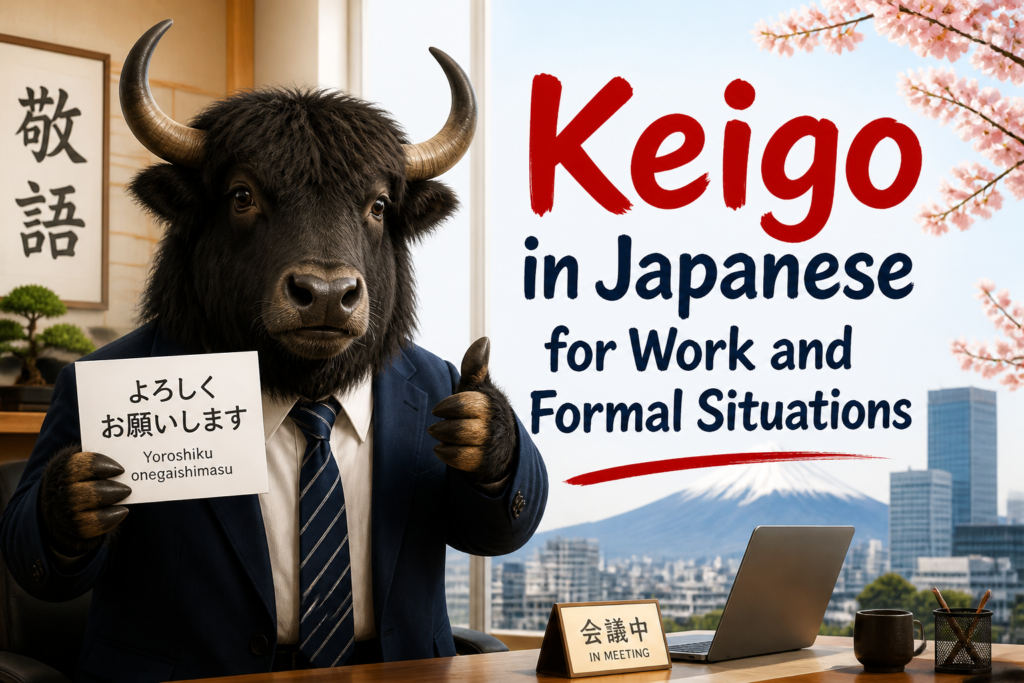
敬語 (Keigo) means polite Japanese used at work, in shops, on the phone, in emails, and basically anywhere you do not want to sound like a feral raccoon in a business suit. It is the language of respect, distance, and professional good sense.
If Japanese plain speech is your friendly neighborhood t-shirt, 敬語 (Keigo) is the clean pressed outfit you wear when the situation asks for manners. The good news: you do not need to become a human honorific dictionary overnight. You just need the core patterns, the common phrases, and a few “please don’t say that at work” traps.
For a broader study path, you can also check the main Learn Japanese page, then branch into deeper practice when you are ready.
Japanese learners often hear that keigo is “too hard.” That is dramatic. It is also a little lazy. Keigo has rules, yes, but most real situations recycle the same patterns again and again. Once you learn the big pieces, you start spotting them everywhere.
Here is the simple idea: in formal Japanese, you often use respectful words for the other person and humble words for yourself. That sounds fancy because it is fancy. But the everyday goal is modest: sound polite, smooth, and safe.
The Three Big Keigo Styles
敬語 (Keigo) usually gets described in three main styles. You do not need to master all of them at once. Start with the map, then learn the roads.
| Style | Japanese | Rōmaji | Meaning | When It Is Used |
|---|---|---|---|---|
| Respectful language | 尊敬語 | sonkeigo | Honorific language for the other person | Customers, bosses, teachers, seniors |
| Humble language | 謙譲語 | kenjōgo | Humble language for your own actions | Speaking about yourself or your in-group |
| Polite language | 丁寧語 | teineigo | Polite standard speech | Most formal everyday situations |
丁寧語 (teineigo) is the easiest place to begin because it mainly uses です (desu) and ます (masu). If you can use those naturally, you are already doing better than many nervous beginners who panic and suddenly start speaking like a broken robot.
Essential Keigo Words And Phrases
Below are the most useful phrases first. These are the ones that show up in offices, stores, service desks, phone calls, and polite emails.
| Kanji | Rōmaji | English Meaning | Example Sentence | Rōmaji | English Translation |
|---|---|---|---|---|---|
| ありがとうございます | arigatō gozaimasu | Thank you very much | ご来店ありがとうございます。 | Go-raiten arigatō gozaimasu. | Thank you very much for coming to our store. |
| お願いします | onegaishimasu | Please; I request this | よろしくお願いします。 | Yoroshiku onegaishimasu. | Please take care of this / Nice to meet you. |
| 失礼します | shitsurei shimasu | Excuse me; I will leave; pardon me | 先に失礼します。 | Saki ni shitsurei shimasu. | Excuse me, I will leave first. |
| お世話になります | o-sewa ni narimasu | Thank you for your support / assistance | いつもお世話になっております。 | Itsumo o-sewa ni natte orimasu. | Thank you as always for your help. |
| 少々お待ちください | shōshō omachi kudasai | Please wait a moment | 少々お待ちください。 | Shōshō omachi kudasai. | Please wait a moment. |
| 承知しました | shōchi shimashita | Understood; certainly | 承知しました。すぐ確認します。 | Shōchi shimashita. Sugu kakunin shimasu. | Understood. I will check right away. |
| かしこまりました | kashikomarimashita | Understood; certainly | かしこまりました。ご案内します。 | Kashikomarimashita. Go-annai shimasu. | Certainly. I will guide you. |
| 恐れ入ります | osoreirimasu | Sorry to trouble you; excuse me | 恐れ入りますが、もう一度お願いします。 | Osoreirimasu ga, mō ichido onegaishimasu. | Sorry to trouble you, but please say that once more. |
| ご確認ください | go-kakunin kudasai | Please confirm | 内容をご確認ください。 | Naiyō o go-kakunin kudasai. | Please confirm the contents. |
| ご案内します | go-annai shimasu | I will guide you; I will show you around | 受付までご案内します。 | Uketsuke made go-annai shimasu. | I will guide you to the reception desk. |
Work And Service Phrases You Will Actually Hear
These phrases are especially common in shops, offices, hotels, clinics, and customer service. Translation note: the same phrase can sound slightly different depending on the situation. Welcome to Japanese, where context does the heavy lifting and leaves you holding the clipboard.
| Kanji | Rōmaji | English Meaning | Example Sentence | Rōmaji | English Translation |
|---|---|---|---|---|---|
| いらっしゃいませ | irasshaimase | Welcome; hello to customers | いらっしゃいませ。どうぞ。 | Irasshaimase. Dōzo. | Welcome. Please come in. |
| ご注文 | go-chūmon | Order | ご注文をお伺いします。 | Go-chūmon o oukagai shimasu. | I will take your order. |
| 伺います | ukagaimasu | To ask; to visit; humble form of “hear/ask” | お名前を伺ってもよろしいですか。 | Onamae o ukagatte mo yoroshii desu ka. | May I ask your name? |
| 確認します | kakunin shimasu | To confirm; to check | 内容を確認します。 | Naiyō o kakunin shimasu. | I will check the details. |
| 参ります | mairimasu | To go / come; humble form | すぐ参ります。 | Sugu mairimasu. | I will come right away. |
| 存じます | zonjimasu | To know; humble form of “know” | その件は存じません。 | Sono ken wa zonjimasen. | I do not know about that matter. |
| 拝見します | haiken shimasu | To look at; humble form | 資料を拝見します。 | Shiryō o haiken shimasu. | I will look at the documents. |
| 申し上げます | mōshiagemasu | To say; very formal humble form | 後ほどご連絡申し上げます。 | Nochi hodo go-renraku mōshiagemasu. | I will contact you later. |
| いただきます | itadakimasu | To receive; humble form | 資料をいただきます。 | Shiryō o itadakimasu. | I will receive the documents. |
| お待たせしました | o-matase shimashita | Sorry to keep you waiting | お待たせしました。こちらです。 | O-matase shimashita. Kochira desu. | Sorry to keep you waiting. This way, please. |
Respectful Language: Making The Other Person Sound Elevated
尊敬語 (sonkeigo) lifts the other person up. It is used for customers, clients, bosses, teachers, and anyone you need to treat with formal distance. The trick is not to decorate every verb like a wedding cake. Use the forms that people actually use.
| Plain Form | Respectful Form | Meaning | Example | Translation |
|---|---|---|---|---|
| 言う | おっしゃる | To say | 先生がそうおっしゃいました。 | The teacher said that. |
| 見る | ご覧になる | To see / look at | 資料をご覧ください。 | Please look at the materials. |
| 行く・来る・いる | いらっしゃる | To go, come, or be | 部長はいらっしゃいますか。 | Is the manager here? |
| 食べる・飲む | 召し上がる | To eat / drink | 何を召し上がりますか。 | What will you have to eat or drink? |
| する | なさる | To do | 明日なさいますか。 | Will you do it tomorrow? |
| 知っている | ご存じです | To know | その方をご存じですか。 | Do you know that person? |
Notice the pattern: respectful forms often replace the regular verb entirely. That is why ご覧になる (goran ni naru) is not just “polite miru.” It is a different beast wearing a polite tie.
Humble Language: Lowering Yourself Gracefully
謙譲語 (kenjōgo) is used for your own actions when you want to show respect to the other person. In English, this feels weird because we usually do not “lower” ourselves grammatically. In Japanese, that modesty is part of the social system.
| Plain Form | Humble Form | Meaning | Example | Translation |
|---|---|---|---|---|
| 行く・来る | 参る | To go / come | 午後に参ります。 | I will come in the afternoon. |
| 言う | 申す | To say | 田中と申します。 | My name is Tanaka. |
| 見る | 拝見する | To look at | メールを拝見しました。 | I read your email. |
| する | いたす | To do | すぐ対応いたします。 | I will handle it right away. |
| 会う | お目にかかる | To meet | 明日お目にかかります。 | I will meet you tomorrow. |
| 聞く | 伺う | To ask / hear | 詳しく伺います。 | I will ask for details. |
| もらう | いただく | To receive; to eat/drink humbly | ご指示をいただきました。 | I received your instructions. |
| 知る | 存じる | To know | その件は存じています。 | I know about that matter. |
お客様 (okyakusama) gets the special treatment, not you. That is the whole point. Japanese politeness is not about sounding fancy for yourself. It is about making the other side comfortable.
Polite Sentence Endings You Need Right Away
If you only learn a few polite endings, learn these. They are everywhere, and they keep your Japanese from sounding too abrupt.
| Kanji | Rōmaji | English Meaning | Example Sentence | Rōmaji | English Translation |
|---|---|---|---|---|---|
| です | desu | Polite “is/are” | こちらは受付です。 | Kochira wa uketsuke desu. | This is the reception desk. |
| ます | masu | Polite verb ending | すぐ確認します。 | Sugu kakunin shimasu. | I will check right away. |
| でしょうか | deshō ka | Polite question / guess | お名前は田中様でしょうか。 | Onamae wa Tanaka-sama deshō ka. | Would your name be Mr./Ms. Tanaka? |
| よろしいですか | yoroshii desu ka | Is it okay? May I? | 今お電話よろしいですか。 | Ima o-denwa yoroshii desu ka. | Is now a good time for a call? |
| ください | kudasai | Please do | こちらにお名前をお書きください。 | Kochira ni onamae o okaki kudasai. | Please write your name here. |
| ございます | gozaimasu | Formal “there is / is” | ご質問はございますか。 | Go-shitsumon wa gozaimasu ka. | Do you have any questions? |
One very useful pattern is 〜ております (te orimasu), the humble version of 〜ている (te iru). Example: 確認しております (kakunin shite orimasu) means “I am checking” in a polite, business-friendly way.
Common Keigo Phrases For Emails And Phone Calls
Email and phone Japanese can feel extra stiff at first. That is normal. Formal communication in Japanese has its own rhythm, and yes, it loves set phrases a bit too much.
| Kanji | Rōmaji | English Meaning | Example Sentence | Rōmaji | English Translation |
|---|---|---|---|---|---|
| いつもお世話になっております | itsumo o-sewa ni natte orimasu | Thank you for your continued support | いつもお世話になっております。ヤマダです。 | Itsumo o-sewa ni natte orimasu. Yamada desu. | Thank you for your continued support. This is Yamada. |
| 恐れ入りますが | osoreirimasu ga | I’m sorry to trouble you, but… | 恐れ入りますが、再送してください。 | Osoreirimasu ga, saisō shite kudasai. | Sorry to trouble you, but please resend it. |
| ご連絡ありがとうございます | go-renraku arigatō gozaimasu | Thank you for contacting me | ご連絡ありがとうございます。確認します。 | Go-renraku arigatō gozaimasu. Kakunin shimasu. | Thank you for your message. I will check. |
| お手数をおかけします | o-tesū o okake shimasu | Sorry to trouble you | お手数をおかけしますが、よろしくお願いします。 | O-tesū o okake shimasu ga, yoroshiku onegaishimasu. | Sorry for the trouble, but thank you in advance. |
| ご査収ください | go-sashū kudasai | Please receive and review | 資料をご査収ください。 | Shiryō o go-sashū kudasai. | Please receive and review the materials. |
| ご返信お待ちしております | go-henjin o-machi shite orimasu | We look forward to your reply | ご返信お待ちしております。 | Go-henjin o-machi shite orimasu. | We look forward to your reply. |
Useful Keigo Sentence Patterns
Here are a few patterns that do a lot of work. Learn the shape, then swap in new words.
| Pattern | Meaning | Example Sentence | Rōmaji | English |
|---|---|---|---|---|
| お + Verb Stem + ください | Please do the action politely | お待ちください。 | Omachi kudasai. | Please wait. |
| ご + Noun + ください | Please do something with a noun | ご確認ください。 | Go-kakunin kudasai. | Please confirm. |
| お + Verb Stem + します | Polite humble action | お知らせします。 | O-shirase shimasu. | I will inform you. |
| 〜ております | Humble ongoing action | 準備しております。 | Junbi shite orimasu. | I am preparing. |
| 〜させていただきます | Very polite “I will do” | 本日対応させていただきます。 | Honjitsu taiō sasete itadakimasu. | I will handle it today. |
| 〜いただけますか | Could you please…? | お名前をいただけますか。 | Onamae o itadake masuka. | Could I have your name? |
The pattern 〜させていただきます (sasete itadakimasu) is famous, useful, and sometimes overused. It literally means something like “I humbly will be allowed to do this.” In practice, it is common in business Japanese, but do not cram it into every sentence like confetti.
Example Dialogues
These short dialogues show how keigo sounds in real situations. Read them aloud. Yes, aloud. Your mouth needs practice too, not just your eyes.
| Situation | Japanese | Rōmaji | English |
|---|---|---|---|
| At a shop | いらっしゃいませ。ご注文はお決まりですか。 | Irasshaimase. Go-chūmon wa okimari desu ka. | Welcome. Have you decided on your order? |
| Replying politely | はい、こちらをお願いします。 | Hai, kochira o onegaishimasu. | Yes, I’ll have this one, please. |
| At work | 資料を拝見しました。修正いたします。 | Shiryō o haiken shimashita. Shūsei itashimasu. | I reviewed the materials. I will make corrections. |
| On the phone | 山田と申します。佐藤様はいらっしゃいますか。 | Yamada to mōshimasu. Satō-sama wa irasshaimasu ka. | My name is Yamada. Is Mr./Ms. Sato available? |
| Leaving early | お先に失礼します。 | Osaki ni shitsurei shimasu. | Excuse me, I’m leaving first. |
Common Mistakes And Easy Fixes
- Mixing plain and formal speech — Keep the level consistent. If you start with です・ます language, do not suddenly drop into casual speech like 食べる?
- Using respectful and humble forms for the same person — Use respectful language for the other person and humble language for yourself. Do not hand out honor and self-demotion randomly.
- Overusing fancy forms — Not every sentence needs 申し上げます or させていただきます. Sometimes plain polite Japanese is cleaner and sounds more natural.
- Saying わかりました when a deeper formal response fits better — 承知しました or かしこまりました can sound safer in business and service settings.
- Forgetting the situation — In a shop, customer-service phrases matter. In an office, email and reporting phrases matter. Keigo is not one-size-fits-all.
Quick Practice Drills
Try changing each plain sentence into a more formal version. The goal is not perfection. The goal is to stop sounding like you wandered into a boardroom wearing slippers.
- Plain: 見る (miru) → Polite: ご覧になる (goran ni naru) — “to look at”
- Plain: 行く (iku) → Humble: 参る (mairu) — “to go / come”
- Plain: 言う (iu) → Humble: 申す (mōsu) — “to say”
- Plain: 待ってください (matte kudasai) → Polite: 少々お待ちください (shōshō omachi kudasai) — “Please wait a moment”
- Plain: 知っています (shitte imasu) → Formal: 存じています (zonjite imasu) — “I know”
- Plain: 確認します (kakunin shimasu) → More polite: 確認いたします (kakunin itashimasu) — “I will check”
Variants You Will See In Real Life
| Formal Idea | Common Variant | When To Use |
|---|---|---|
| ありがとうございます | どうもありがとうございます | Stronger thanks |
| 承知しました | かしこまりました | Very polite, often service industry |
| 確認します | 確認いたします | More humble and formal |
| 行きます | 参ります | Humble self-action |
| 見ます | 拝見します | Humble “I will look” |
| 知っています | 存じています | Polite “I know” |
If you want to compare humble and honorific Japanese more deeply, a good next stop is Honorific and Humble Japanese, and for the respectful side specifically, Honorific Japanese is a useful follow-up.
Need more study structure? A Japanese placement test and JLPT practice can help you see whether your polite Japanese is beginner-friendly or ready for the next level. A Japanese vocabulary test is also a good reality check, because keigo feels much easier when your base vocabulary is solid.
One more useful resource sits quietly at this lesson page, which can give you extra support if you want another angle on formal Japanese study.
For a very boring but very reliable reference on the idea of honorific language, the Wikipedia overview of Japanese honorific speech is useful for quick orientation. Not glamorous, but neither is filing paperwork, and somehow both still matter.
Quick Reference Summary
- 丁寧語 (teineigo) = polite basic Japanese with です and ます
- 尊敬語 (sonkeigo) = respectful language for the other person
- 謙譲語 (kenjōgo) = humble language for yourself
- Use 承知しました or かしこまりました instead of casual “okay” in formal settings
- Use お and ご patterns for polite requests and nouns
- Learn set phrases for email, phone, service, and work first
- Do not overcomplicate every sentence; clean and correct beats fancy and awkward
敬語 (Keigo) is not about sounding superior. It is about making speech fit the room. Once you understand that, Japanese formal language stops feeling like a puzzle box and starts feeling like a useful toolkit.
Learn the core phrases, keep the levels straight, and practice them in real sentences. That is how keigo stops being scary and starts becoming one of your most practical Japanese skills.