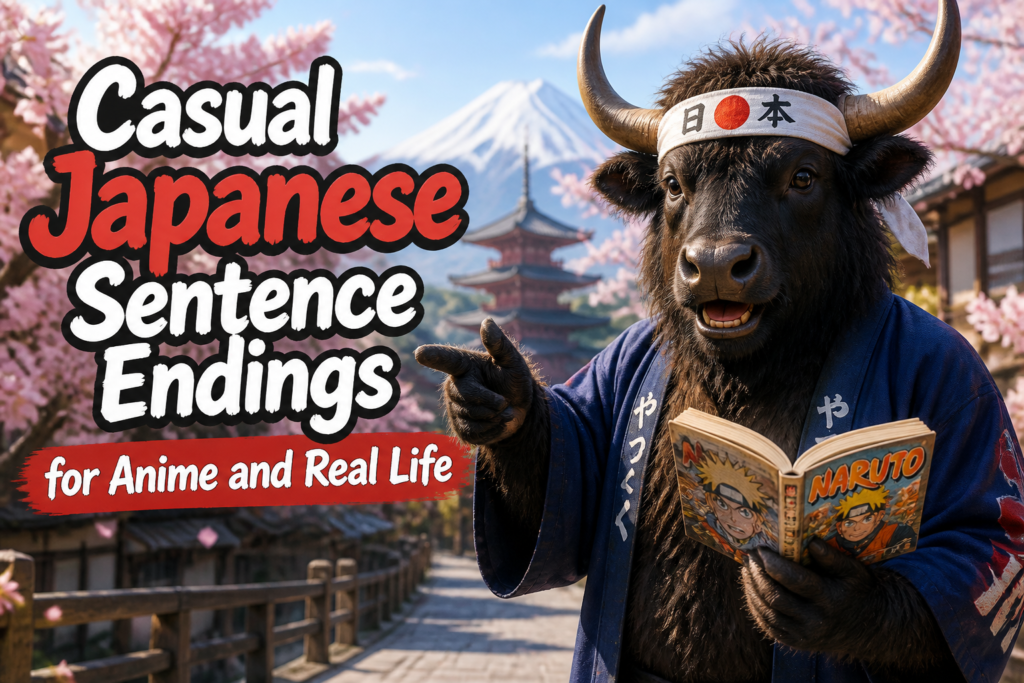
Japanese sentence endings are where a sentence gets its attitude, mood, and a little bit of personality. In anime, they can sound dramatic, cute, rude, cool, or vaguely like a person who has watched too much samurai drama. In real life, the same endings are often much softer and more practical.
For the broader learning path, visit our parent guide.
That is the fun part, and also the trap. A line that sounds amazing in a show can sound weird, too intense, or just plain extra in everyday conversation. So let’s sort out the casual endings you actually hear, what they mean, and when to use them without sounding like you are doing a very committed character impression.
If you want a bigger view of how endings work in general, it helps to compare them with the basic sentence-ending style in desu and da and the smaller helper words in Japanese ending particles.
What Sentence Endings Actually Do
In Japanese, the end of the sentence often carries a lot of meaning. It can show politeness, certainty, emotion, or the speaker’s vibe. English usually adds this with tone, extra words, or punctuation. Japanese often just puts it right at the end. Efficient. Slightly smug. Very Japanese.
Casual sentence endings are the forms you hear in relaxed speech, among friends, in manga dialogue, and in anime. Some are normal and useful. Some are strongly feminine, masculine, childish, rough, or old-fashioned. That does not make them “bad”; it just means you need to know the flavor before you sprinkle it everywhere like it is free seasoning.
Quick Core Endings You Need First
| Kanji / Japanese | Rōmaji | English Meaning | Example Sentence |
|---|---|---|---|
| だ | da | Plain “is/it is”; casual statement ending | 今日は休みだ。 / Kyō wa yasumi da. / Today is a day off. |
| よ | yo | “You know / I’m telling you / for sure” | これは本当だよ。 / Kore wa hontō da yo. / This is really true. |
| ね | ne | “Right? / isn’t it? / you know?” | 寒いね。 / Samui ne. / It’s cold, isn’t it? |
| よね | yone | Soft agreement: “right?” with a little push | この映画、長いよね。 / Kono eiga, nagai yone. / This movie is long, right? |
| かな | kana | Wondering to oneself: “I wonder…” | 明日、雨かな。 / Ashita, ame kana. / I wonder if it will rain tomorrow. |
| かも | kamo | “Maybe / might” | 彼は来るかも。 / Kare wa kuru kamo. / He might come. |
| ぞ | zo | Rough, assertive emphasis | 急ぐぞ。 / Isogu zo. / Let’s hurry. |
| ぜ | ze | Rough, casual masculine emphasis | 行くぜ。 / Iku ze. / I’m going. |
| な | na | Reflective, emotional, or rough depending on tone | いい景色だな。 / Ii keshiki da na. / What a nice view. |
| わ | wa | Often feminine-sounding; adds softness or emotion | きれいだわ。 / Kirei da wa. / It’s beautiful. |
Those ten are the starters. Not every one is equally common in modern daily speech, but anime loves them all like an over-enthusiastic collector of dramatic dialogue.
Useful Casual Endings With Real-Life Feel
| Kanji / Japanese | Rōmaji | English Meaning | Example Sentence |
|---|---|---|---|
| かな | kana | “I wonder…”; soft self-question | 駅、もう閉まったかな。 / Eki, mō shimatta kana. / I wonder if the station is closed already. |
| かしら | kashira | “I wonder…”; often feminine and softer | 彼、来るかしら。 / Kare, kuru kashira. / I wonder if he’ll come. |
| さ | sa | Casual filler, light emphasis, very spoken | まあ、そうさ。 / Mā, sō sa. / Well, that’s how it is. |
| よさ | yosa | Emphatic casual tone, often masculine or rough | 行くよさ。 / Iku yo sa. / I’m going, you know. |
| って | tte | Casual quoting marker; “they say / it’s called” | これ、人気だって。 / Kore, ninki da tte. / They say this is popular. |
| じゃん | jan | Casual “isn’t it?” / “see?” | もう終わったじゃん。 / Mō owatta jan. / It’s already over, you know. |
| だろ | daro | “Right?” with confidence; can sound strong | 簡単だろ。 / Kantan daro. / It’s easy, right? |
| だろう | darō | Likely “probably”; also assertive in speech | 彼は忙しいだろう。 / Kare wa isogashii darō. / He’s probably busy. |
| でしょう | deshō | Politer “probably” or “right?” | 明日は晴れるでしょう。 / Ashita wa hareru deshō. / It will probably be sunny tomorrow. |
| の | no | Explaining tone; soft, emotional, or childish depending on context | 今日は行かないの。 / Kyō wa ikanai no. / I’m not going today. |
| のよ | no yo | Soft but firm explanation | ちゃんと見たのよ。 / Chanto mita no yo. / I really did look at it. |
| のね | no ne | Explaining while seeking agreement | それは大事なのね。 / Sore wa daiji na no ne. / So that’s important, right? |
How The Endings Feel In Real Speech
Let’s keep this simple. Japanese sentence endings are not just “grammar.” They are social signals. The same sentence can sound gentle, blunt, playful, or rude depending on the ending.
- だ (da) is plain and direct. It is common in casual speech and written dialogue.
- よ (yo) adds information or emphasis. It can mean “I’m telling you.”
- ね (ne) invites agreement. It softens the sentence and makes it feel shared.
- よね (yone) combines both: “I’m saying this, and you agree, right?”
- かな (kana) shows uncertainty or quiet wondering.
- かも (kamo) means “maybe” or “might.” It is less dramatic than a full-blown guess.
- ぞ / ぜ (zo / ze) are rough and emphatic. Anime uses them a lot. Real life uses them less, unless someone wants to sound tough, old-school, or a little ridiculous.
- な (na) can be reflective, emotional, or rough, depending on tone and context.
- わ (wa) often sounds feminine or soft in many modern contexts.
- じゃん (jan) is very common in casual spoken Japanese, especially in some regions.
Anime Endings Versus Everyday Endings
Anime loves endings that are highly expressive. Real-life Japanese often keeps the same meanings but tones them down. That is why the same basic sentence can appear in a show as a dramatic declaration, then in conversation as a short and practical comment.
| Anime-Style Ending | Real-Life Use | Feel | Example |
|---|---|---|---|
| だぞ | Used for strong emphasis, often by male characters or tough talk | Very assertive | 気をつけるんだぞ。 / Ki o tsukeru n da zo. / Be careful, okay? |
| だぜ | Casual, confident, sometimes playful | Cool-guy energy | 今日は勝つぜ。 / Kyō wa katsu ze. / We’re winning today. |
| なのだ | Old-fashioned or character-like speech | Slightly theatrical | これが真実なのだ。 / Kore ga shinjitsu na no da. / This is the truth. |
| わよ | Soft feminine emphasis, but context matters a lot | Elegant or theatrical | 見てちょうだい、すごいわよ。 / Mite chōdai, sugoi wa yo. / Look, it’s amazing. |
| ってば | Annoyed repetition or playful insistence | Frustrated | もう、言ったってば。 / Mō, itta tte ba. / I said it already. |
Notice the pattern: many “anime endings” are not made-up magic. They are real pieces of Japanese, just used more dramatically, more often, or with stronger character flavor than most everyday speech.
Sentence Ending Families You Will Hear Often
1. Statement Endings
These endings make a sentence feel complete and clear. They often show certainty or a simple conclusion.
| Kanji / Japanese | Rōmaji | Meaning | Example |
|---|---|---|---|
| だ | da | Plain “is” | それは本当だ。 / Sore wa hontō da. / That is true. |
| です | desu | Polite “is” | それは本当です。 / Sore wa hontō desu. / That is true. |
| でしょう | deshō | Probably / likely | 彼は来るでしょう。 / Kare wa kuru deshō. / He will probably come. |
| らしい | rashii | Apparently / seems like | 雨らしい。 / Ame rashii. / It seems to be raining. |
3. Uncertainty Endings
These are useful when the speaker is unsure, guessing, or thinking out loud.
| Kanji / Japanese | Rōmaji | Meaning | Example |
|---|---|---|---|
| かな | kana | I wonder… | 彼は来るかな。 / Kare wa kuru kana. / I wonder if he’ll come. |
| かしら | kashira | I wonder…; often softer | これで合っているかしら。 / Kore de atte iru kashira. / I wonder if this is correct. |
| かも | kamo | Maybe / might | 遅れるかも。 / Ookureru kamo. / I might be late. |
| だろう | darō | Probably | 間に合うだろう。 / Ma ni au darō. / It will probably be in time. |
4. Rough Or Strong Endings
These are the ones anime likes to flex. They can sound bold, blunt, old-school, or masculine. In real life, use them carefully. The goal is not to sound like you are about to challenge someone to a mountain duel.
| Kanji / Japanese | Rōmaji | Meaning | Example |
|---|---|---|---|
| ぞ | zo | Strong emphasis | 行くぞ。 / Iku zo. / Let’s go. |
| ぜ | ze | Casual strong emphasis | やるぜ。 / Yaru ze. / I’ll do it. |
| だぞ | da zo | “It is, you know!” | 危ないぞ。 / Abunai zo. / It’s dangerous, you know. |
| だぜ | da ze | Confident, cool, rough | 任せろ、俺だぜ。 / Makasero, ore da ze. / Leave it to me, it’s me. |
| な | na | Reflective or rough | すごいな。 / Sugoi na. / Wow. |
Mini Meaning Differences That Matter
Some endings are easy to mix up because English wants to flatten them into the same thing. Japanese does not care about your convenience, sadly.
| Ending | Core Idea | What It Sounds Like | Example |
|---|---|---|---|
| よ | Sharing new info | “I’m telling you” | それは違うよ。 / Sore wa chigau yo. / That’s not right. |
| ね | Looking for agreement | “Right?” | それは違うね。 / Sore wa chigau ne. / That’s not right, is it? |
| よね | New info plus agreement | “Right, you agree?” | それは違うよね。 / Sore wa chigau yone. / That’s not right, right? |
| かな | Self-questioning | Wondering softly | それは違うかな。 / Sore wa chigau kana. / I wonder if that’s wrong. |
Rule of thumb: よ pushes information outward, ね pulls agreement inward, and かな stays inside your own head for a bit. Very considerate. Very unhelpful for drama.
Common Anime Patterns You Will Hear
Anime dialogue often uses short, punchy endings because it needs to sound immediate and memorable. Here are some patterns that show up again and again.
| Pattern | Meaning | Example |
|---|---|---|
| ~だ | Plain statement | 俺は行く。 / Ore wa iku. / I’m going. |
| ~だぞ | Strong warning or emphasis | 遅れるなよ。 / Okureru na yo. / Don’t be late. |
| ~だぜ | Confident, cool style | 準備はいいぜ。 / Junbi wa ii ze. / I’m ready. |
| ~じゃないか | “Isn’t it?” or “Come on” | いいじゃないか。 / Ii janai ka. / It’s fine, isn’t it? |
| ~のだ | Explaining or dramatic tone | そういうことなのだ。 / Sō iu koto na no da. / That’s how it is. |
| ~のよ | Soft explanation with attitude | ちゃんと見ているのよ。 / Chanto mite iru no yo. / I really am watching. |
Real-Life Sentence Endings You Can Actually Use
Here are endings that fit naturally in everyday conversation and will not make people assume you just escaped from a dialogue booth.
- ね — Great for keeping conversation warm.
- よ — Useful when you want to add confidence or new information.
- かな — Very common when thinking aloud.
- かも — Handy for soft guessing.
- じゃん — Common in casual speech, especially informal talk.
- の — Very useful in explanation and emotional speech.
- よね — Good for shared understanding.
- だ — Common in casual statements, especially in dialogue and speech.
Practice: Match The Ending To The Feeling
Try reading each sentence and notice the feeling at the end. The answer is not always in the dictionary meaning. Annoying, yes. Useful, also yes.
- 今日は寒いね。 / Kyō wa samui ne. / It’s cold today, isn’t it? — shared feeling
- 今日は寒いよ。 / Kyō wa samui yo. / It’s cold today, you know. — informing someone
- 今日は寒いかな。 / Kyō wa samui kana. / I wonder if it’s cold today. — self-questioning
- 今日は寒いぞ。 / Kyō wa samui zo. / It’s cold, you know! — strong emphasis
- 今日は寒いかも。 / Kyō wa samui kamo. / It might be cold today. — uncertainty
Now do the reverse. Pick the best ending:
- “This is true, and I want to tell you.” → よ
- “This is true, right?” → ね or よね
- “I wonder if this is true.” → かな
- “This is true, maybe.” → かも
- “This is true, and I sound intense.” → ぞ or だぜ
Common Mistakes And Easy Fixes
| Mistake | Why It Happens | Better Approach |
|---|---|---|
| Using ぞ in every sentence | Anime makes it sound cool | Use it only when you want strong, rough emphasis |
| Mixing up よ and ね | Both feel like sentence helpers | よ adds info; ね invites agreement |
| Using の everywhere | It sounds soft and natural in some scenes | Remember that tone and context matter a lot |
| Calling every anime line “real Japanese” | Anime is real Japanese, but with style | Check whether the ending is common in daily speech or character speech |
| Using rough endings with strangers | They sound easy and memorable | Stick to neutral endings unless you know the situation well |
One small habit helps a lot: listen for the speaker’s relationship, not just the words. Casual Japanese endings are social tools, not decoration. Tiny, sneaky social tools, but still tools.
Quick Reference Summary
| Ending | Use It For | Typical Feel |
|---|---|---|
| だ | Plain statement | Direct, casual |
| よ | Giving info | Confident, helpful |
| ね | Seeking agreement | Warm, shared |
| よね | Strong shared agreement | Friendly, confirmatory |
| かな | Wondering | Soft, unsure |
| かも | Maybe / might | Gentle uncertainty |
| ぞ | Strong emphasis | Rough, forceful |
| ぜ | Cool emphasis | Casual, bold |
| の | Explanation | Soft, emotional |
| じゃん | Casual “see?” | Very spoken, natural |
If you want to check your broader Japanese level, a good next step is a quick Japanese Placement Test JLPT or a Japanese Vocabulary Test. Vocabulary and sentence endings love to team up and cause mild learner confusion.
When To Keep It Neutral
If you are not sure, neutral is usually safest. A plain sentence with です, だ, or a simple ending like ね can sound natural without overcommitting to a style. This is especially important in work, school, or conversations with people you do not know well.
If you are studying dialogue in anime or manga, it helps to ask three questions: Who is speaking? Who are they speaking to? What kind of character is this trying to sound like? That usually explains why an ending was chosen better than a long grammar lecture ever could.
Yak Takeaway
Casual Japanese sentence endings are one of the fastest ways to hear personality in a sentence. よ adds confidence, ね adds shared feeling, かな adds wonder, and rough endings like ぞ or ぜ add flavor with a capital F. Anime exaggerates them, real life uses them more carefully, and that gap is exactly where learners get tripped up. Learn the feeling first, then the grammar. Much less pain. Much more useful.
For more practice with sentence flow and ending choices, you can also review Japanese sentence endings and compare them with ending particles. Same neighborhood, different jobs. Japanese loves that sort of thing.