Dive into the beloved German fairy tale The Star Money, retold in simple A1 beginner German. This heartwarming story follows a kind girl who gives away everything she has to those in need – and receives a magical reward from the stars.
Read at your own pace with clickable word translations, listen to the story audio to improve your pronunciation, and check out the free lesson notes. It's a gentle, no-pressure way to start reading German.
Ein kleines Mädchen lebt allein. Sie ist sehr arm. Sie hat nur ein , eine , ein einfaches Kleid und ein Hemd.
Eines Tages geht sie . Sie trifft einen Mann. Der Mann sagt: "Ich habe so großen Hunger!" Das Mädchen gibt ihm ihr Brot. "Bitte, mein Brot," sagt sie.
Sie geht weiter. Sie sieht ein Kind ohne Mütze. Das Kind . "Mir ist so kalt am Kopf," sagt das Kind. Das Mädchen gibt ihm ihre Mütze. "Hier, meine Mütze," sagt sie.
Bald trifft sie eine Frau. Die Frau hat kein Kleid. "Ich ," sagt die Frau. Das Mädchen gibt ihr ihr Kleid. Jetzt hat sie nur noch ihr Hemd.
Dann kommt ein kleiner Junge. Er hat kein Hemd. "Bitte, ," sagt er. Das Mädchen gibt ihm ihr Hemd. Jetzt hat sie gar nichts mehr. Es ist und .
Plötzlich Sterne vom Himmel. Aber es sind keine normalen Sterne. Sie und werden zu Geldstücken! Das Mädchen sammelt die auf.
Und dann – ! – trägt sie ein neues, feines Hemd und ein Kleid. Das Mädchen ist glücklich und nie wieder arm.
A little girl lives alone. She is very poor. She has only a piece of bread, a cap, a simple dress and a shirt.
One day she goes for a walk. She meets a hungry man. The man says: "I am so hungry!" The girl gives him her bread. "Please, take my bread," she says.
She goes on. She sees a child without a cap. The child is shivering. "My head is so cold," says the child. The girl gives him her cap. "Here, take my cap," she says.
Soon she meets a woman. The woman has no dress. "I am freezing," says the woman. The girl gives her her dress. Now she only has her shirt left.
Then a little boy comes. He has no shirt. "Please, help me," he says. The girl gives him her shirt. Now she has nothing at all. It is dark and cold.
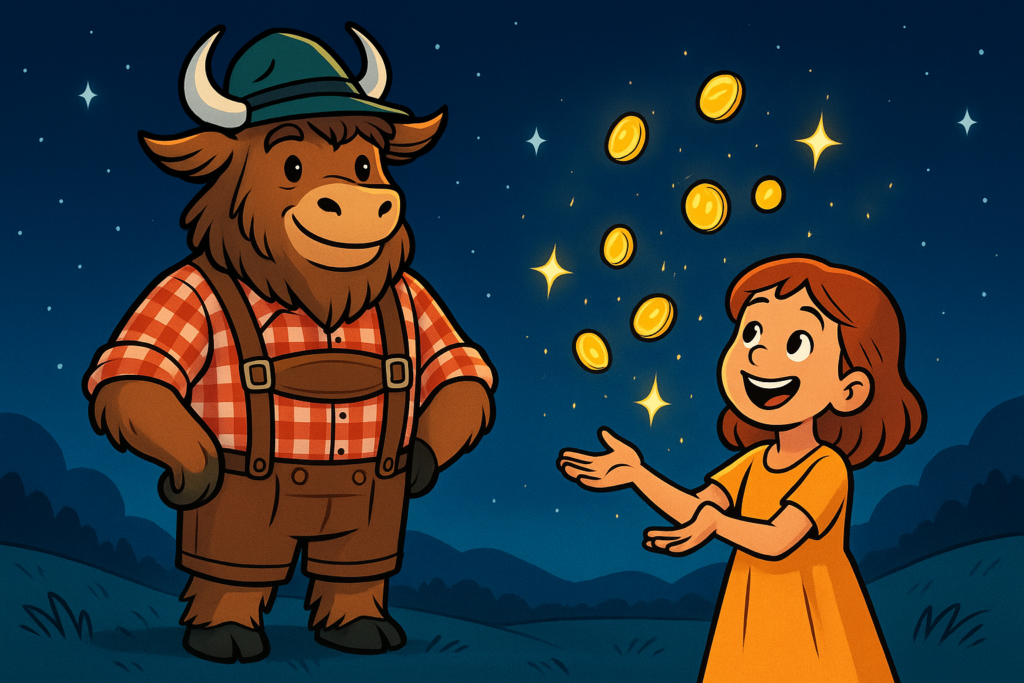
Suddenly stars fall from the sky. But they are not normal stars. They sparkle and turn into coins! The girl gathers the taler coins.
And then - oh wonder! - she is wearing a new, fine shirt and a beautiful dress. The girl is happy and never poor again.
Let's take a closer look at some of the key words you met in the tale. These simple nouns and adjectives will help you talk about everyday things like food and clothes.
Here are the most useful ones to remember.
- das Brot – bread
- die Mütze – cap or hat
- das Kleid – dress
- das Hemd – shirt
- der Stern – star
- das Geldstück – coin
- hungrig – hungry
- arm – poor
The story uses short, clear sentences when the girl gives things away. Notice how 'gibt ihm ihr Brot' means 'gives him her bread.' The word 'ihm' (to him) shows who receives, and 'ihr' means 'her'.
You can build similar phrases using these possessive words and polite requests.
- mein / meine – my (e.g., mein Brot, meine Mütze)
- dein / deine – your (e.g., Nimm dein Hemd)
- ihr / ihre – her (e.g., ihr Kleid)
- gibt – gives (from geben)
- Nimm! – Take! (from nehmen)
Now that you've met these words and patterns, try using them yourself. Retelling the story is a great way to make them stick – even if you just say a few lines out loud.
The kindness in the tale reminds us that language learning also grows when we share. Little by little, you'll collect your own 'star coins' of vocabulary!
- Tell the story to a friend in German, using simple sentences.
- Make up a short dialogue: 'Ich bin hungrig. – Nimm mein Brot!'
- Describe what you are wearing today: 'Ich trage ein Hemd.'
- Listen to the story again and shadow the phrases to improve your pronunciation.
Die Sterntaler comes from an older public-domain story tradition and is best known as a public_domain_fairy_tale_retelling. This Yak Yacker article is an original learner retelling based on public-domain source material, so the wording here is simplified for modern learners rather than copied from one old edition.
Older printings, translations, and retellings of this story can vary quite a bit. This version is adapted for A1 Beginner learners studying German.
If you want to keep going, browse more in our German section and review the Goethe A1 German Vocabulary. After that, try Essential German Grammar Words for another useful next step.