


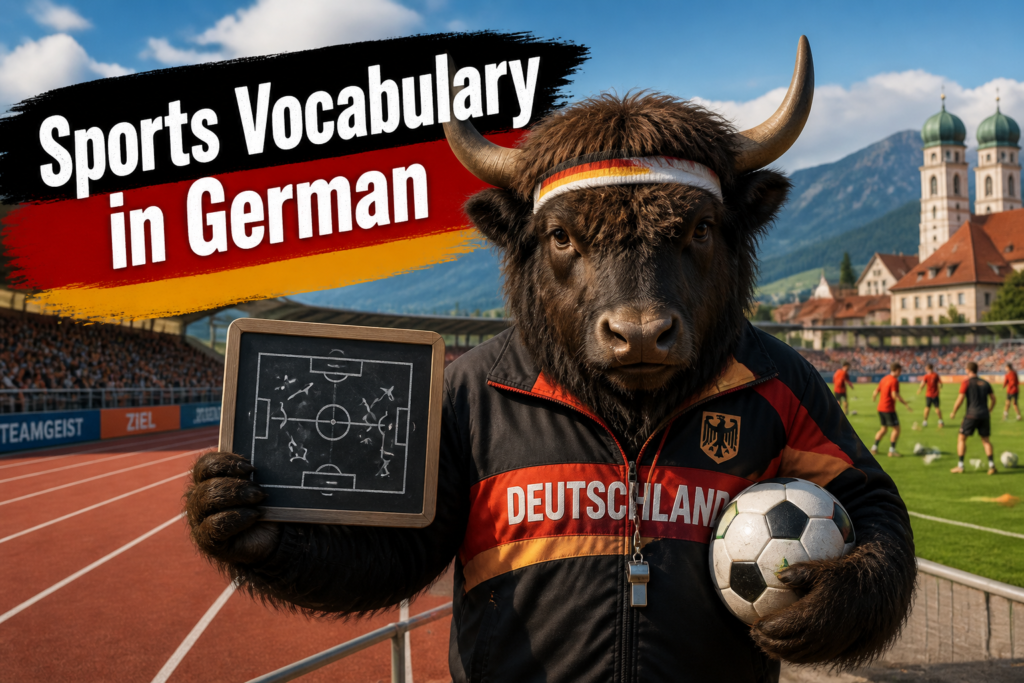
If you want to talk about football, the gym, jogging, or just “I am extremely unathletic but still here,” German has plenty of useful sports words. Some are borrowed from English, some are classic German, and some look friendly until they throw a case ending at your face. That is German being German.
This guide gives you practical sports vocabulary in standard German, with pronunciation help, meanings, example sentences, and little learner notes that save time later. By the end, you should be able to talk about sports, workouts, matches, and what you did at the weekend without sounding like a confused tourist at the stadium snack stand.
One quick cultural note: in Germany, Fußball is the big one, and people can get surprisingly serious about it. Not “slightly interested.” Serious-serious.
Core Sports Words You Will Actually Use
These are the everyday nouns and verbs that come up most often when people talk about sports, exercise, and watching games.
| German | Pronunciation | Meaning | Example Sentence | Translation | Learner Note |
|---|---|---|---|---|---|
| der Sport | shport | sport | Sport ist gut für die Gesundheit. | Sport is good for your health. | Masculine noun: der. |
| die Mannschaft | MAHN-shaft | team | Die Mannschaft hat gut gespielt. | The team played well. | Used a lot for team sports. |
| das Spiel | shpeel | game, match | Das Spiel beginnt um acht Uhr. | The game starts at eight o’clock. | Very common for sports matches and games. |
| das Tor | tohr | goal | Er hat ein Tor geschossen. | He scored a goal. | Classic football word. |
| gewinnen | geh-VIN-en | to win | Wir wollen heute gewinnen. | We want to win today. | Regular verb. |
| verlieren | fer-LEE-ren | to lose | Sie haben das Spiel verloren. | They lost the game. | Useful in sports and life. Unfortunately. |
| spielen | SHPEE-len | to play | Mein Bruder spielt Fußball. | My brother plays football. | Can mean play a sport or a game. |
| trainieren | trah-nee-REEN | to train, to work out | Ich trainiere dreimal pro Woche. | I train three times a week. | Very useful for fitness and sports teams. |
| laufen | LOW-fen | to run | Ich laufe jeden Morgen. | I run every morning. | Can also mean “to walk” in some contexts, but usually run here. |
| springen | SHPRING-en | to jump | Die Kinder springen ins Wasser. | The children jump into the water. | Useful for athletics and swimming contexts. |
| schwimmen | SHVIM-men | to swim | Im Sommer schwimmen wir oft. | In summer we swim often. | Double m is normal here. |
| fahren | FAH-ren | to ride, to drive | Er fährt gern Rennrad. | He likes riding a racing bike. | Often used with cycling sports. |
Common Sports And Games
Here are the sports people talk about most often in real life. Some words look obvious. Some do not. German enjoys keeping a few traps in the attic.
| German | Pronunciation | Meaning | Example Sentence | Translation | Learner Note |
|---|---|---|---|---|---|
| Fußball | FOOSS-bahl | football / soccer | Fußball ist in Deutschland sehr beliebt. | Football is very popular in Germany. | Standard German word in Germany. |
| Tennis | TEN-is | tennis | Sie spielt Tennis im Verein. | She plays tennis in a club. | Often used with spielen. |
| Laufen | LOW-fen | running | Laufen macht mir Spaß. | Running is fun for me. | Can also mean “to go” for machines or events. |
| Joggen | JOG-en | to jog | Am Wochenende gehe ich joggen. | On the weekend I go jogging. | Common borrowed verb in casual speech. |
| Radfahren | RAHT-fah-ren | cycling | Er fährt gern Fahrrad. | He likes cycling. | Also: Fahrrad fahren as two words. |
| Schwimmen | SHVIM-men | swimming | Schwimmen ist gut für den Rücken. | Swimming is good for your back. | Great with gehen: zum Schwimmen gehen. |
| Basketball | BAS-ket-bahl | basketball | Ich schaue oft Basketball. | I often watch basketball. | English-looking word, German pronunciation. |
| Volleyball | VOL-ley-bahl | volleyball | Volleyball spielt sie im Sommer. | She plays volleyball in summer. | Word order changes naturally in German. |
| Handball | HAHND-bahl | handball | Handball ist in Deutschland sehr populär. | Handball is very popular in Germany. | Very big sport in Germany. |
| Schwimmbad | SHVIM-baht | swimming pool | Wir treffen uns im Schwimmbad. | We’re meeting at the swimming pool. | Compound noun: schwimmen + Bad. |
| Turnen | TOOR-nen | gymnastics / to do gymnastics | Die Kinder turnen in der Schule. | The children do gymnastics at school. | Also a verb. Useful in school sports context. |
| Boxen | BOK-sen | boxing | Mein Freund macht Boxen. | My friend does boxing. | Also means “to box” as a sport. |
Useful Sports Phrases And Real-Life Sentences
These phrases help when talking before a game, after training, or while watching a match with friends. Because yes, sports conversations in German are often just people giving opinions with a scoreboard nearby.
| German | Pronunciation | Meaning | Example Sentence | Translation | Learner Note |
|---|---|---|---|---|---|
| Ich mache Sport. | ikh MAH-khe shport | I do sports / I exercise. | Ich mache Sport, weil ich mich danach besser fühle. | I exercise because I feel better afterward. | Very natural everyday phrase. |
| Ich gehe ins Fitnessstudio. | ikh GAY-eh ins FIT-nes-shtoo-dee-oh | I go to the gym. | Nach der Arbeit gehe ich ins Fitnessstudio. | After work I go to the gym. | ins = in das. |
| Wir haben gewonnen. | veer HAH-ben geh-VON-en | We won. | Wir haben 2:1 gewonnen. | We won 2–1. | Perfect tense is common in conversation. |
| Wir haben verloren. | veer HAH-ben fer-LOH-ren | We lost. | Leider haben wir verloren. | Unfortunately, we lost. | Leider is very useful for polite sadness. |
| Das Spiel war spannend. | das shpeel var SHPAN-nent | The game was exciting. | Das Spiel war spannend bis zum Schluss. | The game was exciting until the end. | spannend = exciting, not “spicy.” |
| Er hat ein Tor geschossen. | er hat ayn tohr geh-SHO-sen | He scored a goal. | In der 80. Minute hat er ein Tor geschossen. | In the 80th minute, he scored a goal. | Very common football phrase. |
| Ich bin außer Atem. | ikh bin OW-ser AH-tem | I am out of breath. | Nach dem Sprint war ich außer Atem. | After the sprint I was out of breath. | Great for workouts and running. |
| Mir tut alles weh. | meer toot AL-les vay | Everything hurts. | Nach dem Training tut mir alles weh. | After training, everything hurts. | Classic post-workout complaint. |
| Ich bin im Verein. | ikh bin im feh-RAIN | I am in a club. | Mein Sohn ist im Fußballverein. | My son is in a football club. | Verein is very common for organized sports. |
| Wann beginnt das Spiel? | van beh-GINT das shpeel | When does the game start? | Wann beginnt das Spiel heute Abend? | When does the game start this evening? | Question word order: verb first after the question word. |
| Wie steht es? | vee shtayt es | What’s the score? | Wie steht es gerade? | What’s the score right now? | Common at matches and on the phone. |
| Ich drücke dir die Daumen. | ikh DRUE-ke deer dee DOW-men | I’m keeping my fingers crossed for you. | Viel Glück morgen! Ich drücke dir die Daumen. | Good luck tomorrow! I’m keeping my fingers crossed for you. | Not literal. A nice friendly phrase. |
Sports Gear And Places
If you want to buy equipment, go to a venue, or understand what people are carrying around, these words help a lot.
| German | Pronunciation | Meaning | Example Sentence | Translation | Learner Note |
|---|---|---|---|---|---|
| der Ball | bahl | ball | Der Ball ist sehr leicht. | The ball is very light. | Common across many sports. |
| der Schläger | SCHLAY-ger | racket, bat, club | Der Schläger liegt auf dem Tisch. | The racket is on the table. | Can mean different sports equipment depending on context. |
| das Trikot | tree-KOH | jersey, sports shirt | Er trägt ein neues Trikot. | He is wearing a new jersey. | Often used for football shirts. |
| die Turnschuhe | TOORN-shoo-heh | sports shoes, sneakers | Ich brauche neue Turnschuhe. | I need new sneakers. | Plural only in everyday use. |
| das Stadion | SHTAH-dee-on | stadium | Viele Fans sind im Stadion. | Many fans are in the stadium. | Pronounce the st like sht. |
| die Halle | HAH-leh | hall, indoor sports hall | Das Training ist in der Halle. | The training is in the hall/gymnasium. | Often used for indoor sports. |
| das Feld | felt | field, pitch | Die Spieler sind auf dem Feld. | The players are on the field. | Useful for many team sports. |
| der Platz | plats | court, field, place | Wir spielen auf dem Platz hinter der Schule. | We play on the court behind the school. | Very flexible word. |
| die Umkleide | oom-KLY-deh | changing room | Die Umkleide ist links. | The changing room is on the left. | Often shortened from Umkleidekabine. |
| die Dusche | DOO-sheh | shower | Nach dem Training gehe ich duschen. | After training I go to shower. | Verb form: duschen. |
| das Laufband | LOWF-bahnt | treadmill | Ich laufe heute nur auf dem Laufband. | Today I’m only running on the treadmill. | Very handy gym word. |
| die Hantel | HAN-tel | dumbbell | Die Hanteln sind sehr schwer. | The dumbbells are very heavy. | Plural: die Hanteln. |
Watching Sports And Talking Like A Real Person
Watching a match is one thing. Commenting on it like a normal human is another. These phrases help you sound natural when reacting to what you see.
| German | Pronunciation | Meaning | Example Sentence | Translation | Learner Note |
|---|---|---|---|---|---|
| Das war knapp. | das var knup | That was close. | Das war knapp, aber gut gemacht. | That was close, but well done. | Very common in sports and everyday life. |
| Was für ein Spiel! | vas fyr ayn shpeel | What a game! | Was für ein Spiel! Das war verrückt. | What a game! That was crazy. | Great reaction phrase. |
| Der Schiedsrichter | sheets-rikh-ter | referee | Der Schiedsrichter hat gepfiffen. | The referee blew the whistle. | Long compound noun. German loves those. |
| die Mannschaft | MAHN-shaft | team | Die Mannschaft spielt sehr offensiv. | The team is playing very offensively. | Often used for national teams and club teams. |
| der Fan | fan | fan, supporter | Ich bin ein großer Fan von Tennis. | I’m a big fan of tennis. | Borrowed from English, but works normally in German. |
| das Ergebnis | air-GEB-nees | result, score | Das Ergebnis ist 3:0. | The result is 3–0. | Useful for scores and outcomes. |
| die Verlängerung | fer-LENG-er-oong | extra time | Das Spiel ging in die Verlängerung. | The game went into extra time. | Often in football and tournament sports. |
| das Finale | fee-NAH-leh | final | Sie steht im Finale. | She is in the final. | Also used outside sports. |
| der Rekord | reh-KORT | record | Er hat einen neuen Rekord aufgestellt. | He set a new record. | Common in athletics and competition. |
| die Niederlage | NEE-der-lah-guh | defeat, loss | Die Niederlage war bitter. | The defeat was bitter. | More formal than verlieren. |
| der Sieg | zeek | victory, win | Der Sieg war verdient. | The win was deserved. | Opposite of die Niederlage. |
| die Zuschauer | TSOO-shoo-er | spectators, viewers | Viele Zuschauer waren im Stadion. | Many spectators were in the stadium. | Can also mean TV viewers. |
Pronunciation Tips For Sports Words
Sports vocabulary often includes sounds that are easy to guess wrong. Luckily, a few patterns cover a lot of ground.
- Fußball: the ß is pronounced like s, so it sounds like “fooss-bahl.”
- Spiel: ie usually sounds like a long ee.
- Schwimmen: sch sounds like “sh,” not “sk.”
- Stadion: word-initial st often sounds like sht.
- Trainer: the r is usually softer than in English.
- z in words like Trainerlizenz or Platz sounds like ts.
- Final consonants are often devoiced, so Tag sounds more like “tahk.” That also shows up in some sports words.
- ä in words like Mädchen is not the same as English “a” in “cat.” It is closer to “e.”
For pronunciation help beyond this article, a boring but excellent place to check is Duden. Boring sources are often the most useful ones. Annoying, but true.
Useful Grammar Around Sports Words
Sports vocabulary often appears with the verbs spielen, machen, gehen, trainieren, and fahren. The article you use depends on the noun, and German absolutely loves making that someone else’s problem.
| Pattern | Meaning | German Example | English Translation | Learner Note |
|---|---|---|---|---|
| Sport machen | to exercise | Ich mache jeden Morgen Sport. | I exercise every morning. | Very common general phrase. |
| Fußball spielen | to play football | Meine Freunde spielen Fußball. | My friends play football. | Use spielen with many sports. |
| ins Fitnessstudio gehen | to go to the gym | Sie geht zweimal pro Woche ins Fitnessstudio. | She goes to the gym twice a week. | ins = in das. |
| nach dem Training | after training | Nach dem Training bin ich müde. | After training I am tired. | dem is dative after nach. |
| mit dem Ball | with the ball | Er läuft mit dem Ball zum Tor. | He runs with the ball toward the goal. | mit always takes dative. |
| auf dem Platz | on the field/court | Die Spieler sind auf dem Platz. | The players are on the field. | auf can take dative here because location. |
| ein Tor schießen | to score a goal | Er schießt ein Tor. | He scores a goal. | Very fixed football phrase. |
| einen Rekord brechen | to break a record | Sie hat den Rekord gebrochen. | She broke the record. | Accusative object: den Rekord. |
Quick case reminder: der is nominative, den is accusative, and dem is dative. In sports talk, you will see all three quite a bit. German likes to keep you awake.
Rule of thumb: use spielen for many games and team sports, machen for general exercise, and gehen for going somewhere to do a sport. Simple. Not easy, but simple.
Germany, Austria, And Switzerland: Small Differences
Most sports vocabulary is shared across German-speaking countries, but a few words vary by region.
| German | Region | Meaning | Example Sentence | Translation | Learner Note |
|---|---|---|---|---|---|
| das Fußballspiel | Germany / Austria / Switzerland | football match | Das Fußballspiel beginnt um 15 Uhr. | The football match starts at 3 p.m. | Neutral and widely understood. |
| der Match | Switzerland / Austria, sometimes informal | match | Der Match war spannend. | The match was exciting. | More regional than das Spiel. |
| das Training | Germany / Austria / Switzerland | training session | Heute ist kein Training. | There is no training today. | Very common across regions. |
| das Turnen | Germany / Austria / Switzerland | gymnastics | Turnen ist ein Schulfach. | Gymnastics is a school subject. | Often used in school or club contexts. |
| der Trainer | Germany / Austria / Switzerland | coach | Der Trainer ist sehr streng. | The coach is very strict. | Good general word everywhere. |
Mini Practice
Try these quickly. No need to write a full essay about hydration and team spirit. That would be overachieving.
- Translate: “I do sport three times a week.” → Ich mache dreimal pro Woche Sport.
- Translate: “The team won.” → Die Mannschaft hat gewonnen.
- Translate: “He scored a goal.” → Er hat ein Tor geschossen.
- Translate: “When does the game start?” → Wann beginnt das Spiel?
- Fill in the blank: Ich gehe ins _________. → Fitnessstudio
- Fill in the blank: Wir haben _________. → verloren
- Correct the sentence: Ich spiele Gymnastik. → Ich mache Gymnastik.
- Correct the sentence: Er hat einen Tor geschossen. → Er hat ein Tor geschossen.
- Say it in German: “I am out of breath.” → Ich bin außer Atem.
- Say it in German: “I’m keeping my fingers crossed for you.” → Ich drücke dir die Daumen.
Common Mistakes And Easy Fixes
- Wrong: Ich spiele Sport.
Better: Ich mache Sport.
Most of the time, Germans say “do sport,” not “play sport.” - Wrong: Ich gehe zu Fitnessstudio.
Better: Ich gehe ins Fitnessstudio.
ins is a contraction of in das. - Wrong: Er schoss ein Goal.
Better: Er hat ein Tor geschossen.
Tor is the normal word for a goal in football. - Wrong: Die Spiel beginnt.
Better: Das Spiel beginnt.
Spiel is neuter: das. - Wrong: Mit der Ball
Better: mit dem Ball
mit takes dative. - Wrong: Ich trainiere jeden Tag in die Halle.
Better: Ich trainiere jeden Tag in der Halle.
Location uses dative.
For another useful topic that pairs nicely with sports talk, see Health Vocabulary in German. Sports and health go together so often that separating them would be suspicious.
If you want a broader learning path, the main guide at Learn German is a good place to keep going. Also, the page at this related Yak Yacker guide can help you build more everyday vocabulary without wandering into grammar swamp territory.
Yak takeaway: if you can say Ich mache Sport, Ich gehe ins Fitnessstudio, and Wir haben gewonnen, you already have a solid sports conversation toolkit. Not bad for a language that makes every noun choose a gender before it even gets dressed.