


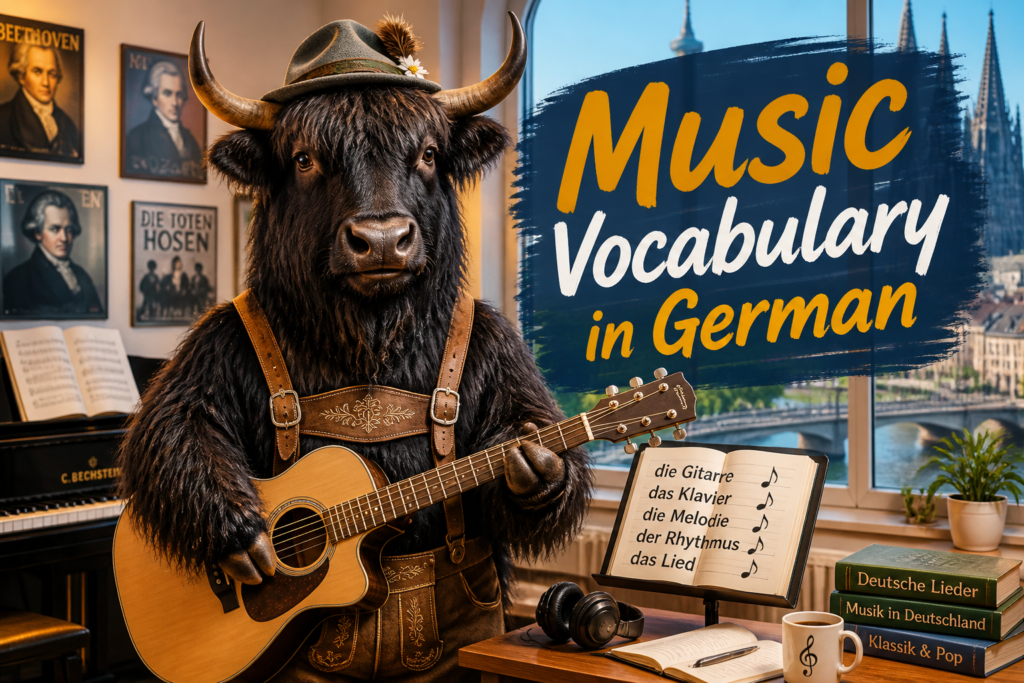
Music Vocabulary in German is one of those topics that looks small at first and then quietly turns into a whole universe. There is the concert, the song, the instrument, the beat, the lyrics, the rehearsal, the ticket, the encore, and suddenly your German needs a playlist.
The good news: German music words are practical, common, and usually easier than they look. If you can talk about what you listen to, what you play, and what you like, you can survive a surprising number of real-life conversations. Tiny miracle, honestly.
In this guide, you will learn useful German words and phrases for talking about music, from instruments and genres to concerts, singing, and practice. You will also get pronunciation help, example sentences, and learner notes so the words actually stick instead of floating away like a badly tuned flute.
For a boring-but-useful reference, the Duden is always there waiting in the wings like a very serious stage manager.
Core Music Words
These are the main words you will see and hear again and again. Learn these first, and you already have a solid foundation.
| German | Pronunciation | Meaning | Example Sentence | Translation | Learner Note |
|---|---|---|---|---|---|
| die Musik | moo-ZEEK | music | Ich liebe Musik. | I love music. | Feminine noun: die Musik. |
| das Lied | leet | song | Das Lied ist sehr schön. | The song is very beautiful. | Neutral noun: das Lied. Plural: die Lieder. |
| der Song | song | song, track | Der Song ist im Radio. | The song is on the radio. | Borrowed word, very common in casual German. |
| das Musikstück | moo-ZEEK-shtook | piece of music | Das Musikstück dauert fünf Minuten. | The piece of music lasts five minutes. | Useful for classical music or formal contexts. |
| der Klang | klahng | sound, tone, timbre | Der Klang ist warm und weich. | The sound is warm and soft. | Often used for instruments and audio quality. |
People, Roles, and Places
| German | Pronunciation | Meaning | Example Sentence | Translation | Learner Note |
|---|---|---|---|---|---|
| der Musiker / die Musikerin | MOO-zi-ker / moo-zee-KEH-rin | musician | Mein Bruder ist Musiker. | My brother is a musician. | Gendered forms are common in German. |
| der Sänger / die Sängerin | ZENG-er / ZENG-er-in | singer | Die Sängerin hat eine starke Stimme. | The singer has a strong voice. | ä often sounds like English “eh” in many beginner-friendly pronunciations. |
| der Gitarrist / die Gitarristin | gi-ta-RIST / gi-ta-RIS-tin | guitarist | Der Gitarrist spielt ein Solo. | The guitarist is playing a solo. | Common ending: -ist for many roles. |
| der Pianist / die Pianistin | pee-ah-NIST / pee-ah-NIS-tin | pianist | Die Pianistin probt heute. | The pianist is rehearsing today. | proben means to rehearse. |
| der Dirigent / die Dirigentin | dee-ree-GENT / dee-ree-gen-TIN | conductor | Der Dirigent gibt das Tempo an. | The conductor sets the tempo. | Common in orchestral settings. |
| die Band | bent | band | Die Band spielt heute Abend live. | The band is playing live tonight. | Very natural in modern German. |
| das Orchester | or-KES-ter | orchestra | Das Orchester klingt großartig. | The orchestra sounds fantastic. | Neutral noun: das Orchester. |
Instruments You Will Actually Hear About
| German | Pronunciation | Meaning | Example Sentence | Translation | Learner Note |
|---|---|---|---|---|---|
| die Gitarre | gi-TAR-uh | guitar | Ich spiele Gitarre. | I play guitar. | Say Gitarre spielen for “to play guitar.” |
| das Klavier | klah-VEER | piano | Sie spielt Klavier. | She plays piano. | No article in the phrase when talking generally is also common: Klavier spielen. |
| die Geige | GIE-guh | violin | Die Geige ist sehr schwierig. | The violin is very difficult. | Watch the soft g sound. |
| das Schlagzeug | SCHLAHK-tsook | drums, drum kit | Er spielt Schlagzeug in einer Band. | He plays drums in a band. | Compound noun: schlagen + Zeug. |
| die Flöte | FLUR-tuh | flute | Meine Tochter lernt Flöte. | My daughter is learning flute. | The ö sound is rounded, like “ur” with lips rounded. |
| das Cello | CHEL-oh | cello | Das Cello klingt tief und warm. | The cello sounds deep and warm. | Borrowed word; pronunciation is close to English. |
| die Trompete | trom-PAY-tuh | trumpet | Die Trompete ist sehr laut. | The trumpet is very loud. | Good word for brass instruments in general. |
| die Trommel | TROM-mel | drum | Die Trommel gibt den Rhythmus. | The drum gives the rhythm. | Simple and useful in many contexts. |
| das Mikrofon | MEE-kroh-fohn | microphone | Das Mikrofon funktioniert nicht. | The microphone is not working. | Handy at concerts, podcasts, and rehearsals. |
| der Lautsprecher | LOWT-shpreh-ker | speaker | Der Lautsprecher ist zu leise. | The speaker is too quiet. | Useful for sound systems and technology. |
Genres And Styles
German genre words are usually straightforward. Some are borrowed from English, some are not, and some look like they should behave politely but absolutely refuse to do so.
| German | Pronunciation | Meaning | Example Sentence | Translation | Learner Note |
|---|---|---|---|---|---|
| die klassische Musik | KLAS-si-she moo-ZEEK | classical music | Ich höre gern klassische Musik. | I like listening to classical music. | Adjective ending changes with the noun phrase. |
| der Pop | pop | pop music | Pop ist im Radio sehr beliebt. | Pop is very popular on the radio. | Common and simple. |
| der Rock | rok | rock music | Er hört Rock und Metal. | He listens to rock and metal. | Pronounced like English “rock” but shorter. |
| der Jazz | jets | jazz | Jazz klingt oft sehr entspannt. | Jazz often sounds very relaxed. | The final s sounds like ts in many German words. |
| der Hip-Hop | hip-hop | hip-hop | Hip-Hop ist bei vielen Jugendlichen beliebt. | Hip-hop is popular with many young people. | Hyphenated loanword, very normal. |
| die elektronische Musik | eh-lek-TROH-ni-she moo-ZEEK | electronic music | Elektronische Musik läuft oft im Club. | Electronic music often plays in the club. | Useful in modern music contexts. |
| der Schlager | SCHLAH-ger | German pop song / catchy easy-listening song | Meine Oma hört gern Schlager. | My grandma likes Schlager. | Very German cultural word; often associated with older audiences. |
| die Volksmusik | FOLKS-moo-zeek | folk music | Volksmusik ist nicht mein Stil. | Folk music is not my style. | Can mean traditional music. |
| der Metal | MET-tl | metal | Metal ist laut, schnell und intensiv. | Metal is loud, fast, and intense. | Borrowed word; used naturally in German. |
| die Rap-Musik | rap-moo-ZEEK | rap music | Rap-Musik höre ich beim Sport. | I listen to rap music when I work out. | Compound with a hyphen is common. |
Verbs For Music
Music vocabulary gets much easier when you know the verbs people actually use. In German, you do not just “play music” in one fixed way. You sing, play, listen, practice, perform, and sometimes complain that the sound check is too late. Very artsy.
| German | Pronunciation | Meaning | Example Sentence | Translation | Learner Note |
|---|---|---|---|---|---|
| spielen | SHPLEE-len | to play | Ich spiele Gitarre. | I play guitar. | Use with instruments and games. |
| singen | ZING-en | to sing | Sie singt im Chor. | She sings in a choir. | Strong verb: singt in the present tense. |
| hören | HUH-ren | to hear, to listen to | Ich höre jeden Tag Musik. | I listen to music every day. | Usually Musik hören, Radio hören. |
| anhören | AHN-huh-ren | to listen to, to give a listen | Hör dir das Lied mal an. | Give the song a listen. | Separable verb: an … hören in sentence order. |
| proben | PROH-ben | to rehearse, to practice | Die Band probt heute Abend. | The band is rehearsing tonight. | Common for groups and musicians. |
| üben | OO-ben | to practice, to rehearse | Ich übe jeden Tag zehn Minuten. | I practice for ten minutes every day. | Very common for instruments and skills. |
| komponieren | kom-pon-EE-ren | to compose | Er komponiert eigene Musik. | He composes his own music. | More formal, often for serious music. |
| aufführen | OWF-fyuh-ren | to perform, to stage | Das Orchester führt das Stück auf. | The orchestra performs the piece. | Separable verb: auf … führen. |
| auftreten | OWF-treh-ten | to perform, to appear on stage | Die Sängerin tritt heute auf. | The singer is performing today. | Very useful for live music. |
| aufnehmen | OWF-neh-men | to record | Wir nehmen den Song morgen auf. | We will record the song tomorrow. | Separable verb: auf … nehmen. |
| mitsingen | MIT-zing-en | to sing along | Das Publikum singt mit. | The audience sings along. | Very common at concerts. |
| klatschen | KLAHT-shen | to clap | Alle klatschen nach dem Lied. | Everyone claps after the song. | Final -sch is a “sh” sound. |
Concerts, Shows, And Music Events
These words are useful if you go to a concert, festival, club, rehearsal, or music school. Also useful if you want to sound like a normal human being and not a tired dictionary.
| German | Pronunciation | Meaning | Example Sentence | Translation | Learner Note |
|---|---|---|---|---|---|
| das Konzert | kon-TSERT | concert | Wir gehen heute Abend ins Konzert. | We are going to the concert tonight. | Use ins Konzert for “to the concert.” |
| das Festival | FES-ti-val | festival | Das Festival dauert drei Tage. | The festival lasts three days. | Borrowed word, very common. |
| die Bühne | BOO-nuh | stage | Die Band kommt auf die Bühne. | The band comes on stage. | Good word for live events. |
| das Publikum | POO-blee-kum | audience | Das Publikum ist begeistert. | The audience is thrilled. | Neutral collective noun. |
| die Zugabe | TSOO-gah-buh | encore | Das Publikum ruft nach einer Zugabe. | The audience calls for an encore. | Useful at concerts and theater. |
| die Eintrittskarte | EIN-tritts-kar-tuh | ticket, admission ticket | Ich habe die Eintrittskarte online gekauft. | I bought the ticket online. | Compound noun; often just das Ticket in everyday speech. |
| die Karte | KAR-tuh | ticket, card | Hast du noch eine Karte? | Do you still have a ticket? | Context decides meaning. |
| der Soundcheck | SAWNT-chek | sound check | Der Soundcheck beginnt um fünf. | The sound check starts at five. | Very common backstage word. |
| die Probe | PROH-buh | rehearsal | Die Probe dauert zwei Stunden. | The rehearsal lasts two hours. | Also used for many other kinds of rehearsals. |
| der Auftritt | OWF-tritt | performance, appearance | Der Auftritt war großartig. | The performance was fantastic. | Very useful in reviews and event talk. |
| das Live-Konzert | lahyv-kon-TSERT | live concert | Wir lieben Live-Konzerte. | We love live concerts. | Often written with a hyphen. |
Words For Sound, Rhythm, And Style
These are the words that help you describe what music sounds like. You do not need to be a critic. You just need enough vocabulary to say, “This sounds good,” or, “This bass is doing something strange.”
| German | Pronunciation | Meaning | Example Sentence | Translation | Learner Note |
|---|---|---|---|---|---|
| der Rhythmus | RITH-muss | rhythm | Der Rhythmus ist sehr eingängig. | The rhythm is very catchy. | Note the y-like sound in the first syllable. |
| der Beat | beet | beat | Der Beat ist schnell. | The beat is fast. | Common in pop and dance music. |
| die Melodie | meh-lo-DEE | melody | Die Melodie bleibt im Kopf. | The melody stays in your head. | Beautiful and very useful word. |
| der Text | tekst | lyrics, text | Der Text ist sehr poetisch. | The lyrics are very poetic. | For song lyrics, Text is common. |
| die Stimme | SHTIM-uh | voice | Ihre Stimme ist sehr klar. | Her voice is very clear. | Can also mean “vote” in other contexts. |
| laut | lowt | loud | Die Musik ist zu laut. | The music is too loud. | Antonym: leise. |
| leise | LY-suh | quiet, soft | Bitte spiel leiser. | Please play more quietly. | Comparative: leiser. |
| schnell | shnel | fast | Das Stück ist sehr schnell. | The piece is very fast. | Watch the sch sound: “sh.” |
| langsam | LANG-zahm | slow | Das Lied ist langsam und ruhig. | The song is slow and calm. | Great for describing tempo. |
| fröhlich | FRUH-lich | cheerful | Das Lied klingt fröhlich. | The song sounds cheerful. | Useful for mood and tone. |
| traurig | TROW-rikh | sad | Der Song ist eher traurig. | The song is rather sad. | Common emotion word for music reviews. |
| eingängig | EIN-geng-ikh | catchy | Der Refrain ist sehr eingängig. | The chorus is very catchy. | Very useful for songs people remember. |
Useful Phrases For Real Life
These are the kinds of things people actually say when talking about music. Keep them handy. They will save you from the classic “I know the word for piano but not the sentence” trap.
| German | Pronunciation | Meaning | Example Sentence | Translation | Learner Note |
|---|---|---|---|---|---|
| Musik hören | moo-ZEEK HUH-ren | to listen to music | Ich höre abends gern Musik. | I like listening to music in the evening. | Very common everyday phrase. |
| ein Instrument spielen | ine in-stroo-MENT SHPLEE-len | to play an instrument | Spielst du ein Instrument? | Do you play an instrument? | Good conversation starter. |
| ein Lied singen | ine leet ZING-en | to sing a song | Die Kinder singen ein Lied. | The children sing a song. | Simple and flexible. |
| laut / leise stellen | lowt / LY-suh SHTEL-len | to turn up / down | Kannst du die Musik leiser stellen? | Can you turn the music down? | Very practical at home or in a car. |
| live auftreten | lahyv OWF-treh-ten | to perform live | Die Band tritt heute live auf. | The band is performing live today. | Word order matters: separable verb. |
| den Takt halten | dehn takt HAL-ten | to keep the beat | Ich kann den Takt noch nicht halten. | I still can’t keep the beat. | Useful for beginners in music lessons. |
| auswendig lernen | OWS-ven-dikh LEHR-nen | to learn by heart | Wir müssen den Text auswendig lernen. | We have to memorize the lyrics. | Common for lyrics, poems, and exams. |
| ein Solo spielen | ine SOH-lo SHPLEE-len | to play a solo | Der Gitarrist spielt ein Solo. | The guitarist plays a solo. | Great for rock, jazz, and classical contexts. |
| im Chor singen | im kor ZING-en | to sing in a choir | Sie singt im Chor an der Uni. | She sings in a choir at university. | Chor is masculine: der Chor. |
| das Publikum begeistert | das POO-blee-kum beh-GUY-stert | to delight the audience | Der Auftritt begeistert das Publikum. | The performance delights the audience. | Useful in reviews and descriptions. |
| sehr bekannt sein | zehr beh-KANT zayn | to be very well known | Der Song ist sehr bekannt. | The song is very well known. | Simple but useful when naming artists and hits. |
Short Vocabulary Set For Music Lovers
This set mixes words you will hear in everyday talk with words you will hear in lessons, concerts, or playlists. A little bit of everything. Like a decent shuffle mode, but with less chaos.
| German | Pronunciation | Meaning | Example Sentence | Translation | Learner Note |
|---|---|---|---|---|---|
| die Playlist | PLAY-list | playlist | Ich habe eine neue Playlist erstellt. | I created a new playlist. | Very modern everyday word. |
| das Album | AL-bum | album | Das neue Album ist gut. | The new album is good. | Same word as English, same vibe. |
| die Single | SING-guhl | single | Die Single kam letzte Woche heraus. | The single came out last week. | Common in the music industry. |
| der Refrain | reh-FRAIN | chorus, refrain | Der Refrain ist leicht zu merken. | The chorus is easy to remember. | Very useful for describing songs. |
| die Strophe | SHTROH-fuh | verse | Die erste Strophe ist besonders stark. | The first verse is especially strong. | Often used in lyrics analysis. |
| der Songtext | song-tekst | lyrics | Ich kenne den Songtext fast auswendig. | I know the lyrics almost by heart. | More specific than Text. |
| der Ton | tohn | note, tone, sound | Der Ton ist zu hoch. | The note is too high. | Also means “tone” in general. |
| die Tonart | TOHN-art | key | Das Lied ist in einer anderen Tonart. | The song is in a different key. | Useful for musicians and students. |
| der Akkord | ah-KORT | chord | Ich kenne diesen Akkord noch nicht. | I don’t know this chord yet. | Good for guitar and piano talk. |
| die Note | NOH-tuh | musical note | Die Note ist zu hoch geschrieben. | The note is written too high. | Not the same as school grades, though the spelling is identical. |
| das Konzertticket | kon-TSERT-ti-ket | concert ticket | Ich brauche noch ein Konzertticket. | I still need a concert ticket. | Longer but very clear. |
| der Fan | fan | fan | Ich bin ein großer Fan von der Band. | I am a big fan of the band. | With von after the noun in normal speech. |
Pronunciation Notes That Help A Lot
Music words are friendly, but German pronunciation still likes to keep people humble. Here are a few sound patterns that show up in this topic a lot.
| Sound | Example | How To Think About It | Learner Note |
|---|---|---|---|
| ch | ich, Musik no, nicht | Two main sounds: soft “hiss” after front vowels, harder after back vowels. | Do not replace it with English “k.” |
| r | Rock, Rhythmus | Often softer than English. It may sound more throat-like or reduced at the end. | Do not roll it dramatically unless you want stage drama. |
| z | Zugabe, Jazz | Sounds like “ts.” | Very common in music words. |
| sch | Schlagzeug, Strophe no, schön | Sounds like English “sh.” | Clean and easy once you notice it. |
| sp, st | spielen, Stimme | At the beginning of a word, often like “shp” and “sht.” | Common in German and very noticeable. |
| ä, ö, ü | Sängerin, Flöte, Musikstück | Rounded or fronted vowels that English does not have exactly. | Do not ignore the umlaut; it changes meaning and pronunciation. |
Germany, Austria, And Switzerland Notes
Most of the words above work across German-speaking countries. Still, a few differences are worth knowing so you do not get gently confused in public.
| Situation | Germany | Austria | Switzerland | Note |
|---|---|---|---|---|
| Musical event | das Konzert | das Konzert | das Konzert | Same word everywhere. Rare moment of peace. |
| ticket | die Karte / das Ticket | die Karte / das Ticket | die Karte / das Billett in some contexts | Billett is more Swiss; Ticket is widely understood. |
| singalong / audience sings | mitsingen | mitsingen | mitsingen | Standard and common. |
| concert hall / venue | die Halle, der Saal | die Halle, der Saal | der Saal, die Halle | Regional preferences vary, but these are all useful. |
Mini Practice
Try these quick exercises. Small practice beats heroic intentions. Every time.
- Fill in the blank: Ich ___ Gitarre. → spiele
- Fill in the blank: Die ___ ist sehr schön. → Melodie
- Fill in the blank: Wir gehen ins ___. → Konzert
- Translate: “The singer is performing live.” → Die Sängerin tritt live auf.
- Translate: “Can you turn the music down?” → Kannst du die Musik leiser stellen?
- Rewrite with a separable verb: Wir hören den Song an.
- Answer in German: Spielst du ein Instrument? → Ja, ich spiele Klavier. / Nein, leider nicht.
- Spot the article: der Rhythmus, die Gitarre, das Lied
- Choose the better word: a song you remember easily = eingängig
- Choose the better word: a group practice session = Probe or Proben depending on the sentence
Common Mistakes And Easy Fixes
- “Ich höre Musik” is correct. Do not add extra words unless you need them.
- “Ich spiele auf Gitarre” is wrong in standard German. Say Ich spiele Gitarre.
- “Ich höre das Musik” is wrong because Musik is feminine: die Musik.
- “Die Sänger spielt” is wrong. Use the correct gender: der Sänger / die Sängerin.
- “Das Lied ist eingängig” is fine. eingängig is the adjective you want for catchy music.
- “Der Musik” is wrong in standard German. The noun is die Musik.
- “Ich spiele ein Gitarre” is wrong. Use no article for general instrument playing: Ich spiele Gitarre.
- “Die Band tritt auf heute” sounds wrong. In German, separable verbs usually split: Die Band tritt heute auf.
Yak wisdom: If you can talk about the song, the beat, and the concert, you are already doing real German. Fancy vocabulary can wait until the encore.
For more German learning, the main hub at Learn German is a useful place to keep building your vocabulary. And if you want another practical lesson, this related guide at Yak Yacker lesson is worth a look too.
Yak takeaway: In German, music vocabulary is a mix of everyday words, helpful verbs, and a few sounds that love to show off. Learn the basics first, keep the phrases practical, and soon enough you will be talking about songs, concerts, and instruments without sounding like you swallowed a textbook.