You can survive a lot in French with bonjour, merci, and a brave smile. But when you really need a bathroom, bravery stops being charming very quickly.
The good news: French gives you a few very useful, very normal ways to ask where the toilet is. The even better news: most of them are easy to remember, and people hear them all the time in cafés, stations, museums, and restaurants.
In this guide, you’ll learn the most natural ways to say “Where is the toilet?” in French, plus other bathroom lifesavers like “I need toilet paper,” “Is there soap?” and “I need to wash my hands.” Because language learning is fun, but also, occasionally, urgent.
If you want more French basics after this, the main Learn French hub is a good next stop.
The Main Phrase You Need
| French | Pronunciation | Meaning | Example Sentence | Translation | Learner Note |
|---|---|---|---|---|---|
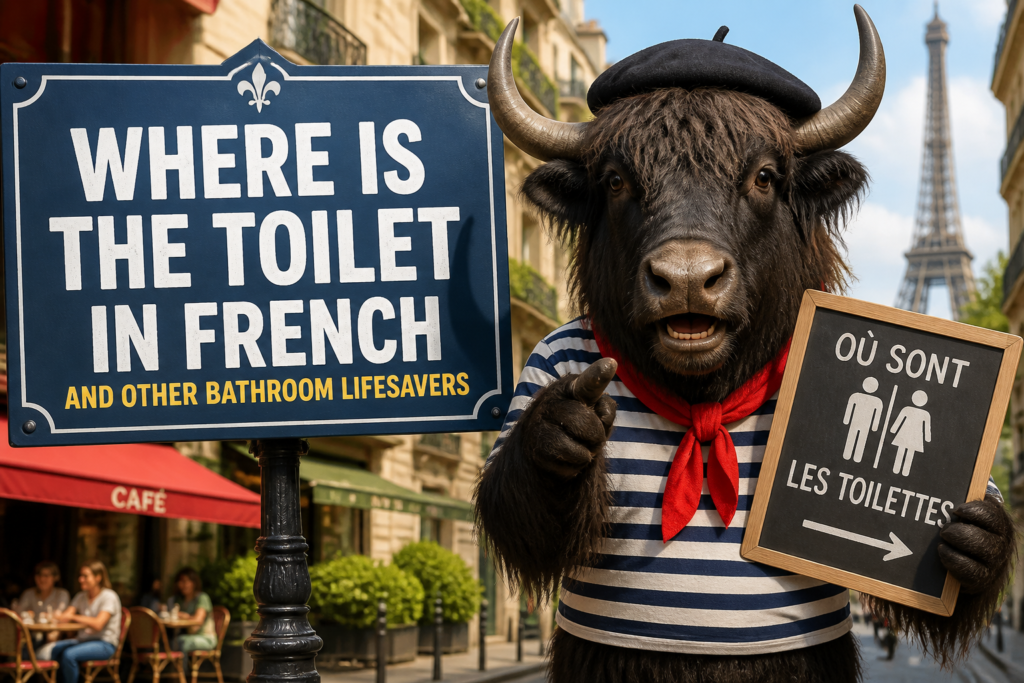
| Où sont les toilettes ? | oo soh(n) lay twah-LET | Where are the toilets? | Excusez-moi, où sont les toilettes, s’il vous plaît ? | Excuse me, where are the toilets, please? | The most common and safest phrase. In French, people often say “the toilets” rather than “the toilet.” |
| Où sont les WC ? | oo soh(n) lay vay-say | Where are the toilets / restroom? | Pardon, où sont les WC ? | Sorry, where are the toilets? | WC is very common on signs. People pronounce the letters in French: vay-say. |
| Il y a des toilettes ? | eel ee ah day twah-LET | Are there toilets? | Bonjour, il y a des toilettes ici ? | Hello, are there toilets here? | A little less direct. Useful in shops, small places, or public spaces. |
If you remember only one phrase, make it Où sont les toilettes ? It sounds natural, polite enough in most situations, and nobody will blink.
Yak Wisdom: In French, asking for les toilettes is much more natural than translating English word-for-word and hunting for “the bathroom.”
Polite Versions That Sound Better Fast
Technically, you can just say Où sont les toilettes ? But adding a tiny polite phrase makes you sound much nicer, especially in France, where greetings matter. A lot.
| French | Pronunciation | Meaning | Example Sentence | Translation | Learner Note |
|---|---|---|---|---|---|
| Excusez-moi, où sont les toilettes ? | ex-kew-zay mwah, oo soh(n) lay twah-LET | Excuse me, where are the toilets? | Excusez-moi, où sont les toilettes ? | Excuse me, where are the toilets? | Very standard and polite. Great for strangers. |
| Pardon, où sont les toilettes ? | par-DO(n), oo soh(n) lay twah-LET | Sorry, where are the toilets? | Pardon, où sont les toilettes, s’il vous plaît ? | Sorry, where are the toilets, please? | Pardon is short and useful when you are stopping someone quickly. |
| Bonjour, où sont les toilettes, s’il vous plaît ? | bohn-ZHOOR, oo soh(n) lay twah-LET, seel voo play | Hello, where are the toilets, please? | Bonjour, où sont les toilettes, s’il vous plaît ? | Hello, where are the toilets, please? | Excellent in cafés, restaurants, hotels, and shops. Starting with bonjour is never a bad idea. |
| Est-ce qu’il y a des toilettes ? | ess-keel ee ah day twah-LET | Is there a restroom? | Est-ce qu’il y a des toilettes dans le train ? | Is there a restroom on the train? | Useful when you are not sure toilets exist in the place at all. |
Toilettes, WC, Salle De Bains, Or Bathroom?
This is where English speakers often get tripped up. French does not map perfectly onto English bathroom words.
| French Term | Pronunciation | Meaning | Example Sentence | Translation | Learner Note |
|---|---|---|---|---|---|
| les toilettes | lay twah-LET | the toilet / restroom / toilets | Les toilettes sont au fond à gauche. | The toilets are at the back on the left. | The most useful public word. |
| les WC | lay vay-SAY | the restroom / toilet | Les WC sont au premier étage. | The restroom is on the first floor. | Very common on signs and in speech. |
| la salle de bains | lah sal duh ba(n) | bathroom | La salle de bains est à côté de la chambre. | The bathroom is next to the bedroom. | Usually the room with a bath or shower at home, not the best public-restroom word. |
| la salle d’eau | lah sal doh | shower room / washroom | L’appartement a une petite salle d’eau. | The apartment has a small shower room. | Common in property descriptions and homes. |
So if you are in a restaurant and need a restroom, say les toilettes or les WC. If you ask for la salle de bains, people will understand eventually, but it sounds a bit like you’re hoping to move in.
Useful Phrases For Real Bathroom Emergencies
Here are the phrases that become surprisingly important the second something goes wrong.
| French | Pronunciation | Meaning | Example Sentence | Translation | Learner Note |
|---|---|---|---|---|---|
| J’ai besoin d’aller aux toilettes. | zhay buh-ZWA(n) dah-LAY oh twah-LET | I need to go to the toilet. | Désolé, j’ai besoin d’aller aux toilettes. | Sorry, I need to go to the toilet. | Very natural. Note the contraction: à les becomes aux. |
| Je peux utiliser les toilettes ? | zhuh puh oo-tee-lee-ZAY lay twah-LET | Can I use the restroom? | Bonjour, je peux utiliser les toilettes ? | Hello, can I use the restroom? | Good in cafés or shops if you want permission. |
| Les toilettes sont occupées ? | lay twah-LET soh(n)t oh-kew-PAY | Are the toilets occupied? | Pardon, les toilettes sont occupées ? | Sorry, are the toilets occupied? | Helpful when waiting outside and trying not to look dramatic. |
| Il y a du papier toilette ? | eel ee ah dew pah-PYAY twah-LET | Is there toilet paper? | Excusez-moi, il y a du papier toilette ? | Excuse me, is there toilet paper? | Du means “some.” Very common with uncountable stuff. |
| Il n’y a plus de papier toilette. | eel nee ah plew duh pah-PYAY twah-LET | There’s no more toilet paper. | Excusez-moi, il n’y a plus de papier toilette. | Excuse me, there’s no more toilet paper. | Ne…plus means “no more / no longer.” |
| Il n’y a pas de savon. | eel nee ah pah duh sa-VO(n) | There is no soap. | Dans les toilettes, il n’y a pas de savon. | In the restroom, there is no soap. | Simple and useful complaint. Sadly timeless. |
| Je dois me laver les mains. | zhuh dwah muh lah-VAY lay ma(n) | I need to wash my hands. | Attendez, je dois me laver les mains. | Wait, I need to wash my hands. | Literally “I must wash myself the hands.” French often uses a reflexive verb plus body part article. |
| Le robinet ne marche pas. | luh roh-bee-NAY nuh marsh pah | The tap doesn’t work. | Excusez-moi, le robinet ne marche pas. | Excuse me, the tap doesn’t work. | Ne…pas is the standard negation. |
| La chasse d’eau ne marche pas. | lah shass doh nuh marsh pah | The toilet won’t flush. | Pardon, la chasse d’eau ne marche pas. | Sorry, the toilet won’t flush. | La chasse d’eau is the flush mechanism. |
| La porte est bloquée. | lah port eh bloh-KAY | The door is stuck. | Excusez-moi, la porte est bloquée. | Excuse me, the door is stuck. | Useful and mildly alarming. |
| Il faut un code ? | eel foh uh(n) kohd | Do you need a code? | Pour les toilettes, il faut un code ? | For the restroom, do you need a code? | Very useful in stations, cafés, and fast-food places. |
| Le code des toilettes, s’il vous plaît ? | luh kohd day twah-LET, seel voo play | The restroom code, please? | Bonjour, le code des toilettes, s’il vous plaît ? | Hello, the restroom code, please? | Short, polite, efficient. |
How To Understand The Answer
Asking is only half the battle. Then comes the answer, usually delivered at full local speed with pointing.
| French | Pronunciation | Meaning | Example Sentence | Translation | Learner Note |
|---|---|---|---|---|---|
| à gauche | ah gosh | on the left | Les toilettes sont à gauche. | The toilets are on the left. | Very common direction phrase. |
| à droite | ah drwaht | on the right | C’est à droite après la caisse. | It’s on the right after the checkout. | C’est means “it is.” |
| au fond | oh fo(n) | at the back | Les toilettes sont au fond. | The toilets are at the back. | À le becomes au. |
| en bas | ah(n) bah | downstairs / below | Les toilettes sont en bas. | The toilets are downstairs. | Very handy in cafés and stations. |
| en haut | ah(n) oh | upstairs / above | Les WC sont en haut. | The restroom is upstairs. | Short and common. |
| au premier étage | oh pruh-MYAY ay-TAZH | on the first floor | Les toilettes sont au premier étage. | The toilets are on the first floor. | In France, rez-de-chaussée is ground floor, so premier étage is the floor above that. |
| au rez-de-chaussée | oh ray-duh-shoh-SAY | on the ground floor | Les WC sont au rez-de-chaussée. | The restroom is on the ground floor. | Very useful in public buildings. |
| c’est là-bas | say lah-BAH | it’s over there | Les toilettes ? C’est là-bas. | The toilets? They’re over there. | Usually accompanied by a vague wave of the hand. Excellent luck. |
Mini Grammar That Actually Helps
You do not need a giant grammar lecture in the middle of a bathroom emergency, so here are the bits that matter.
Why Is It Où Sont Les Toilettes?
Où means “where.”
Sont means “are.” It comes from the verb être, “to be.”
Les toilettes is grammatically plural: “the toilets.” That is why French uses sont and not est.
So:
- Où est la gare ? = Where is the station?
- Où sont les toilettes ? = Where are the toilets?
Why Is It Aux Toilettes?
French contracts à + les into aux.
- aller à les toilettes → wrong
- aller aux toilettes → correct
That is why you say:
- Je vais aux toilettes. = I’m going to the toilet.
- J’ai besoin d’aller aux toilettes. = I need to go to the toilet.
A Quick Pronunciation Note
In Où sont les toilettes ?, the final s in les usually links to the vowel at the start of toilettes. You may hear something like lay-z-toilettes. This is called liaison, but you do not need to say the fancy grammar word out loud to benefit from it.
Also, the t at the end of sont is normally silent.
Common Mistakes English Speakers Make
| Mistake | Better French | Why | Example |
|---|---|---|---|
| Où est la toilette ? | Où sont les toilettes ? | French usually uses the plural form for public toilets/restrooms. | Où sont les toilettes, s’il vous plaît ? |
| Je vais à les toilettes. | Je vais aux toilettes. | À + les contracts to aux. | Je reviens, je vais aux toilettes. |
| Où est la salle de bains ? in a café | Où sont les toilettes ? | Salle de bains means bathroom in a home sense, not usually the public restroom word. | Bonjour, où sont les toilettes ? |
| Toilette for “toilet paper” | papier toilette | You need the full expression. | Il n’y a plus de papier toilette. |
| Skipping bonjour with staff | Start with Bonjour | In France, greeting first sounds much more polite. | Bonjour, je peux utiliser les toilettes ? |
Quick Situation Phrases
These are short, realistic lines you can actually use without mentally writing a dissertation first.
| Situation | French | Meaning | Learner Note |
|---|---|---|---|
| In a café | Bonjour, je peux utiliser les toilettes ? | Hello, can I use the restroom? | Polite and natural. |
| At a station | Excusez-moi, où sont les WC ? | Excuse me, where are the toilets? | WC is especially common on signs. |
| In a museum | Pardon, les toilettes sont à quel étage ? | Sorry, what floor are the toilets on? | À quel étage = on which floor. |
| No toilet paper | Excusez-moi, il n’y a plus de papier toilette. | Excuse me, there’s no more toilet paper. | Useful, if not glamorous. |
| Need the code | Le code des toilettes, s’il vous plaît ? | The restroom code, please? | Short and effective. |
| Need soap | Il n’y a pas de savon. | There is no soap. | Simple complaint phrase. |
| Need to wash hands | Je dois me laver les mains. | I need to wash my hands. | Good everyday phrase beyond this topic too. |
Practice: What Would You Say?
Try these before peeking at the answers.
- You’re in a restaurant. Ask politely where the toilets are.
- You need the restroom code in a café.
- Say: “There’s no more toilet paper.”
- Ask: “Are there toilets here?”
- Say: “I need to go to the toilet.”
Possible Answers
- Bonjour, où sont les toilettes, s’il vous plaît ?
- Le code des toilettes, s’il vous plaît ?
- Il n’y a plus de papier toilette.
- Il y a des toilettes ici ?
- J’ai besoin d’aller aux toilettes.
Related Words Worth Knowing
| French | Pronunciation | Meaning | Example Sentence | Translation | Learner Note |
|---|---|---|---|---|---|
| le savon | luh sa-VO(n) | soap | Le savon est à côté du lavabo. | The soap is next to the sink. | Masculine noun. |
| le papier toilette | luh pah-PYAY twah-LET | toilet paper | Il faut acheter du papier toilette. | We need to buy toilet paper. | Very practical household vocabulary. |
| le lavabo | luh lah-va-BOH | sink | Le lavabo est propre. | The sink is clean. | Common in bathrooms and washrooms. |
| le robinet | luh roh-bee-NAY | tap / faucet | Le robinet goutte. | The tap is dripping. | France French uses robinet. |
| la porte | lah port | door | La porte des toilettes est fermée. | The restroom door is closed. | Feminine noun. |
| la clé | lah clay | key | Il faut demander la clé des toilettes. | You have to ask for the restroom key. | Useful in small cafés and older places. |
If you want more hygiene and personal care vocabulary, this body care and hygiene in French guide pairs nicely with this one.
Quick Reference Summary
- Où sont les toilettes ? = Where are the toilets?
- Où sont les WC ? = Where is the restroom?
- J’ai besoin d’aller aux toilettes. = I need to go to the toilet.
- Je peux utiliser les toilettes ? = Can I use the restroom?
- Le code des toilettes, s’il vous plaît ? = The restroom code, please?
- Il n’y a plus de papier toilette. = There’s no more toilet paper.
- Les toilettes sont à gauche / à droite / au fond / en bas / en haut. = The toilets are on the left / right / at the back / downstairs / upstairs.
Keep Going
If you want to check your level, try the French placement test. If you want to build more everyday words fast, the French vocabulary test is a good next challenge.
You can also bookmark this French toilet phrase guide for the day your memory suddenly disappears in public. Amazing how often that happens.
Yak Takeaway: If all else fails, say Bonjour, où sont les toilettes, s’il vous plaît ? clearly and confidently. It is polite, useful, and dramatically more effective than panicked mime.