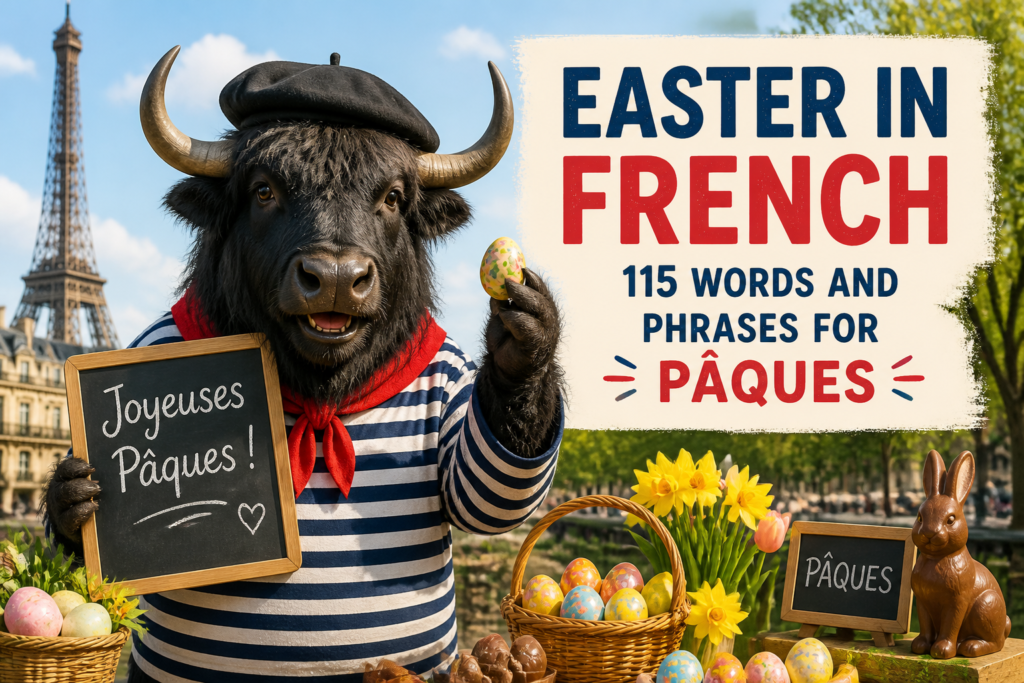
Pâques in France is a fun little mix of chocolate, church bells, spring sunshine, family lunch, and children sprinting around gardens like tiny sugar-powered detectives. If you want to talk about Easter in French, you’ll need more than just Joyeuses Pâques.
This guide gives you practical French Easter vocabulary, useful phrases, and real example sentences you can actually use. Some words are religious, some are seasonal, and some are gloriously about chocolate. Priorities, obviously.
You’ll learn everyday France French by default, with notes when a phrase needs extra context. If you want more holiday vocabulary after this, you can also explore French Halloween vocabulary and French New Year vocabulary, or test yourself with the French vocabulary test and the French placement test.
Essential Easter Words In French
Let’s start with the most common Easter words you’re likely to hear, read, or need first.
| French | Pronunciation | Meaning | Example Sentence | Translation | Learner Note |
|---|---|---|---|---|---|
| Pâques | pahk | Easter | Pâques tombe en mars ou en avril. | Easter falls in March or April. | Usually used without an article in many contexts. |
| Joyeuses Pâques | zhwah-yuhz pahk | Happy Easter | Je te souhaite de joyeuses Pâques. | I wish you a happy Easter. | The standard greeting. |
| le dimanche de Pâques | luh dee-monsh duh pahk | Easter Sunday | Nous déjeunons en famille le dimanche de Pâques. | We have lunch with family on Easter Sunday. | Dimanche is masculine. |
| le lundi de Pâques | luh lun-dee duh pahk | Easter Monday | Le lundi de Pâques est férié en France. | Easter Monday is a public holiday in France. | Very useful cultural word. |
| la Semaine sainte | lah suh-men sant | Holy Week | La Semaine sainte précède Pâques. | Holy Week comes before Easter. | Sainte is the feminine form of saint. |
| le Vendredi saint | luh vahn-druh-dee san | Good Friday | Le Vendredi saint est important pour les chrétiens. | Good Friday is important for Christians. | Capital letters are often used for holiday names. |
| le Carême | luh kah-rem | Lent | Certaines personnes font le Carême avant Pâques. | Some people observe Lent before Easter. | Masculine noun. |
| la résurrection | lah ray-zuh-rek-syon | resurrection | Les chrétiens célèbrent la résurrection du Christ à Pâques. | Christians celebrate the resurrection of Christ at Easter. | More religious register. |
| une fête | ewn fet | a celebration, holiday | Pâques est une fête importante. | Easter is an important holiday. | Very common general word. |
| férié / fériée | fay-ree-ay | public holiday, non-working | Lundi est un jour férié. | Monday is a public holiday. | Adjective; agrees with the noun. |
Chocolate And Treats Vocabulary
If Easter had a second official language, it would probably be chocolate. French has plenty of useful words here.
| French | Pronunciation | Meaning | Example Sentence | Translation | Learner Note |
|---|---|---|---|---|---|
| le chocolat | luh shoh-koh-lah | chocolate | Les enfants adorent le chocolat de Pâques. | Children love Easter chocolate. | Always useful. Deeply practical. |
| un œuf en chocolat | uhn uhf ahn shoh-koh-lah | a chocolate egg | J’ai acheté un gros œuf en chocolat. | I bought a big chocolate egg. | Œuf sounds like “uhf.” |
| des œufs de Pâques | day zuh duh pahk | Easter eggs | Les œufs de Pâques sont cachés dans le jardin. | The Easter eggs are hidden in the garden. | Liaison in des œufs. |
| un lapin en chocolat | uhn lah-pan ahn shoh-koh-lah | a chocolate rabbit | Mon neveu a reçu un lapin en chocolat. | My nephew received a chocolate rabbit. | Very common in shops. |
| une cloche en chocolat | ewn klosh ahn shoh-koh-lah | a chocolate bell | En France, on voit souvent des cloches en chocolat. | In France, you often see chocolate bells. | A very French Easter symbol. |
| des friandises | day free-yon-deez | sweets, treats | Les enfants ont reçu plein de friandises. | The children got lots of treats. | Plural is very common. |
| des bonbons | day bon-bon | candies | Il y avait aussi des bonbons dans le panier. | There were also candies in the basket. | The final s is silent. |
| un panier | uhn pah-nee-ay | a basket | Elle remplit le panier avec des chocolats. | She fills the basket with chocolates. | Useful beyond Easter too. |
| des confiseries | day kon-feez-ree | confectionery, sweets | La vitrine est pleine de confiseries de Pâques. | The display window is full of Easter sweets. | Slightly more formal than bonbons. |
| une chasse aux œufs | ewn shahs ohz uhf | an Easter egg hunt | Nous organisons une chasse aux œufs dimanche matin. | We’re organizing an egg hunt Sunday morning. | Liaison in aux œufs. |
Animals And Symbols Of Easter
| French | Pronunciation | Meaning | Example Sentence | Translation | Learner Note |
|---|---|---|---|---|---|
| un lapin | uhn lah-pan | a rabbit | Le lapin de Pâques apporte des chocolats dans certaines traditions. | The Easter Bunny brings chocolates in some traditions. | In France, bells are also important. |
| le lapin de Pâques | luh lah-pan duh pahk | the Easter Bunny | Les enfants parlent du lapin de Pâques. | The children talk about the Easter Bunny. | Understood, even if bells are more traditional in France. |
| une cloche | ewn klosh | a bell | Les cloches sonnent le dimanche de Pâques. | The bells ring on Easter Sunday. | Very culturally important in France. |
| les cloches de Pâques | lay klohsh duh pahk | Easter bells | Selon la tradition, les cloches de Pâques reviennent de Rome. | According to tradition, the Easter bells return from Rome. | A classic French tradition. |
| un poussin | uhn poo-san | a chick | On voit souvent des poussins sur les décorations de Pâques. | You often see chicks on Easter decorations. | Cute and common in seasonal decor. |
| un agneau | uhn an-yo | a lamb | L’agneau est un symbole important dans la tradition chrétienne. | The lamb is an important symbol in the Christian tradition. | The gn sounds like “ny.” |
| une croix | ewn krwah | a cross | La croix est un symbole religieux central. | The cross is a central religious symbol. | Religious vocabulary. |
| un nid | uhn nee | a nest | Les enfants ont trouvé des œufs dans un petit nid décoratif. | The children found eggs in a small decorative nest. | Final d is silent. |
| le printemps | luh pran-tan | spring | Pâques arrive au printemps. | Easter comes in spring. | Very useful seasonal word. |
| une fleur | ewn flur | a flower | La table est décorée avec des fleurs. | The table is decorated with flowers. | Common spring vocabulary. |
Religious Easter Vocabulary In French
Not every Easter conversation is religious, but these words matter if you’re reading, listening, or talking about the Christian meaning of Pâques.
| French | Pronunciation | Meaning | Example Sentence | Translation | Learner Note |
|---|---|---|---|---|---|
| la messe | lah mess | Mass | Ma grand-mère va à la messe de Pâques. | My grandmother goes to Easter Mass. | Very common in Catholic contexts. |
| l’église | lay-gleez | church | L’église est pleine le dimanche de Pâques. | The church is full on Easter Sunday. | Elision: la église becomes l’église. |
| prier | pree-ay | to pray | Ils se réunissent pour prier ensemble. | They gather to pray together. | Regular -er verb. |
| la prière | lah pree-air | prayer | La célébration commence par une prière. | The celebration begins with a prayer. | Feminine noun. |
| Jésus-Christ | zhay-zew kree | Jesus Christ | Les chrétiens célèbrent la résurrection de Jésus-Christ. | Christians celebrate the resurrection of Jesus Christ. | Standard form. |
| le Christ | luh kreest | Christ | Pâques célèbre le Christ ressuscité. | Easter celebrates the risen Christ. | Used in religious register. |
| la crucifixion | lah kru-see-feek-syon | crucifixion | Le Vendredi saint commémore la crucifixion. | Good Friday commemorates the crucifixion. | Formal religious word. |
| la foi | lah fwah | faith | Pour eux, Pâques est une fête de foi et d’espérance. | For them, Easter is a holiday of faith and hope. | Short but common. |
| l’espérance | les-pay-rahnss | hope | Cette fête symbolise l’espérance. | This holiday symbolizes hope. | More elevated than everyday espoir. |
| célébrer | say-lay-bray | to celebrate | Nous célébrons Pâques avec la famille. | We celebrate Easter with family. | One of the most useful verbs in this topic. |
Family Meal And Easter Table Words
For plenty of people, Easter means a long meal, too much dessert, and someone insisting you eat more when you are already visibly struggling. So here’s the useful food side.
| French | Pronunciation | Meaning | Example Sentence | Translation | Learner Note |
|---|---|---|---|---|---|
| un repas de famille | uhn ruh-pah duh fah-mee | a family meal | On prépare un grand repas de famille pour Pâques. | We prepare a big family meal for Easter. | Very common phrase. |
| déjeuner | day-zhuh-nay | to have lunch / lunch | Nous déjeunons chez mes parents. | We’re having lunch at my parents’ house. | In France, déjeuner is lunch. |
| le gigot d’agneau | luh zhee-go dah-nyo | leg of lamb | Le gigot d’agneau est un plat traditionnel de Pâques. | Leg of lamb is a traditional Easter dish. | Very common in France. |
| un plat traditionnel | uhn plah trah-dee-syon-nel | a traditional dish | Chaque famille a son plat traditionnel. | Each family has its traditional dish. | Useful general phrase. |
| un dessert | uhn day-sair | a dessert | Le dessert est tout au chocolat. | The dessert is entirely chocolate. | A noble Easter objective. |
| une pâtisserie | ewn pah-tees-ree | a pastry | Nous avons acheté une pâtisserie pour le repas. | We bought a pastry for the meal. | Can mean a pastry or pastry shop depending on context. |
| dresser la table | dreh-say lah tahbl | to set the table | Je vais dresser la table avant l’arrivée des invités. | I’m going to set the table before the guests arrive. | Useful household phrase. |
| les invités | layz an-vee-tay | guests | Les invités arrivent à midi. | The guests arrive at noon. | Liaison in les invités. |
| partager | par-tah-zhay | to share | On aime partager ce moment en famille. | We like sharing this moment with family. | Useful emotional and practical verb. |
| un déjeuner de Pâques | uhn day-zhuh-nay duh pahk | an Easter lunch | Le déjeuner de Pâques dure souvent plusieurs heures. | Easter lunch often lasts several hours. | That is not an exaggeration. |
Useful Easter Phrases You Can Actually Say
Now for practical ready-made phrases. These are the ones that help in real conversations, messages, social media captions, family chats, and seasonal small talk.
| French | Pronunciation | Meaning | Example Sentence | Translation | Learner Note |
|---|---|---|---|---|---|
| Joyeuses Pâques ! | zhwah-yuhz pahk | Happy Easter! | Joyeuses Pâques à toute la famille ! | Happy Easter to the whole family! | Most common greeting. |
| Tu fais quelque chose pour Pâques ? | tu feh kel-kuh shohz poor pahk | Are you doing anything for Easter? | Tu fais quelque chose pour Pâques cette année ? | Are you doing anything for Easter this year? | Casual tu form. |
| Vous fêtez Pâques ? | voo feh-tay pahk | Do you celebrate Easter? | Vous fêtez Pâques en famille ? | Do you celebrate Easter with family? | Polite or plural vous. |
| On organise une chasse aux œufs. | on or-gah-neez ewn shahs ohz uhf | We’re organizing an egg hunt. | On organise une chasse aux œufs dans le jardin. | We’re organizing an egg hunt in the garden. | On often means “we” in spoken French. |
| Les enfants cherchent les œufs. | layz an-fan shairsh layz uhf | The children are looking for the eggs. | Les enfants cherchent les œufs partout. | The children are looking for the eggs everywhere. | Simple, useful present tense. |
| J’ai trop mangé de chocolat. | zhay troh mon-zhay duh shoh-koh-lah | I ate too much chocolate. | Après le dessert, j’ai trop mangé de chocolat. | After dessert, I ate too much chocolate. | A phrase with strong seasonal realism. |
| On va chez mes grands-parents pour Pâques. | on vah sheh may grahn-par-on poor pahk | We’re going to my grandparents’ place for Easter. | On va chez mes grands-parents pour Pâques dimanche. | We’re going to my grandparents’ place for Easter on Sunday. | Chez means “at the home/place of.” |
| Le lundi de Pâques est férié. | luh lun-dee duh pahk ay fay-ree-ay | Easter Monday is a public holiday. | Je ne travaille pas, le lundi de Pâques est férié. | I’m not working, Easter Monday is a public holiday. | Very practical in France. |
| On a décoré la maison. | on ah day-koh-ray lah meh-zon | We decorated the house. | On a décoré la maison avec des fleurs et des œufs colorés. | We decorated the house with flowers and colored eggs. | Common spoken French. |
| Je te souhaite un bon week-end de Pâques. | zhuh tuh soo-wet uhn bon wee-kend duh pahk | I wish you a nice Easter weekend. | Je te souhaite un bon week-end de Pâques et beaucoup de chocolat. | I wish you a nice Easter weekend and lots of chocolate. | Warm and natural. |
More Easter Vocabulary By Theme
Here’s a bigger bank of words so you can push past the basics and actually talk about Easter in detail.
| French | Pronunciation | Meaning | Example Sentence | Translation | Learner Note |
|---|---|---|---|---|---|
| un œuf | uhn uhf | an egg | J’ai trouvé un œuf derrière le buisson. | I found an egg behind the bush. | Plural pronunciation changes in some contexts. |
| des œufs | dayz uh / dayz uhf | eggs | Des œufs étaient cachés partout. | Eggs were hidden everywhere. | After liaison, many speakers soften the final sound. |
| cacher | kah-shay | to hide | Les parents cachent les chocolats avant le réveil des enfants. | Parents hide the chocolates before the children wake up. | Very useful Easter verb. |
| chercher | shair-shay | to look for | Les petits aiment chercher les œufs. | Little ones love looking for eggs. | Don’t confuse with trouver. |
| trouver | troo-vay | to find | Elle a trouvé le plus gros chocolat. | She found the biggest chocolate. | Result, not search. |
| décorer | day-koh-ray | to decorate | Nous allons décorer la salle à manger. | We’re going to decorate the dining room. | Regular -er verb. |
| coloré / colorée | koh-loh-ray | colored | Les œufs colorés plaisent beaucoup aux enfants. | The colored eggs are very popular with children. | Adjective agreement matters. |
| une décoration | ewn day-koh-rah-syon | a decoration | Cette décoration en forme de lapin est adorable. | This rabbit-shaped decoration is adorable. | Easy cognate. |
| un jardin | uhn zhar-dan | a garden | La chasse aux œufs se passe dans le jardin. | The egg hunt takes place in the garden. | French j sound. |
| une tradition | ewn trah-dee-syon | a tradition | C’est une tradition très ancienne. | It’s a very old tradition. | Another easy cognate. |
| traditionnel / traditionnelle | trah-dee-syon-nel | traditional | Le repas traditionnel varie selon les familles. | The traditional meal varies by family. | Masculine and feminine forms differ. |
| une célébration | ewn say-lay-brah-syon | a celebration | La célébration commence à dix heures. | The celebration begins at ten o’clock. | Formal but common. |
| une réunion de famille | ewn ray-oo-nyon duh fah-mee | a family gathering | Pâques est souvent une réunion de famille. | Easter is often a family gathering. | Useful phrase for holidays in general. |
| un cadeau | uhn kah-doh | a gift | Les enfants ont reçu de petits cadeaux. | The children received small gifts. | Not always used, but common enough. |
| offrir | oh-freer | to give, to offer | J’aime offrir du chocolat à mes proches. | I like giving chocolate to my loved ones. | Useful irregular verb. |
| recevoir | ruh-suh-vwar | to receive | Elle a reçu une boîte de chocolats. | She received a box of chocolates. | Very common verb. |
| une boîte | ewn bwat | a box | La boîte est remplie d’œufs en chocolat. | The box is filled with chocolate eggs. | The circumflex doesn’t change much for learners. |
| remplir | rahn-pleer | to fill | Nous allons remplir les paniers. | We’re going to fill the baskets. | Useful everyday verb. |
| une surprise | ewn sur-preez | a surprise | Chaque enfant a eu une surprise. | Each child got a surprise. | Same meaning as English. |
| un jeu | uhn zhuh | a game | Après le repas, on a fait un jeu en famille. | After the meal, we played a game as a family. | Can also mean toy depending on context. |
| la joie | lah zhwa | joy | Pâques est un moment de joie pour beaucoup de gens. | Easter is a moment of joy for many people. | Useful emotional noun. |
| heureux / heureuse | uh-ruh / uh-ruhz | happy | Les enfants sont heureux de découvrir les chocolats. | The children are happy to discover the chocolates. | Agreement matters. |
| le renouveau | luh ruh-noo-voh | renewal | Le printemps évoque le renouveau. | Spring evokes renewal. | A nice seasonal word. |
| naître | netr | to be born | Le printemps semble faire naître de nouvelles couleurs. | Spring seems to bring new colors to life. | More literary, but useful in seasonal language. |
| religieux / religieuse | ruh-lee-zhuh | religious | C’est une fête religieuse pour certains, familiale pour d’autres. | It’s a religious holiday for some, a family one for others. | Good descriptive adjective. |
| la foi chrétienne | lah fwah kray-tee-en | the Christian faith | Pâques est centrale dans la foi chrétienne. | Easter is central in the Christian faith. | More specific religious phrase. |
| un dimanche | uhn dee-monsh | a Sunday | Pâques tombe toujours un dimanche. | Easter always falls on a Sunday. | Very useful fact sentence. |
| au mois d’avril | oh mwah dah-vreel | in the month of April | Cette année, Pâques est au mois d’avril. | This year, Easter is in April. | Elision in d’avril. |
| au mois de mars | oh mwah duh mars | in the month of March | Parfois, Pâques tombe au mois de mars. | Sometimes Easter falls in March. | Simple date phrase. |
| un jour férié | uhn zhoor fay-ree-ay | a public holiday | Le lundi de Pâques est un jour férié. | Easter Monday is a public holiday. | High-frequency phrase in France. |
| fermer | fair-may | to close | Beaucoup de magasins sont fermés le dimanche de Pâques. | Many shops are closed on Easter Sunday. | Very practical travel vocabulary. |
| ouvrir | oo-vreer | to open | Certains commerces ouvrent le lundi de Pâques. | Some businesses open on Easter Monday. | Common opposite of fermer. |
| un magasin | uhn mah-gah-zan | a shop, store | Le magasin vend déjà des chocolats de Pâques. | The shop is already selling Easter chocolates. | Useful when shopping. |
| une boulangerie | ewn boo-lahn-zhree | a bakery | La boulangerie propose des spécialités de saison. | The bakery offers seasonal specialties. | Classic France vocabulary. |
| une vitrine | ewn vee-treen | a shop window, display window | La vitrine est pleine de lapins en chocolat. | The display window is full of chocolate rabbits. | Common shopping word. |
| une spécialité | ewn spay-see-ah-lee-tay | a specialty | Cette région a une spécialité de Pâques. | This region has an Easter specialty. | Useful for food and culture. |
| une recette | ewn ruh-set | a recipe | Ma tante suit une vieille recette de famille. | My aunt follows an old family recipe. | Common food vocabulary. |
| préparer | pray-pah-ray | to prepare | Nous préparons le repas depuis le matin. | We’ve been preparing the meal since the morning. | Very common verb. |
| inviter | an-vee-tay | to invite | Nous allons inviter nos voisins pour le café. | We’re going to invite our neighbors for coffee. | Easy cognate. |
| un voisin / une voisine | uhn vwah-zan / ewn vwah-zeen | neighbor | Nos voisins passent nous dire bonjour. | Our neighbors stop by to say hello. | Both masculine and feminine forms are useful. |
| en famille | ahn fah-mee | with family, as a family | On passe Pâques en famille. | We spend Easter with family. | Very common phrase. |
| entre amis | ahn-tra-mee | with friends | Cette année, on fête Pâques entre amis. | This year, we’re celebrating Easter with friends. | Casual and natural. |
| passer un bon moment | pah-say uhn bon moh-mon | to have a good time | On a passé un bon moment ensemble. | We had a good time together. | Excellent everyday phrase. |
| profiter de | proh-fee-tay duh | to enjoy, make the most of | Nous voulons profiter du week-end de Pâques. | We want to enjoy the Easter weekend. | Very common construction. |
| se réunir | suh ray-oo-neer | to gather | La famille se réunit pour le déjeuner. | The family gathers for lunch. | Reflexive verb. |
| rendre visite | rahn-dr veez-eet | to visit | Nous allons rendre visite à ma tante. | We’re going to visit my aunt. | French says “pay a visit.” |
| envoyer un message | ahn-vwah-yay uhn meh-sahzh | to send a message | J’ai envoyé un message pour souhaiter de joyeuses Pâques. | I sent a message to wish a happy Easter. | Useful for texting. |
| souhaiter | soo-wet-ay | to wish | Je voulais te souhaiter de joyeuses Pâques. | I wanted to wish you a happy Easter. | Great holiday verb. |
| une carte | ewn kart | a card | Elle a reçu une carte de Pâques. | She received an Easter card. | Simple and useful. |
| un week-end prolongé | uhn wee-kend proh-lohn-zhay | a long weekend | Pâques permet souvent un week-end prolongé. | Easter often creates a long weekend. | Very practical lifestyle phrase. |
| se reposer | suh ruh-poh-zay | to rest | On va enfin se reposer lundi. | We’re finally going to rest on Monday. | Reflexive verb. |
| partir en week-end | par-teer ahn wee-kend | to go away for the weekend | Certains partent en week-end pour Pâques. | Some people go away for Easter weekend. | Common modern usage. |
| les vacances | lay vah-kahns | holidays, vacation | Les vacances de printemps commencent bientôt. | The spring holidays are starting soon. | Plural in French. |
| les vacances de printemps | lay vah-kahns duh pran-tan | spring holidays | Les vacances de printemps tombent parfois autour de Pâques. | The spring holidays sometimes fall around Easter. | Useful for school contexts. |
| une couronne | ewn koo-ronn | a wreath | Une couronne de fleurs décore la porte. | A flower wreath decorates the door. | Seasonal decoration word. |
| un bouquet | uhn boo-kay | a bouquet | Ils ont mis un bouquet sur la table. | They put a bouquet on the table. | Useful spring vocabulary. |
| jaune | zhon | yellow | Le jaune est une couleur fréquente à Pâques. | Yellow is a common Easter color. | Color vocabulary. |
| pastel | pas-tel | pastel | Les décorations pastel sont très populaires. | Pastel decorations are very popular. | Same meaning as English. |
Quick Notes On French Easter Usage
- Pâques is a bit special. In modern usage, it is often treated as feminine in the singular when referring to the Christian feast, but in everyday fixed expressions you will usually just learn it as a set phrase: à Pâques, pour Pâques, Joyeuses Pâques.
- In France, les cloches de Pâques are a classic tradition. Children may hear that the church bells flew to Rome and came back with chocolates. Very dramatic. Very French.
- Le lapin de Pâques is still understood and used, especially in commercial or international contexts, but bells are often more traditional in France than the Easter Bunny is.
- Watch the pronunciation of œuf. In the singular it sounds like uhf. In plural contexts after des or les, pronunciation can shift depending on the phrase and speaker.
- Useful liaison examples: les amis, vous avez, des œufs, aux œufs.
The safest Easter phrase in French is still Joyeuses Pâques. You can say it to family, friends, coworkers, neighbors, and anyone currently holding suspicious amounts of chocolate.
Mini Practice: Can You Use The Words?
Try translating these into French:
- Happy Easter!
- We’re organizing an egg hunt.
- The children are looking for chocolate eggs in the garden.
- Easter Monday is a public holiday in France.
- We’re having lunch with family.
Possible answers:
- Joyeuses Pâques !
- On organise une chasse aux œufs.
- Les enfants cherchent des œufs en chocolat dans le jardin.
- Le lundi de Pâques est férié en France.
- Nous déjeunons en famille.
Quick Reference Summary
- Pâques = Easter
- Joyeuses Pâques = Happy Easter
- une chasse aux œufs = an egg hunt
- un œuf en chocolat = a chocolate egg
- les cloches de Pâques = Easter bells
- le lapin de Pâques = Easter Bunny
- le lundi de Pâques = Easter Monday
- un repas de famille = family meal
- le gigot d’agneau = leg of lamb
- célébrer = to celebrate
Yak takeaway: if you can say Joyeuses Pâques, une chasse aux œufs, and j’ai trop mangé de chocolat, you are already weirdly well prepared for Easter in French. And honestly, that third one may be the most useful of all.
For more French vocabulary, browse the full Learn French section, then check your level with the French placement test or see how many words you really know with the French vocabulary test.